Unpaved, With Good Intentions
Sunday was an uphill battle from the beginning. The plan was to somehow drive three hours from Moab, UT, to Monument Valley, which is on the Utah/Arizona border. After driving the 17-mile scenic loop road through Monument Valley, we would drive back up into Utah for another 4.5 hours to Bryce Canyon National Park. How would we fit it all in? How would I handle 7.5 hours of driving? How many times would Sam make fun of Bob Dylan whenever one of his songs played? I was wondering all those same things myself when I woke up Sunday morning.
The drive to Monument Valley was actually quite pleasant. The weather was great, we drove with the top down, and we managed to find enough to do and talk about on the way. As an added bonus, the closer we got to Monument Valley, the cooler the landscape became, so we spent a fair amount of time gawking out the windows at various rock formations and changing terrain.


This formation is called Mexican Hat Rock
You may not have heard of Monument Valley, but you’ve seen it in the movies. It was used as the backdrop for countless Westerns, Close Encounters, and the scene from National Lampoon’s Vacation when they drive off a cliff and Clark has to wander through the desert to find help. It’s basically a collection of massive, red rock formations that stick up out of the dessert in various interesting shapes for no apparent reason. The most famous “monuments” are the first ones you come to: the mittens, which you’ve probably seen in pictures. They look like this:
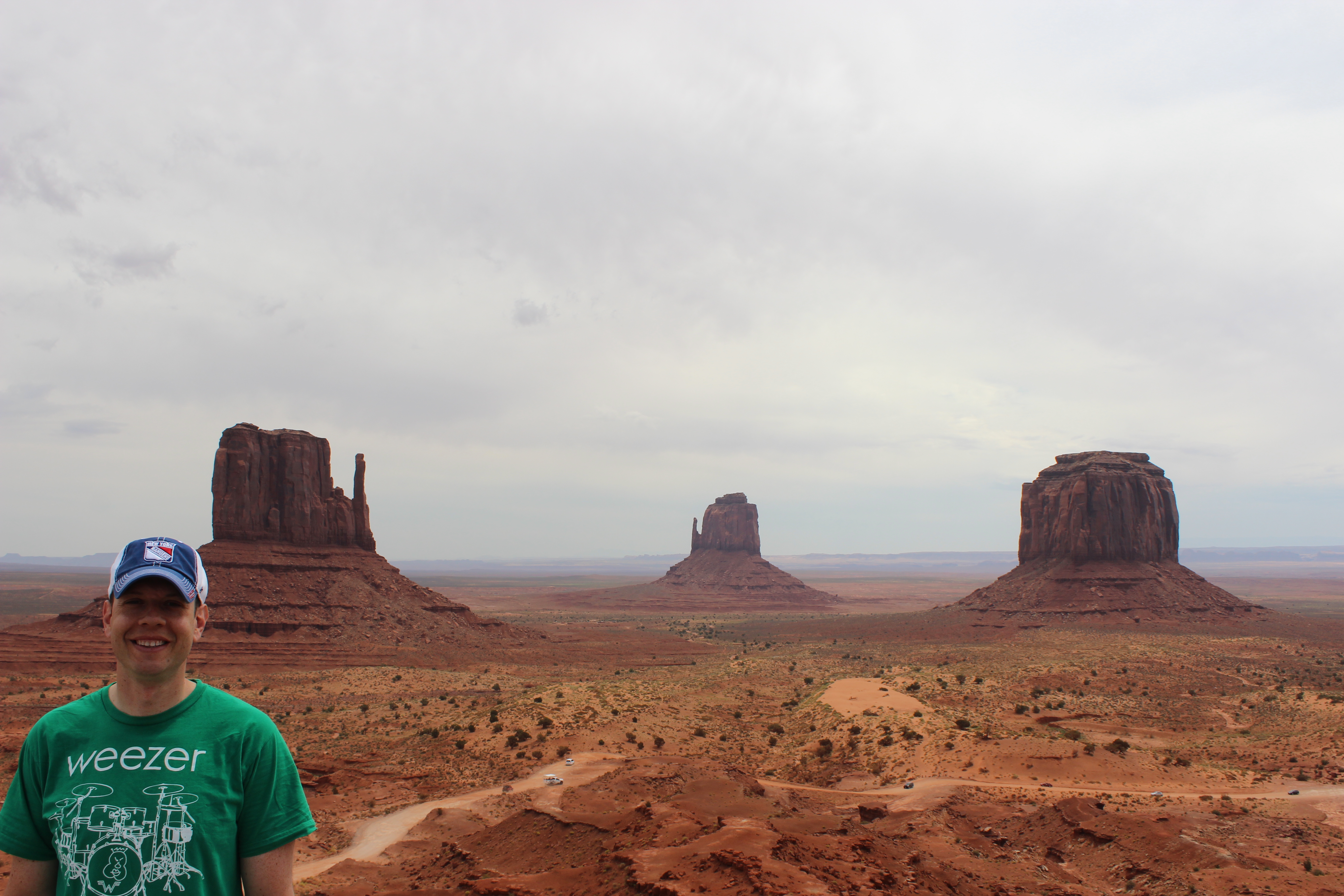
OK, so the pictures you’ve seen probably don’t have me in them. The monument on the right is called Merrick Butte. Butte is pronounced “beaut” but Sam naturally assumed it was pronounced “butt,” which provided great amusement. The amusement only grew in intensity when we got to the next two monuments, which are called Elephant Butte and Camel Butte because they’re shaped like those animals.

Elephant Butte

Camel Butte
He was less amused by the monument called the Three Sisters, but it was pretty cool nonetheless.

Three Sisters
Meanwhile, Monument Valley, like Four Corners Monument, is not a National Park and is on Navajo land, which means that, like Four Corners, the facilities are rather bare-bones. This time at least there was a real bathroom. But what nobody mentions until after you’ve paid the $20 entrance fee is that the loop road that takes you past the monuments is not paved. It’s a dirt road that’s badly rutted. Wait, let me rephrase that—it’s a dust road that’s badly rutted. A dirt road actually provides some sort of traction. This road was covered with such a thick layer of fine dust that it was like driving on a beach. There was no traction at all and the car got stuck a couple of times in inches-deep dust. This would have been difficult if the road were relatively flat or straight, but it is neither. Sharp turns, steep hills, deep dust sand, and deep holes is not a combination that makes for pleasant driving.
We were thoroughly amazed and awed by the monuments. We just wished that the road to see them would have been a little more like an actual road. The dusty road did add to the desert ambiance, I suppose, but I am left wondering what my $20 entrance fee pays for, besides the salary of the guy who collects the entrance fee.
A few monuments in, we came to a little ranch where you can take guided tours of Monument Valley on horseback. It immediately occurred to me that horseback would be an infinitely better way to see Monument Valley. Hey, it was good enough for John Wayne. I contemplated ditching the plan for the rest of the day and spending a few hours riding on horseback through the valley. But we’re already trying to jam too much into not enough time, so extending Monument Valley would have meant missing out on something else down the line.
Meanwhile, I was starting to seriously worry about the car, which was completely covered in dust and struggling to make it up the dustier hills. So after seeing six monuments up close and a few more from a distance, we turned around and headed back out.
The good thing about bailing out on Monument Valley earlier than expected was that it meant we’d get to Bryce Canyon sooner and have a little more time there. The bad news was that it was time for me to do more driving.
When I talk to people about these road trips they tend to react as if the thousands of miles we drive are done all at once. Like we just do nothing but drive for days and days. In reality, the driving is done in small chunks—two hours here, and hour there, three hours the next day, etc., with hours in between spent having fun at various destinations. This trip, however, is turning out to be more like people’s assumptions. A big part of that is that things are spaced further apart in the Southwest, so there’s more ground to cover between stops. In fact we’ve done so much driving that for the first time we’re starting to run out of things to say to each other. Making matters worse is when the destination involves more driving, like in Monument Valley. I drove for three hours just to be able to drive for a couple of hours. Then we drove for a few more hours to get to a National Park, and National Parks tend to be pretty heavy on driving, too.
It turned out that just getting to Bryce Canyon was an adventure itself. For starters, it was a sunny day but we started seeing intense lightning off in the distance, so we drove with the roof closed. Then the sky darkened. Then the sky opened up. It was one of those furious summer rain storms that just pelts the world with unimaginable amounts of rain to the point where you can barely see out your windshield, and then 15 minutes later the rain has stopped completely. Well, at least all that dust got washed off the car.

We were making pretty good time to Bryce when the GPS told me to turn right off the highway onto some other road called County Road 1870. I was a little unsure, so I tried to double check the directions on my phone using Google Maps, but I had no signal. CR-1870 went in the right direction, so I obliged. I came to regret this decision after about 15 miles, when the road suddenly became unpaved. As in pebbles. I was driving on my second unpaved road of the day, and this one was a road made of pebbles, with such tight twists and turns that I felt the rear wheels slip several times. And this went on for 15 miles, and the whole time the undercarriage of the car was being constantly pinged with pebbles kicked up by the tires. As if that wasn’t enough of a challenge, there were cows. In the road. Repeatedly. Apparently CR-1870 runs through some farmland in which cows roam free and occasionally find themselves standing in the middle of the unpaved road, even when a car comes.

Going to visit the chicken, I presume?
In fairness to the GPS, the CR-1870 route is physically shorter than just staying on the nicely paved Route 89 would have been. But besides the emotional trauma inflicted by this “short cut,” it took us almost six hours to get to Bryce. At that point we had only a little more than two hours before dark in which to see the whole park, or at least as much of it as we could cram in. Again a friendly Ranger helped us make a plan, and again it worked perfectly.
Bryce Canyon is filled with enormous, funky-shaped stone spires called hoodoos that look a little like a medieval Scandinavian village, or like an above-ground Atlantis, or like a city built by mentally disturbed garden gnomes.
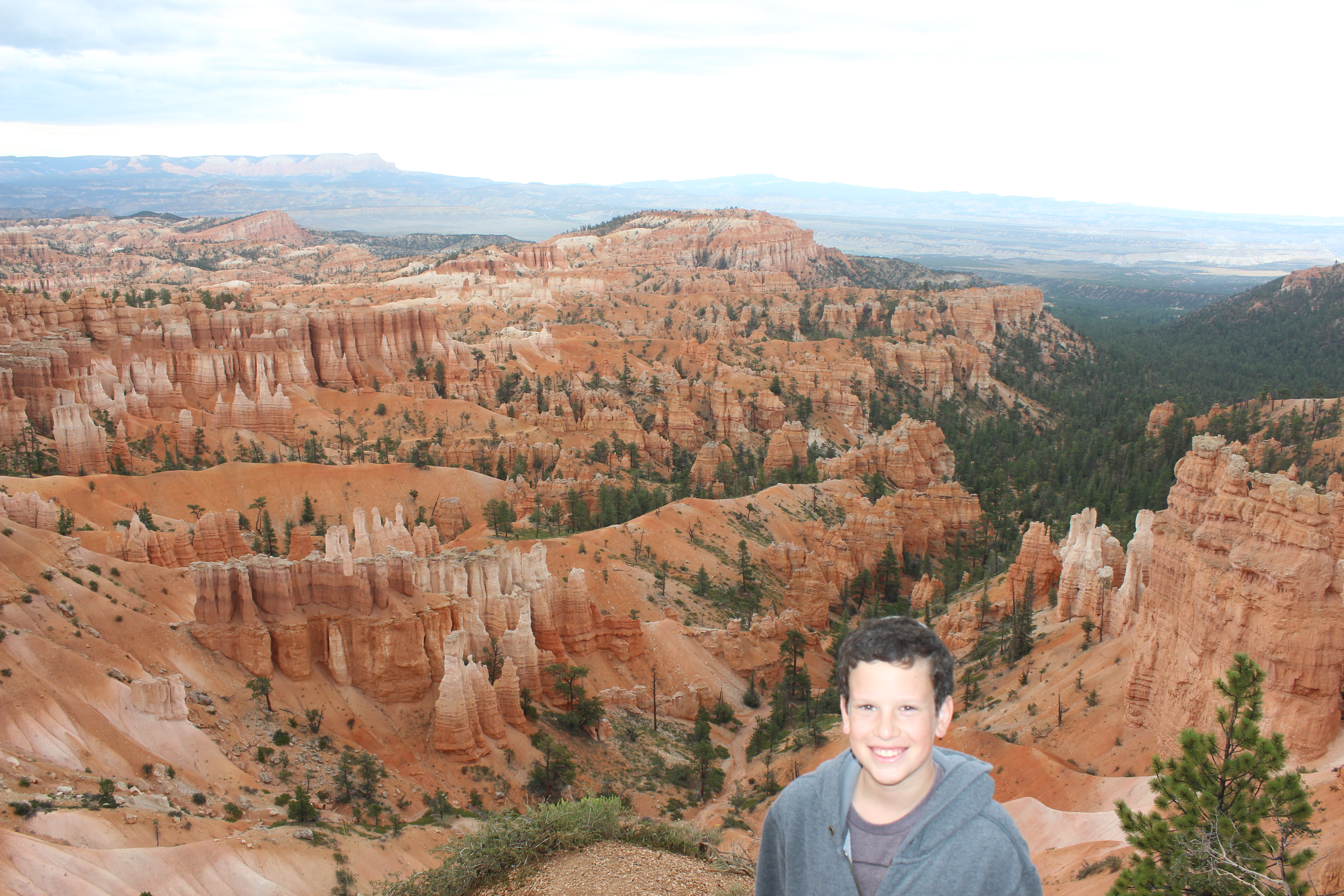

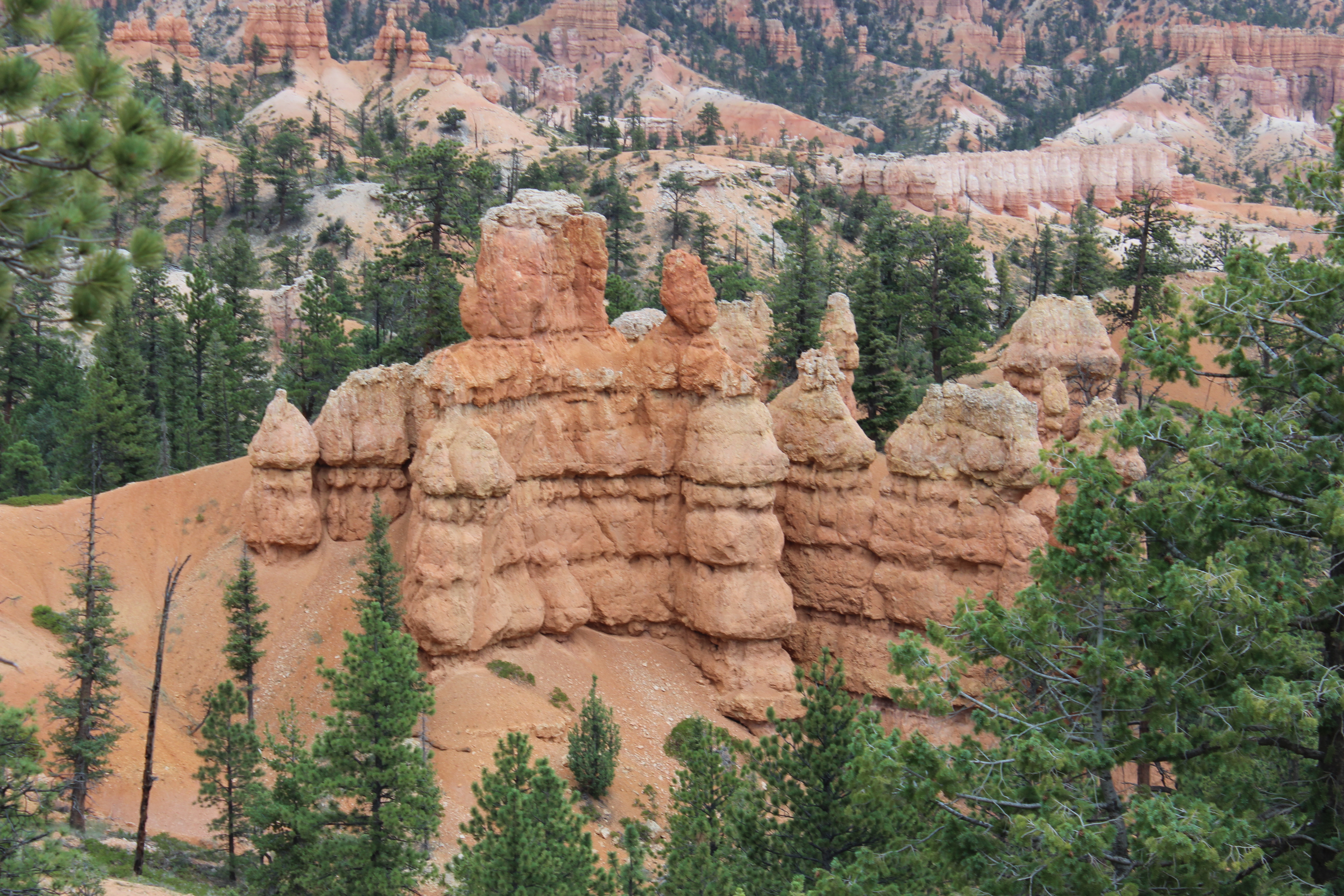
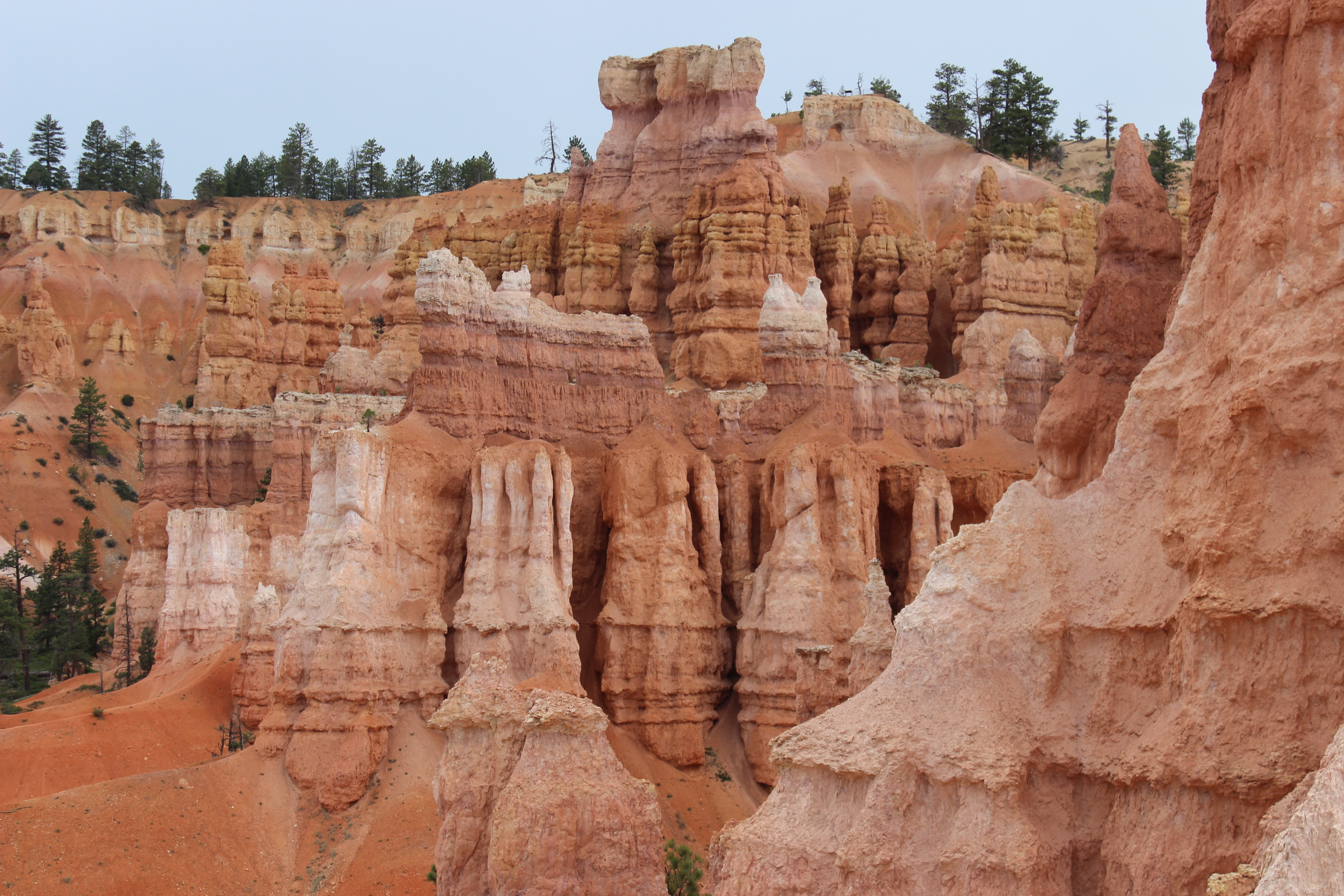
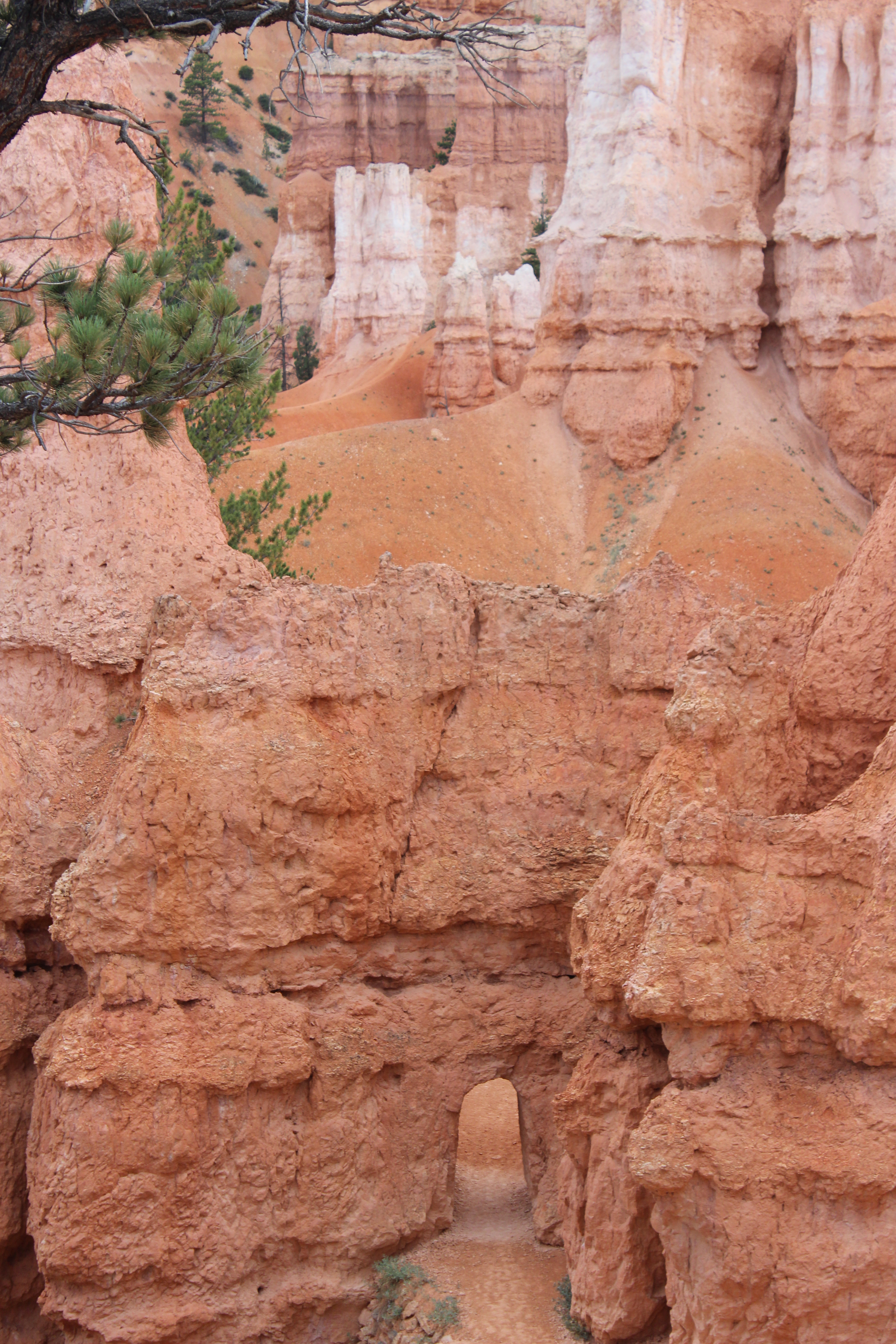
And most of the park’s hoodoos are inside a massive stone bowl called an amphitheater. There are several spots where you can park your car and get good views of the hoodoos from the rim of the amphitheater. But I wanted to get closer, and I also wanted to get out of the car. So when the Ranger suggested the most popular hike in the park, which is a three-mile loop that goes all the way down to the bottom of the bowl and around and back up again, and it’s really steep and narrow, it actually sounded like a good idea.
Oh boy, was it a good idea. The views were incredible whether we were above, below, or anywhere in between.
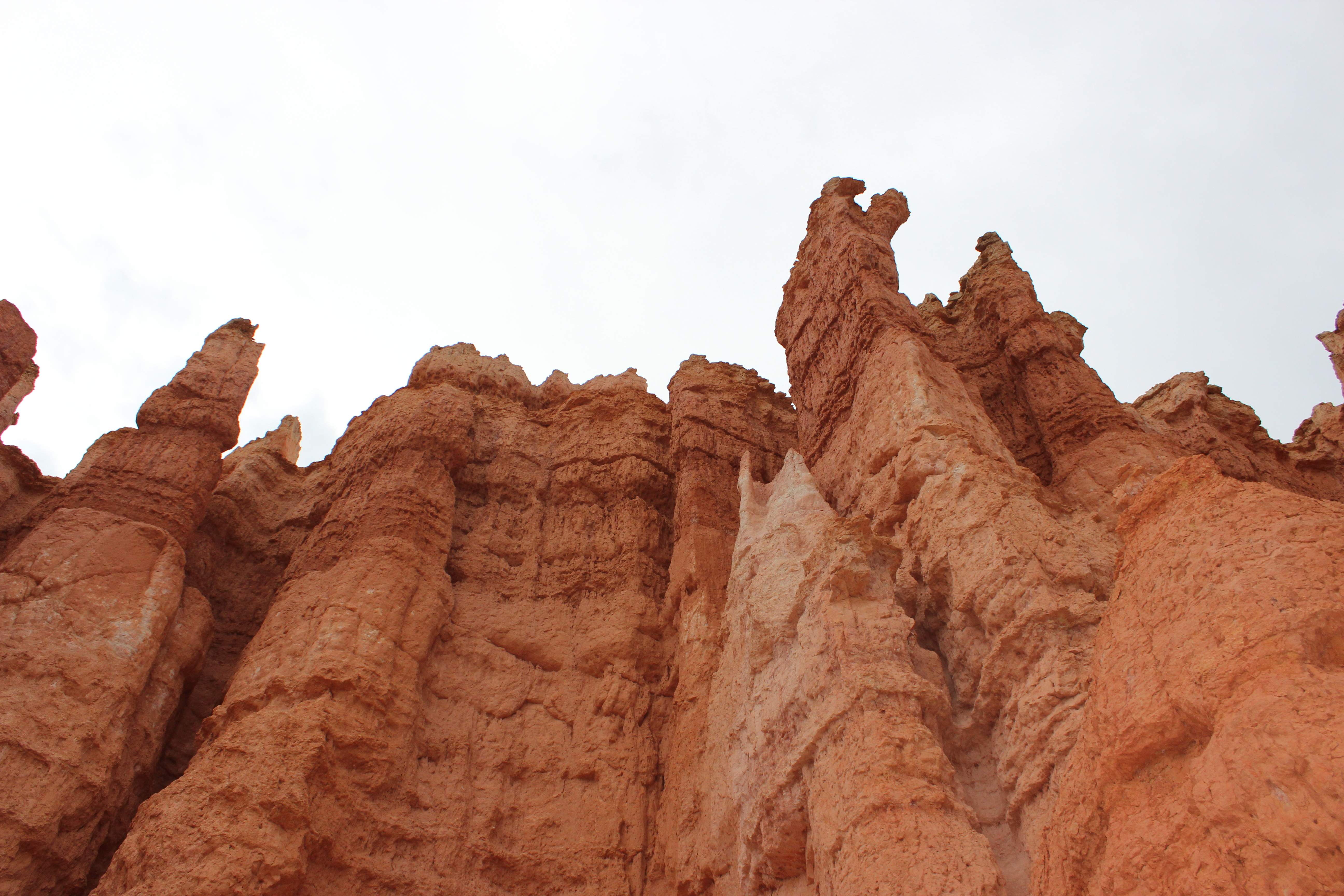
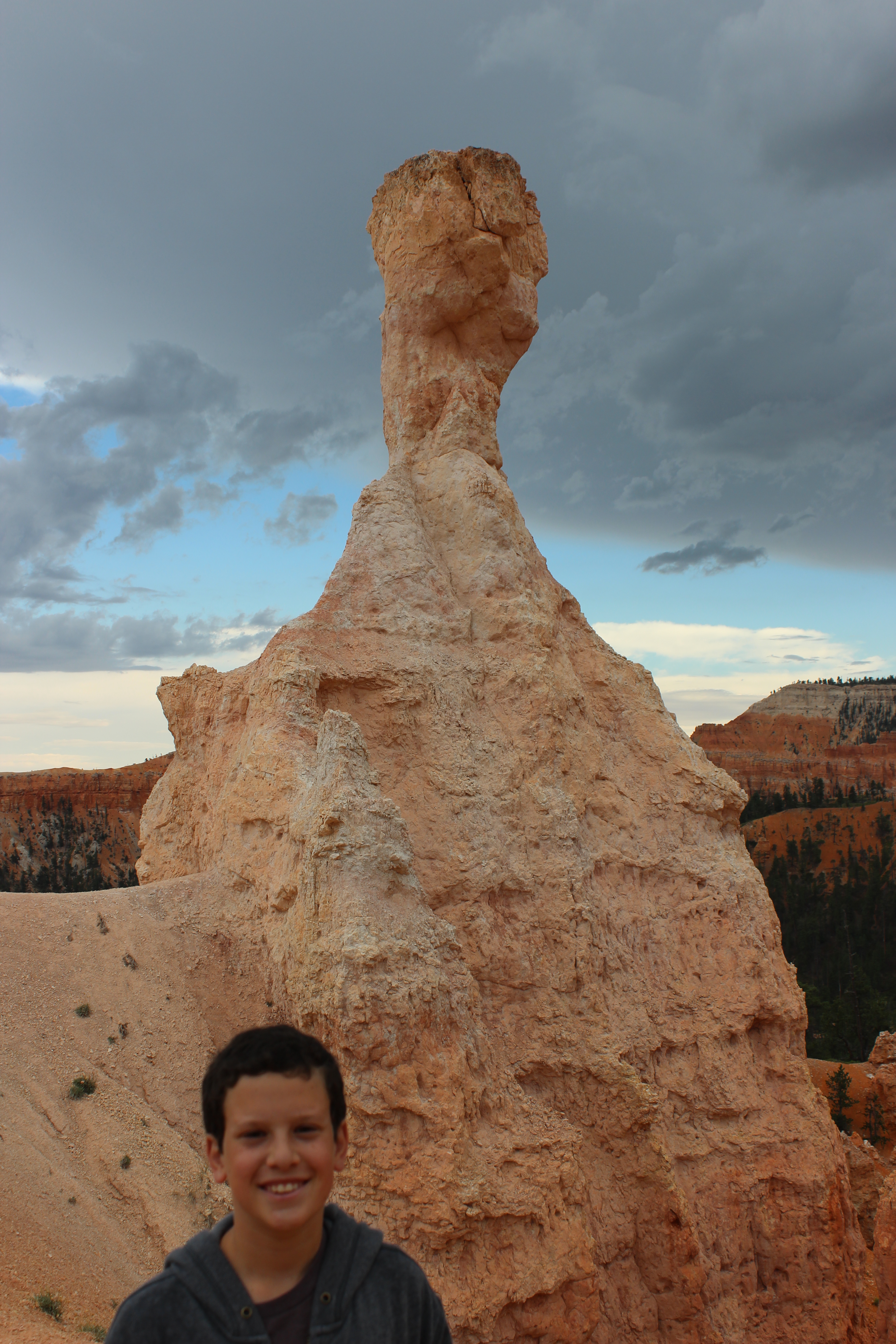
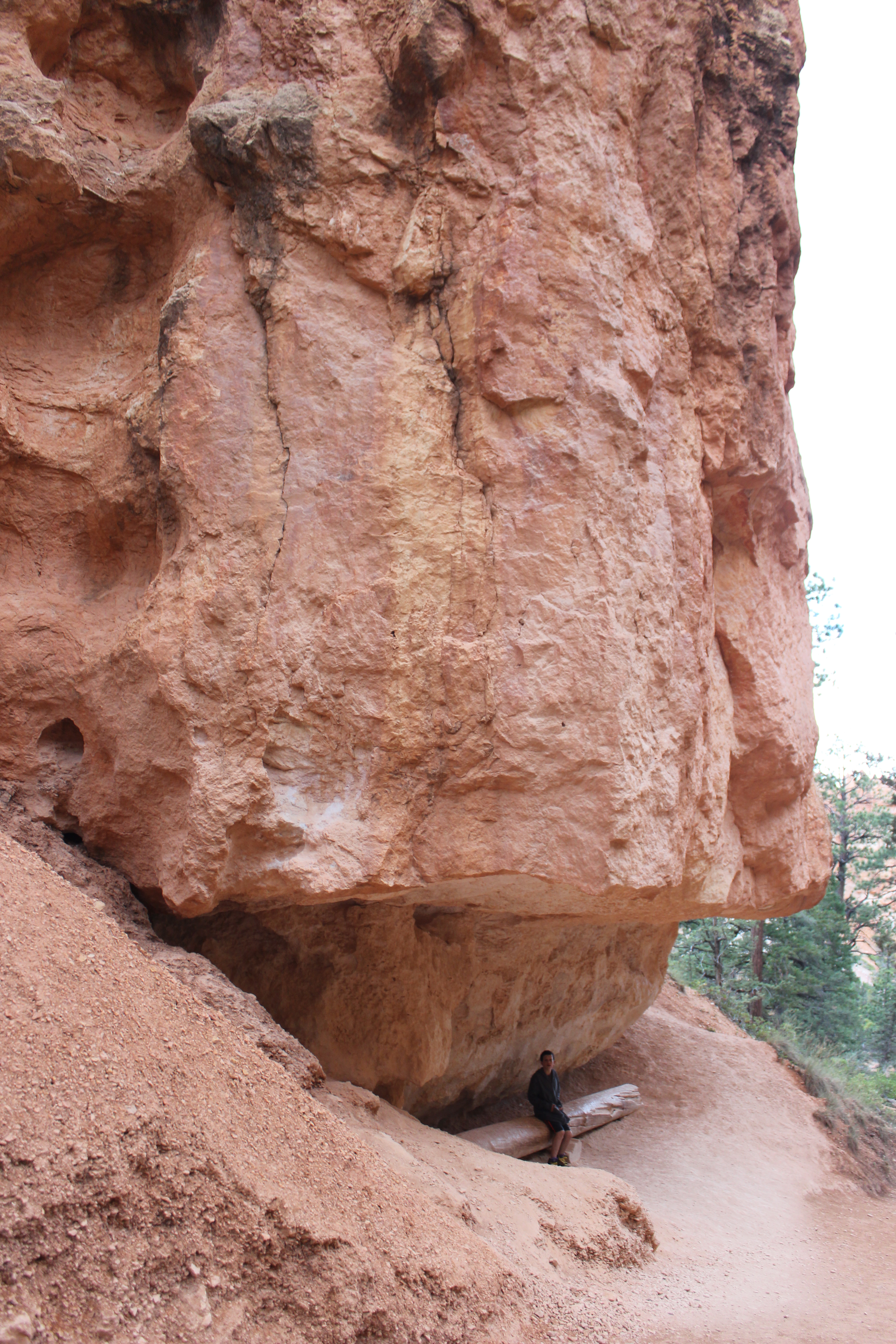
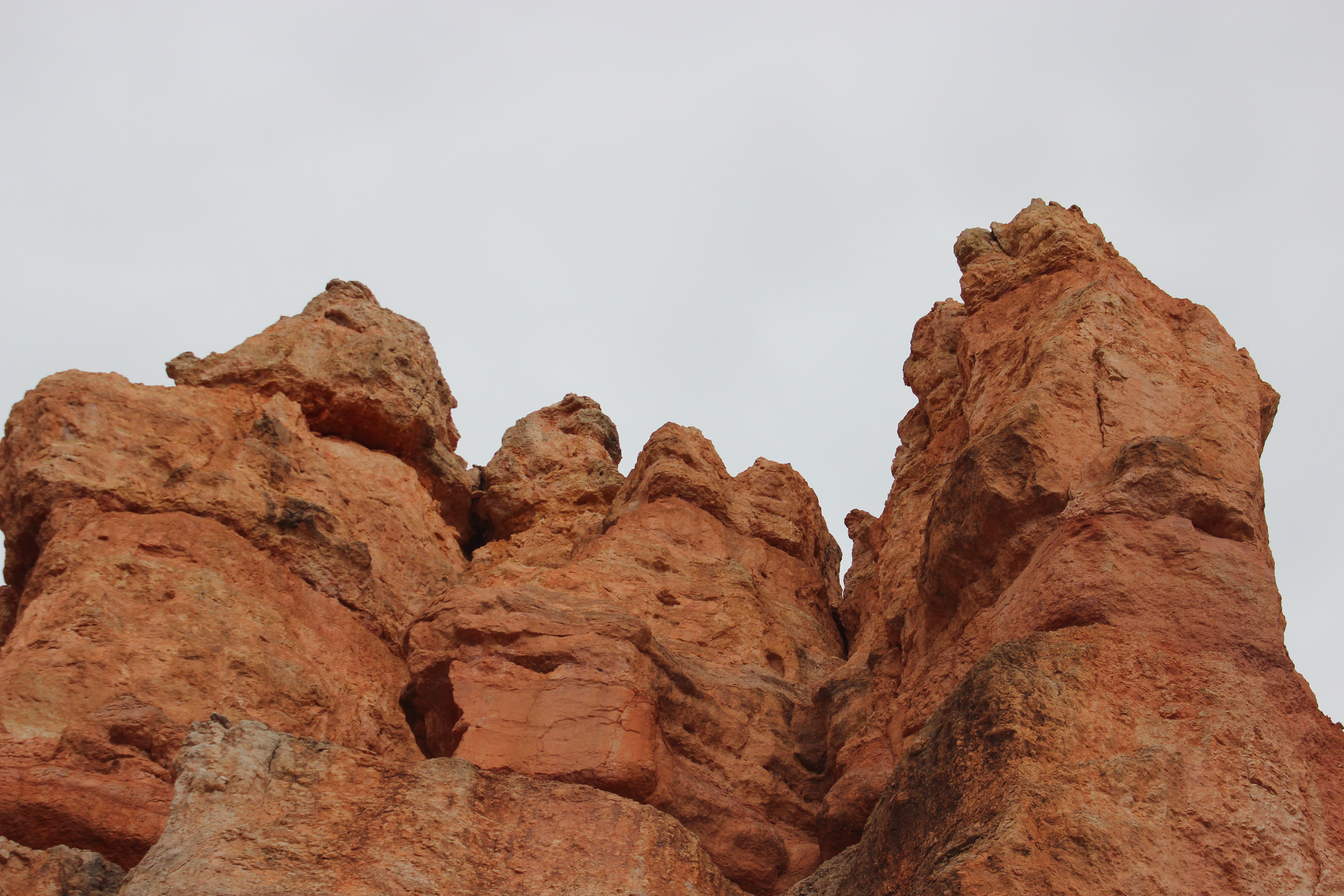

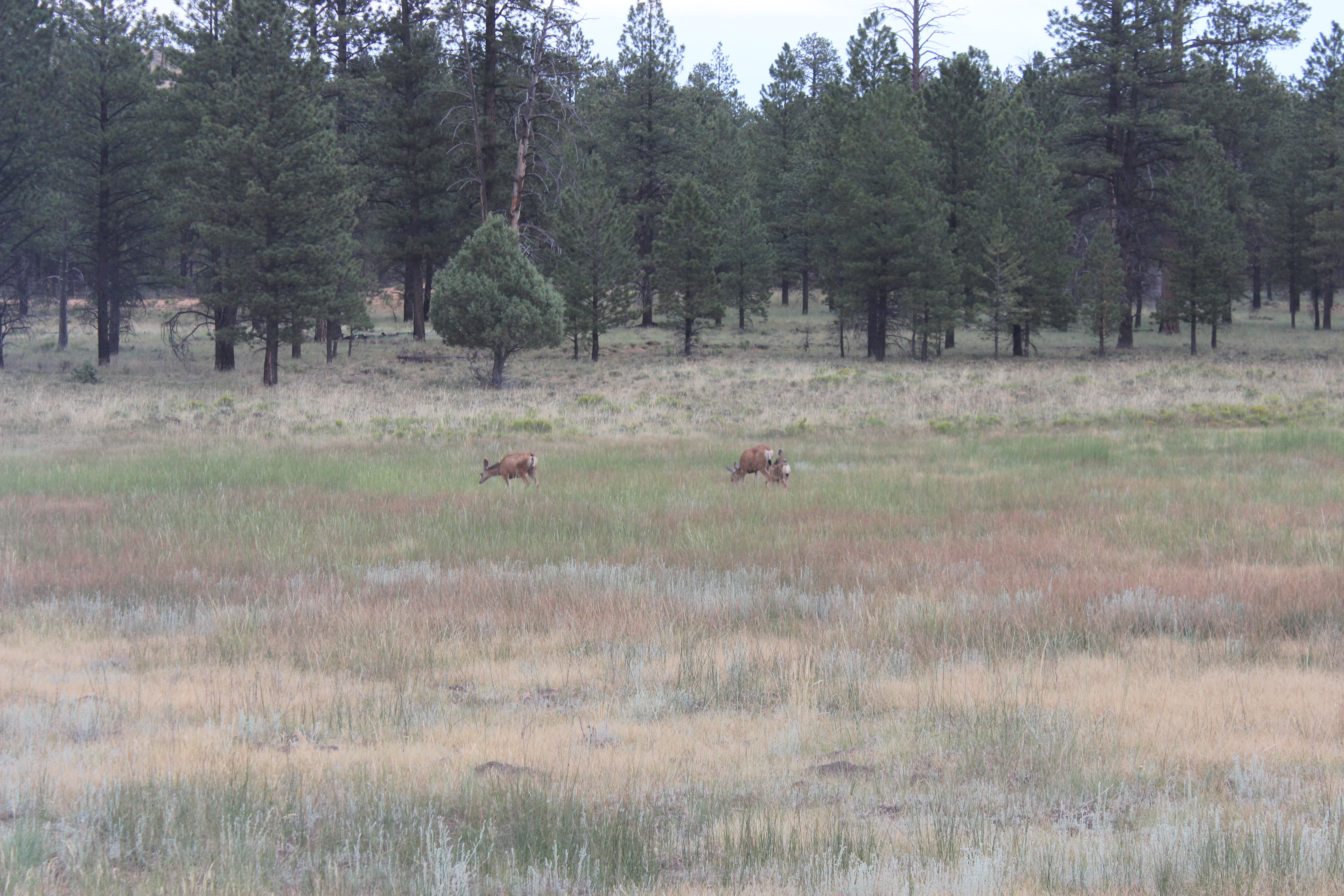
We got up close to hundreds of hoodoos, and we saw some wildlife along the way, which is always especially exciting for Sam. We saw a few deer, but mostly we saw chipmunks.


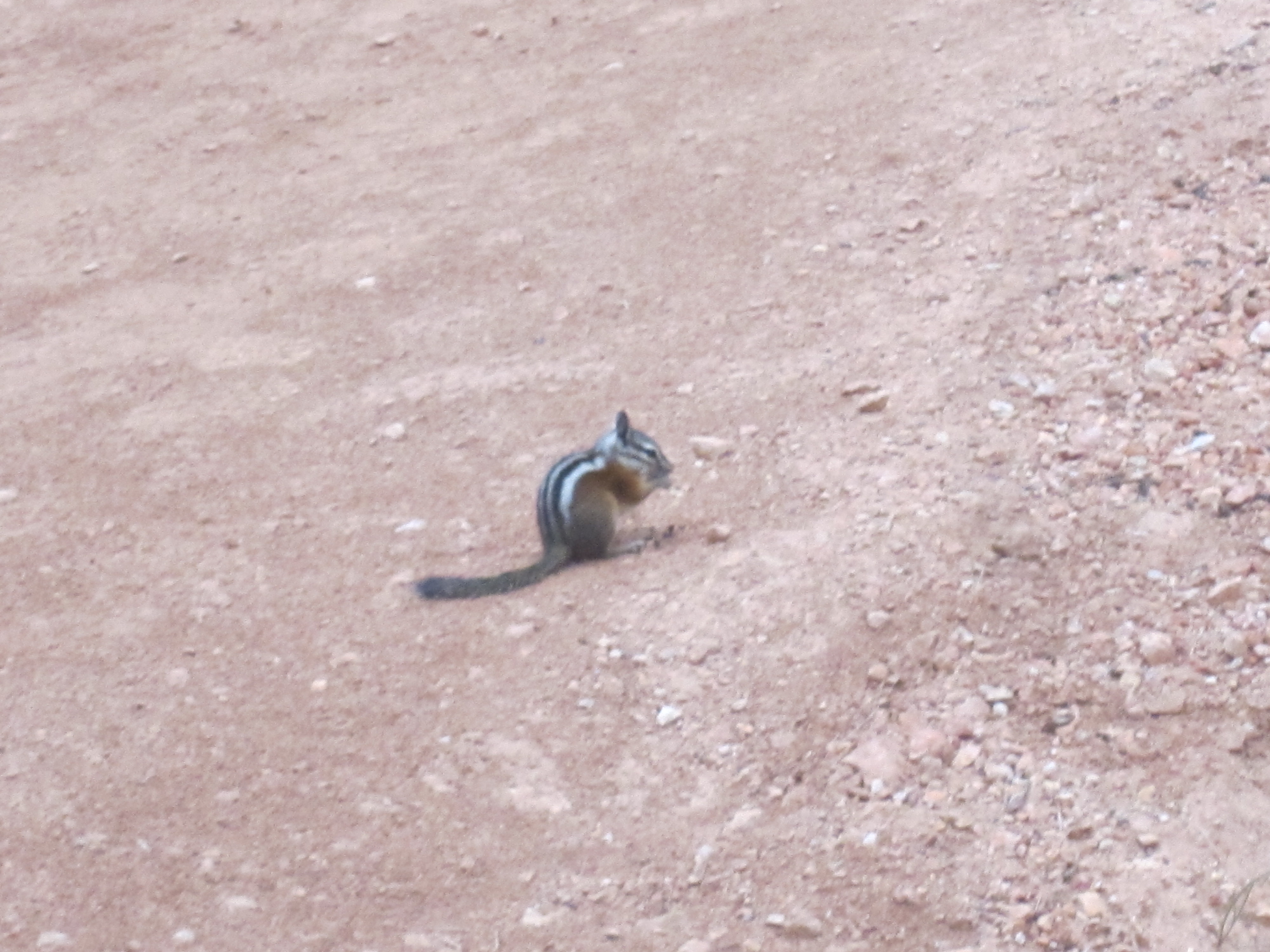

Sam adores chipmunks. They’re tiny and cute, they’re soft and furry, they’re fast, and they let you get pretty close before they dart away.

They’re basically attractive miniature squirrels. After a while Sam started to get annoyed at animals that weren’t chipmunks. When he thought he heard a chipmunk and it turned out to be a small bird, he scolded the bird: “Why aren’t you a chipmunk, bird?!”
We had so much fun admiring the hoodoos, admiring the chipmunks, and admiring the extraordinary views that we didn’t even mind the steep climb back up to the rim at the end of the hike. OK, that’s a lie. The climb was exhausting.
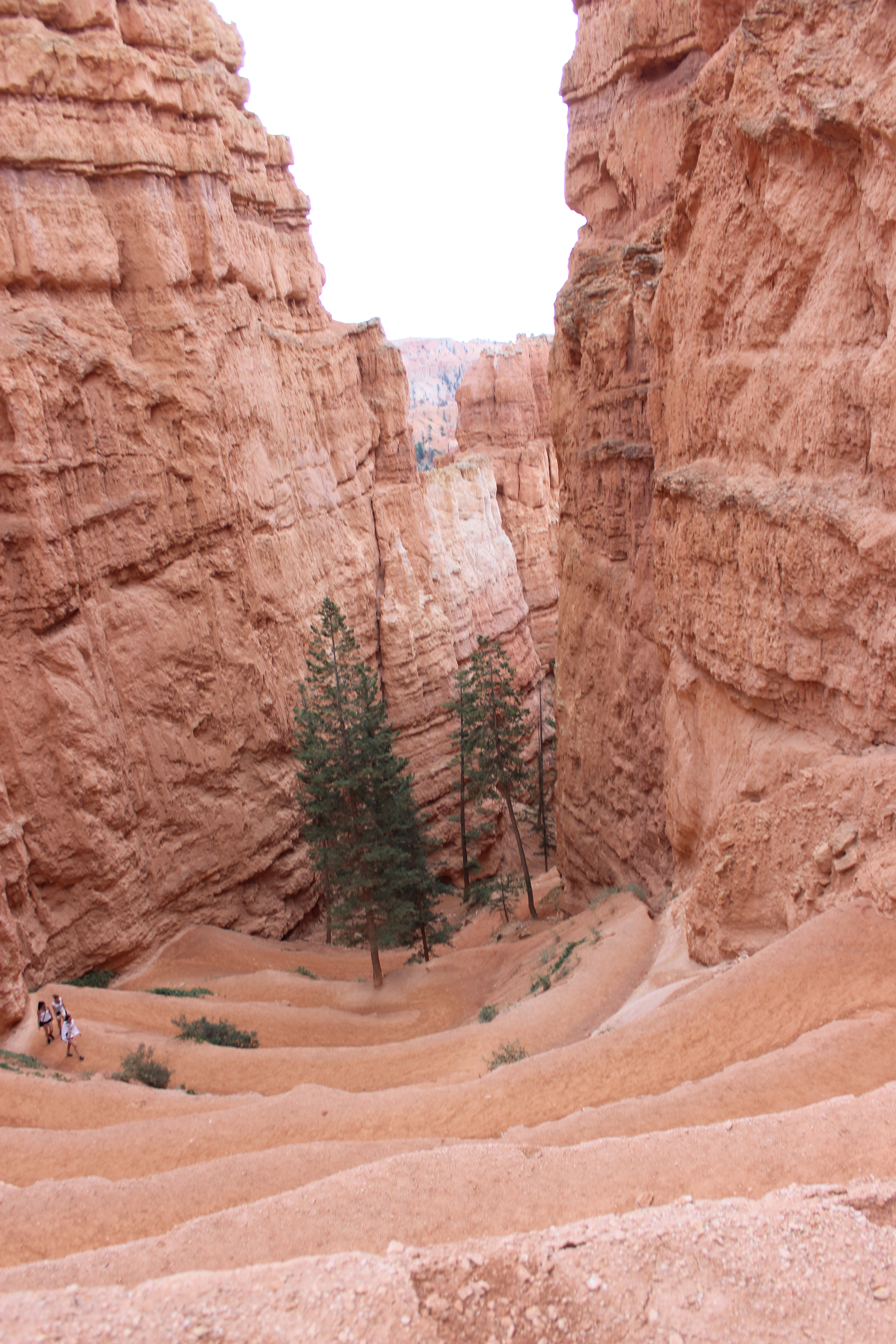
Yeah, we climbed this. Look how small the people are who are only halfway up.
But we made it back up before sunset, and we rewarded ourselves with a steak dinner before heading out in search of a place to spend the night.
Last Resort
I apologize for the lack of a real post tonight. A quick summary: Today we woke up early so that we could see Monument Valley and Bryce Canyon National Park. We did, and we had a great time despite some strange road issues that I’ll explain tomorrow. Anyway, it turns out it’s really hard to find a place to stay near Bryce, as there are very few choices and they’re very, very expensive. We ended up at a place called Bryce Canyon Resort, which was clearly named by someone who does not know the meaning of “resort.” It’s a typical mountain motel: outside doors to the rooms, worn furniture, worn carpet, worn towels. No breakfast, and most important, no wifi. But hey, atty least it’s stupidly expensive!
No wifi = no real blog post. I’m writing this on my phone just so I can post something. I’ll post the real synopsis of our crazy and awesome day once I find a motel that exists in the 21st century.
Golden Arches

Well, it was bound to happen sooner or later. On our way to Arches National Park Friday morning we passed through a town called Dove Creek, Utah. I’ve been pretty careful to stick close to the speed limits throughout the trip but I lapsed for a few seconds in Dove Creek and that’s when they got me. Long story short, I got a ticket for driving 40 mph in a 35. The whole story includes me going a bit faster than that and the cop being very kind. I felt pretty stupid the bottom line isn’t too bad–$50 and one point.
With that ugly little incident behind us we had a fantastic time at Arches National Park. One thing I’ve learned from our many trips to National Parks is that you have to leave more time than you think you’re going to need. Really, you could spend an entire day even at the smaller parks. So I budgeted six hours for Arches, and it turned out to be just about right. As usual, an awesome Park Ranger helped me craft a plan for the day. And as usual, she was spot on about everything. Well, not quite everything–she overestimated our stamina for multiple long hikes in hot weather. More on that later.
Sam used the Visitors Center parking lot as a hunting ground for new state license plates. And sure enough, he found the missing North Dakota, as well as this very pleasant surprise:
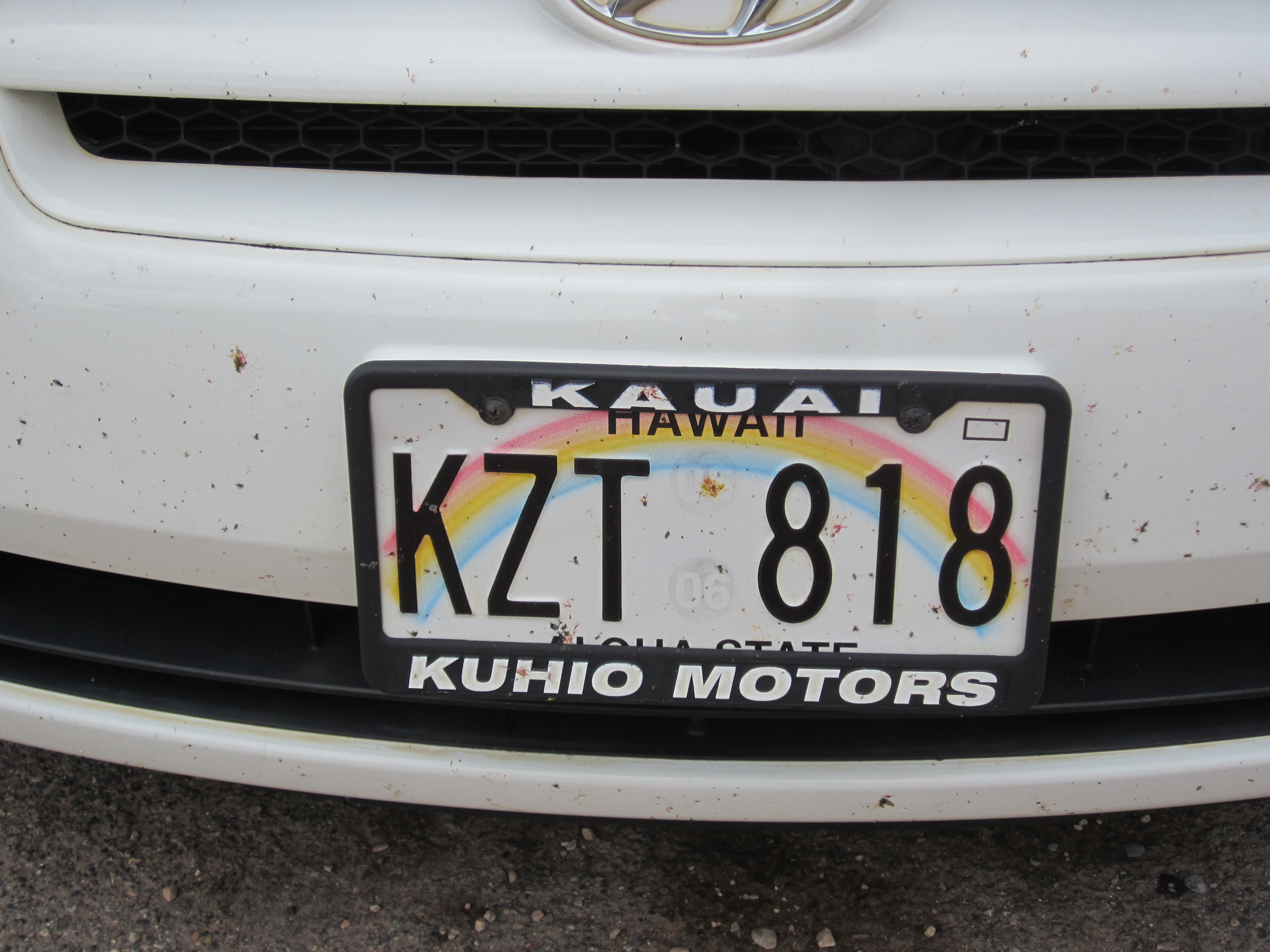
Now the only state plate we haven’t seen is Alaska. I’m hopeful, though, as Juneau is only 2,200 miles from here (Sam looked it up), and We’ve seen plates from states that are further away than that.
By the time we were ready for the longest, toughest hike of the day (a 2-3 hour hike to Delicate Arch that is steeply uphill on the way there) we were too exhausted from the heat and from our other hikes. Delicate Arch is the most famous one, the one that’s on Utah’s license plate, and we couldn’t miss it. So we took the easy way out and took a much shorter hike to an overlook so we could at least see it. The overlook was a mile from the arch, but we got a good view, and with a good zoom lens we got some great shots.

What a cute little baby arch!
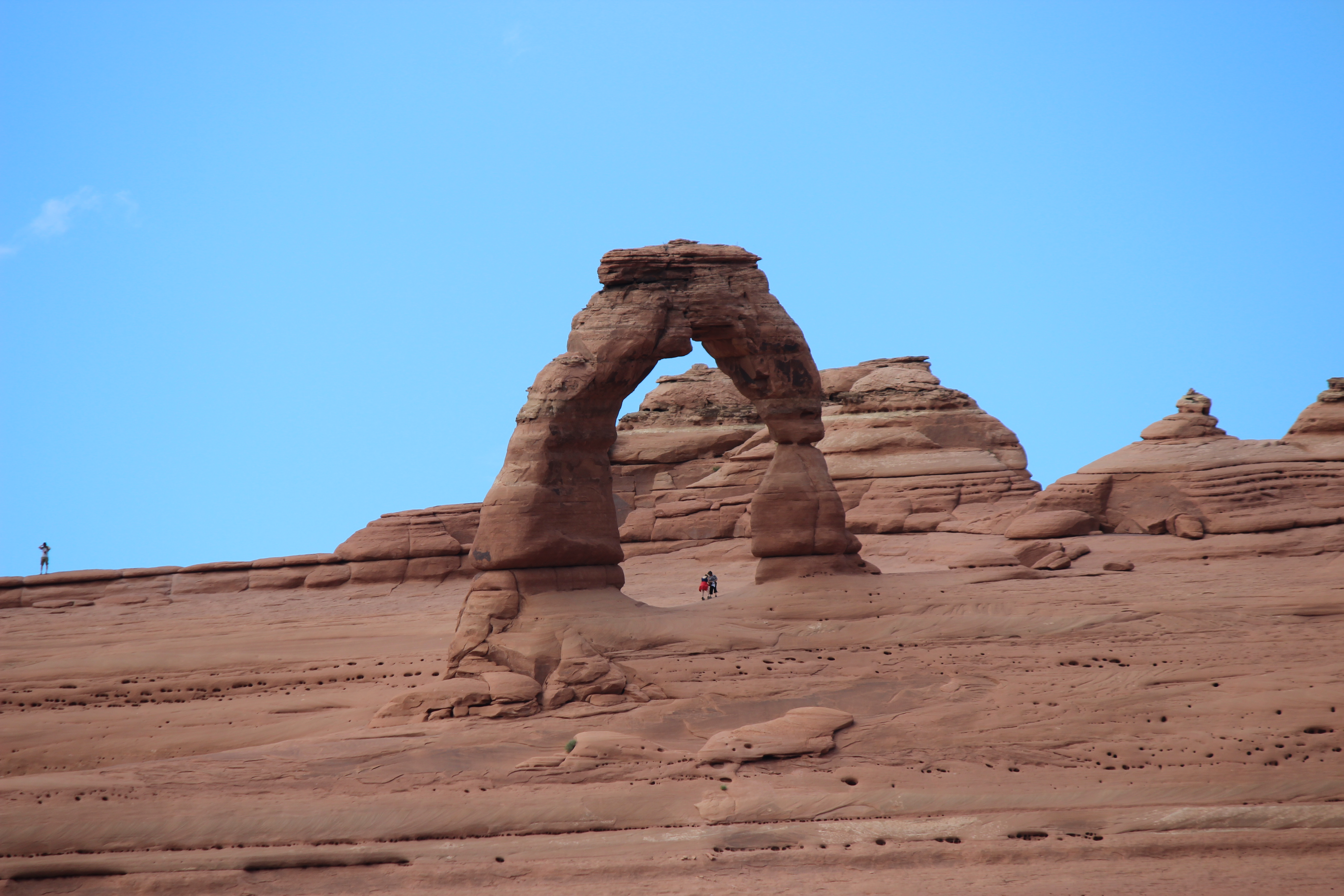
Here’s Delicate Arch for real. Note the hiker directly beneath the arch to give you an idea of scale.
There’s not much else to say except that there was extraordinary beauty in every direction we looked. So I’m going to shut up now and just show you some of the highlights.


This row of tall rock formations is called Park Avenue


Sheep Rock

The rock behind me is called Balanced Rock
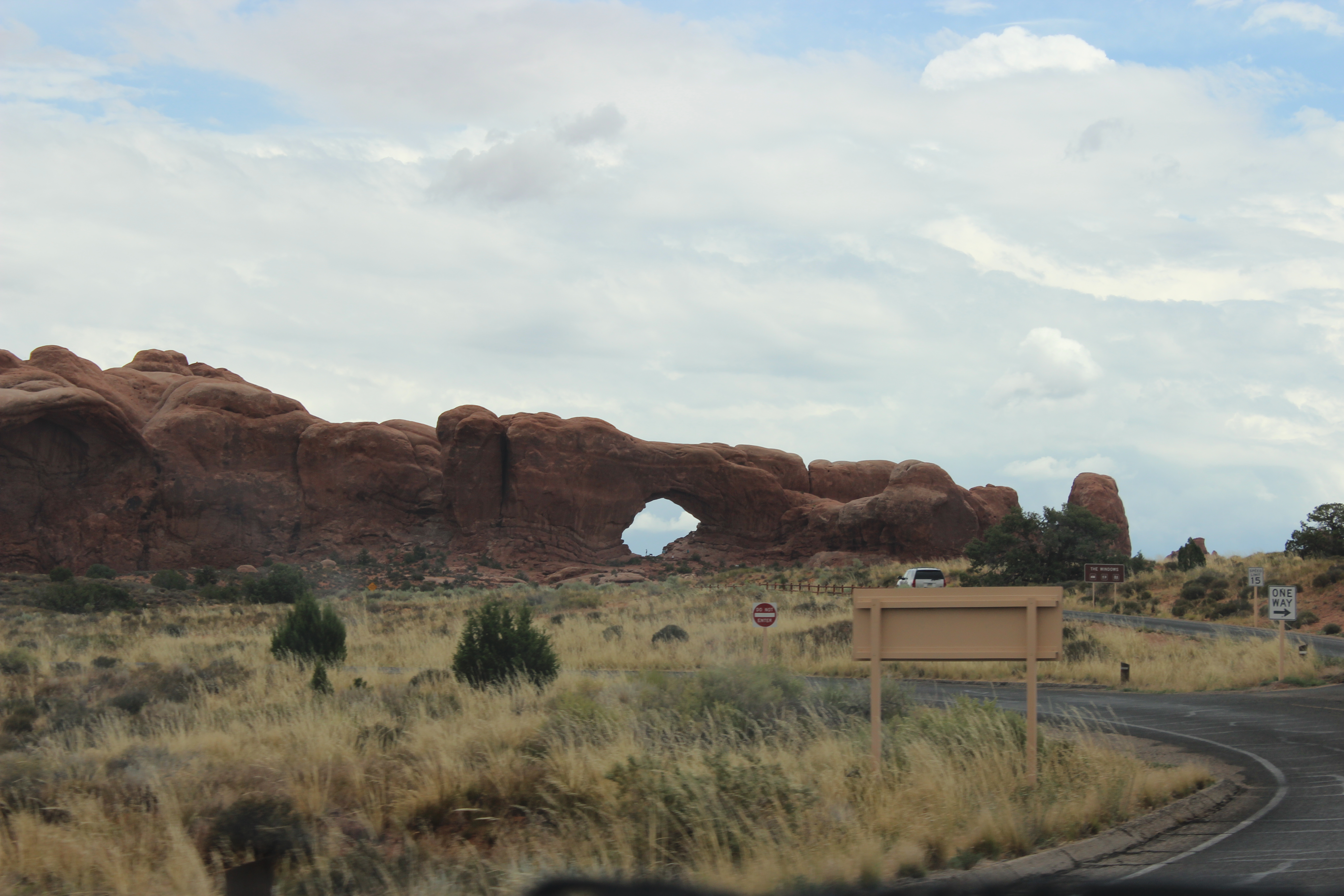
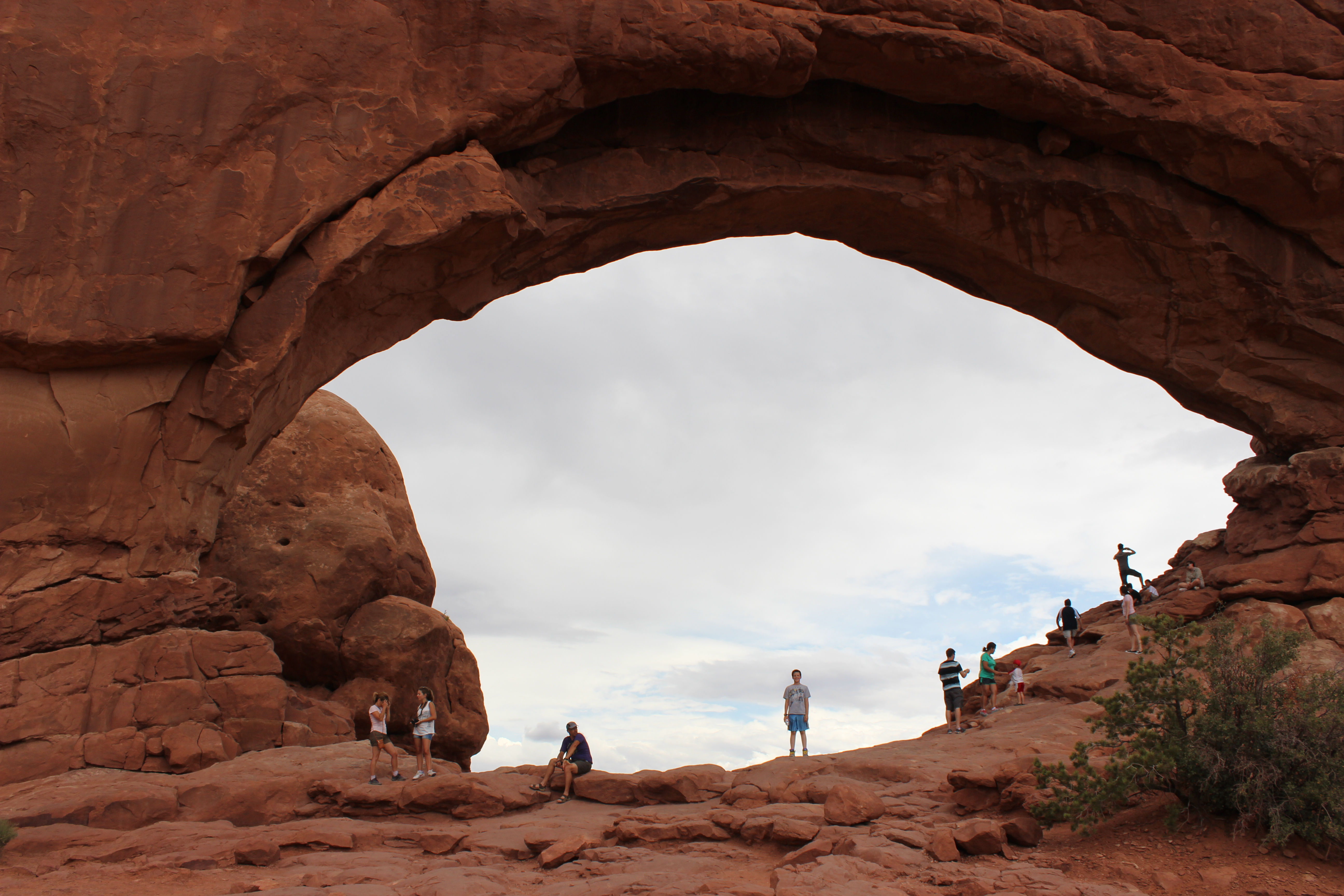
Sam stands beneath an arch called North Window


This one is South Window

Both Windows together look like the face of a troll
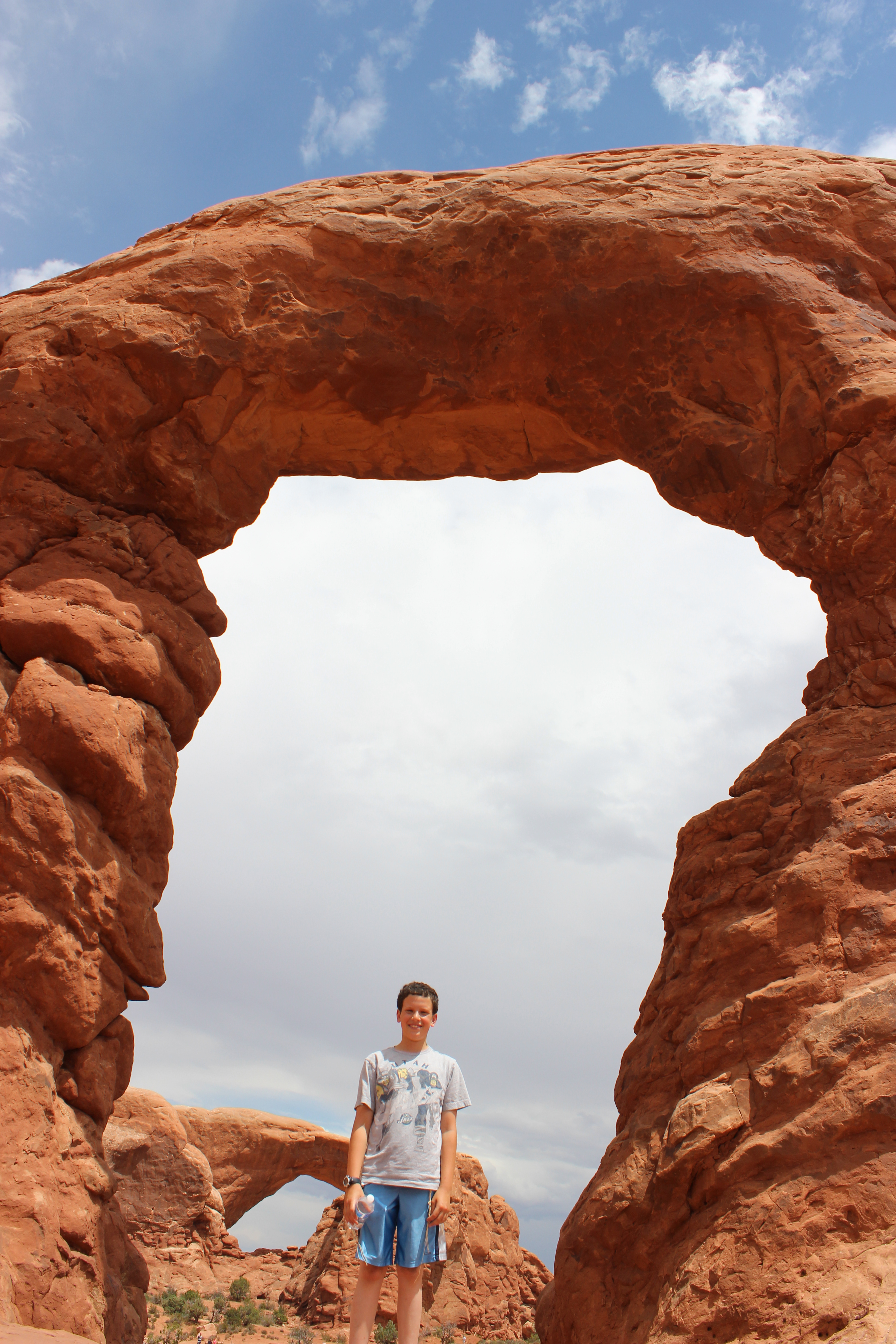
Looking through Turret Arch you can see three other arches
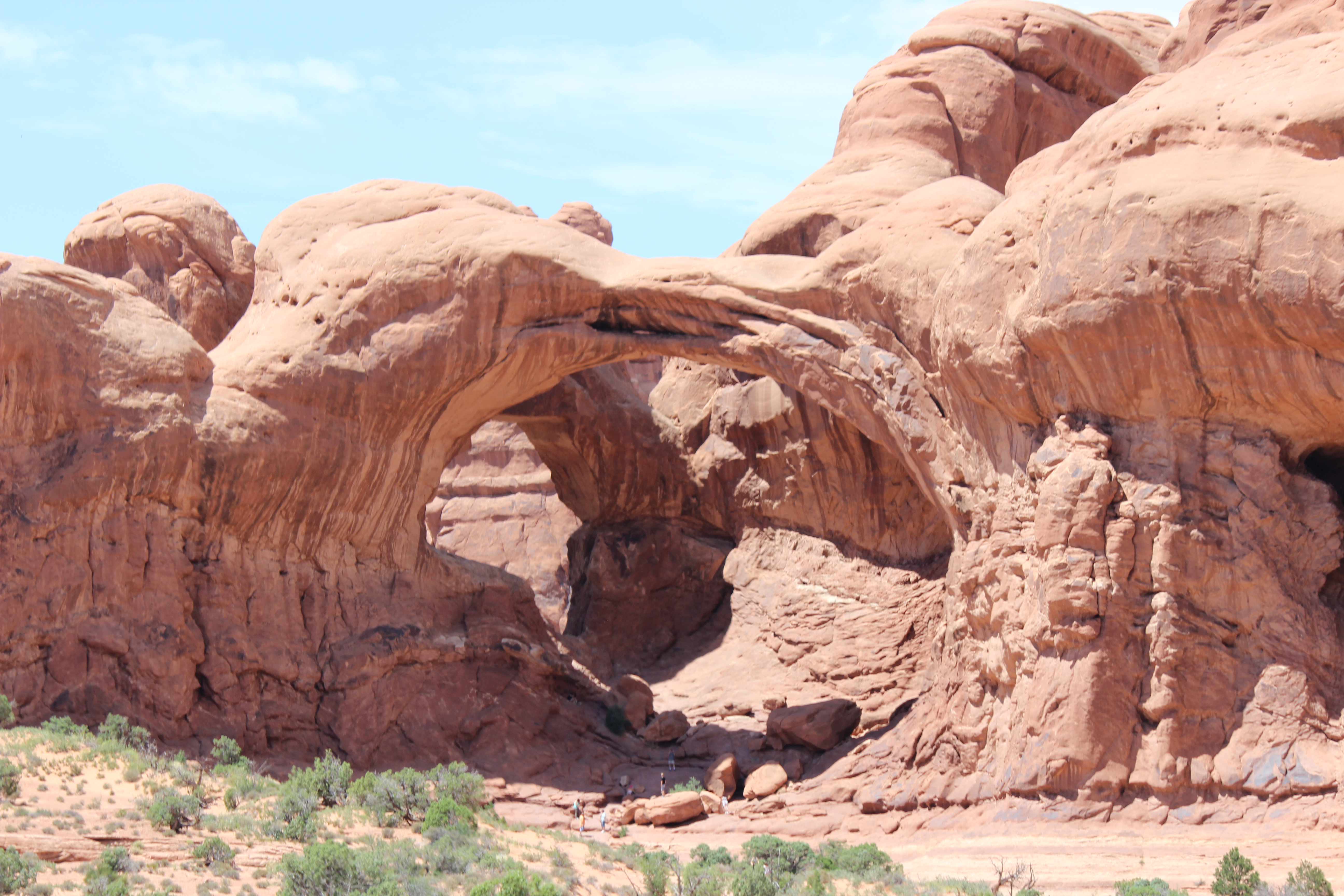
Double Arch, so named because one pillar arches in two directions (the second arch is behind the first in this photo
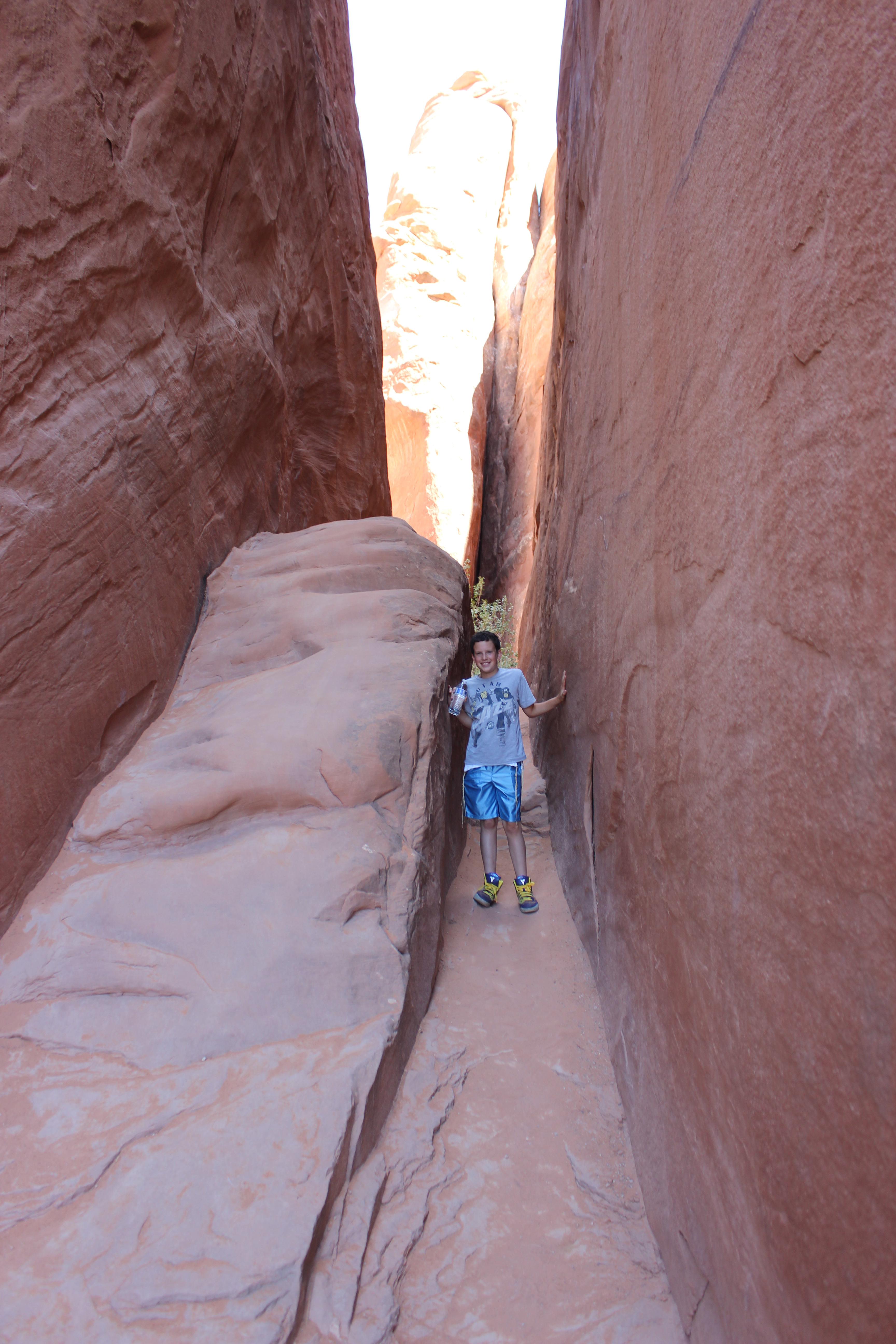
Just an afternoon stroll through enormous stone monliths
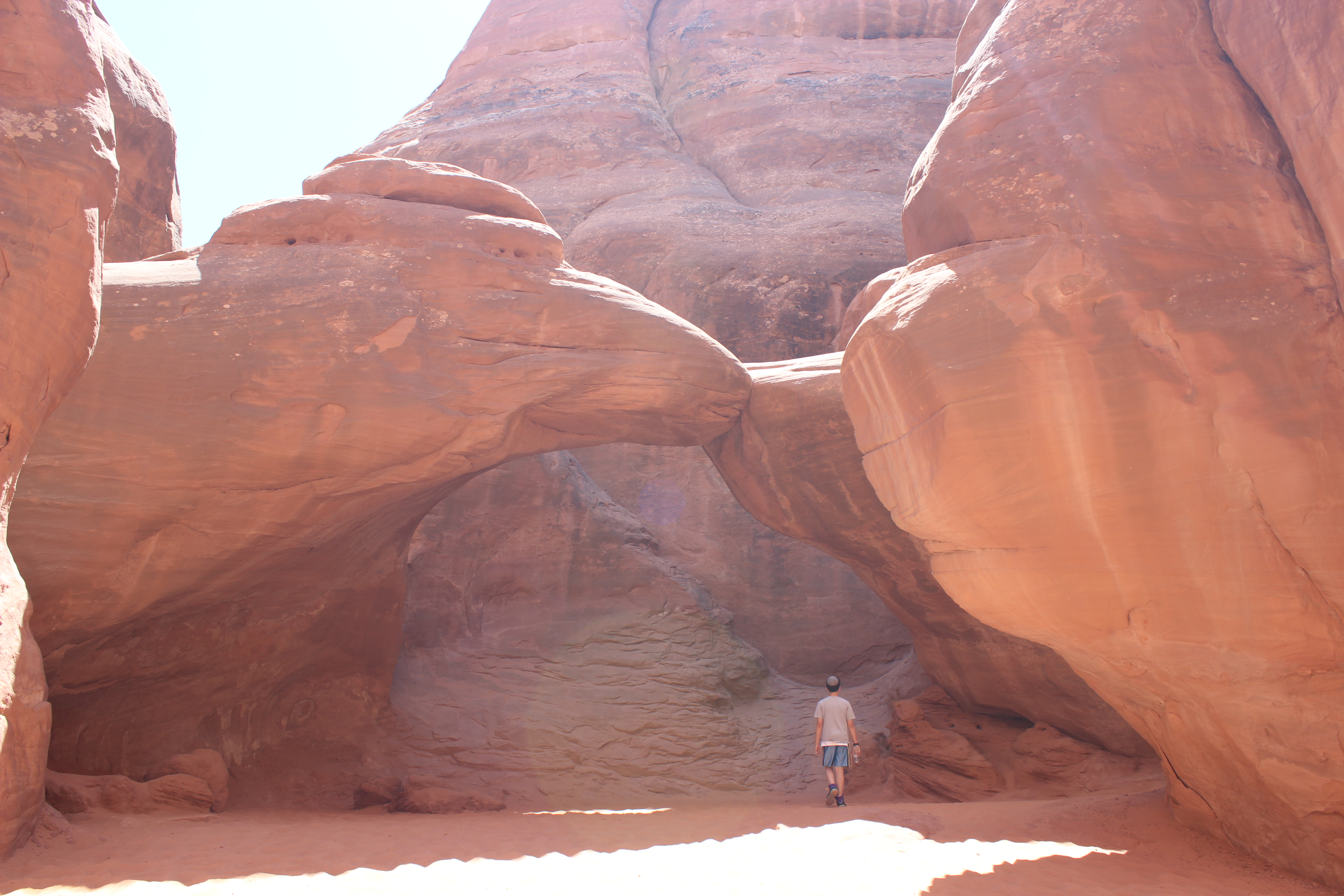
Sandy Dunes Arch

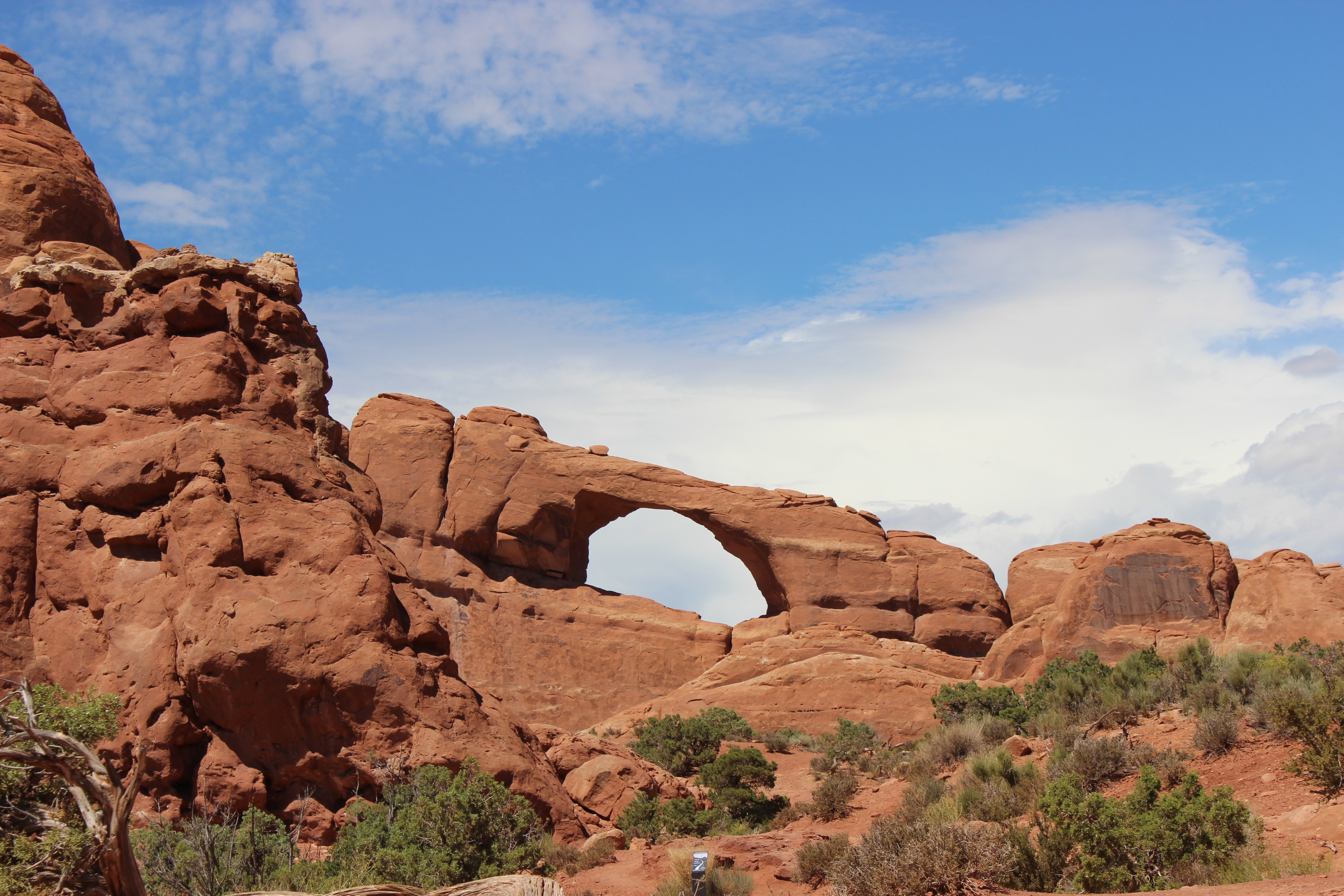
Skyline Arch
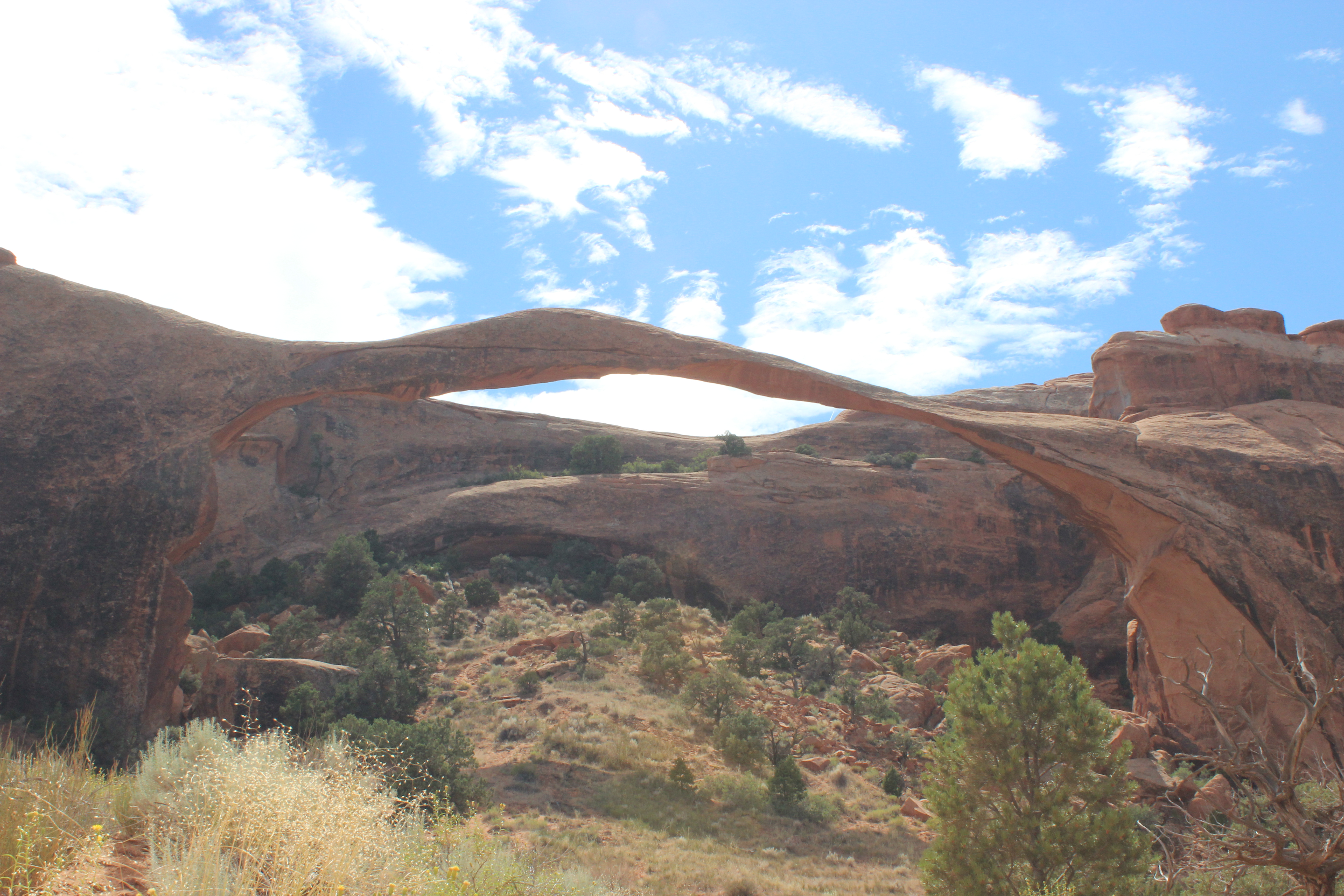
Landscape Arch is the longest one in the park. A ribbon of stoe on the underside of the arch fell several years ago, making the arch even thinner but also forcing the park to close direct access to the arch.
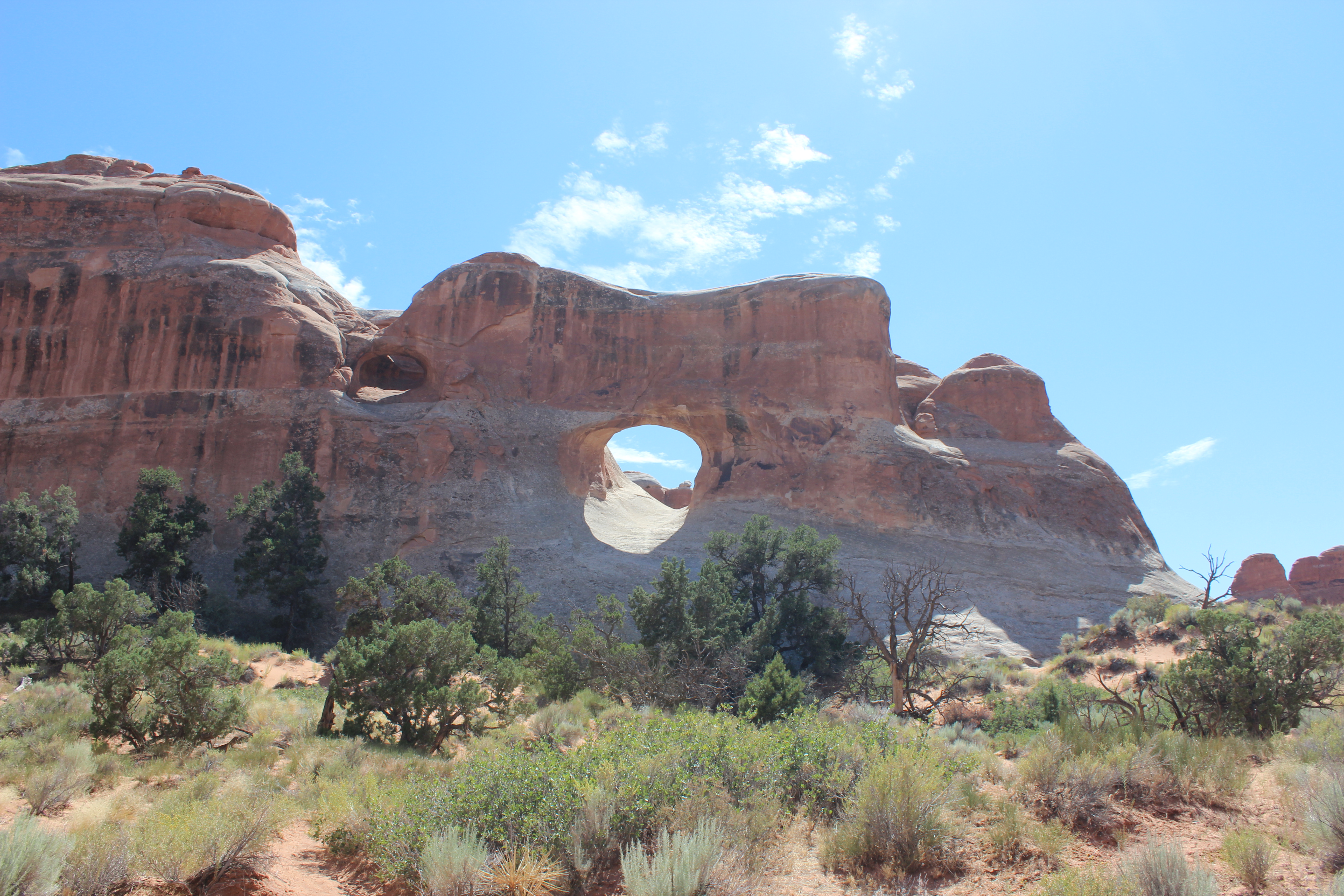
Tunnel Arch
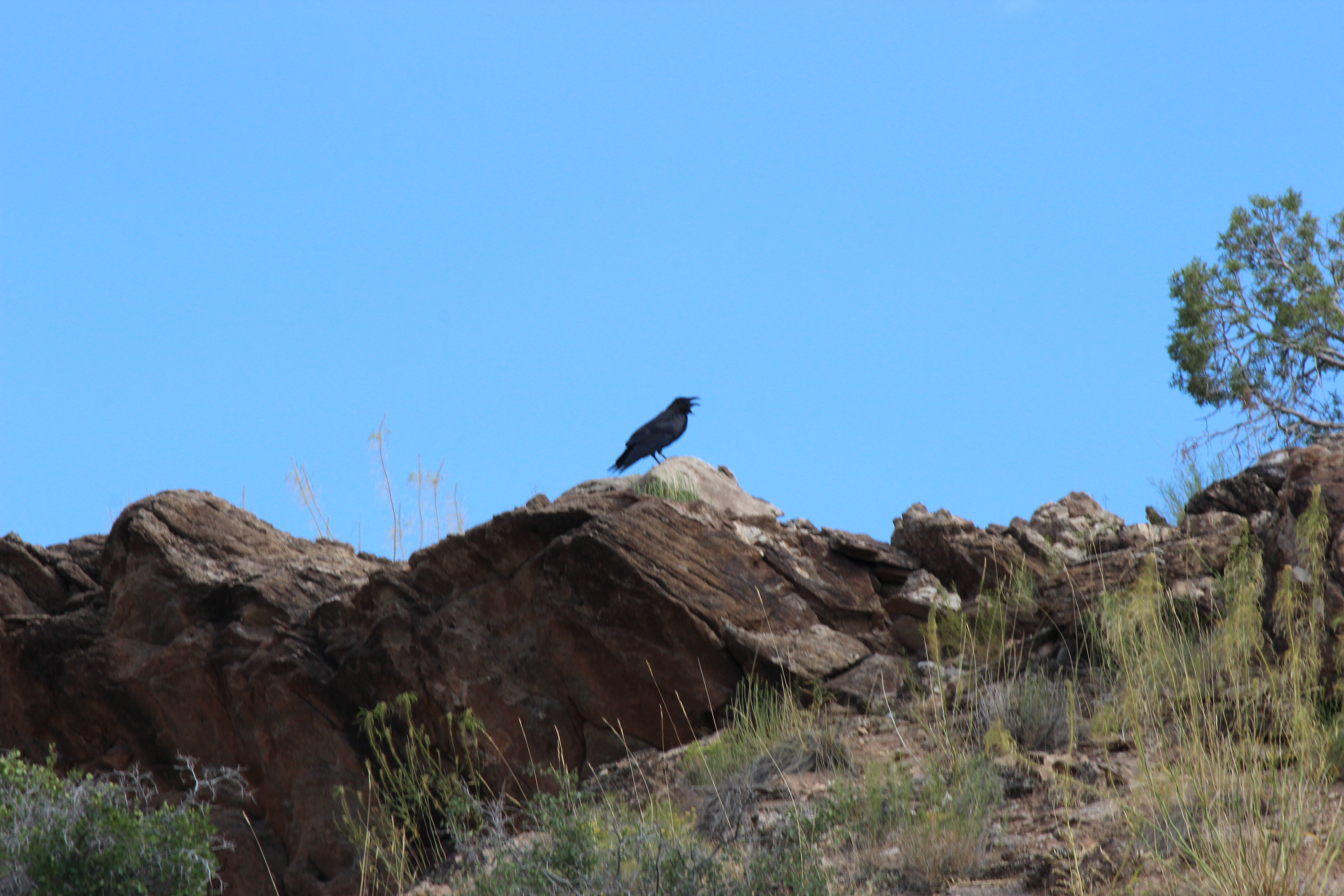
That’s so raven!
Four Square
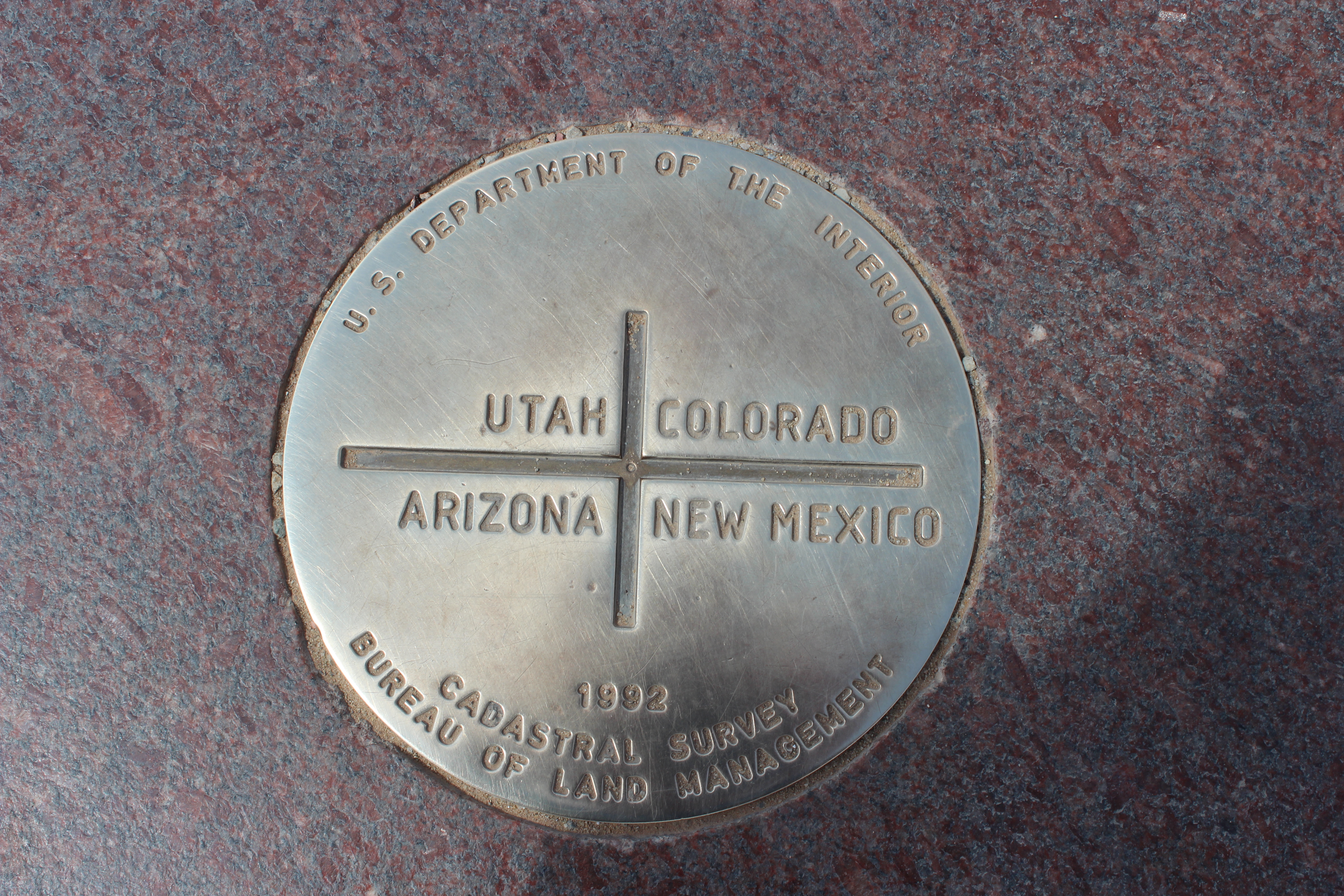
We finally did it.
Since our first road trip three summers ago the Hamster and I have been keeping an informal list of other places and things in America we want to see. One of the top items on the list is the Four Corners Monument, the exact spot where New Mexico, Arizona, Utah, and Colorado meet.
When we decided our road trip this year would go through Route 66, I knew we’d have to take a short detour to the Four Corners. OK, it turns out it’s not a very short detour–it’s a little more than four hours from Albuquerque, much of which is spent driving through the desert.
Of course, one detour leads to another, and we’re going to be spending the next several days hours north of Route 66 as we visit various National Parks, mostly in southern Utah.
On the way there we stopped off to get our first oil change of the trip. I say “first” because there will be at least one more and possibly a third, depending on our growing mileage total. Not to go off on a tangent, but if you ever find yourself in need of an oil change in Farmington, NM, do yourself a favor and go to Totah Lube Express. They were nice, they were thorough, they were reasonably priced, and most importantly they were fast. We were in and out in about 10 minutes and back on our way to the Four Corners. I absolutely love it when people are very good at their jobs, especially when I get to benefit directly from their competence.
When we finally got to Four Corners were jumped out of the car and ran, partly out of excitement and partly out of a desire to leave the car after driving for so long. In the end we enjoyed the visit but it was a little underwhelming.
For starters, Four Corners is on Navajo land, which means it’s not a National Park and it’s pretty bare bones. You drive up to a toll booth, pay $5 per person, and then park on an unpaved and badly rutted lot just outside the monument. The restrooms are essentially just holes in the ground surrounded by four walls. There’s no cell service for miles. And ringing the monument are 40 tiny concrete-block stalls, each populated by a Navajo who is selling the exact same junk as the person in the next stall. (I briefly wondered if I should choose which stall to patronize based on the sales tax in the state the stall is in, but then realized that the question is moot because there’s no sales tax on Navajo land.)
The monument itself is beautiful, but there was a long and slow-moving line to stand on the exact center and take pictures. On the plus side, the line the line itself straddled Arizona and New Mexico, so we visited two states while waiting to visit four.
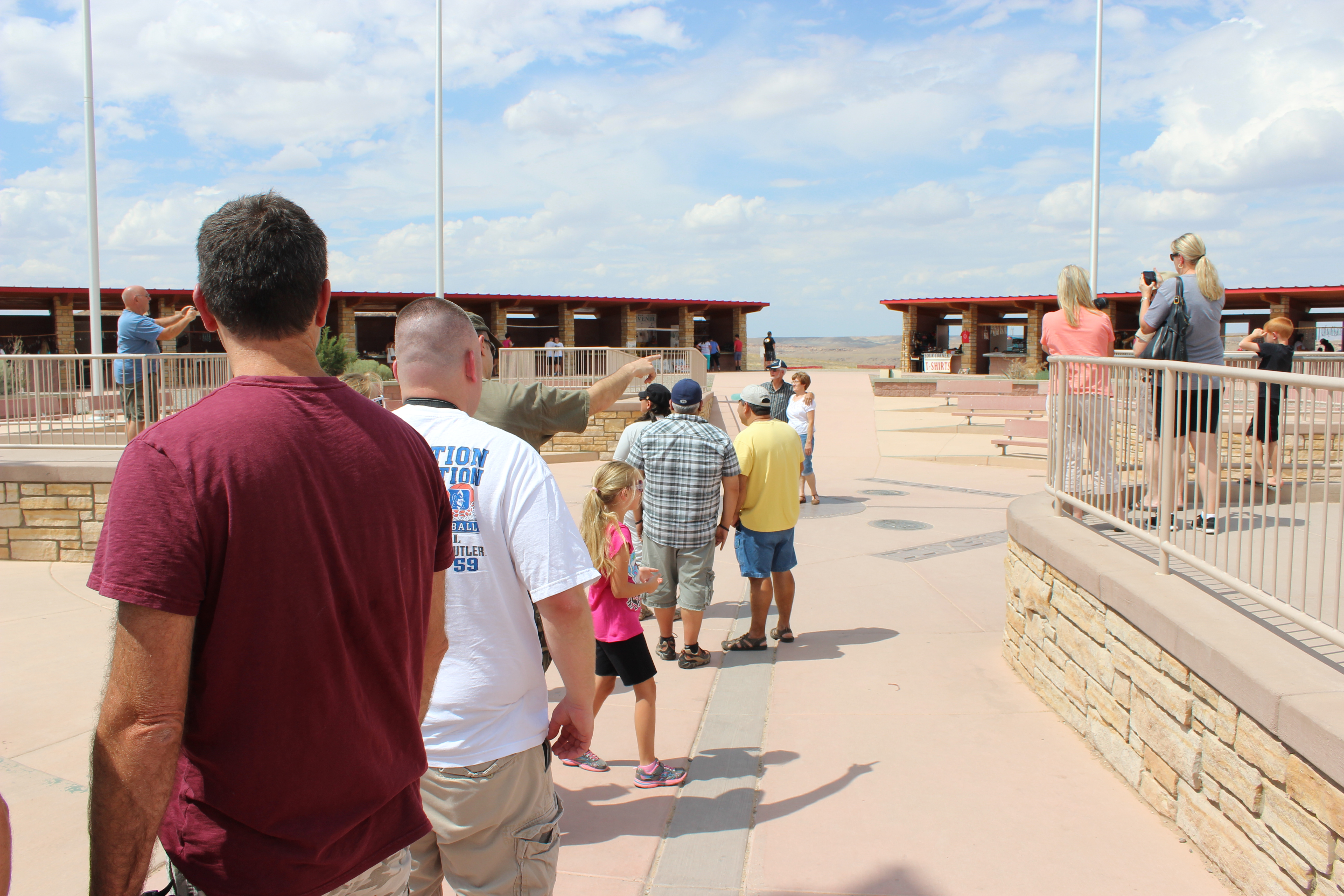
It was pretty cool to stand in four states at once, and even , but when it was finally our turn I felt kind of rushed because there were so many people waiting. We did still manage to take a few good pictures, though.
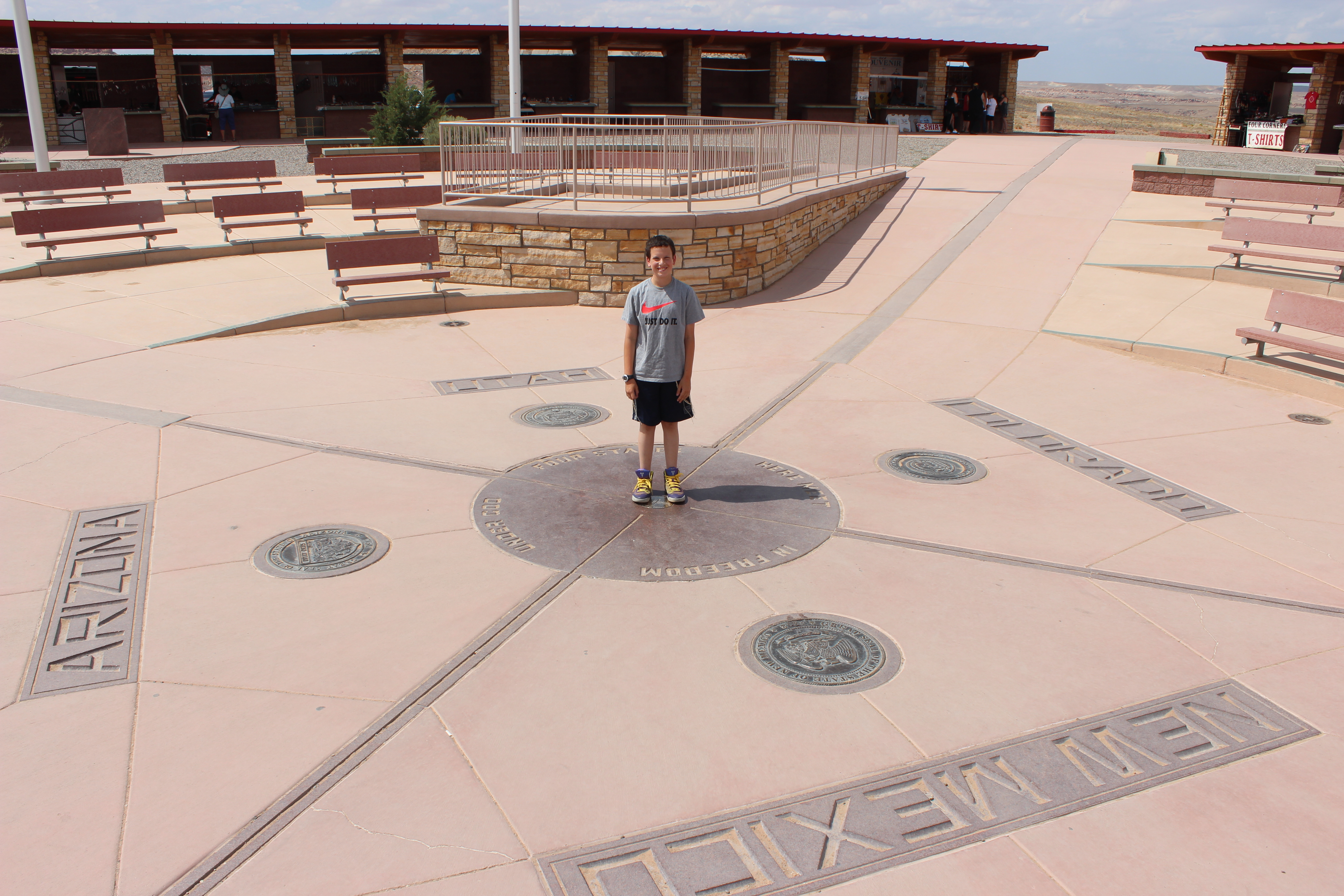
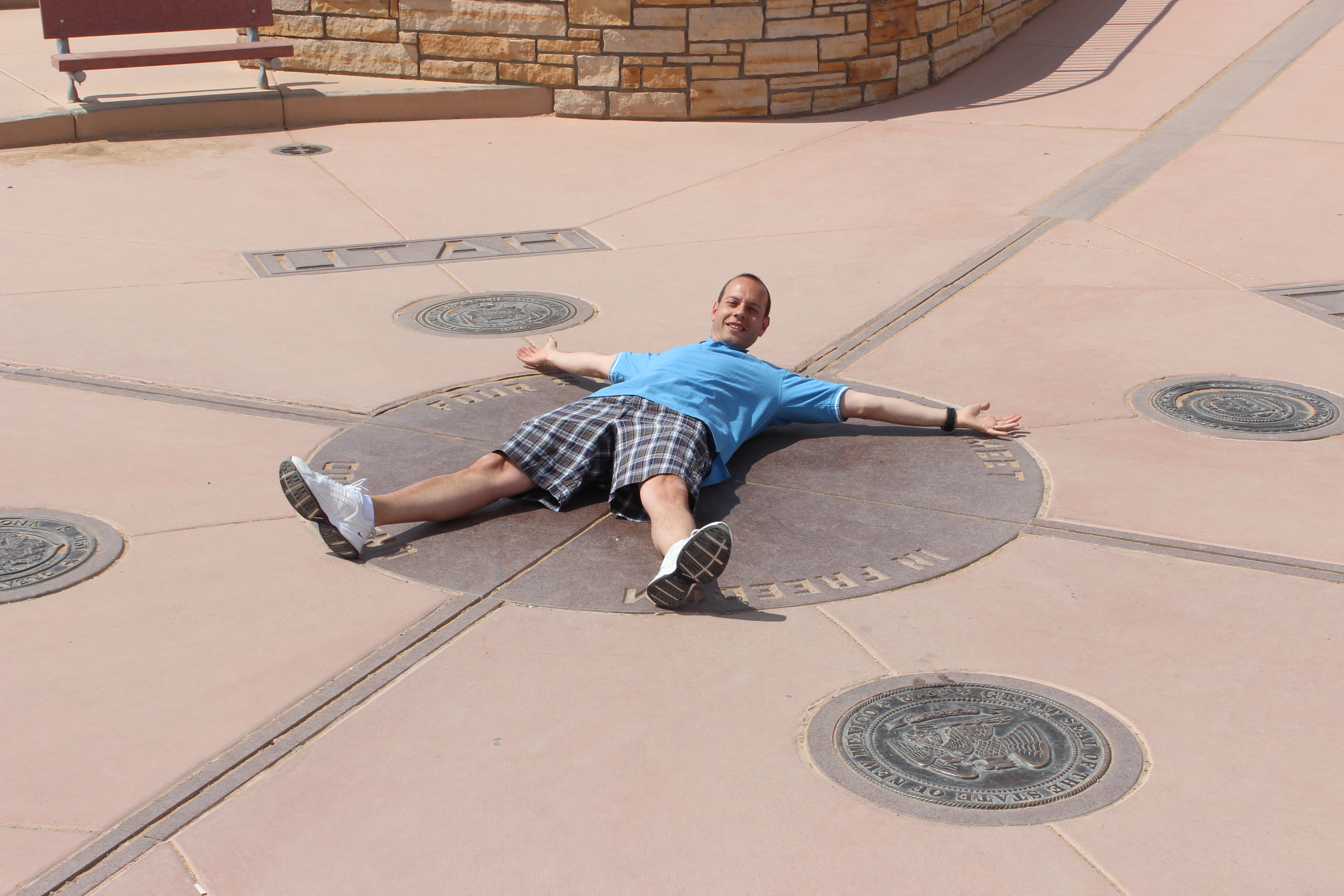
Weirdest game of Twister EVER.
Incidentally, that photo was surprisingly difficult to pose for, because it was over 90 and sunny today and that circular emblem is metallic and was insanely hot to the touch.
One of the fun bonuses for Sam when it comes to major attractions like this one is that it brings people from all over the country, so the parking lot is a good place to visit when you’re looking for state license plates you haven’t seen yet. We were missing several when the day began but we found four of the missing ones here and now all we need is North Dakota, Alaska and Hawaii.
We had four states to choose from when we left, and we headed into Colorado to visit Mesa Verde National Park. It’s relatively small as National Parks go, but it is home to several 800-year-old villages built into the sides of overhanging cliffs, and it’s only an hour from Four Corners, so we figured it was worth seeing.
I want to take a minute here and give a big shout-out to the National Parks. We have been to only a fraction of them but every single one of them has been run smoothly, cleanly, and intelligently. Every single Park Ranger we have encountered in any capacity has been friendly, deeply knowledgeable, beyond helpful, and 100% spot on with every single recommendation for what to do and how and where and when. Today was no exception. We started at the Visitors Center and the Ranger we spoke to made up a whole itinerary for us based on how much time we had. He even gave us some tips on which towns to look in for a place to stay tonight.
Anyway, the park was cool. I’m a history buff so I knew I would enjoy it. I wasn’t completely sure about Sam, but he loved it. In just a couple of hours we managed to see all the most impressive cliff dwellings and even sneak in a little hike.
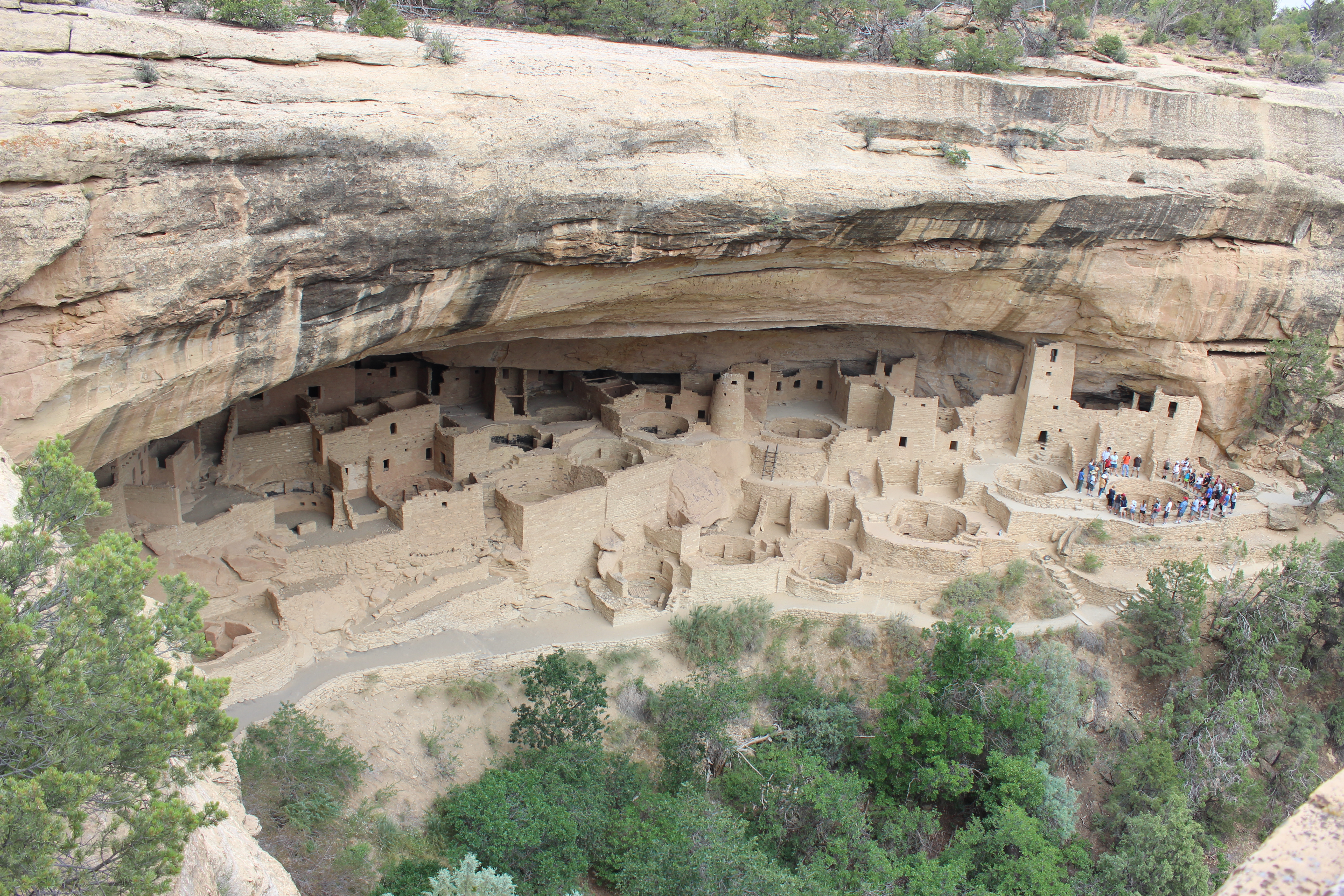
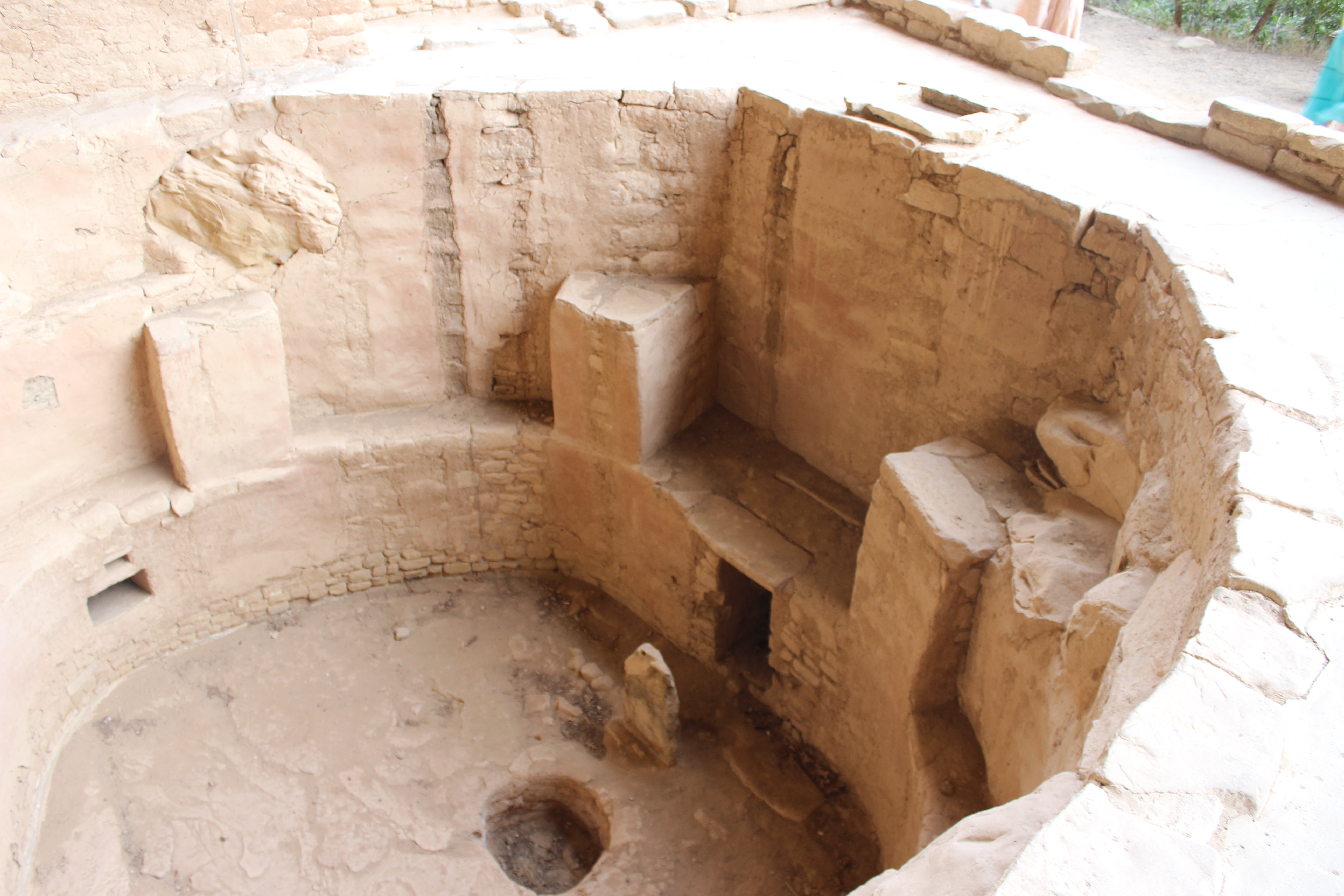
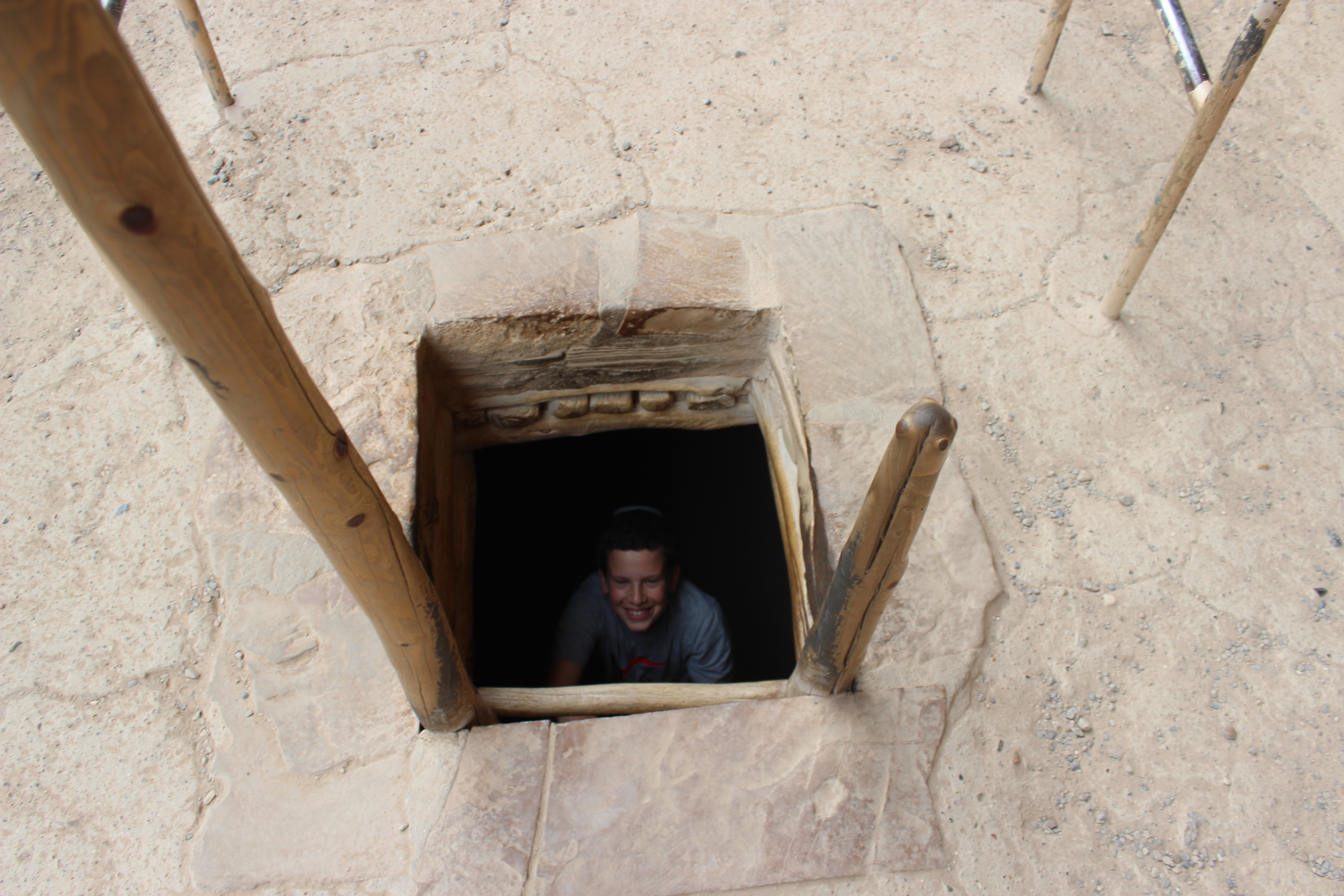

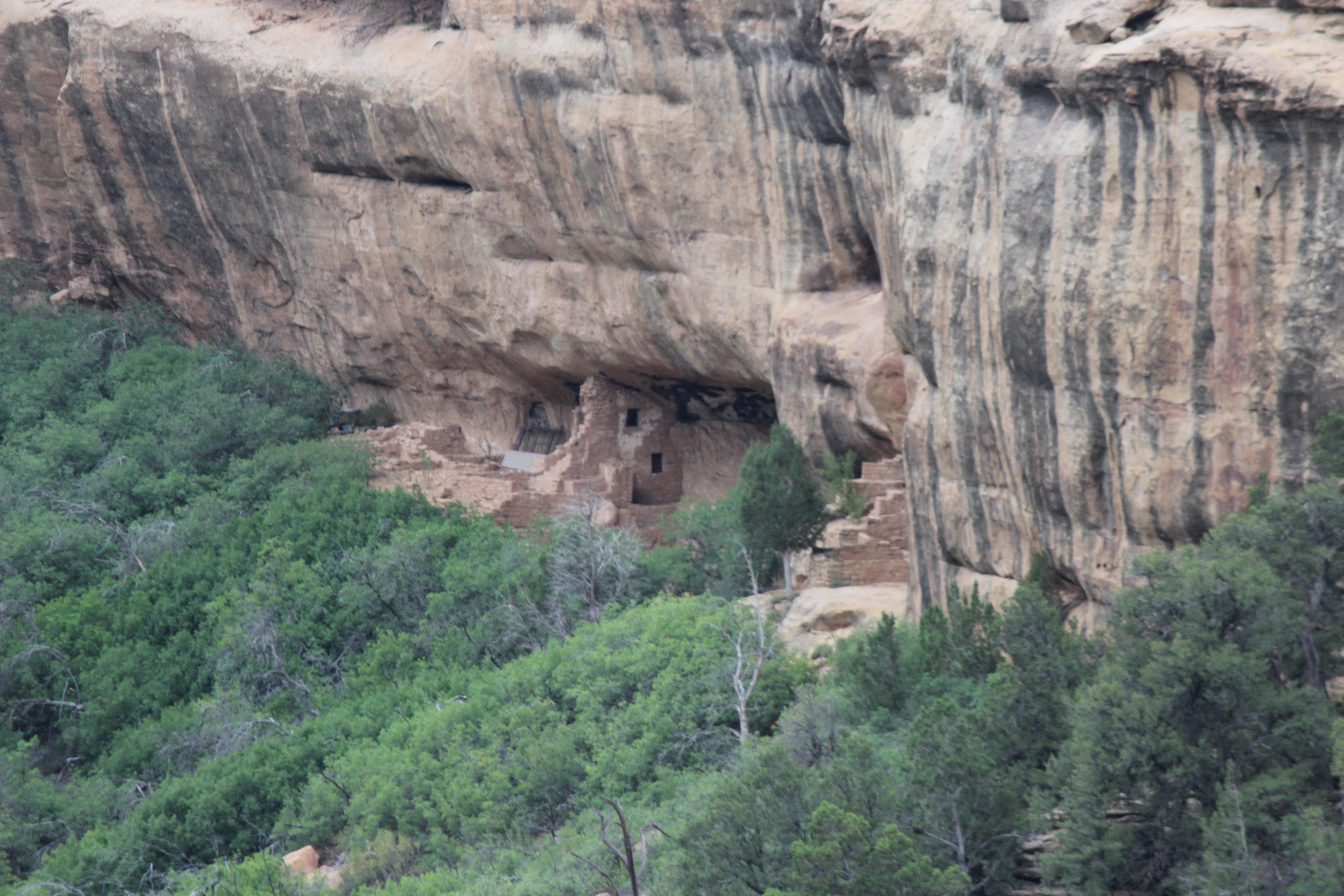
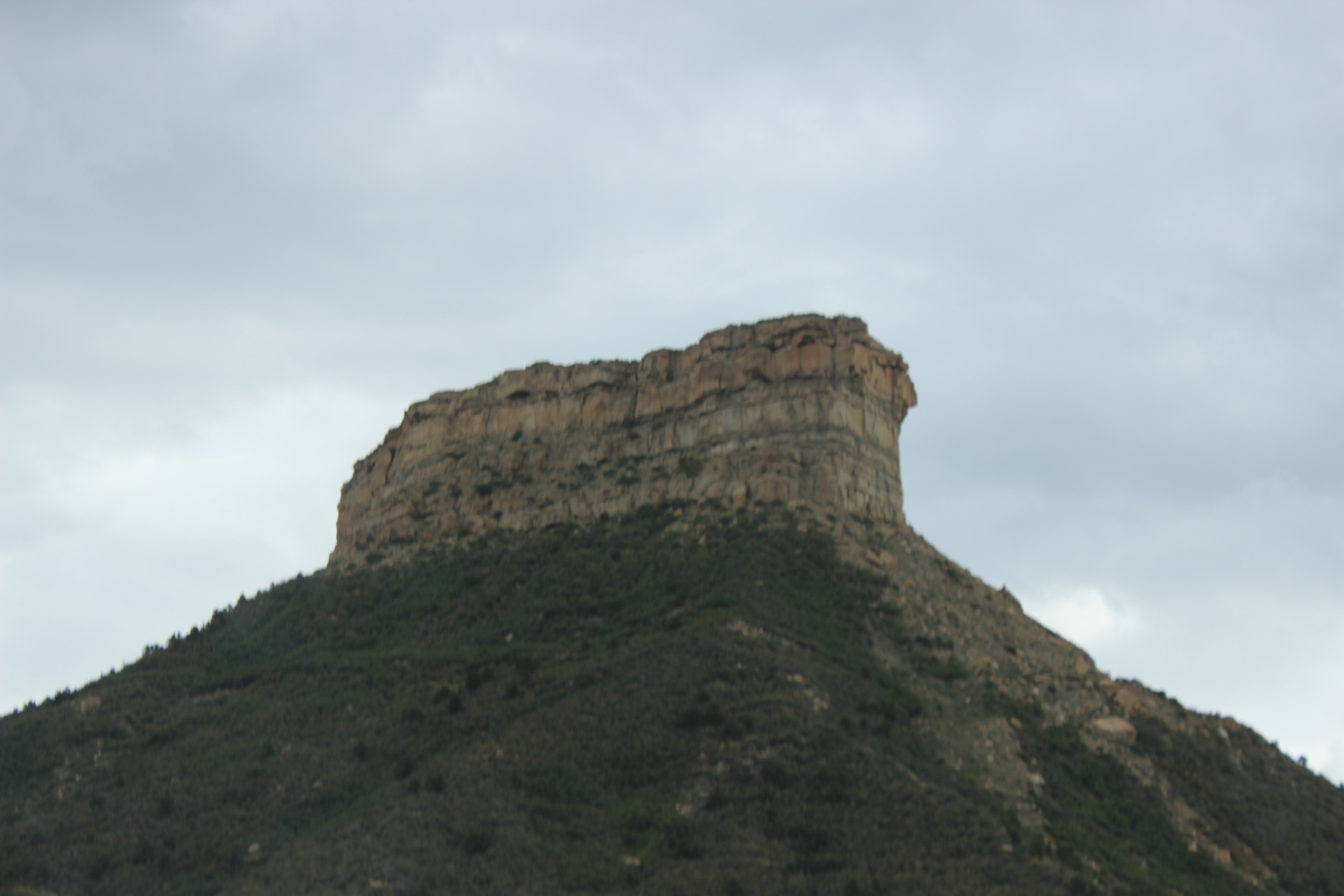
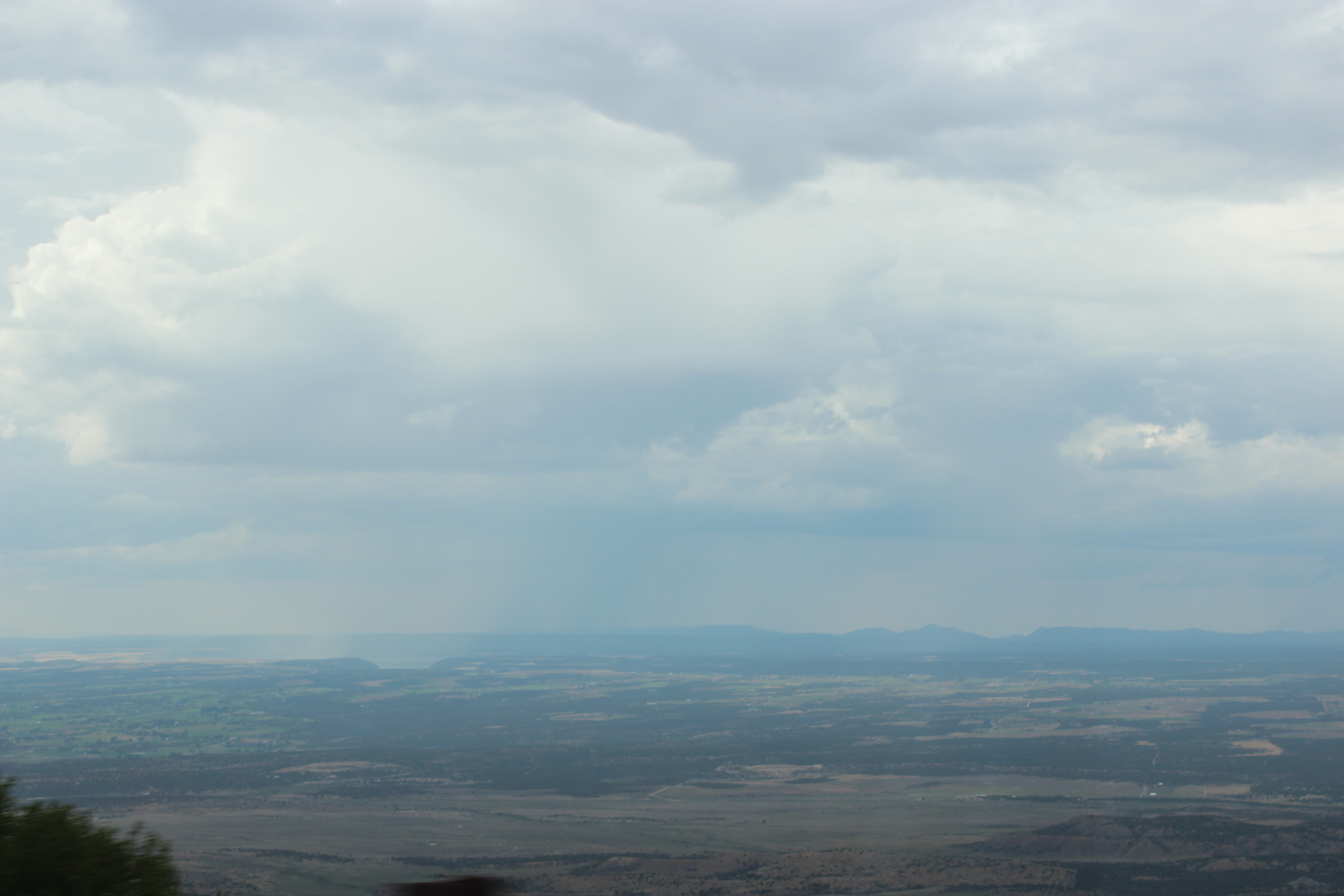
Meanwhile, we were so high up that the views of the world outside the park were almost as impressive as the cliff dwellings we came to see.
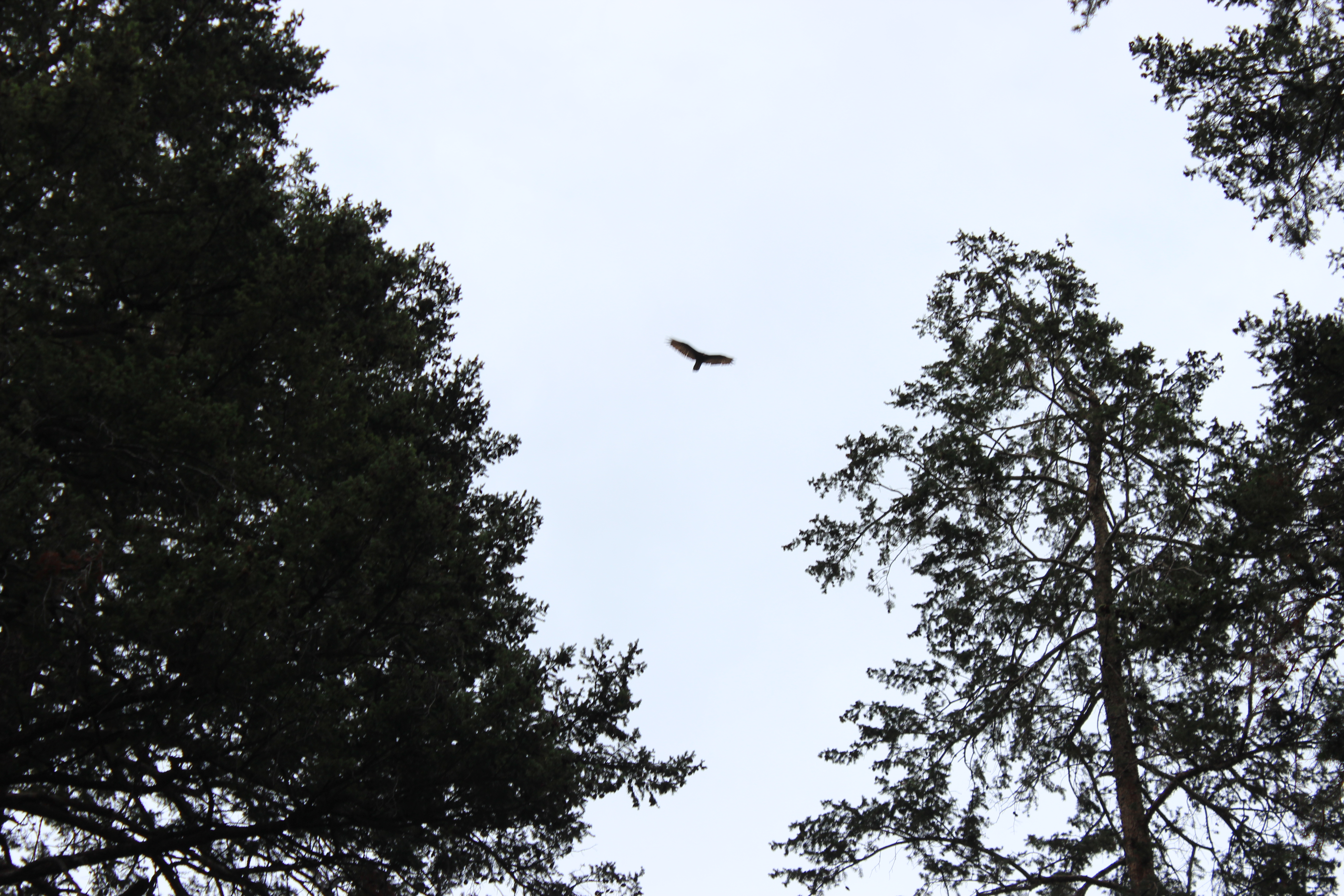
A Park Ranger told us these birds were turkey vultures. I don’t know exactly what that means but I assume they’re the vulture version of turkey pastrami–they’re just like vultures, but they’re made out of turkey.
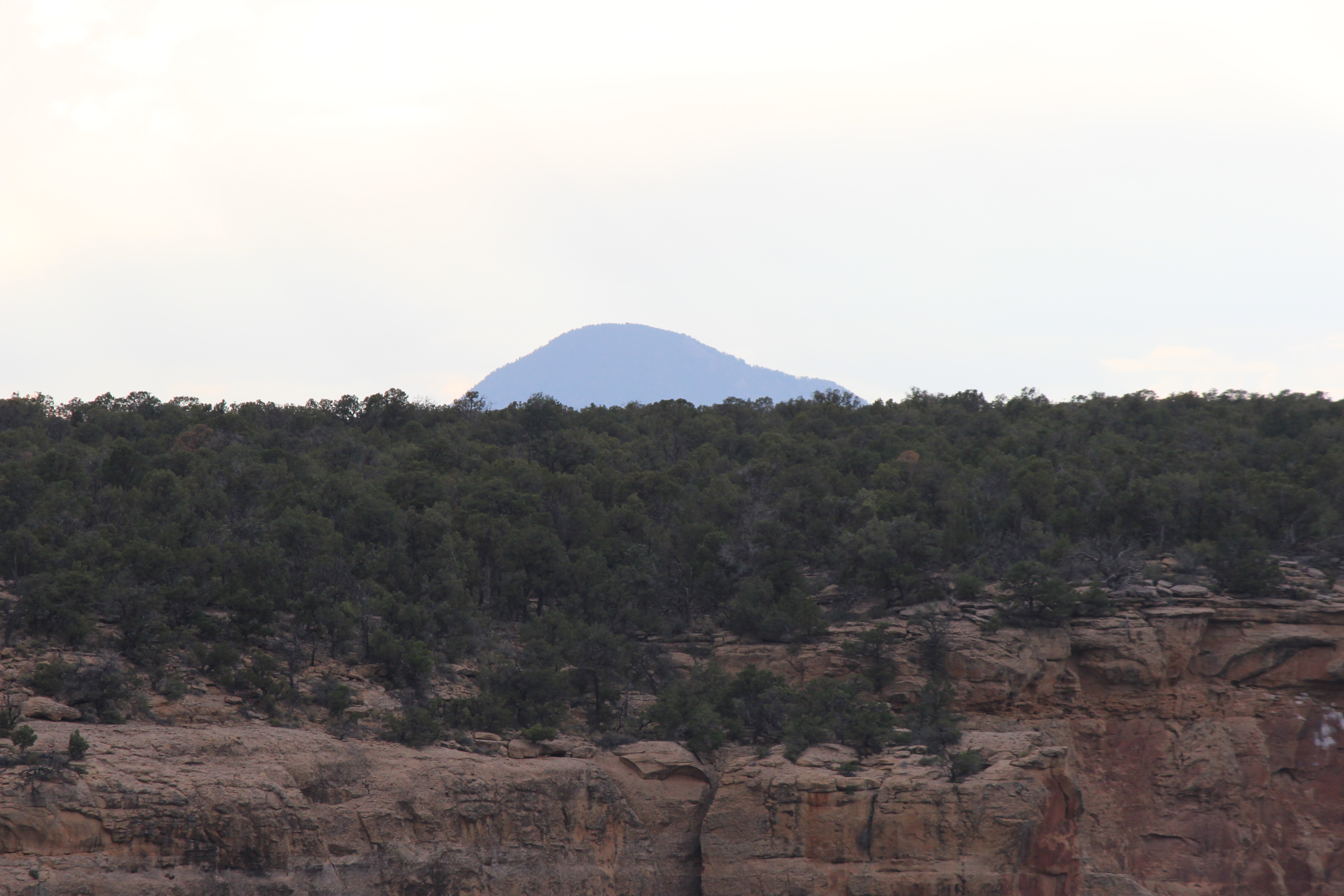
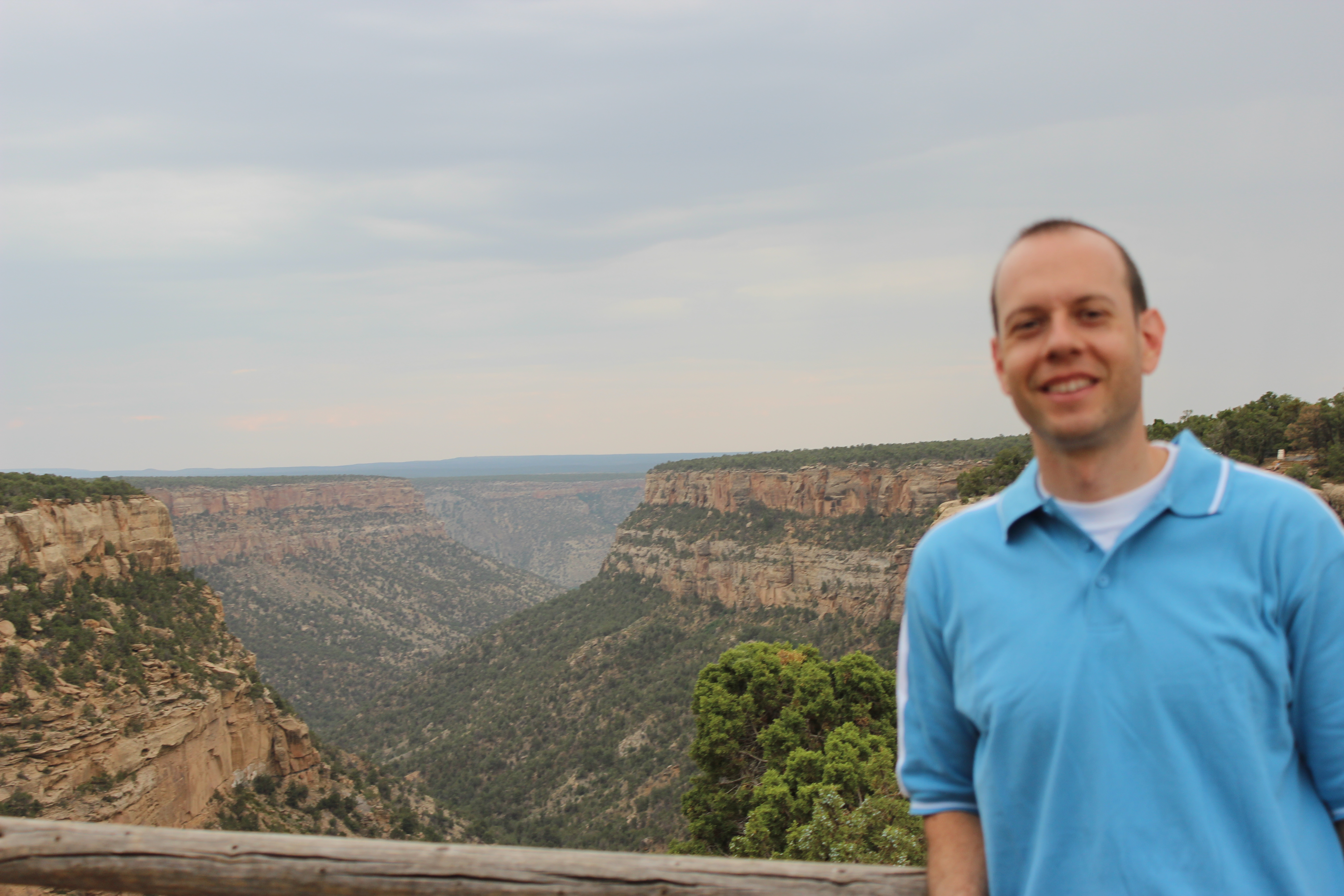
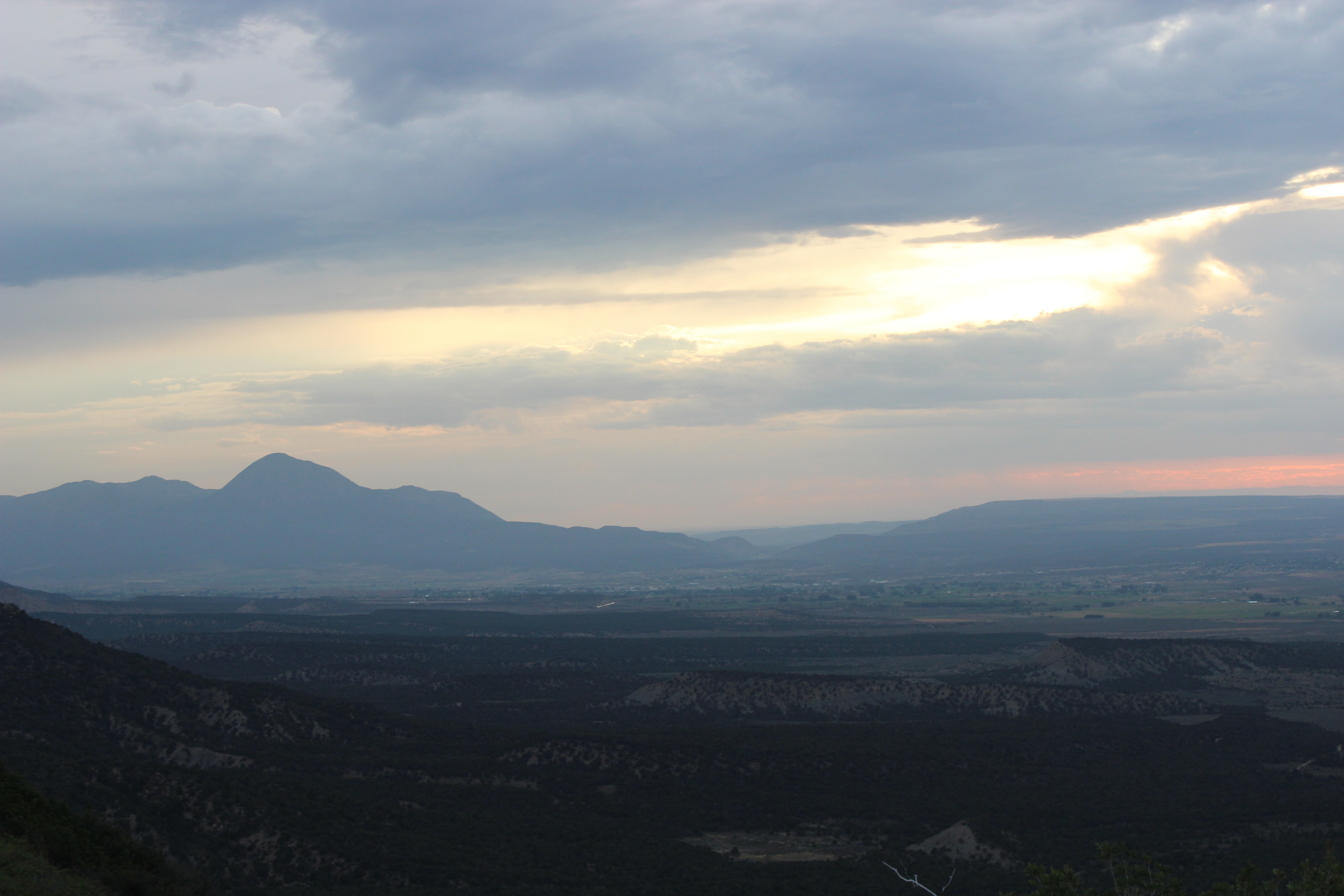
Our high perch also allowed us to be both dazzled and unsettled by a pretty serious lightning storm that was brewing in the distance all evening. We briefly got some rain but it was nothing too disruptive or unpleasant.
For me, the best part of the whole day might have been dinner. Sam chose a picnic area in the park that had fantastic views and turned out to be completely empty except for us and a curious young deer who came right up to us for a minute or so while our burgers were cooking.
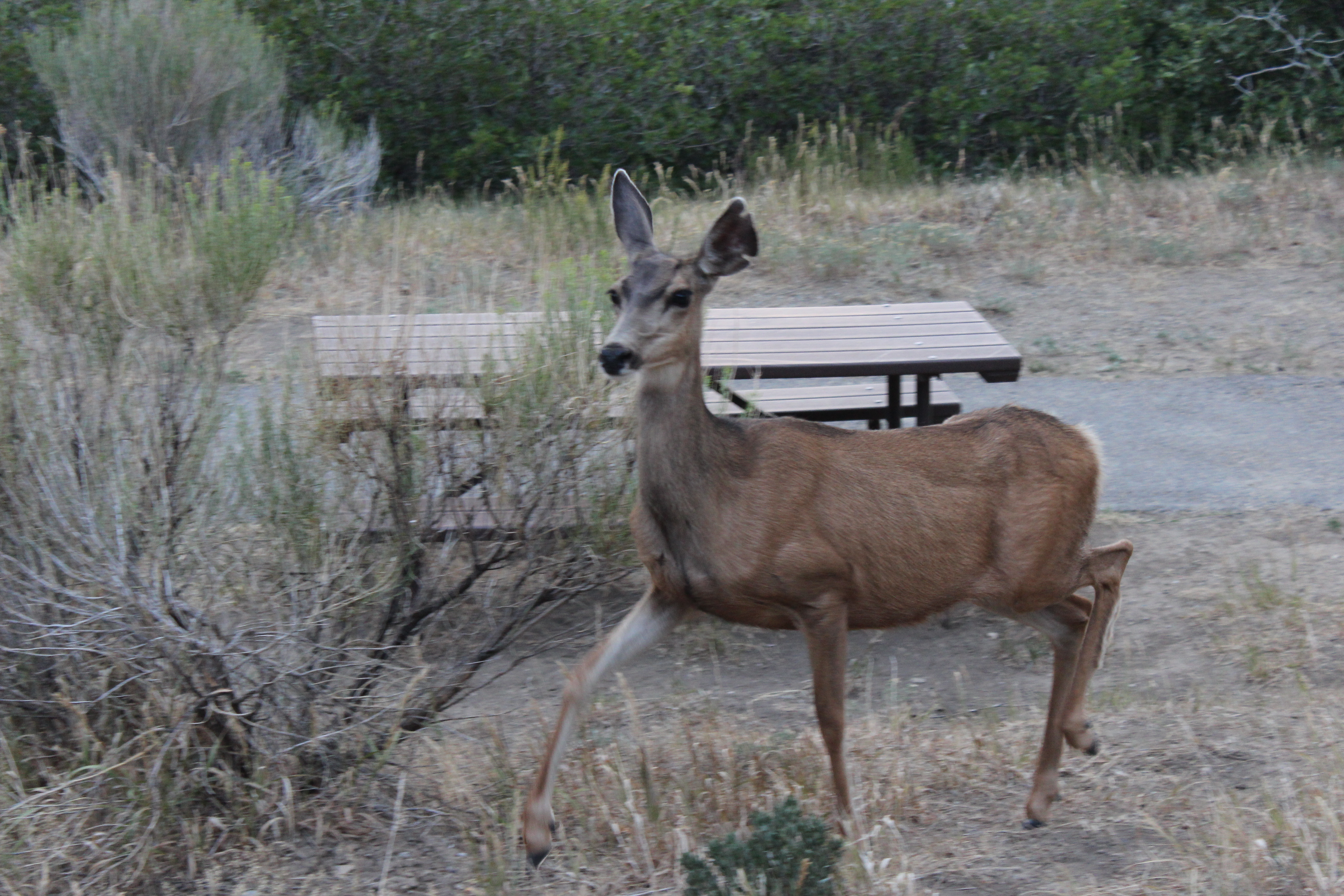
Or maybe it was a turkey deer.
As we ate, we watched the sun set from our picnic table and marveled at the surrounding beauty.
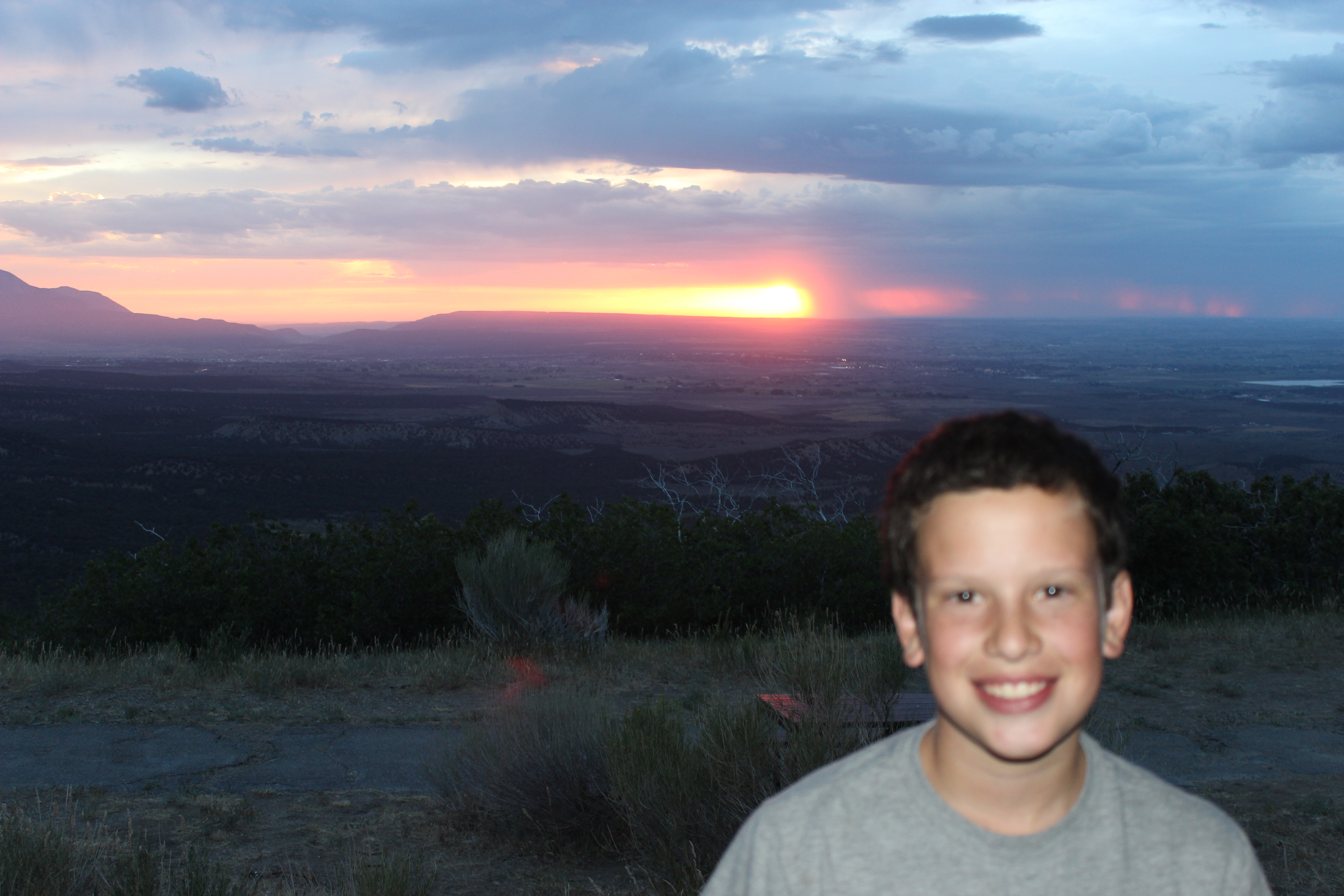
It’s funny how the main focus of the day was the Four Corners but the best part of the day turned out to be Mesa Verde. Before we started taking these road trips I had never been to any National Parks. Now we’re spending almost a week going straight from park to park to park and I can’t wait. Mesa Verde was a surprisingly good start.
Querque
Wednesday might have been the most fun day of our trip so far, and for completely unexpected reasons.
We started with several frogs in the hallway of our motel, which I found disturbing and Sam found hilarious. Then it was a four-hour drive to Albuquerque, which turned into a five-hour drive because we made a few unscheduled stops along the way–for souvenir shopping, for lunch, and to see Blue Hole.
What is Blue Hole? Well the name is entirely accurate but doesn’t quite do the place justice. There we were, driving along Route 66, when we saw a highway sign for Blue Hole. I pointed it out to Sam just because I thought it was a funny name.
“Oh! I’ve heard of Blue Hole!” he said.
“What is it?” I asked.
“I don’t remember, but I know I’ve heard of it.”
That was good enough for me. We had a pretty loose afternoon planned in Albuquerque, so I figured it wouldn’t hurt to lose a few minutes to go see what Blue Hole is. It was fewer than two miles off the highway, anyway.
It turned out to be totally worth the detour. Blue Hole is maybe the coolest swimming spot we’ve ever seen. It’s a natural geological phenomenon that is basically just a small but very deep swimming hole surrounded by stone. Specifically, it’s 81 feet deep and stays a constant temperature of around 64 degrees, which is a bit chilly for swimming but on a hot, sunny New Mexico summer day it can be very refreshing. It also is not a stagnant pond but rather is constantly flowing, so the water is extremely clean and clear. And because it’s very deep, it’s also very blue–not the light blue of a Caribbean beach but the deep, rich blue of a sapphire.
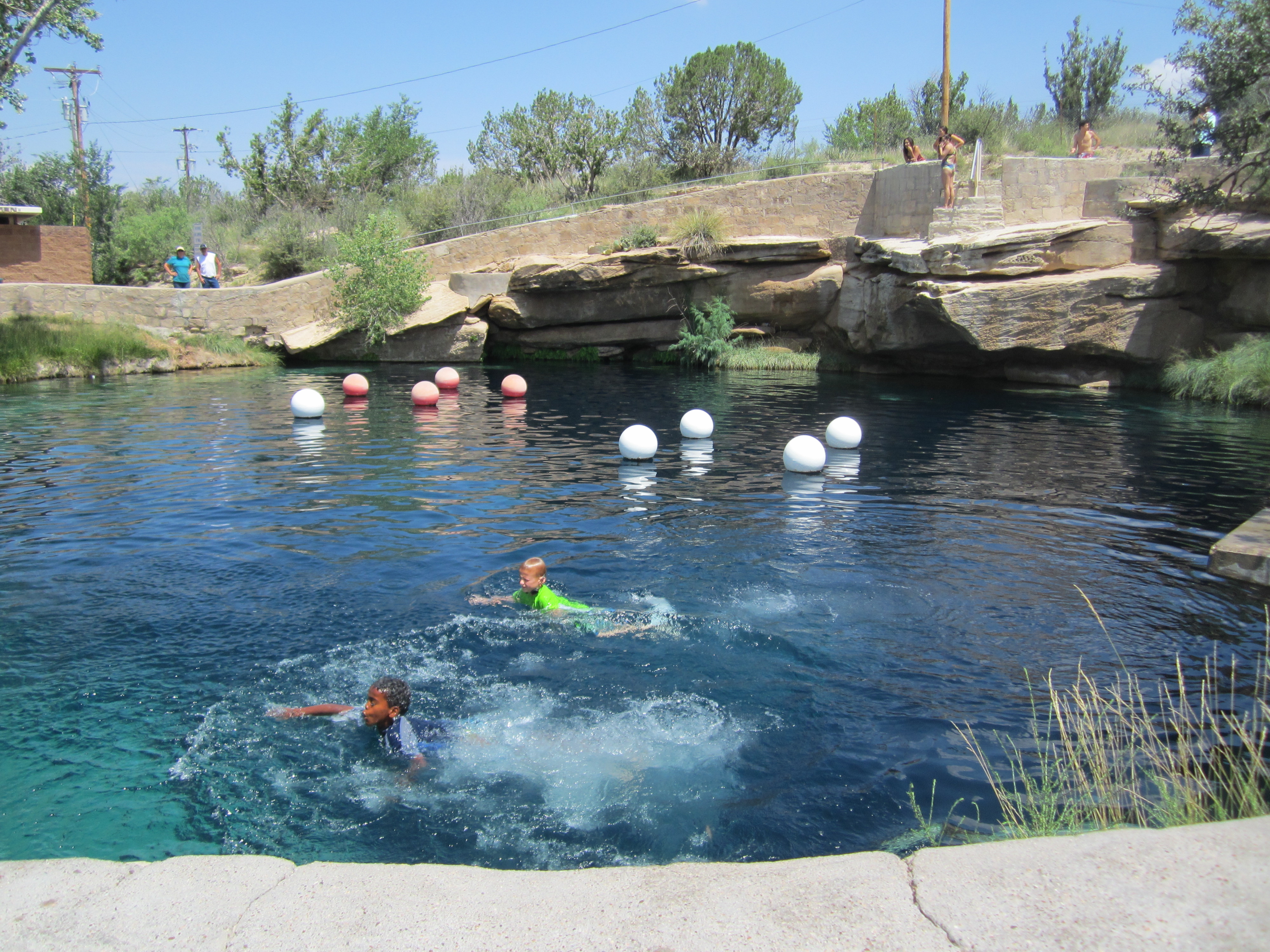
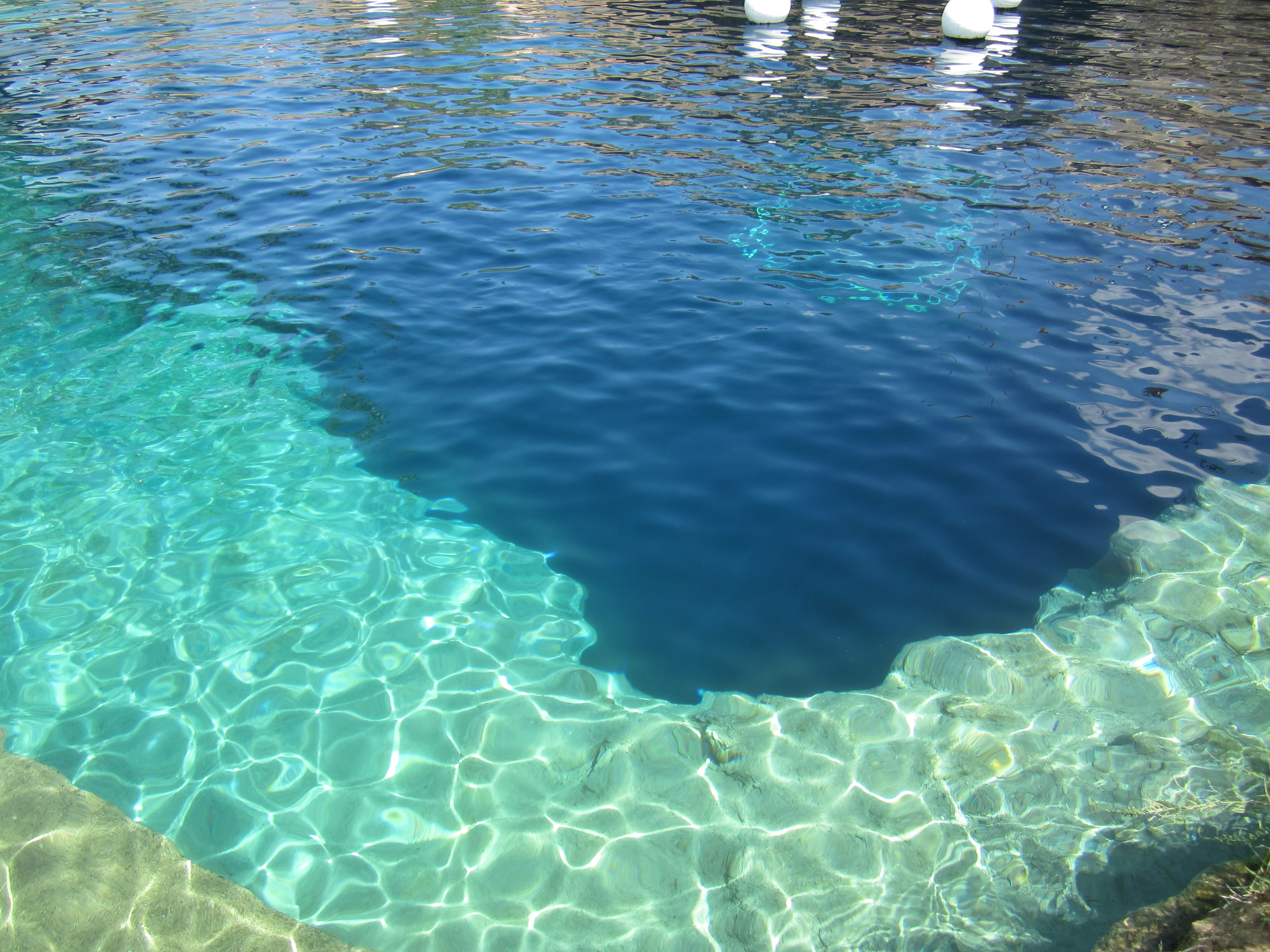
It’s now a state park, which means there are changing rooms and a concrete diving board in addition to the much higher stone diving board left by nature. There were several people there but not so many that it was overwhelming. And everyone was clearly having a great time.
Hamster and I looked at each other. He wanted to jump in. We had not planned on swimming today and were certainly not dressed for it. But there were changing rooms, and we had clothes in the trunk, so I said OK. I was wearing sandals, so I dipped my toes in to check out the water. It was FREEZING! I decided there was no way I was putting my whole body in there. But Sam still wanted to, so I figured I would just watch him splash around for 15 minutes or so and then we’d continue on our way.
[This is probably when I should mention the thing about laundry. See, on Saturday night we were staying in a place with a guest laundry, so I asked Sam how he was doing on clean clothes. He said he was fine. Then Tuesday night as Sam was getting into pajamas he suddenly announced that he had no clean shorts left. None. I was not pleased. And the place we stayed Tuesday night had no guest laundry. As a result he was stuck wearing pants today, which made him a little warmer than me and thus more willing to jump into the cold water.]
As I opened the trunk to get out his bathing suit, I realized that we had no towels with us. At first this seemed like a dealbreaker, but then I suggested that we drive with the top down so he could simply dry off in the sun as we drove. He didn’t love the idea but decided it was a worthwhile trade-off. But then he remembered that both bathing suits he brought were dirty from use last week. Ahh, the never-ending consequences of his not telling me he needed me to do laundry until it was too late. We briefly considered having him wear a dirty bathing suit, but then realized that the laundry bag was at the bottom of the trunk, in the back, and we’d have to empty the trunk completely and then empty the laundry bag completely just to get to this dirty bathing suit. Alas, Blue Hole never got its Hamster.
The big thing to do in Albuquerque is hot-air ballooning. In fact there’s a massive balloon festival every spring–one of the biggest in the world, But balloons take off early in the morning and we were not scheduled to arrive until afternoon. I might have rescheduled some things to make sure we were there in time for a balloon ride if the festival was going on, but it’s not, and balloon rides are very expensive, and we’ve taken one before, on our first big road trip.
We got pretty high up into the air in a different way, but I’ll get to that in a minute.
When I was looking for other things to do in Albuquerque, one of the things that kept coming up is something called Tinkertown Museum. The descriptions of the place were kind of confusing but I put it on our itinerary because I figured the many people who rated it so highly couldn’t all be wrong.
Tinkertown Museum was our first scheduled stop of the day. I had high hopes mostly because I had been driving all day and I wanted something fun to keep us out of the car for a little while. When we pulled into the parking lot, we saw what looked like a very small private house decorated with various signs and sculptures and surrounded by a fence made of sticks. My heart sank. “This is it?” I accidentally said out loud. But we were there, and I didn’t want to drive anymore, and admission was just a few dollars, so in we went.
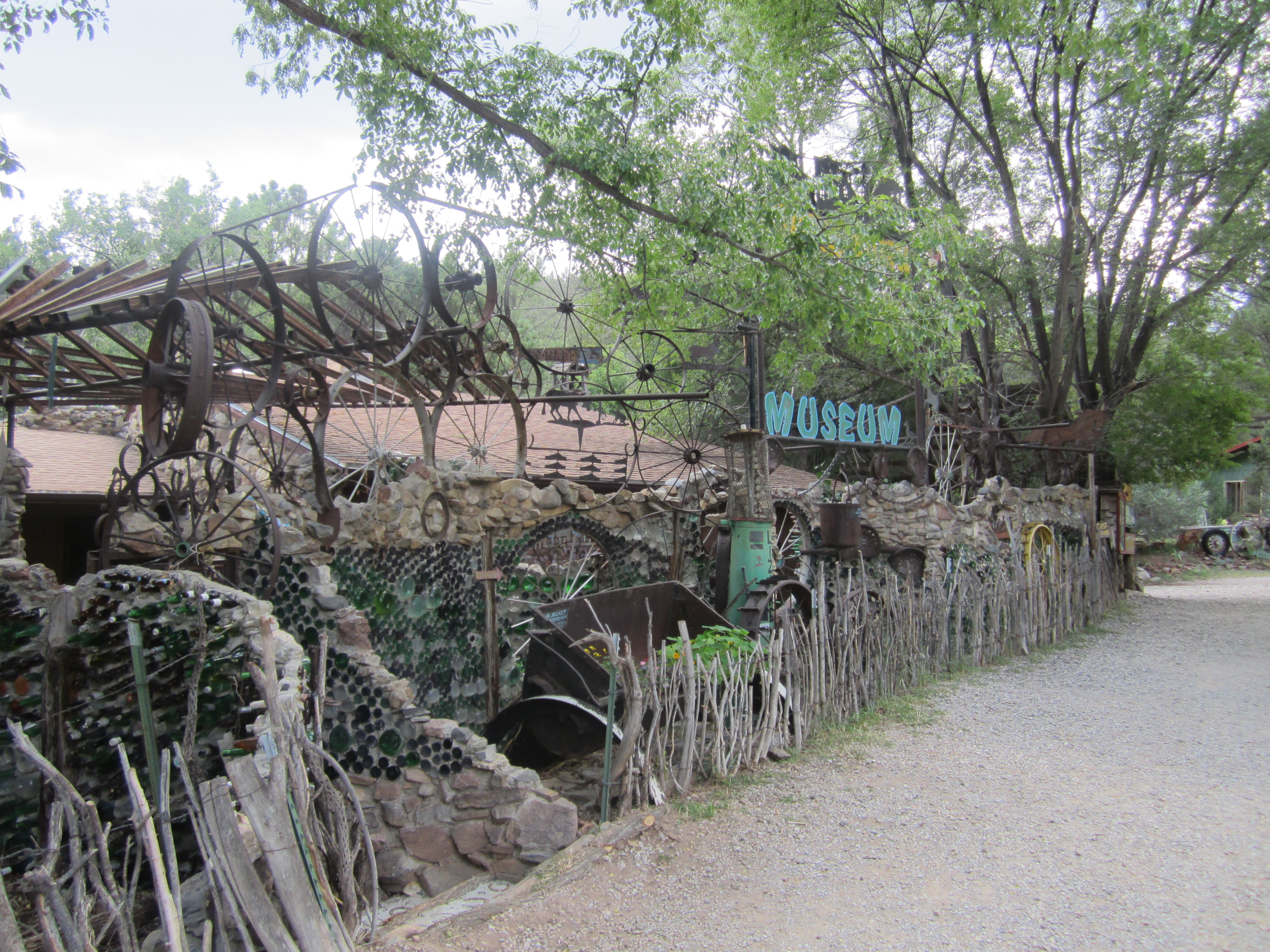
It turned out to be one of the highlights of our trip so far. I’m not sure how to even describe this place adequately. Behind the strange facade at the entrance is a maze of rooms and outdoor walkways of various shapes and sizes. These rooms and walkways are decorated with all sorts of miniature figures and buildings, old license plates, odd signs of all sorts, and wacky stuff like an animatronic band, an old-timey automated fortune-teller, and much more. Some of the miniature figures move if your press buttons. The old-timey machines all work if you drop a quarter into each one, which of course we did. Everything in the place was either made or collected as a hobby (hence the name Tinkertown) by a strange and fun-loving local folk artist named Ross Ward, who died about 15 years ago. My description of the place has just begun to scratch the surface so I’ll shut up now and just show you some photos.

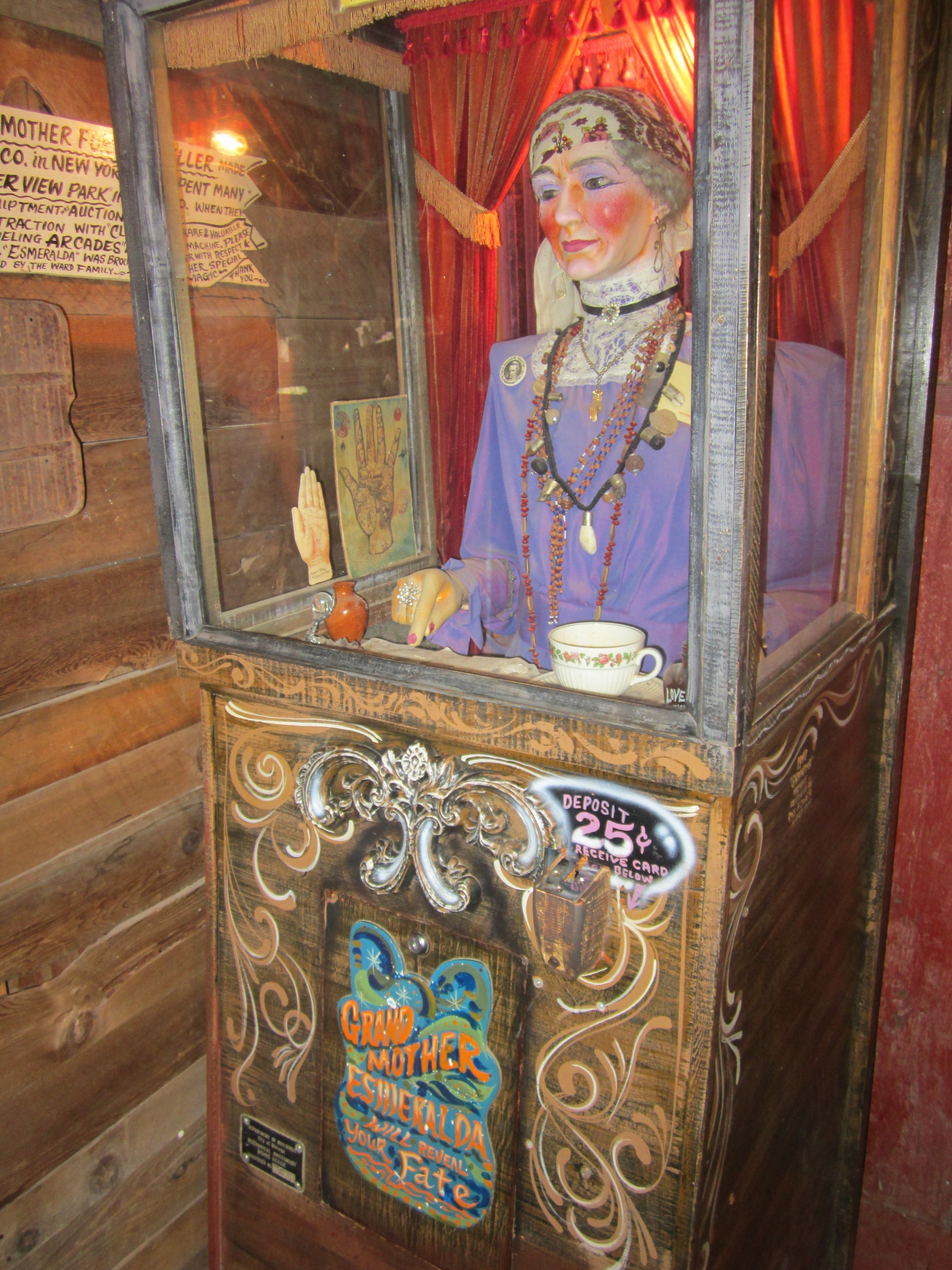

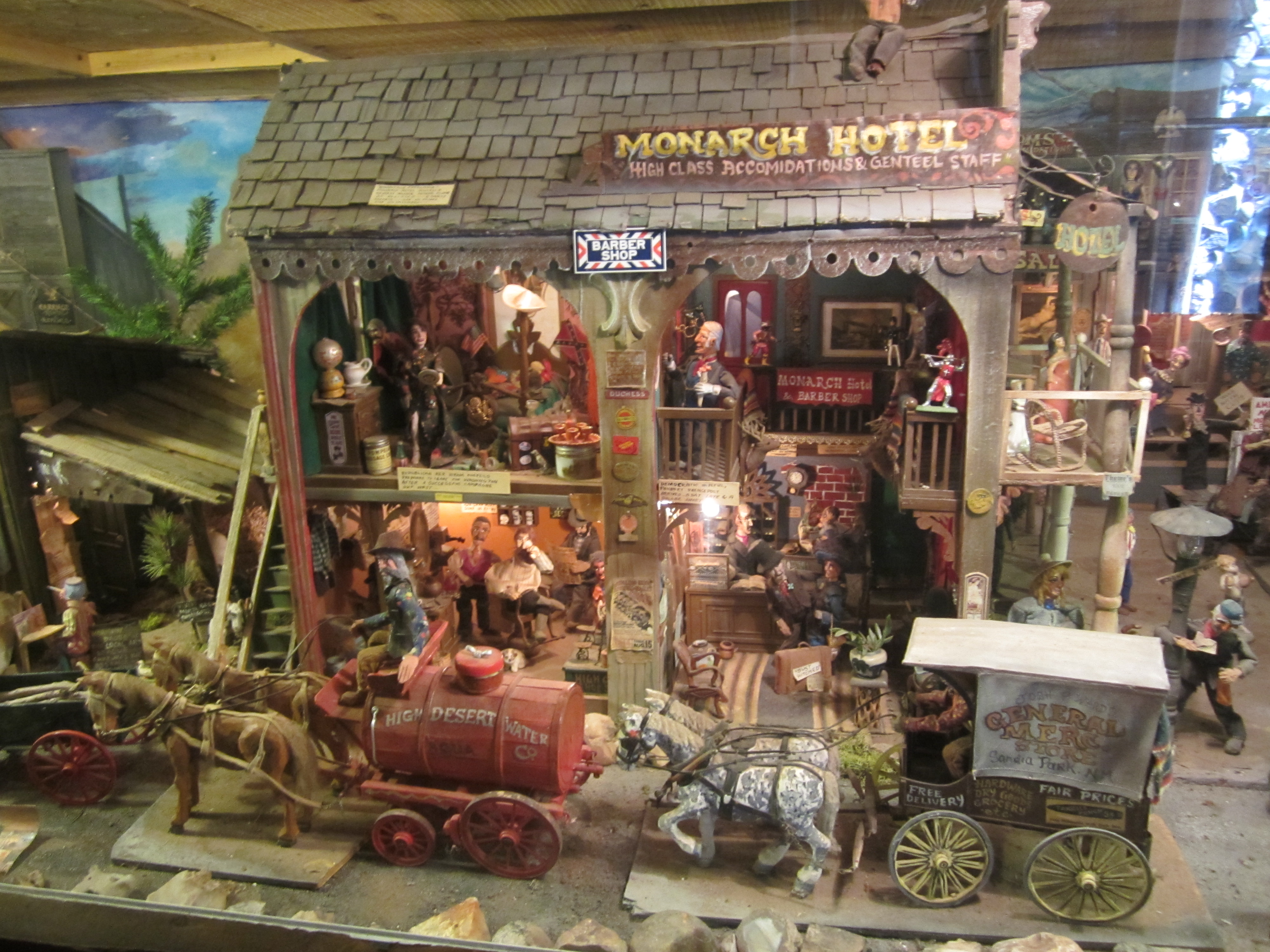


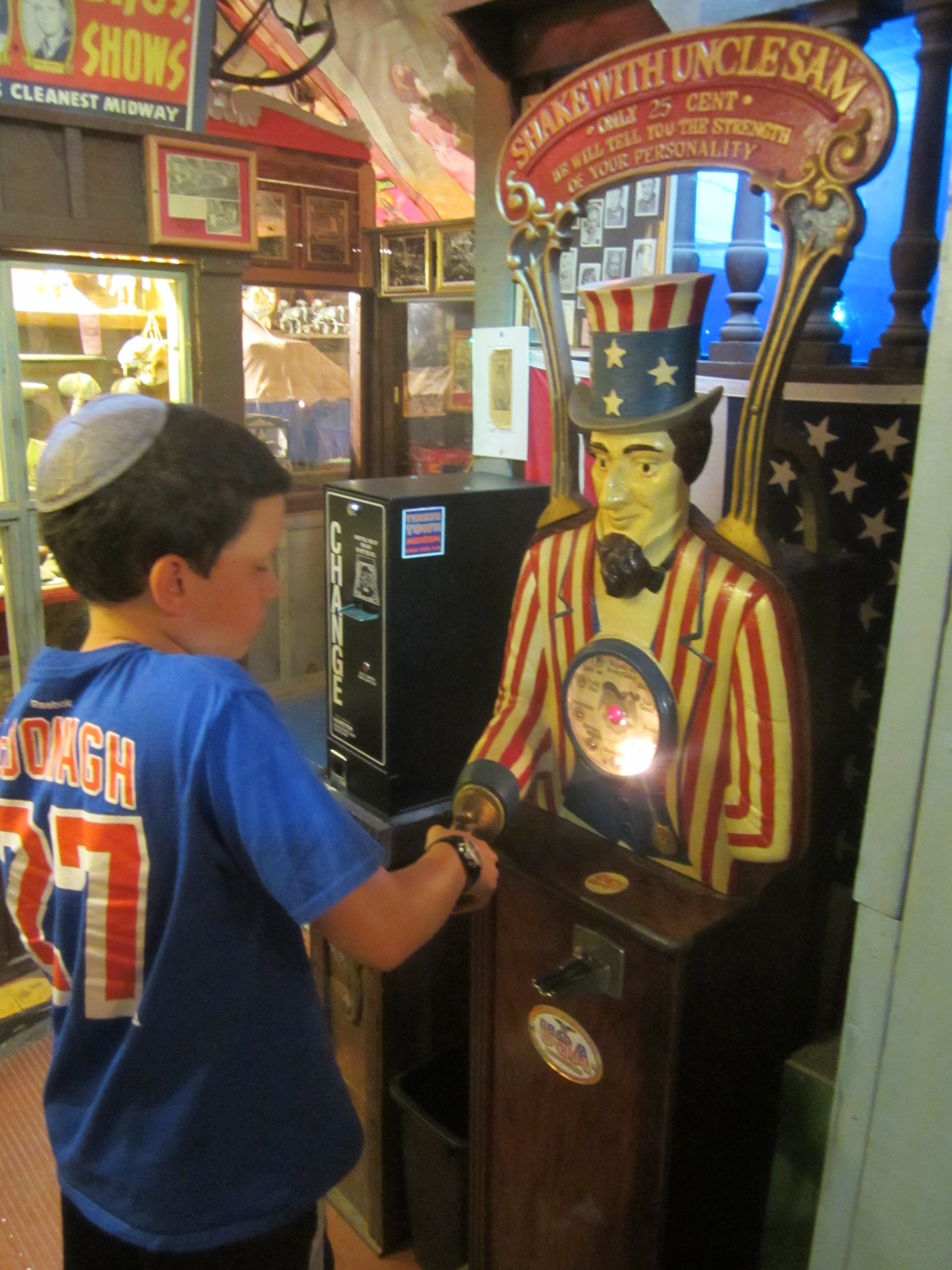
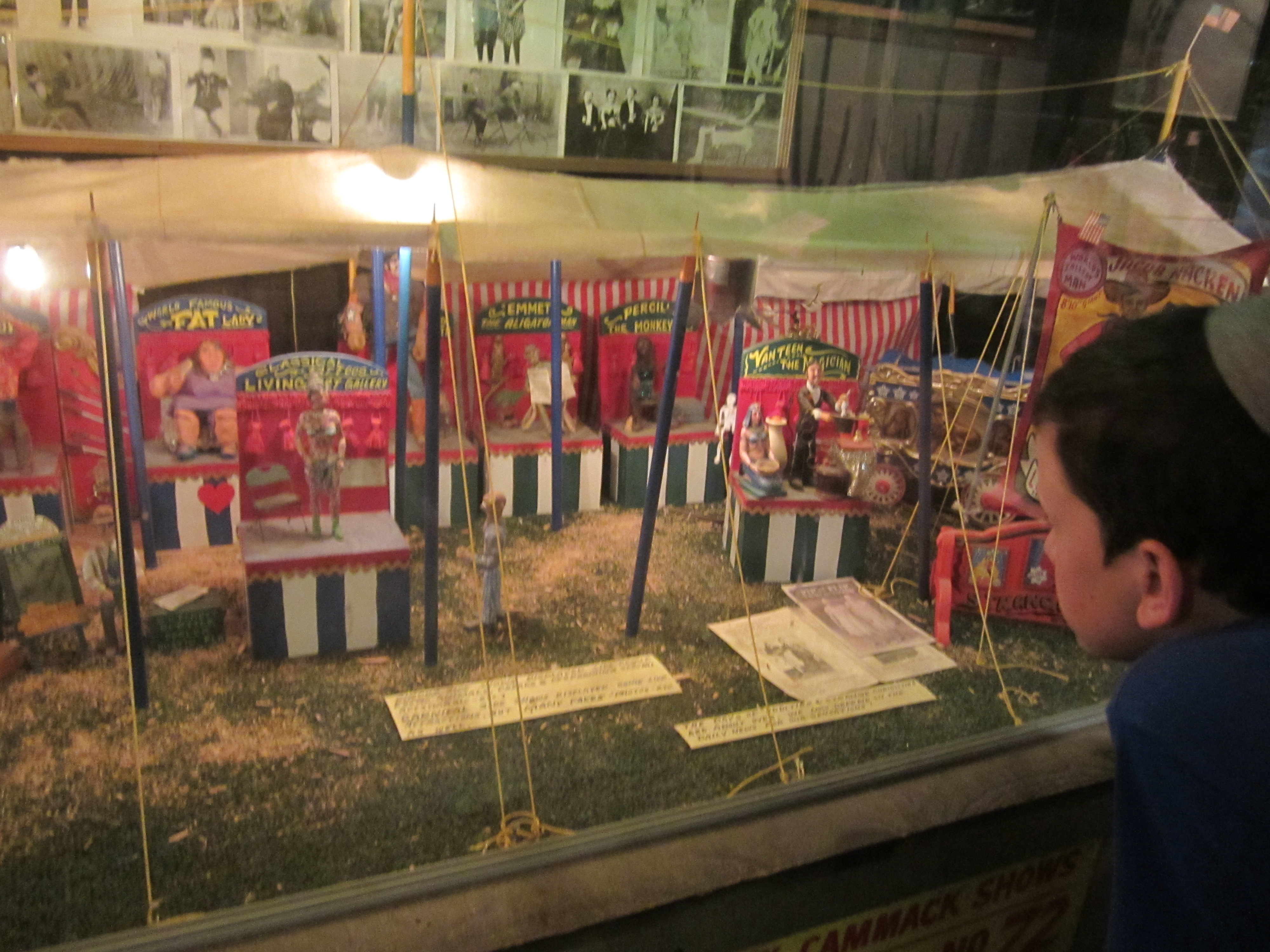
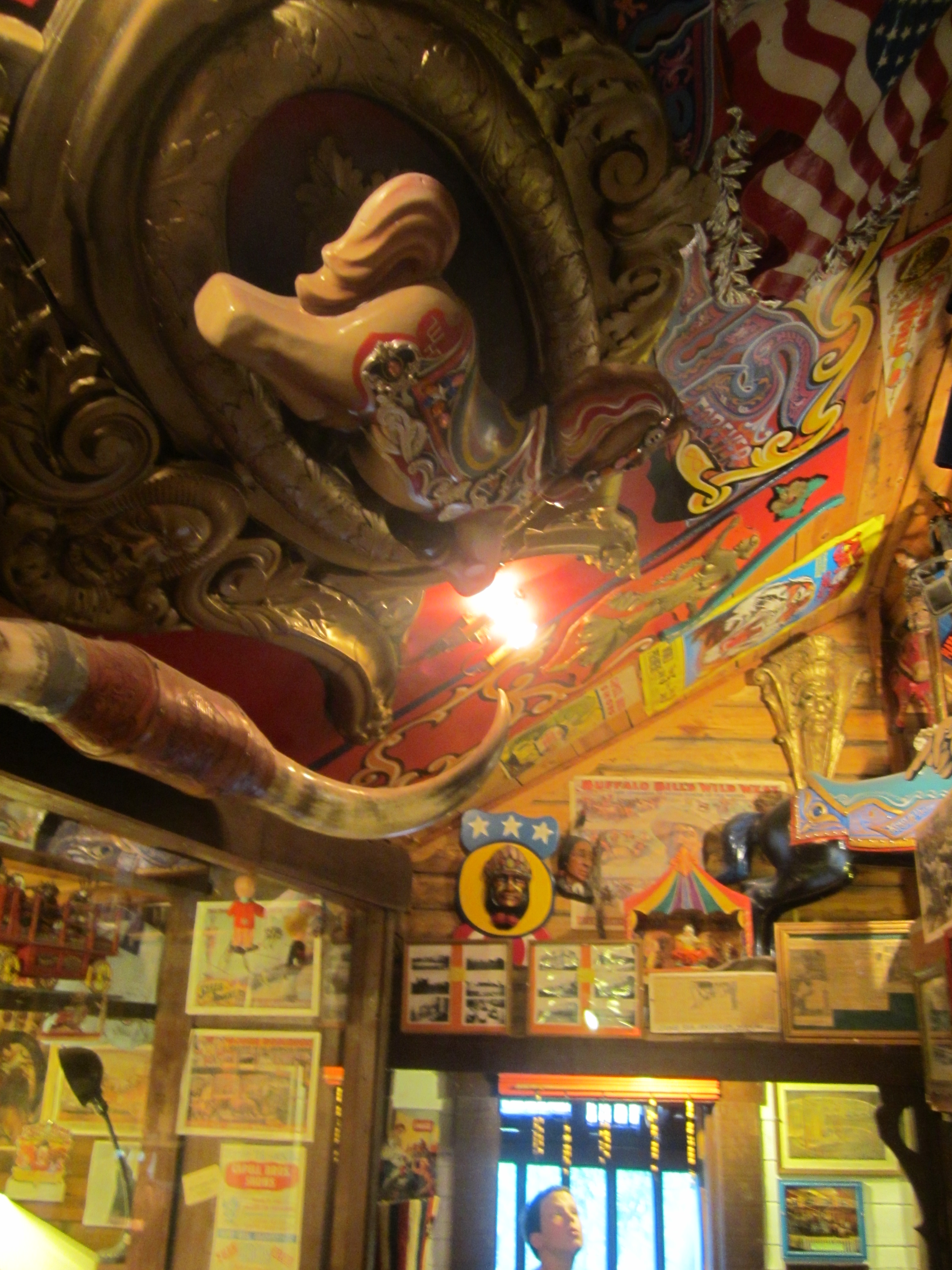
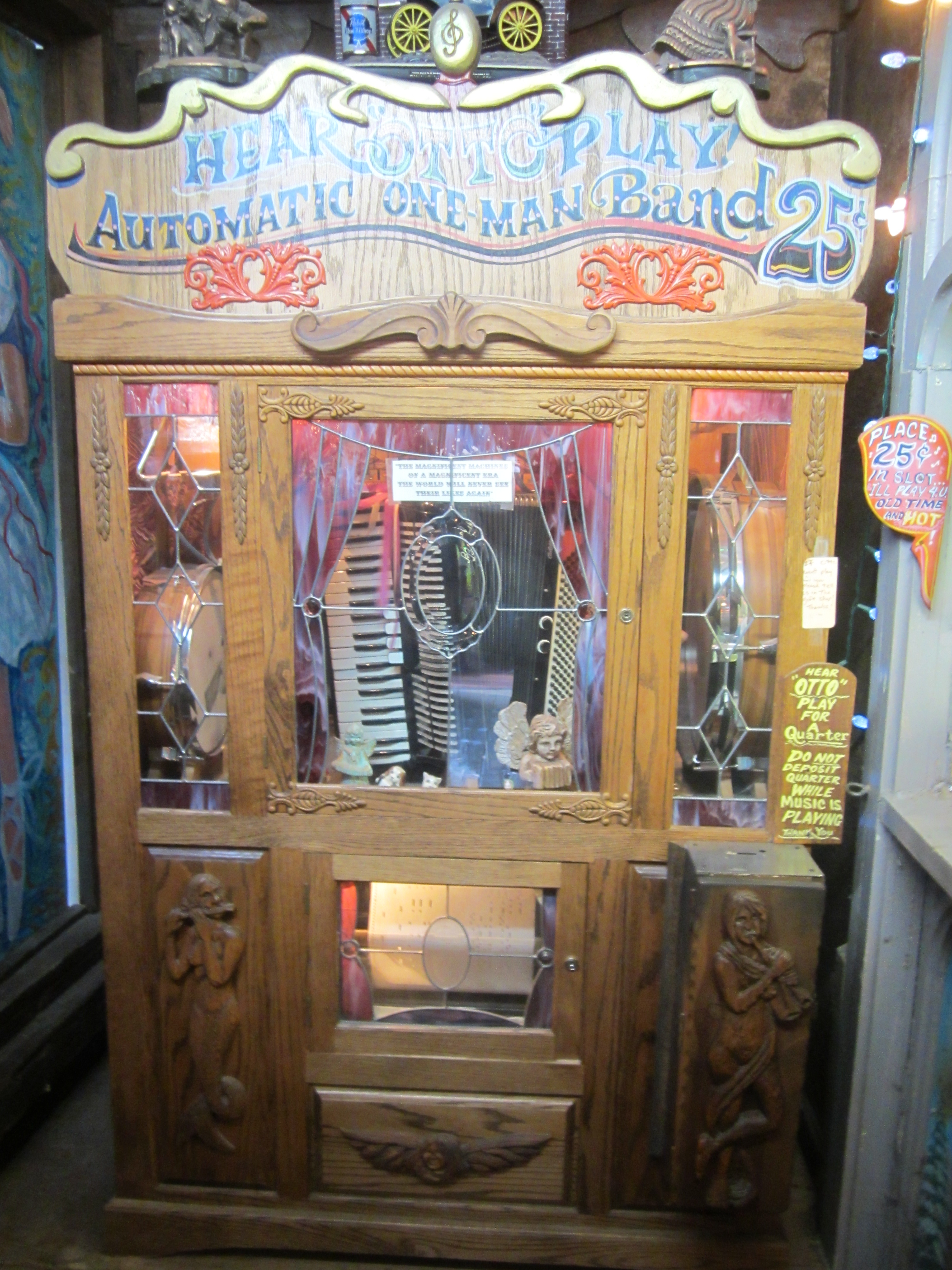
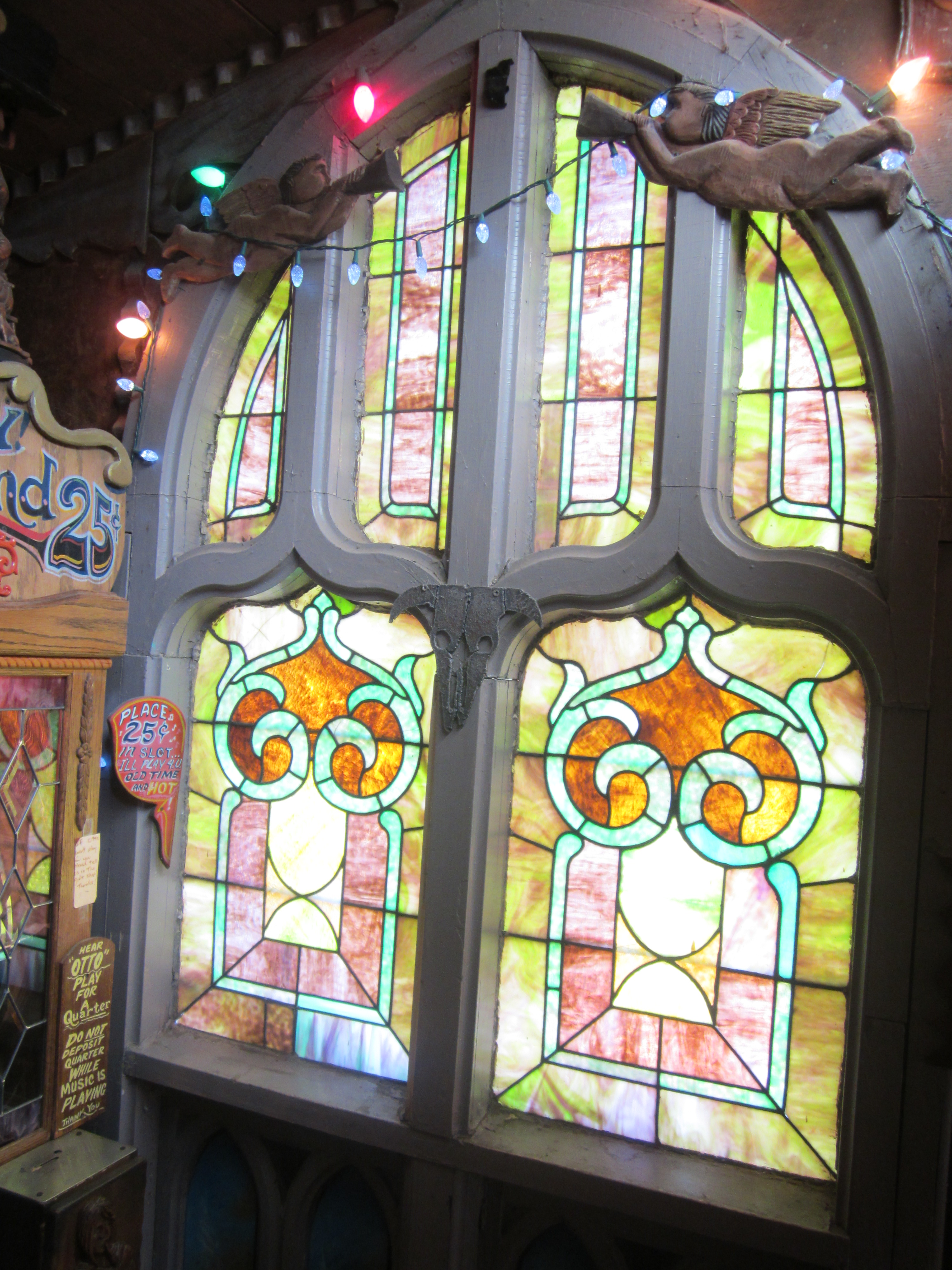
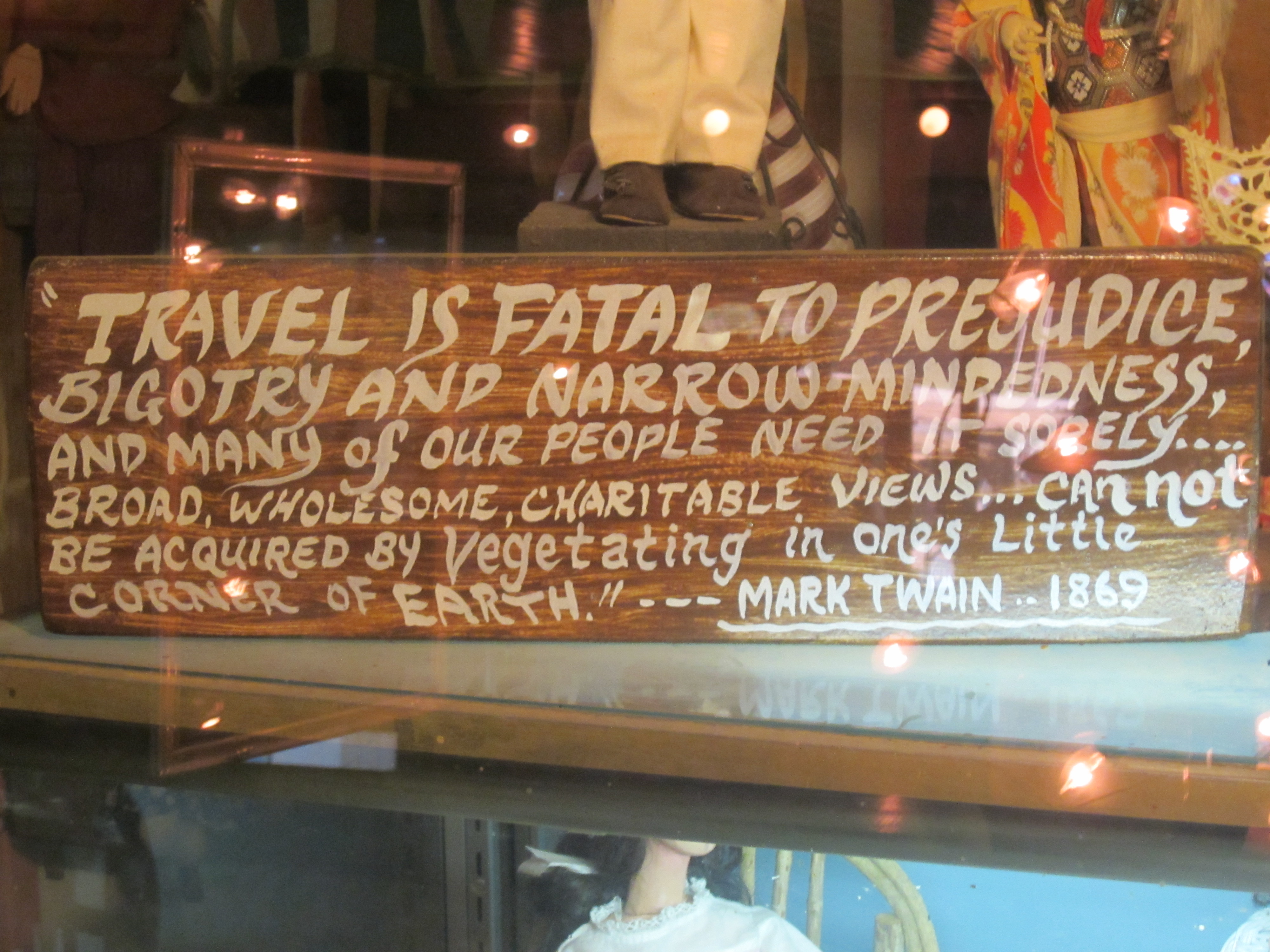
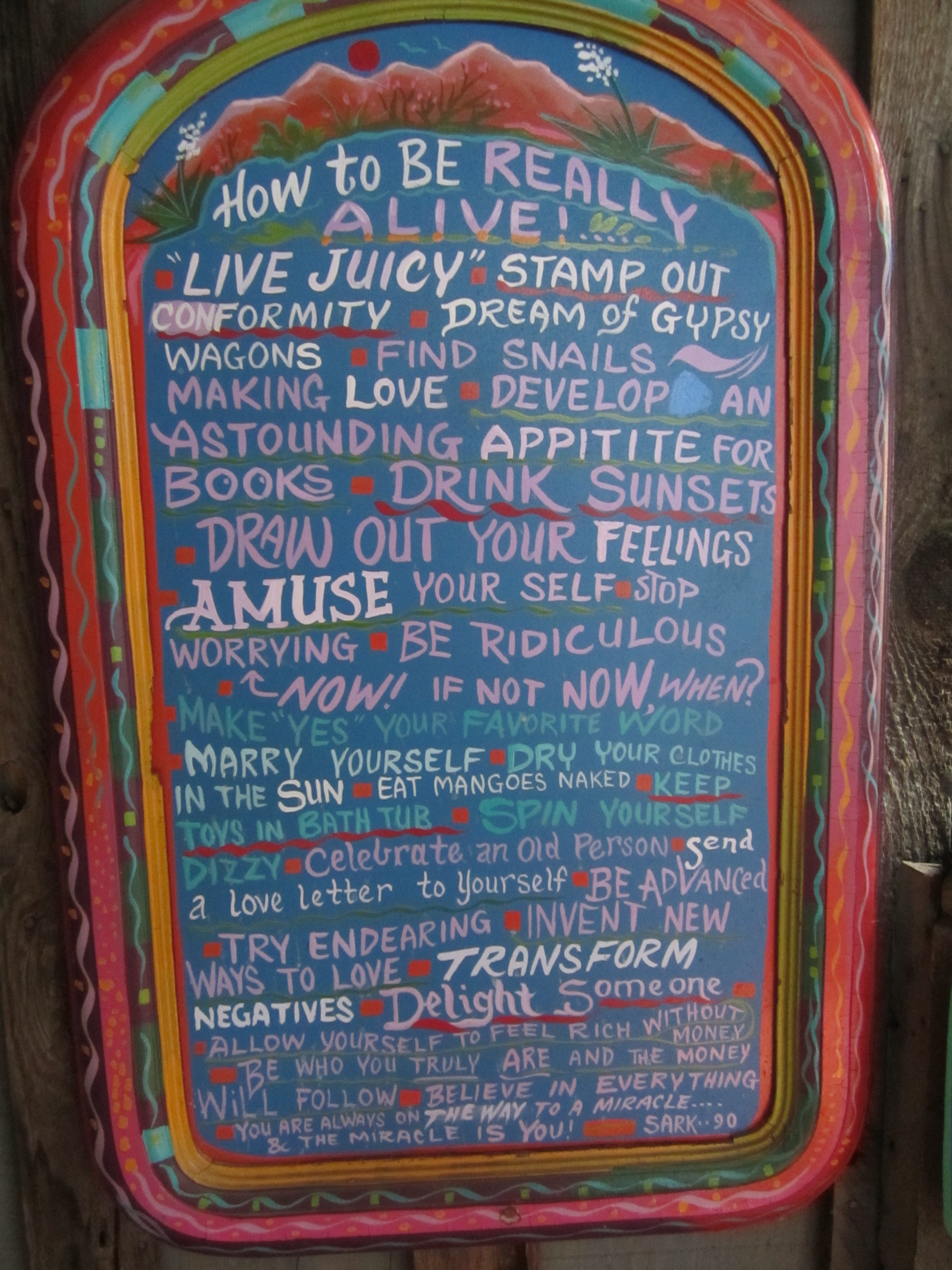
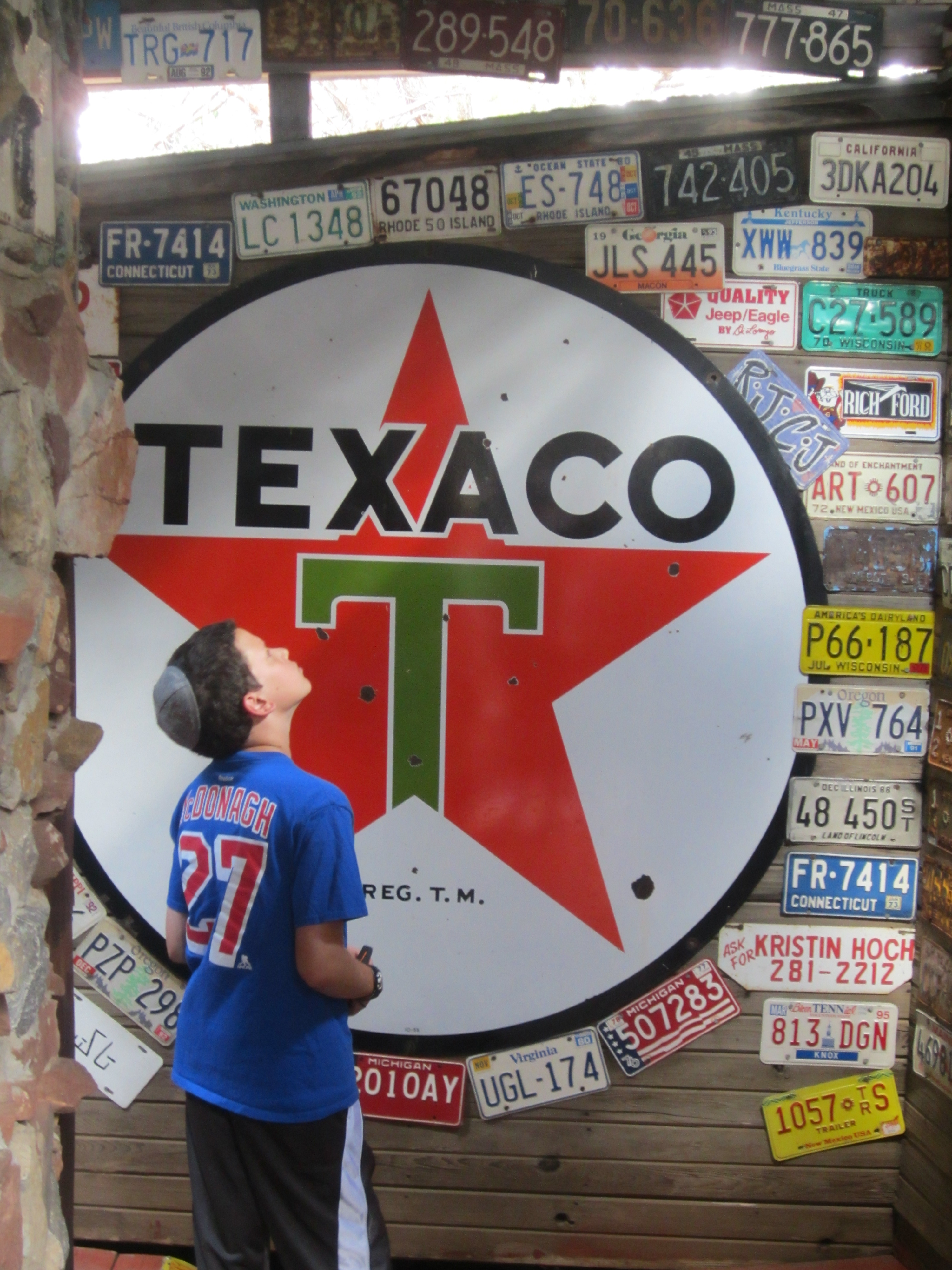

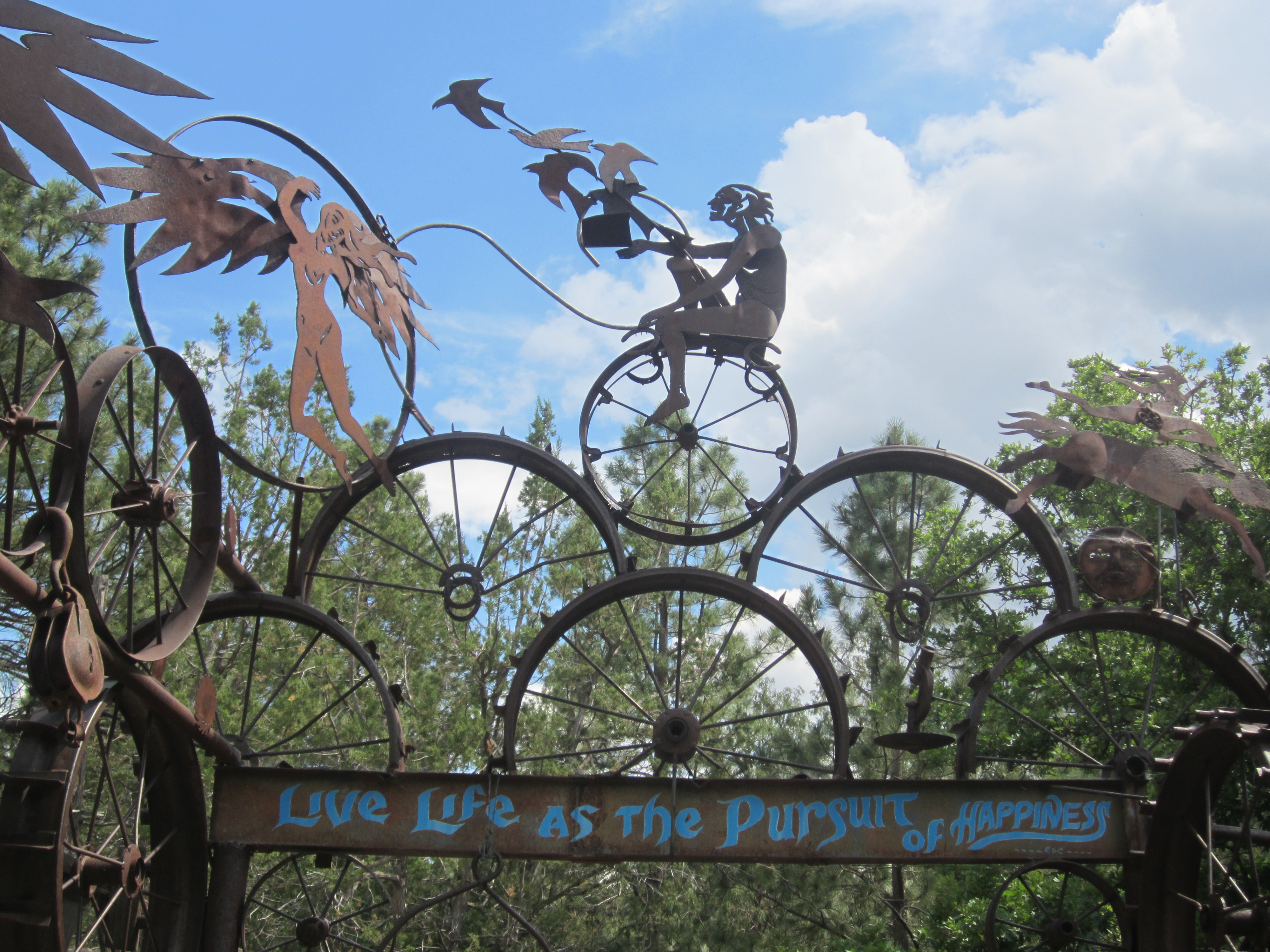
It was so weird and so inspiring and so much fun that we didn’t want to leave. And the gift shop was just as quirky as the museum: several tiny rooms, all sorts of cool, weird, and interesting items, somehow punctuating it all was a little basket of tiny plastic figurines next to the cash register with a bright pink sign that said, “NUDE BABIES 25 CENTS.” Sam and I looked in the basket. Yup, the figurines were actually tiny naked babies. I bought a dollar’s worth. I don’t even know why, or what I might possibly do with them.
Our next stop was not exactly fun but was necessary: picking up food from Sharon’s Gourmet to Go, a kosher caterer in town who made us food for Shabbos. Sharon is the last source of kosher food until we get to L.A. next Friday, so this might have been the most important stop of the day. I’m actually pretty excited about this because at my request she made us traditional New Mexican cuisine. For me, the biggest disappointment when it comes to traveling within the U.S. is the food. Yes, there are good kosher restaurants in a few cities. But so much of traveling is about sampling the local cuisine, and that’s basically impossible when you keep kosher. You may find kosher restaurants in most of the bigger cities but they tend to all serve the same pizza or cold cuts and potato kugel and schnitzel you get at home. So I can’t eat BBQ in Memphis or Kansas City or Texas, and I can’t eat sourdough bread in San Francisco, and so on. So I am overly excited to eat New Mexican food Friday night. In fact, I’m excited just to find out what New Mexican food is, because I don’t even recognize the names of some of the dishes she cooked for us.
By the time we got the food it was 4:30 p.m. and we still had two more big activities. Suddenly the day went from lazy and meandering to rushed and hyper-focused. We were going to a ballgame at 7, and before then we had to squeeze in a trip to the top of a mountain and dinner.
Albuquerque is mainly very flat but New Mexico is not, and on the edge of the city is a 10,000-foot mountain called Sandia Peak. The summit offers extraordinary views of not just the city but of almost 10% of the state, as you can see for about 75 miles in every direction. There are only two ways to get to the top of Sandia Peak: you can hike for 4-6 hours, half of which is spent climbing up narrow cliffs, or you can take the longest aerial tram in the world. We chose the latter. I forget the physical length of the tram ride but I can tell you that it takes 15 minutes each way and that your ears pop several times as you gain altitude. I can also tell you that as the tram moves hundreds of feet above rocky valleys it sways considerably in the strong gusts that occasionally come blasting through. I can also tell you that taking this ride in a tram completely packed with teenagers from Arkansas on a Christian mission includes a lot of screaming and a lot of selfies. But man, what a view we had once we got to the summit!
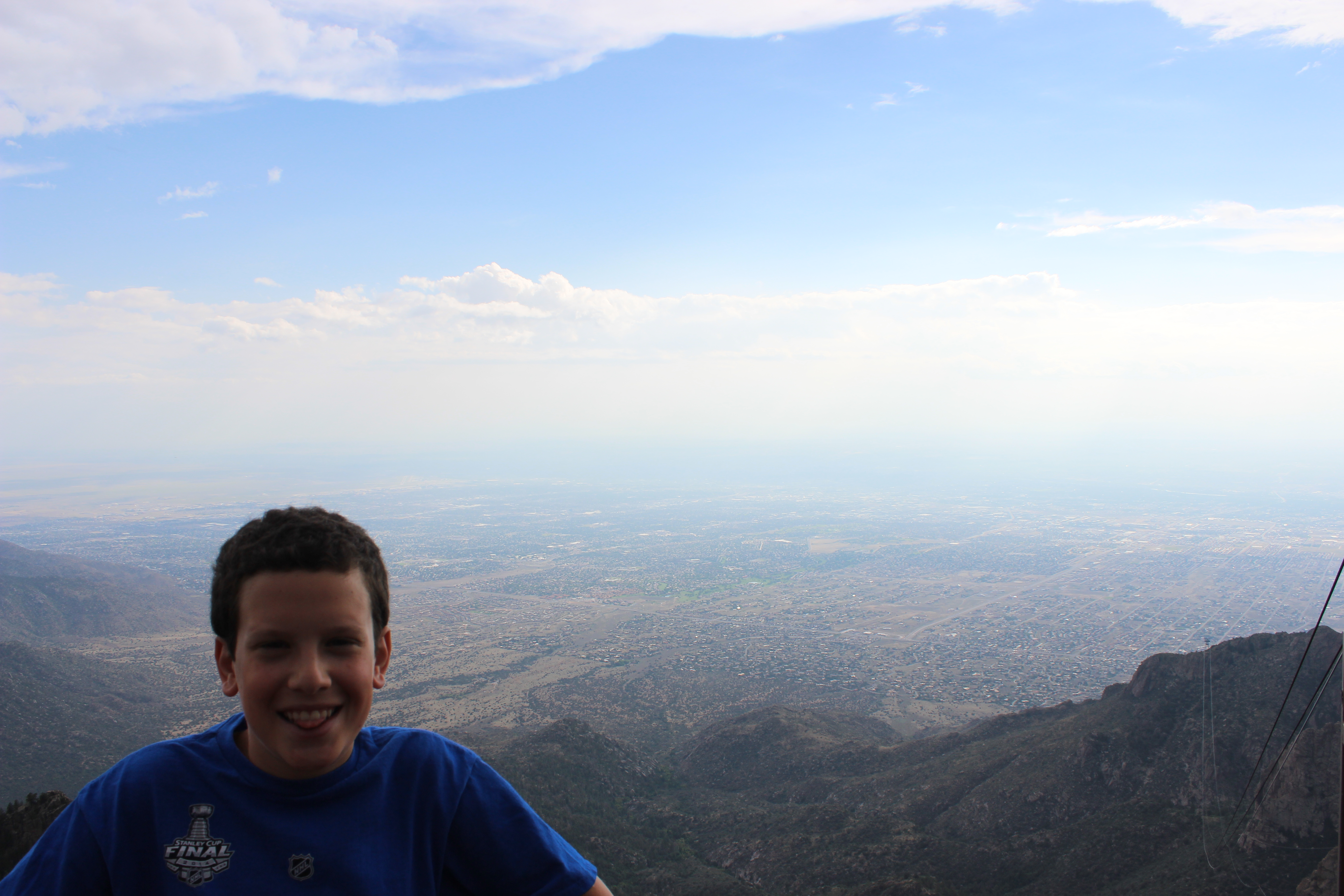

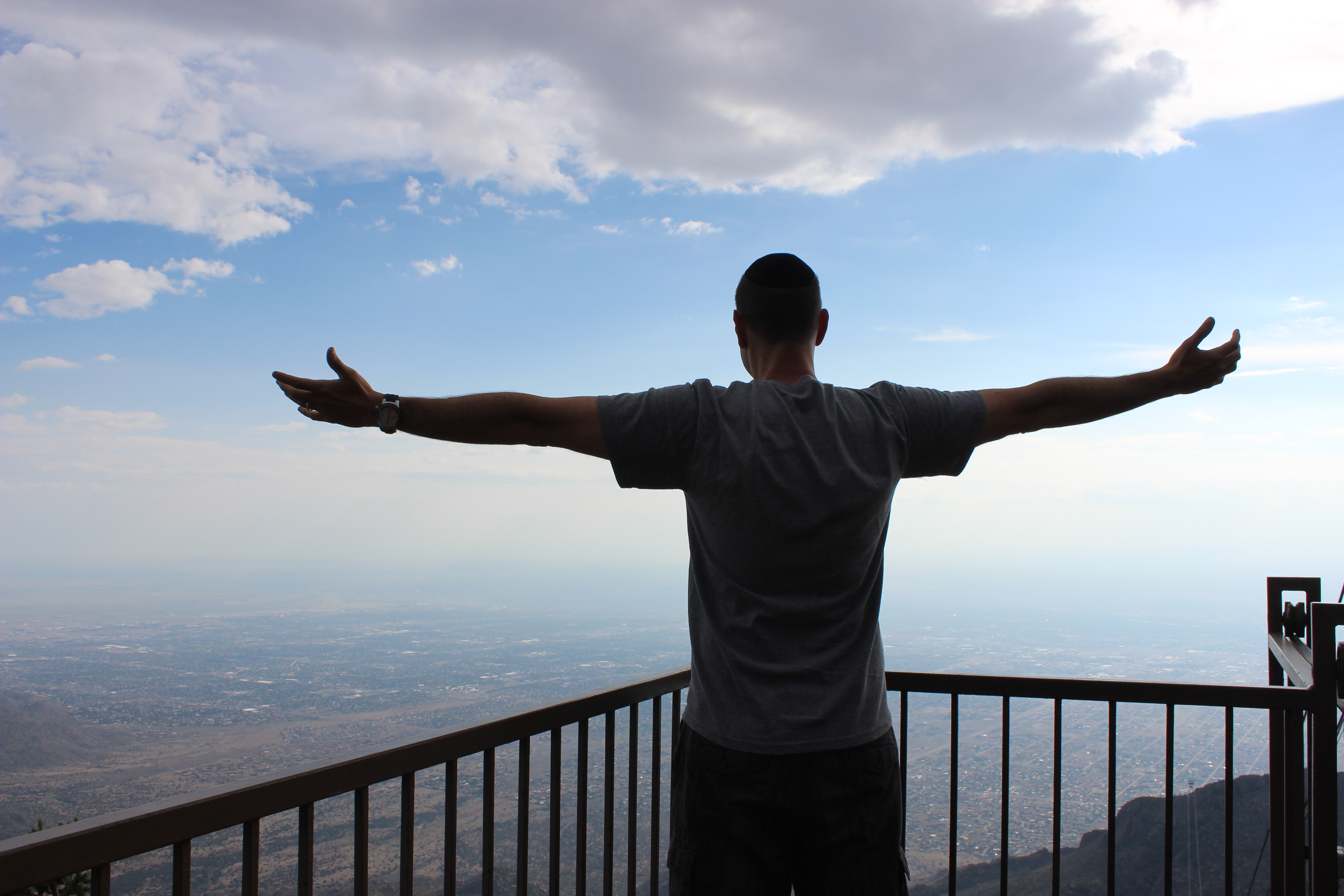
Sam and I have now been at the top of three mountains higher than 10,000 feet: Sandia in NM, Haleakala in Hawaii, and Pike’s Peak in Colorado. I have no desire to climb mountains the traditional way, but man, there is something about standing on top of the world and looking out over everything below.
By the time we got to the bottom, though, it was about 6:20 and we still needed to eat dinner before the ballgame. We didn’t really have time to grill, but in the end that didn’t matter because the fire conditions were especially dangerous today so we weren’t allowed to grill anywhere near the mountain and we didn’t really have any other place to do it. So we quickly had sandwiches in the car and still got to the game late.
The Albuquerque baseball team is the Triple-A affiliate of the Dodgers, which means they’re usually pretty good. They used to be called the Dukes, but several years ago there was an odd episode of The Simpsons in which Homer uncovered and thwarted a secret plan to move the local team, the Springfield Isotopes, to Albuquerque. In 2003 the Dukes were sold and there were various legal and financial issues with keeping the name Dukes. Needing a new name for the team, the ownership decided to embrace The Simpsons episode and renamed the team the Albuquerque Isotopes. The team’s name is half the reason I wanted to go to an Isotopes game. The shirt I wore to the game says “Springfield Isotopes” across the chest and garnered several smiles and compliments throughout the stadium, especially from team employees.
The game itself started out disastrous for two reasons. First, the ‘Topes gave up 5 runs in the second inning and appeared to be on their way to a solid spanking. Second, our seats were fantastic–second row, right next to the visitors’ dugout–but they were also right behind an entire Little League team. Sam has had a ridiculous streak of being tossed a ball by a player or coach at every minor league game we’ve been to for the past four years. The Little Leaguers were probably 8, maybe 9, so they had a major advantage over Sam in location, in numbers, and in cuteness. They were also supremely annoying, constantly standing up and frequently screaming for players to toss them a ball in the middle of a play. They did eventually get a ball tossed their way, and a T-shirt, and Sam was getting increasingly frustrated. He was resourceful, asking the security guard for a ball, looking up the visiting players on his phone so he could call them by name instead of by number, and even leaning over the railing to the clubhouse tunnel and asking the players who were ducking out for bathroom breaks. Nothing worked. One visiting player, Fresno leftfielder Darren Ford, promised to get Sam a ball and then immediately sat in the dugout and forgot all about it. Sam got his attention a couple of other times but got no ball. Nothing worked.
Meanwhile the game turned out great. The weather was fantastic. Both teams featured former major leaguers we knew: Chone Figgins and Mike Baxter on the Isotopes and Dan Uggla on the visiting Fresno Grizzlies. The ballpark was friendly and comfortable and even had life-sized statues of Simpsons characters scattered around the main concourse.
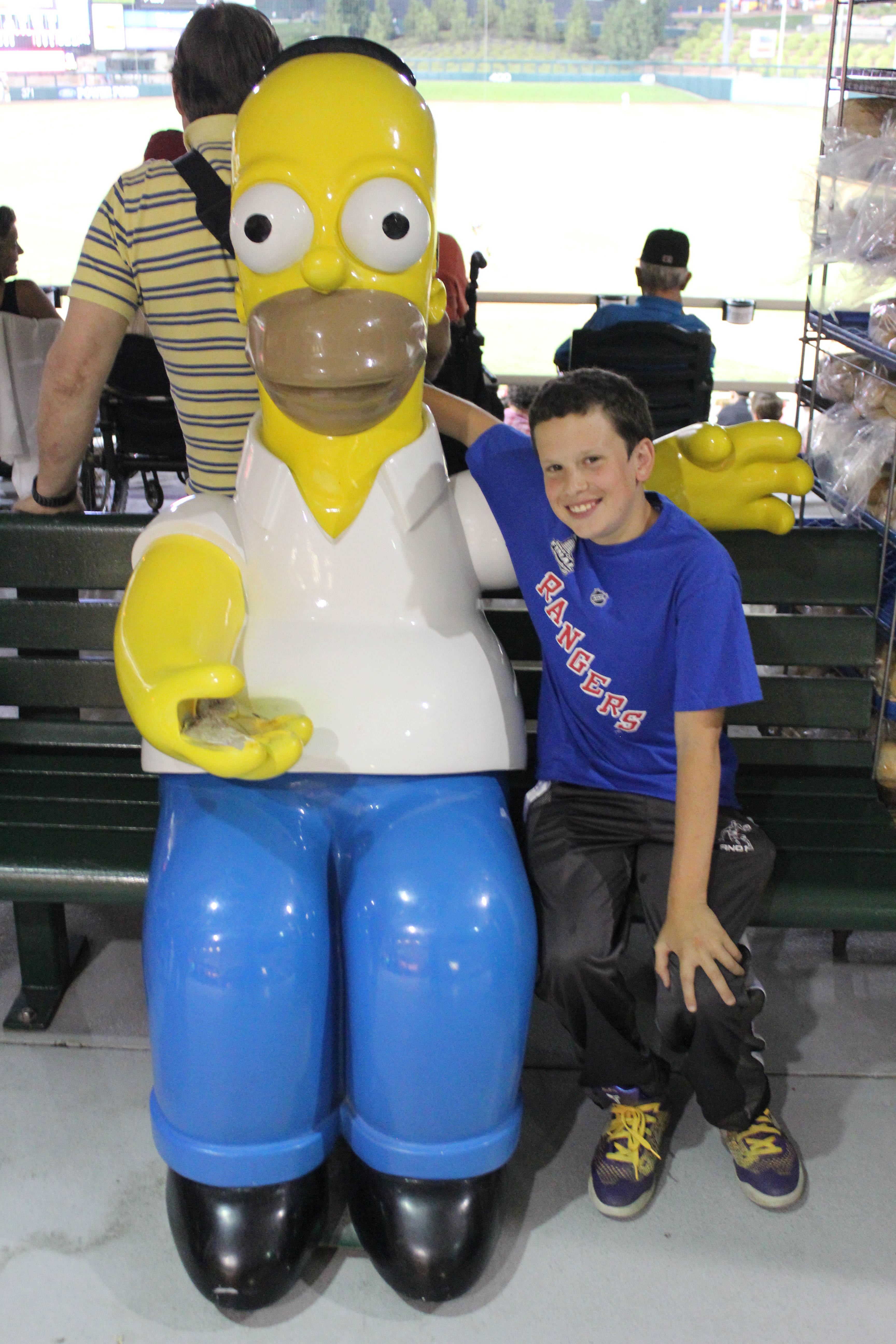
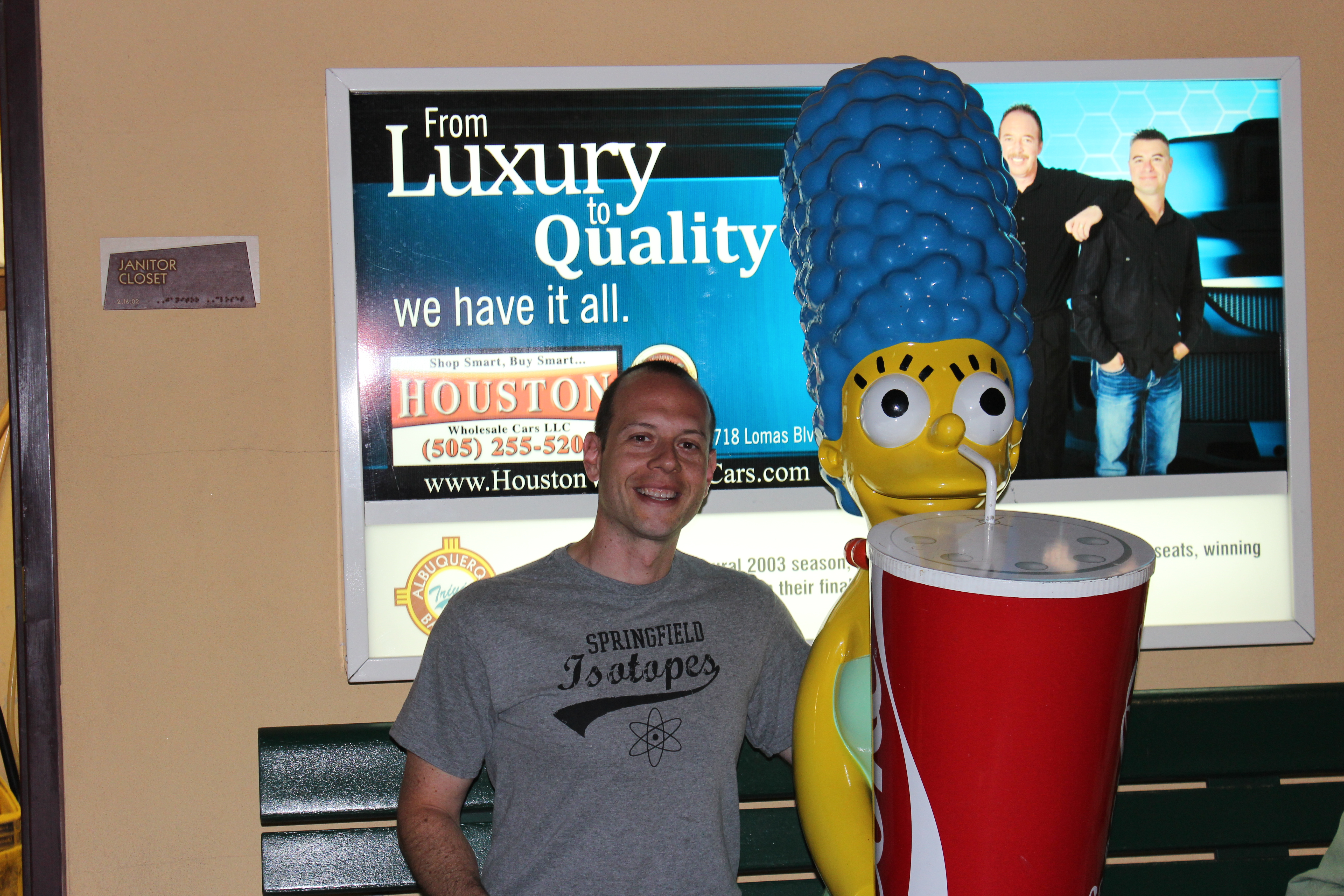
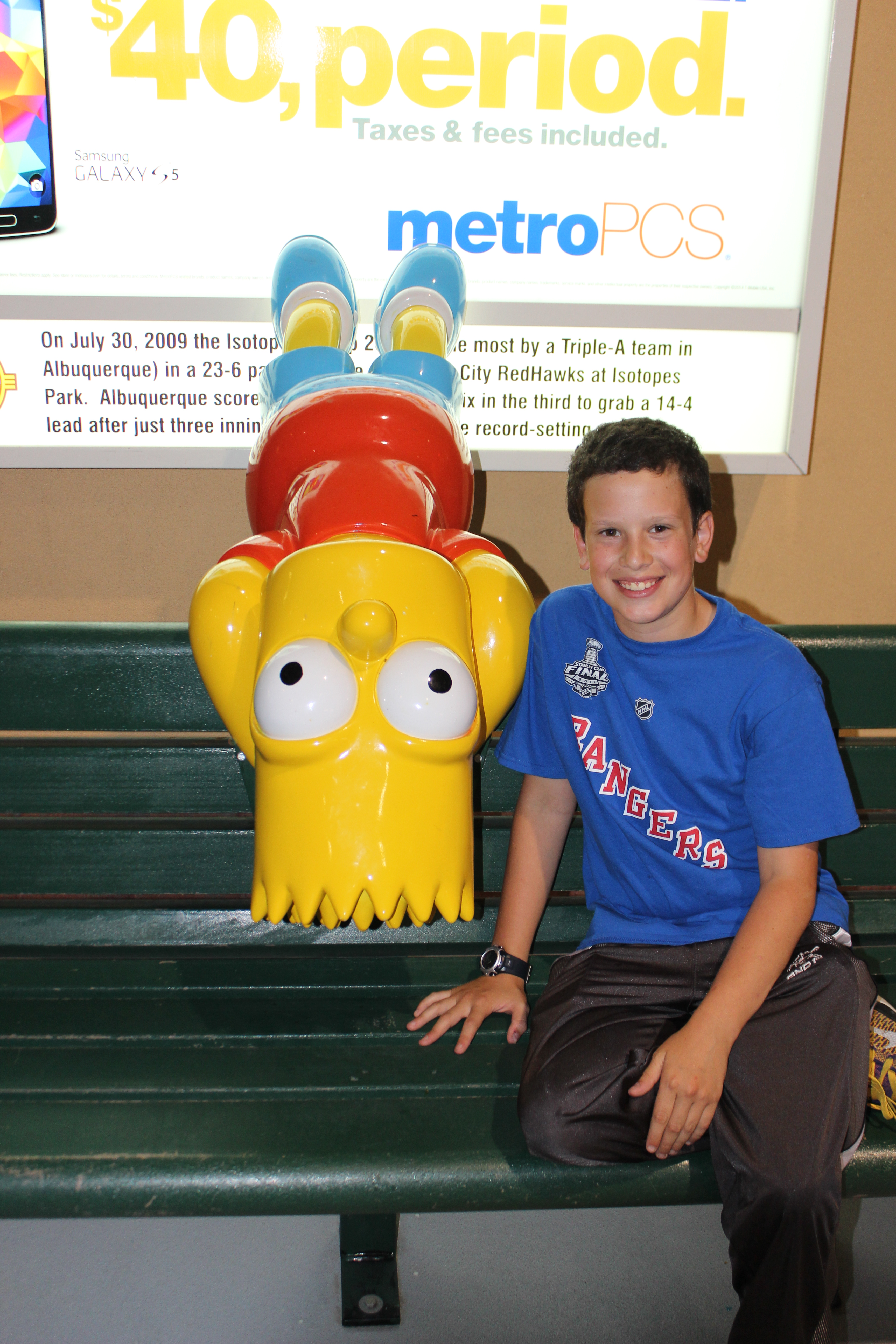
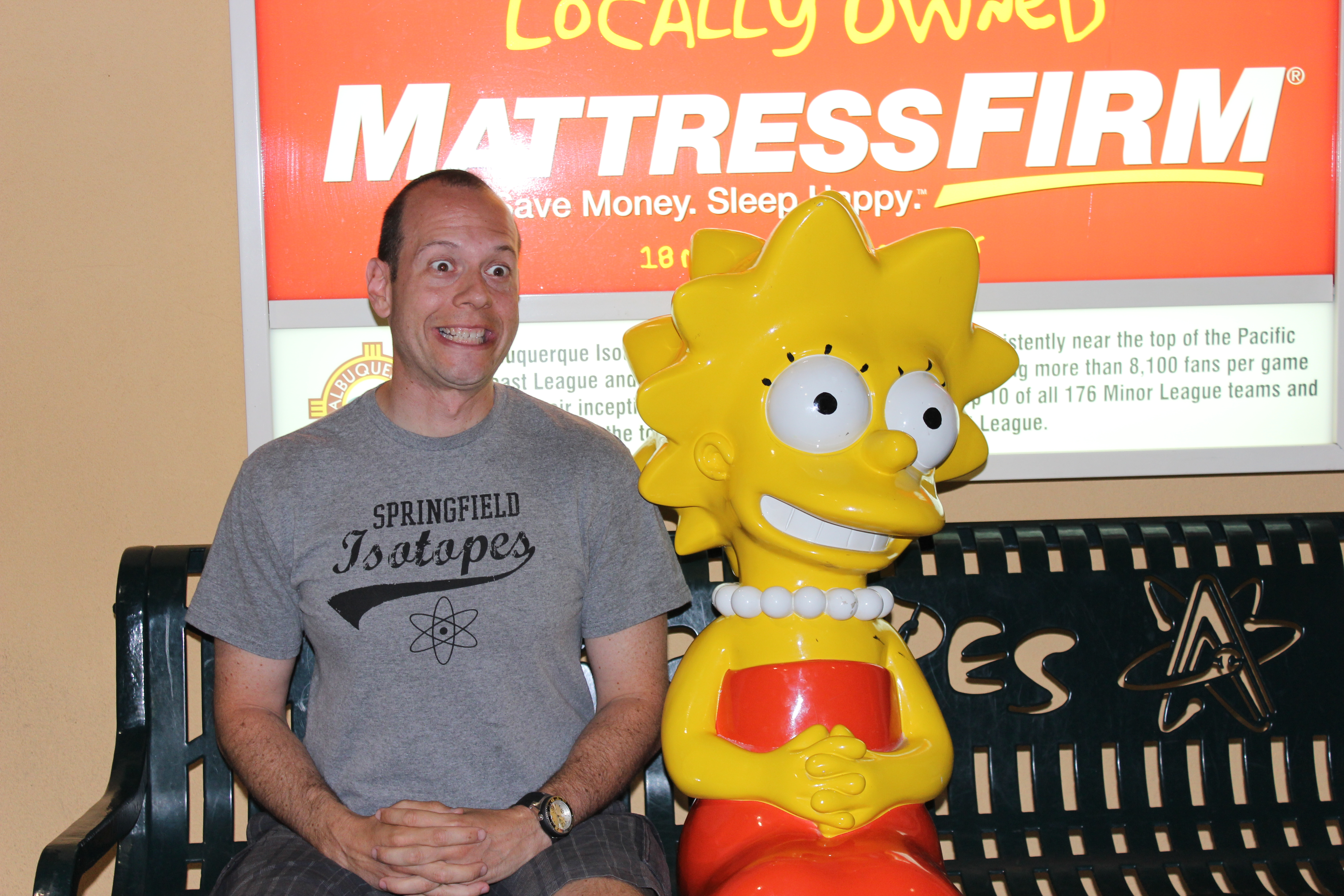
And did I mention the strange assortment of taco-related foods that raced around the bases?
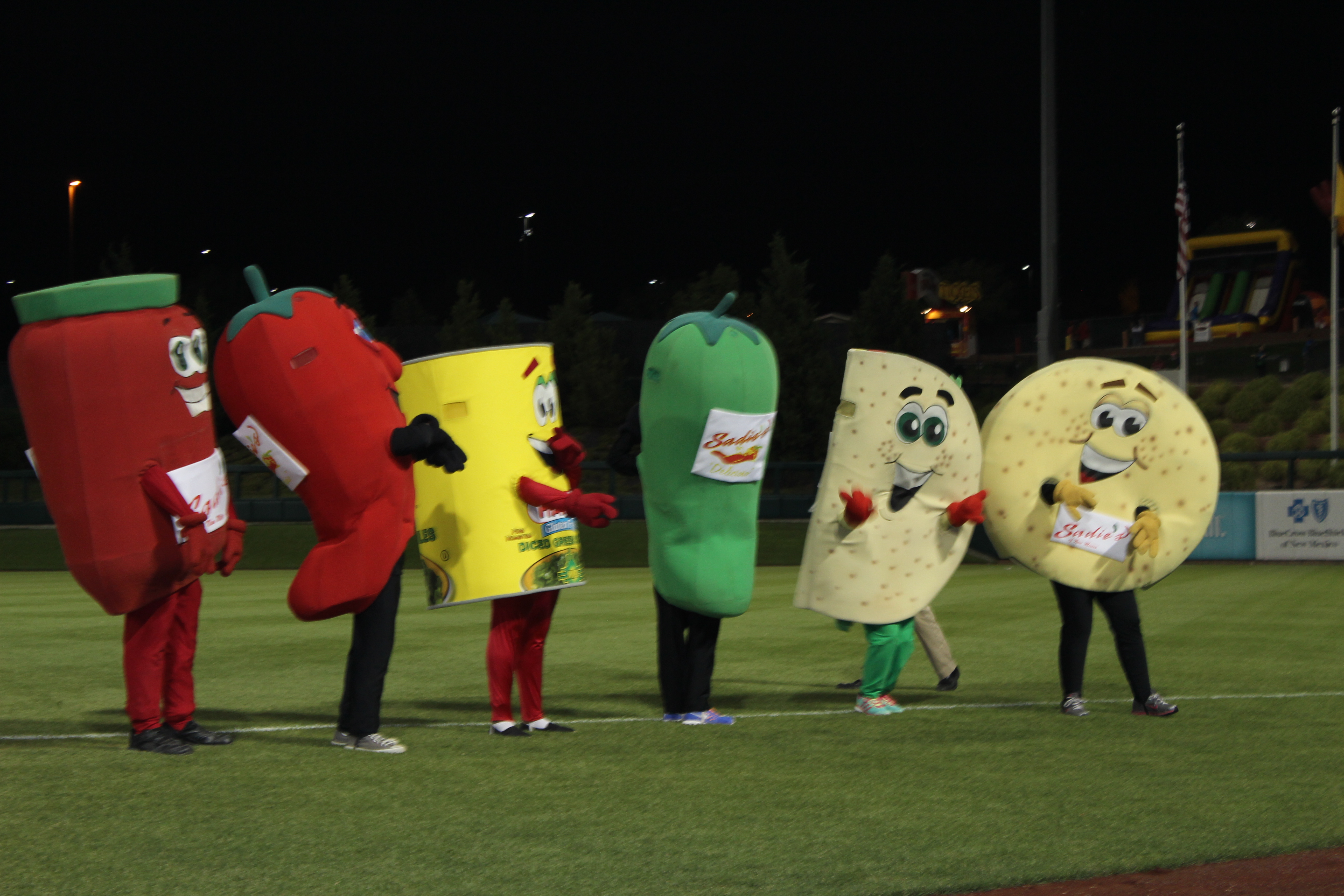
And the ‘Topes staged a comeback and ended up winning the game 8-7. But Sam still wanted that ball. Lucky for us, those Little Leaguers left shortly before the 7th-inning stretch, and Sam was now the only young kid in our section. The bottom of the eighth inning ended with a flyout to centerfield, and Sam hoped to get the centerfielder’s attention as he trotted back to the dugout with the ball. He didn’t need to–another player (number 25) walked right out in front of Sam, called for the ball, and then tossed it right to Sam. It took almost the entire game, but he finally got his ball.

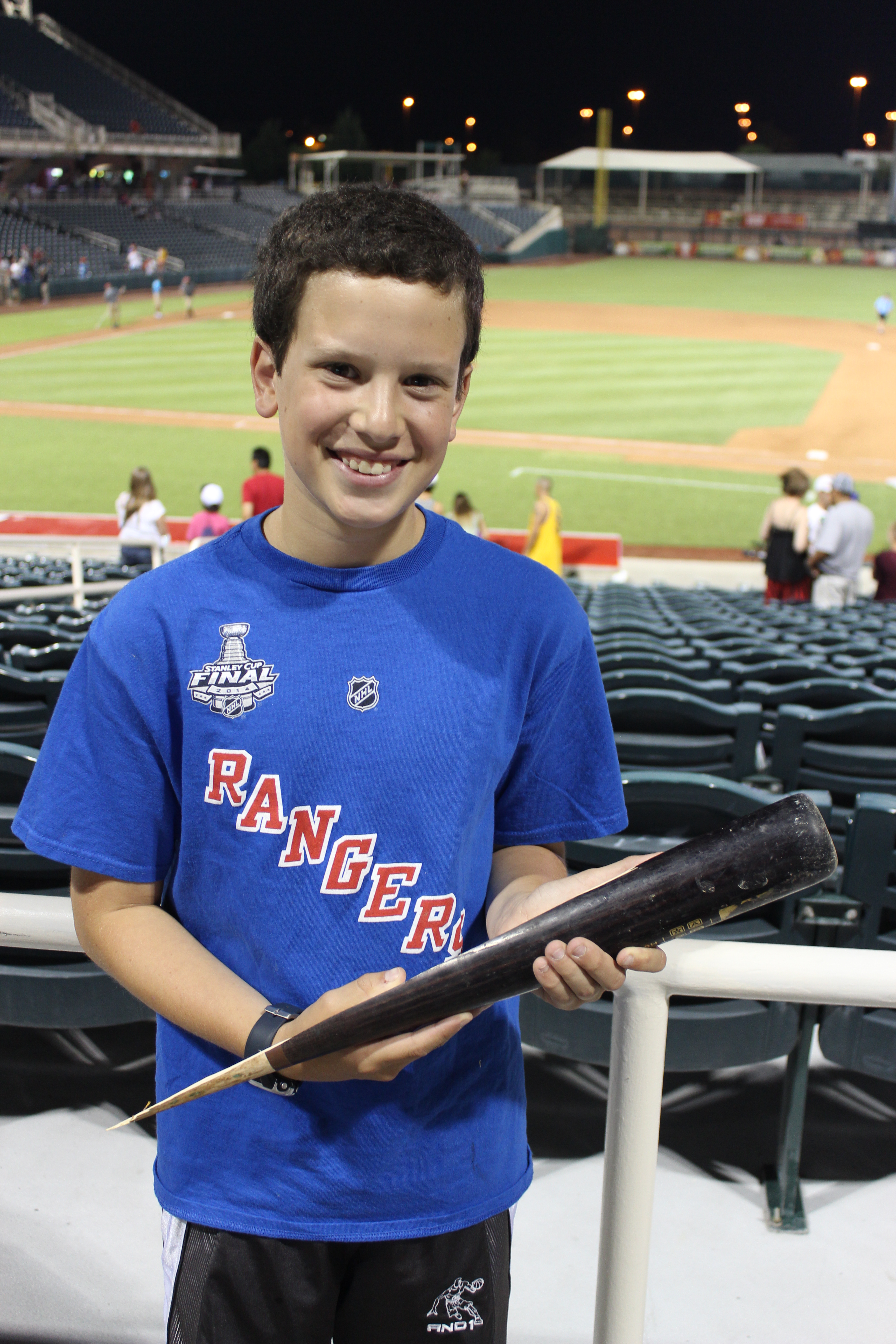
And then things got even better. As the Albuquerque closer recorded the last out, Sam ran to the other end of the Fresno dugout and started asking any player who would listen to give him the broken bat that lay on the dugout floor. It took a little while, but eventually he got someone’s attention–Darren Ford. by this time there were several other kids clamoring for the bat shard but Ford handed it right to Sam. He was on cloud nine.
And then it got even better. I didn’t tell Sam this until the game was almost over, but tonight was one of those games where kids are allowed to go on the field and run the bases after the game. When it was Sam’s turn he tore around the bases and confidently stomped on home. He was handed a little card saying “I ran the bases at Isotopes Park,” which he promptly got autographed by one of the Isotopes players who was lingering in the dugout. It was a fantastic end to a thoroughly quirky and thoroughly fun day.
Well, for Sam, anyway. My day wasn’t quite over; we’re staying in a Quality Inn tonight, which I chose because it has a guest laundry. I’m not getting much sleep tonight, but in the morning Sam will wake up to plenty of clean clothes.
Ozymandias
I mentioned to Sam a few days ago that the many defunct motels, restaurants, and gas stations we’ve passed along Route 66 remind me of one of my favorite poems: Percy Bysshe Shelley’s sonnet “Ozymandias”:
I met a traveller from an antique land
Who said: “Two vast and trunkless legs of stone
Stand in the desert. Near them on the sand,
Half sunk, a shattered visage lies, whose frown
And wrinkled lip and sneer of cold command
Tell that its sculptor well those passions read
Which yet survive, stamped on these lifeless things,
The hand that mocked them and the heart that fed.
And on the pedestal these words appear:
`My name is Ozymandias, King of Kings:
Look on my works, ye mighty, and despair!’
Nothing beside remains. Round the decay
Of that colossal wreck, boundless and bare,
The lone and level sands stretch far away.”
The king in the poem, Ozymandias, is so hubristic that he has a massive statue of himself made with perhaps the most boastful inscription possible: “Look on my works, ye mighty, and despair!” But by the time the traveler in the poem comes upon the statue it’s in ruins, reduced to just a pair of legs and a broken face; the works he wants us to look at are all gone, turned to sand as if they never existed at all. Shelley makes a powerful statement about the fleeting nature of success and power and material wealth.
The Hamster and I have driven 2,500 miles since we left home last week, and I can’t tell you how many enormous neon signs we’ve seen literally pointing the way to motels and restaurants that are either run down, permanently shuttered, or completely nonexistent. Those big neon signs, I was telling Sam, are like the inscription at the base of the statue, calling on everyone to look at something that’s no longer there.
In Oklahoma, however, the scene has been very different. We left Oklahoma City this morning and continued west on Route 66, only this time as we passed through towns we saw life. We saw motel signs that pointed to actual, functioning motels. We saw billboards for restaurants that were open when we passed them. And we saw all sorts of quirky celebrations of the Mother Road and of the communities is passes through.
Today we stopped off in Clinton, OK, to shop at an Indian trading post. (Well, browse more than shop–it turned out to be a ripoff and we didn’t buy anything.) We bought gas from busy gas stations. We passed through towns with vibrant and charming Main Streets. We stopped in Elk City to visit the National Route 66 Museum, which was fun and creatively designed. We got pulled over by a state trooper who recommended various other stops for us to make on our way.
OK, let me back up for a second and tell you about that state trooper. We had just left Oklahoma City and I was starting to get frustrated at Route 66’s low speed limits, which kept dipping down to 45 and even 35, when I got pulled over. I was pretty sure I wasn’t speeding but I couldn’t imagine what else I had done wrong, and I started to wonder whether I had missed a speed trap or a stop sign or something. The young officer walked up and politely asked me for my license and insurance card. I complied. As he looked them over he commented on the New York license plates and asked if we were moving to Oklahoma or just on vacation. I told him we’re on vacation, driving on Route 66. He asked how far we’re going. I told him all the way to California, and mentioned that we were planning to spend some time today in Amarillo, Texas. He recommended that we have dinner at a steakhouse there that serves a 72-ounce steak, which is free if you actually finish the thing. At this point I started thinking about the “Old 96er” steak that John Candy ate in The Great Outdoors, but I quickly snapped out of it because I STILL HAD NO IDEA WHAT I HAD DONE WRONG! Finally he explained that he had pulled me over for … improper use of seat belts. As he said this I looked down at my seat belt–yup, still buckled. I looked over at Sam’s, and his was buckled, too. I looked back up at the officer quizzically. He explained that my shoulder strap was draped over my upper arm and in Oklahoma the law is that it has to be fully over the shoulder. Seriously. This is why he pulled me over–for wearing my seat belt a few inches too low. He said he’d let me off with a warning. Then he took my paperwork back to his cruiser and came back a minute later with an actual written warning with a preprinted message about highway safety and hand-filled-in info about my seat belt use. My mind was still trying to piece itself back together from being blown by the knowledge that a person wearing a seat belt can get pulled over for not properly wearing a seat belt, and then I had to find a way to psychologically grapple with the fact that there is such a thing as a preprinted warning. While layers of disbelief were causing my brain to malfunction the officer pointed out that in the place on the warning where he writes where he stopped me, he made sure to write “Route 66” so that I can keep it as a souvenir. Then he told us about how he and some of the other deputies went to that steak place in Amarillo and the biggest guy in their group was unable to finish the steak, but that there was a picture on the wall of a 90-pound older woman who had finished it. Then he told us that there’s a historic fort just off Route 66 in El Reno, which was the next town over. And he wished us a good trip and sent us on our way.
It’s a good thing Sam was with me because parts of me still don’t believe that any of this actually happened. If you add up our four major road trips, I’ve driven somewhere around 20,000 miles, and this was the first time I’ve been pulled over. I knew it was bound to happen at some point; I just always figured it would be for something that, you know, is a real thing.
Well, with that out of the way, we broke up our very long drive to Amarillo* a couple of hours later by stopping off at the Route 66 museum.
* I swear I kept my seat belt properly over my shoulder the whole time. I do find it more comfortable to wear it on my lower shoulder/upper arm, but you know what they say: when in Oklahom, do as the Oklahomans do.
The museum was much more impressive and interesting than the one we saw in Illinois. This one takes up a whole city block and is made up of several little buildings, mostly connected to each other, that are made up to look like a typical small town that people might have passed through on Route 66 back in its heyday.
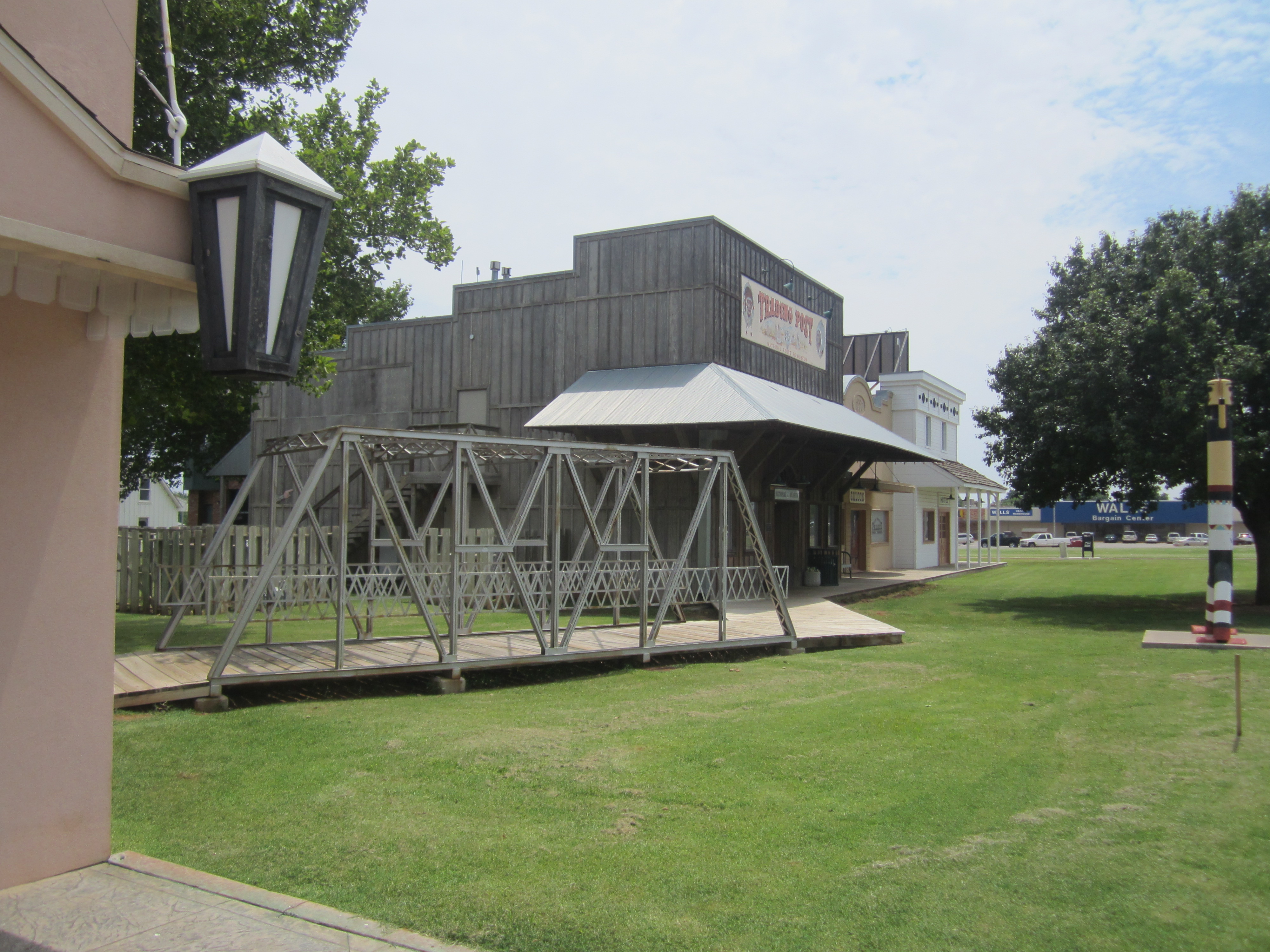
Inside the museum is loaded with classic cars and motorcycles from the 20s through the 70s, and even an old truck made up to look like what the Joads might have driven in The Grapes of Wrath.
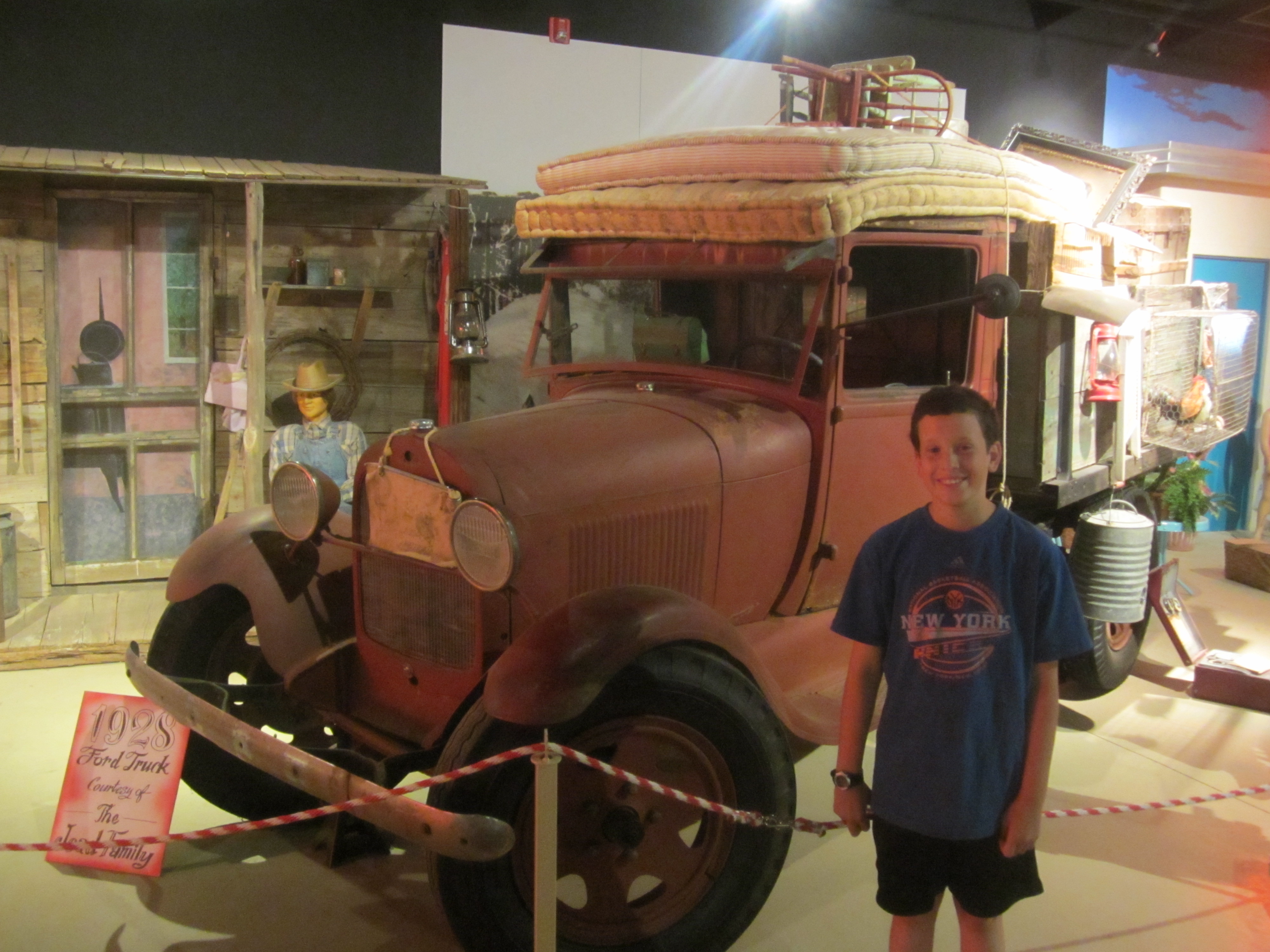
On our way out a guy asked me to take a picture of him and his son outside the museum. The dad noticed Sam’s Knicks shirt–it turns out they live in Syracuse and are rooting as hard as we are for Carmelo Anthony to succeed.
Anyway, we eventually crossed the border into Texas, where we were greeted by the nicest rest stop I’ve ever seen. That’s saying a lot, considering how many rest stops I’ve been to in how many states. But this one was special. For starters, there was the view:
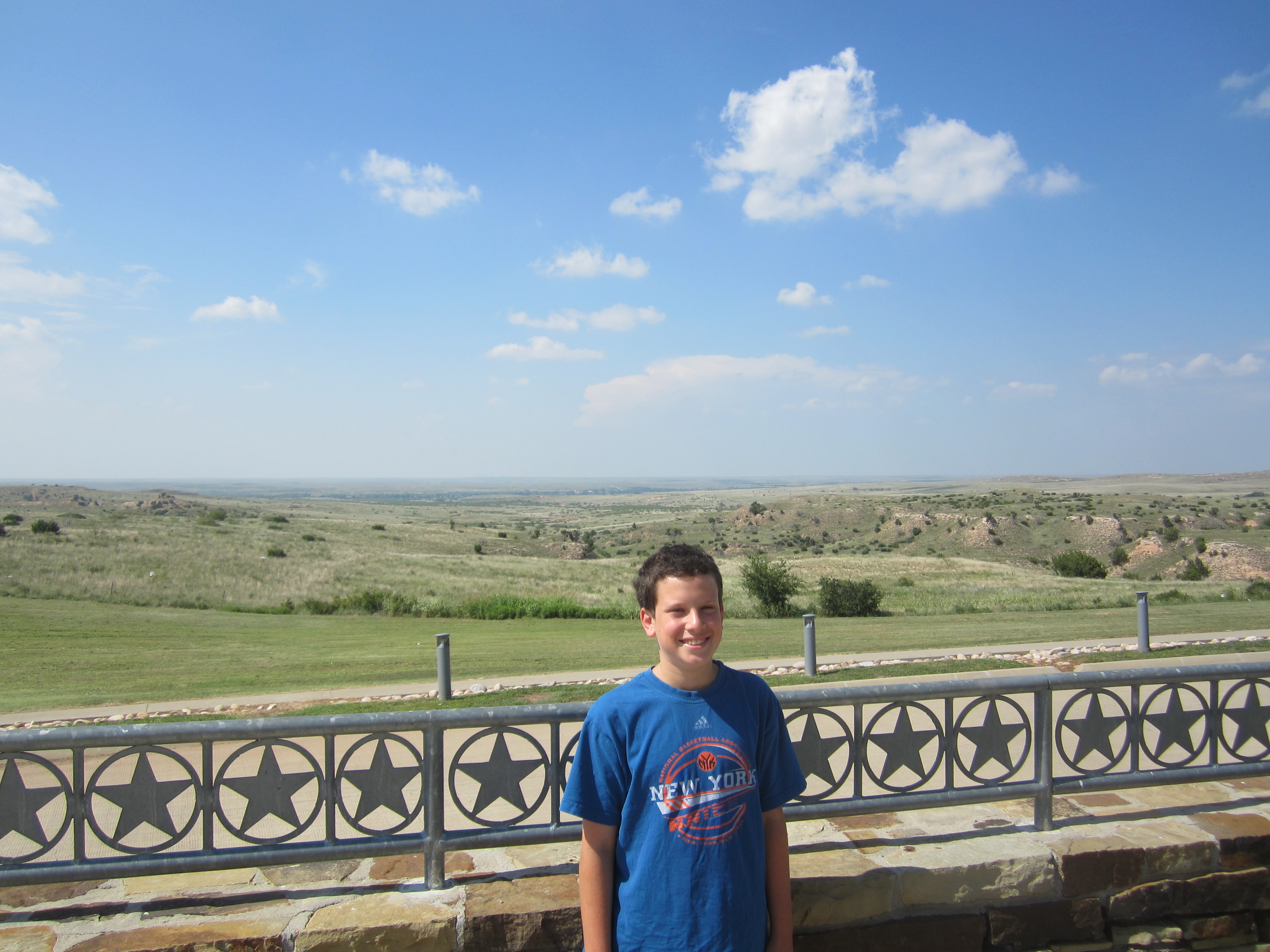
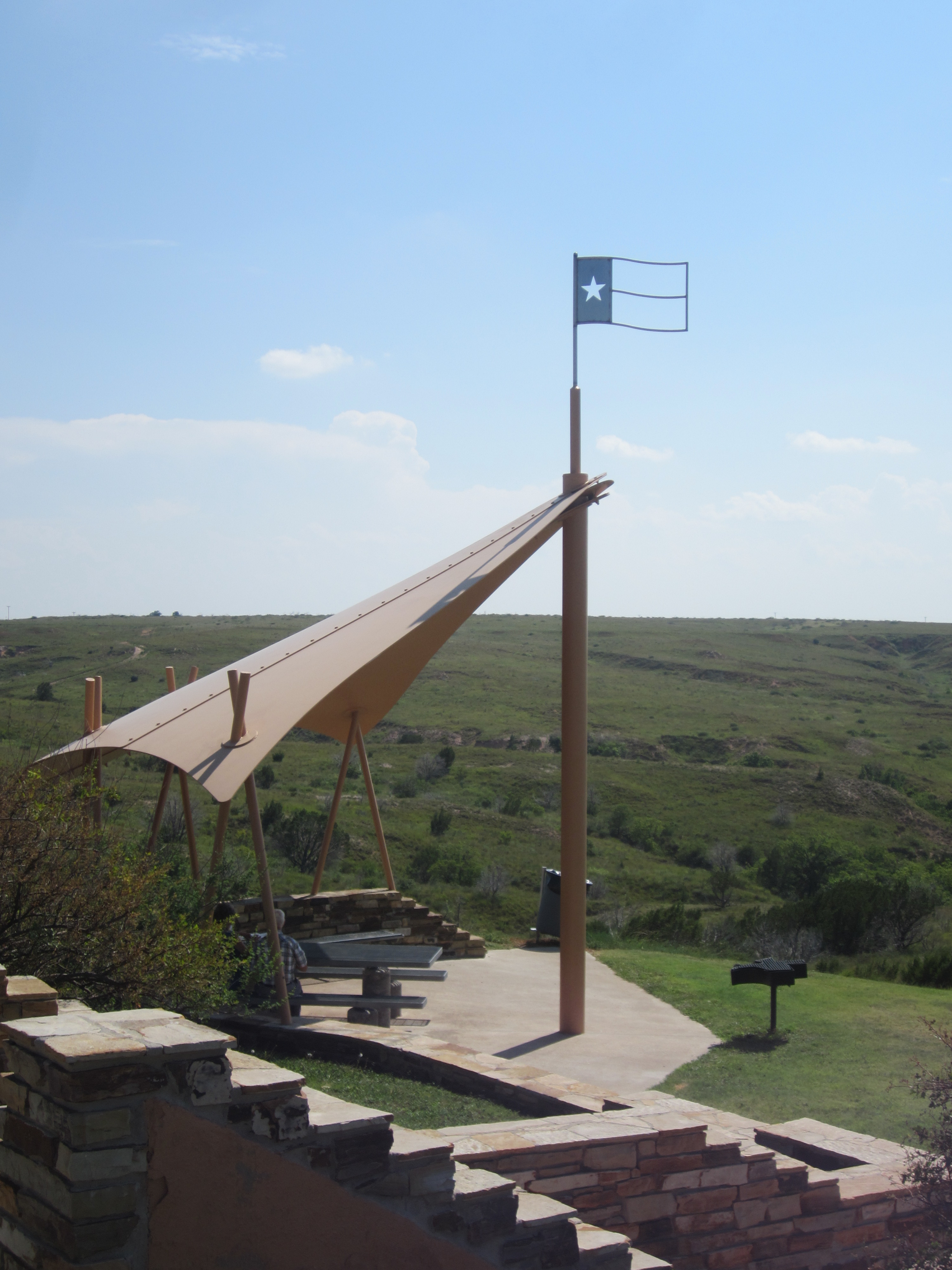
Then there were the picnic tables, which were each sheltered from the oppressive sun with a half-tepee topped with the state flag.
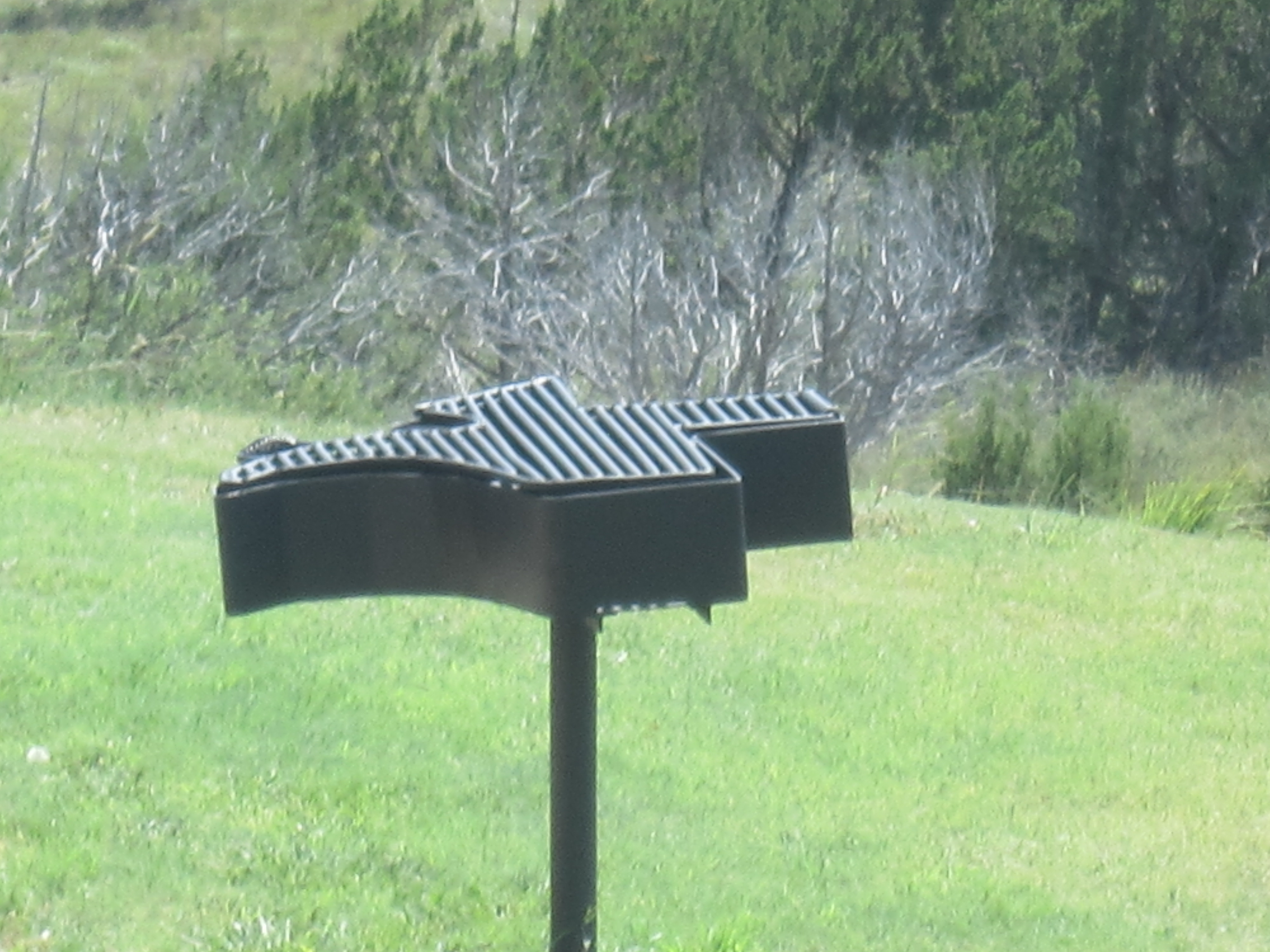
Did you notice the charcoal grill on the right side of the photo? It’s shaped like Texas!
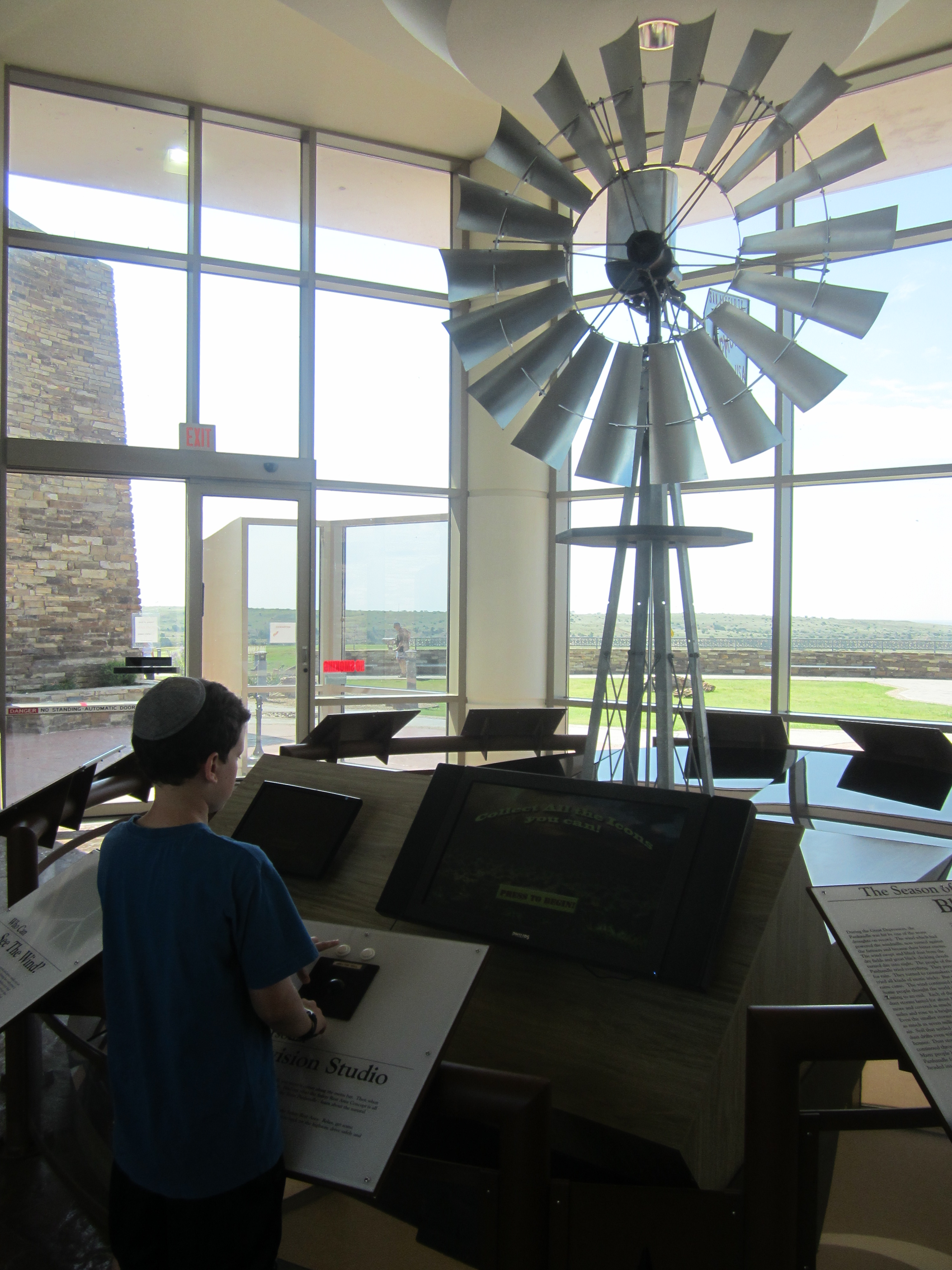
And inside the building there were not only clean bathrooms but also an interactive educational display about how the state uses wind power.
Anyway, that was one of the highlights for Texas’s chunk of Route 66. Most of the rest of it was abandoned businesses or just nothingness. And then, suddenly, Amarillo. We spent only a few hours in Amarillo, so I could be wrong about this, but it seemed like the entire city is nothing but insanely inexpensive steakhouses and even more impossibly inexpensive motels (many places advertised rooms for $29). Of course we found the restaurant with the 72-ounce steak:
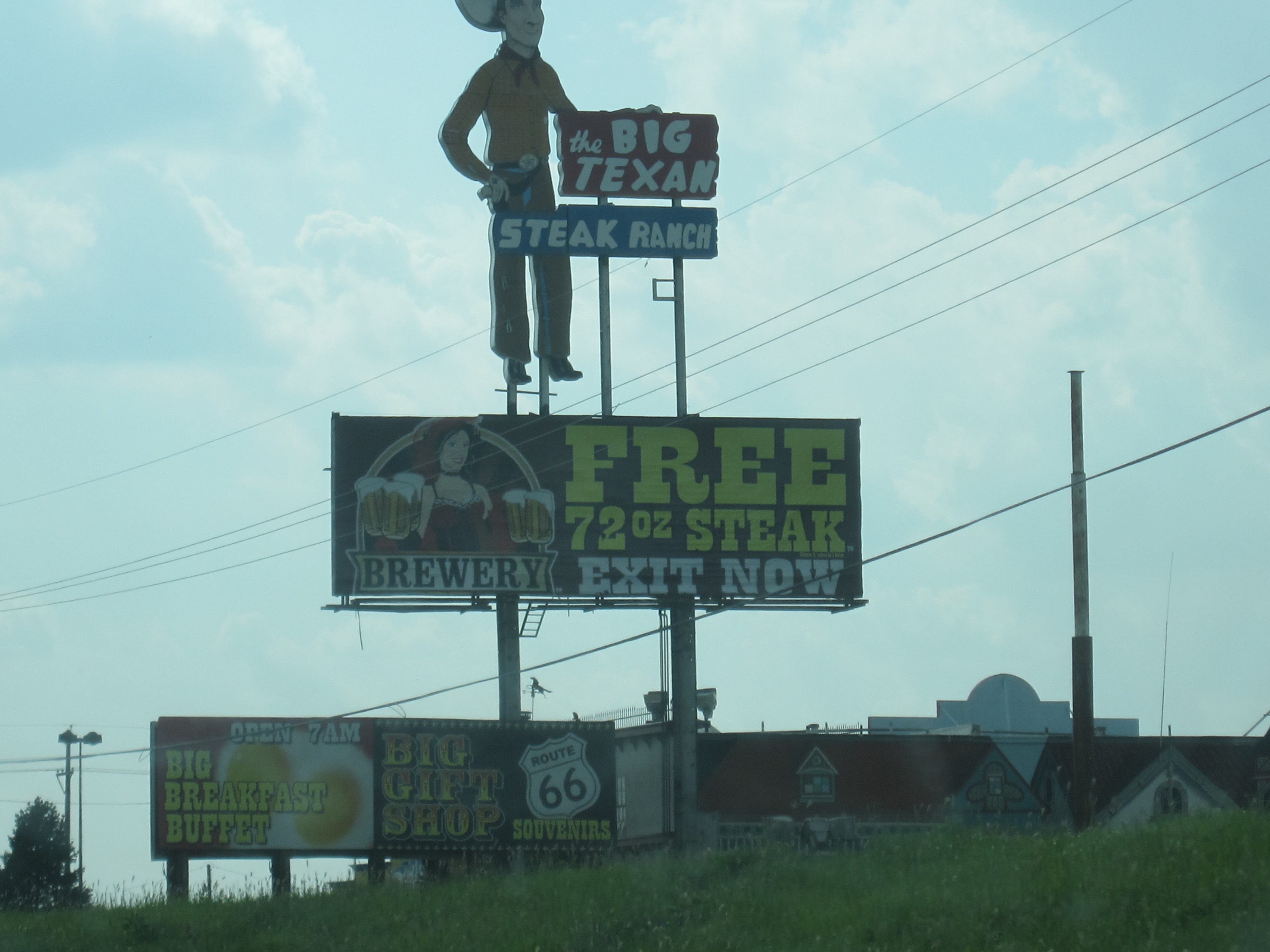
We also visited the Discovery Center to see the Helium Time Monument, a really strange sculpture outside the building. It’s a helium molecule (Amarillo is the helium capital of the U.S., as I’m sure you knew), and it’s also a time capsule, and just for fun it’s also a sundial.
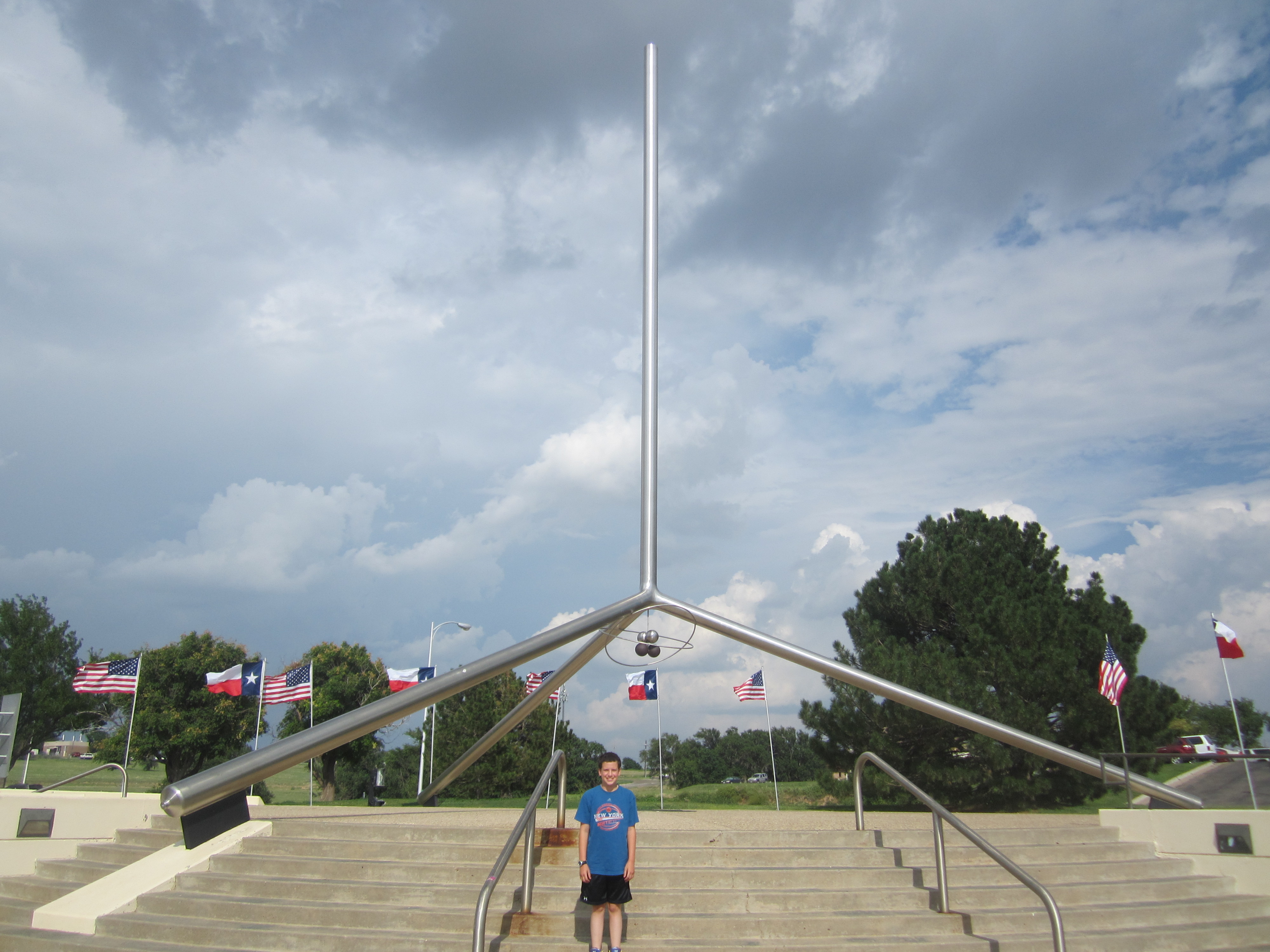
But that’s just the tip of the weirdness iceberg when it comes to Amarillo. Because near the southern city limits we found this:

Yup. Two vast and trunkless legs of stone, just like the poem says. And around them, nothing beside remains. Round the decay of that colossal wreck, boundless and bare, the lone and level field stretches far away. The legs are on private property and there’s a locked gate. But right in front of the gate is a very official-looking bronze plaque that claims (falsely, and with tongue in cheek) that it was these very legs that inspired Shelley’s poem.
We had originally planned to spend a couple of hours going horseback riding just outside Amarillo, but when I spoke to the ranch lady on Sunday she said the weather forecast said it would be 98 degrees and rainy, and that they don’t take the horses out when it’s that hot or when it’s raining. That’s certainly understandable, but when we got to Amarillo it was sunny, clear, and in the low 90s without even a hint of humidity, so I wondered if the woman falsified the forecast just to get rid of us. However, as we were leaving the Ozymandias legs the sky suddenly went from clear and bright blue to very, very dark gray and we saw several lightning bolts off in the distance.
But back to those giant legs for a second–you probably noticed the graffiti. Well that’s nothing compared to what I’m about to show you. The main attraction in Amarillo is Cadillac Ranch, a row of 10 vintage Cadillacs with their noses buried into the ground at the same precise angle. It too, is behind a gate on private property, but the owner, a local millionaire (and possible sexual predator) who died just last month, encourages not just tresspassing but participation. Some people come to look at the cars, but most people bring a can or two of spray paint and “decorate” the cars. Over the years the cars have been stripped to their frames but as you can see there’s still plenty of room for painting.

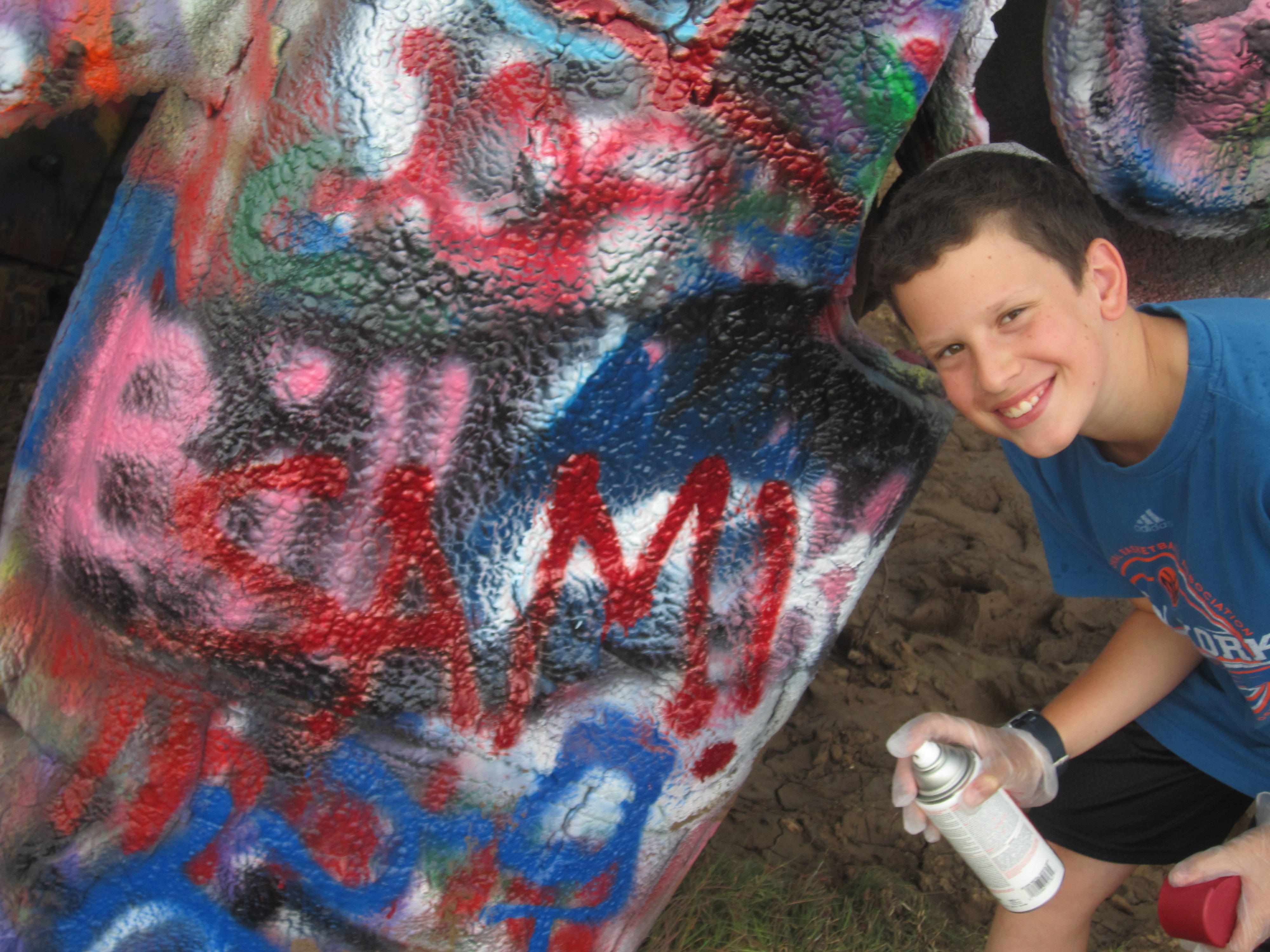
The Hamster and I thought we were well prepared by bringing a can of metallic red spray paint and we even thought to bring disposable gloves to keep ourselves (and thus our own car) from getting painted. Once we got there we say that the real pros brought multiple colors so that they could first paint themselves a blank canvas and then really get creative.
By this point it had started raining, and the lightning continued. Is there a better place to be in a lightning-filled rain storm than painting large, metal objects in an open field? Yes, many. So we didn’t dilly-dally, but we still had a great time checking out the cars and literally leaving our mark. Here’s some of Sam’s handiwork:
And here’s mine:
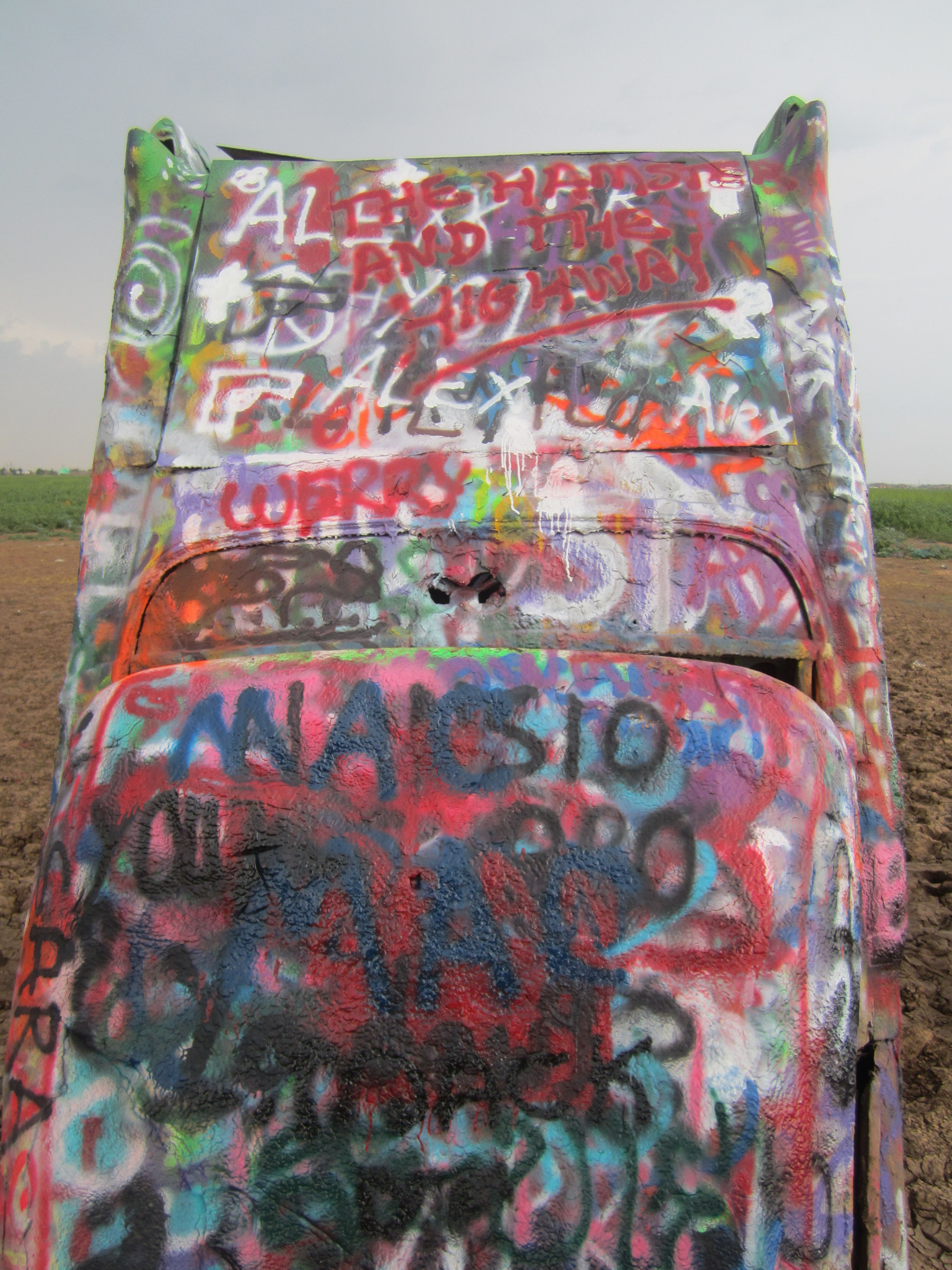
Can’t see it? Here, let me zoom in for you:
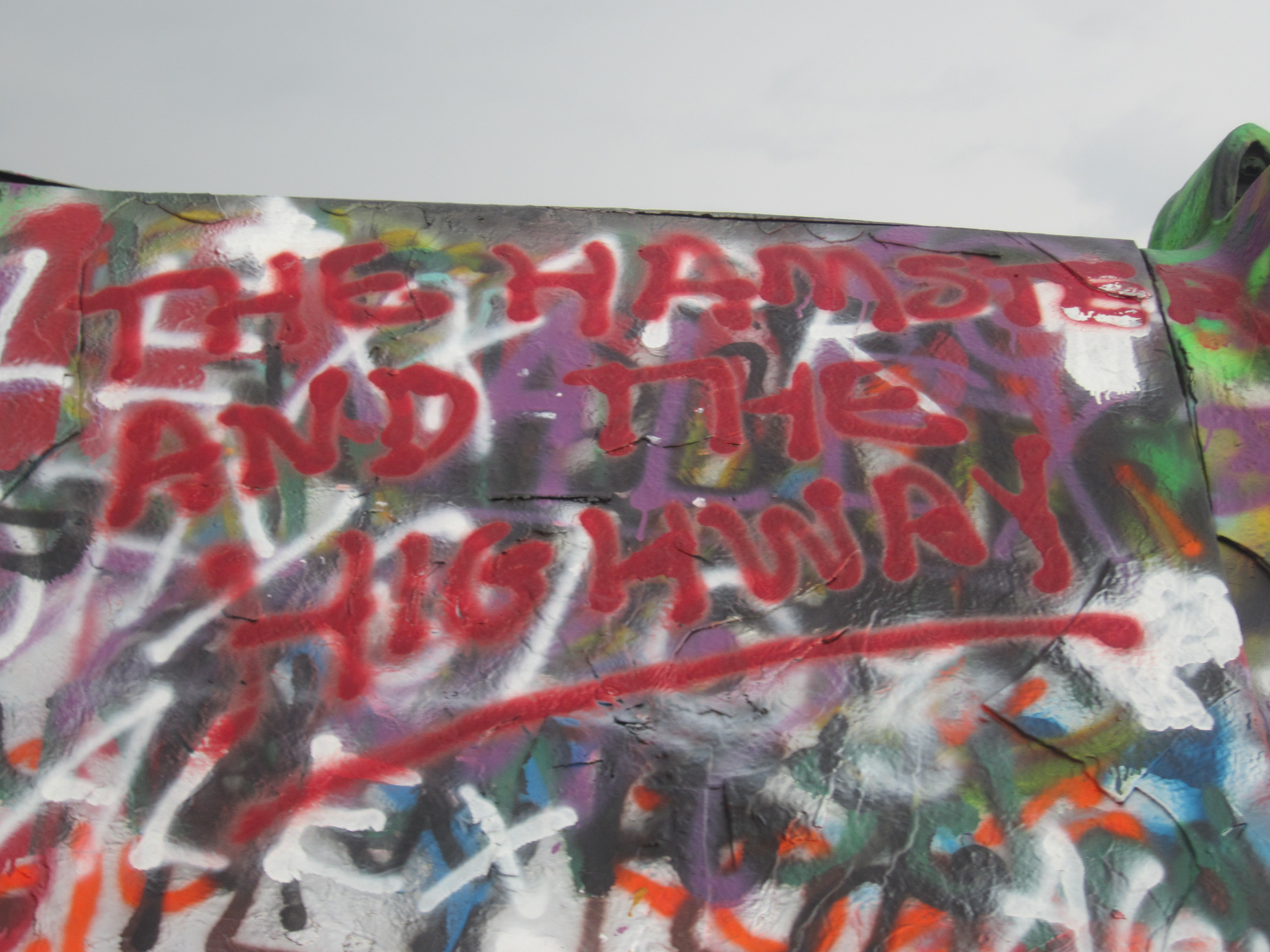
A couple maybe five years older than me asked me to take their picture next to the cars. Of course it turns out they’re from Queens, and we consoled each other over the state of the Mets.
Bruce Springsteen’s song “Cadillac Ranch” is supposedly named after the car farm we had just visited. On the surface it’s a fun, rocking song but if you pay attention to the lyrics it’s actually about the inevitability of death.
My guess is that Springsteen saw Cadillac Ranch as a metaphor: all these cars that were once proud, great, and worshipped are now lying in ruins and half buried in the ground. It happens to cars just like it happened to Ozymandias.
On our way out of Cadillac Ranch we gave our remaining paint to a family that was heading in and had forgotten to bring their own. Our timing was pretty good, because as soon as we got back into the car it started raining much harder. We drove off through one of those blinding, furious summer rainstorms that are great fun to watch from a front porch but less fun to drive in, especially when you’re in tornado country. Within a few minutes, though, we had outrun the storm and we had the odd experience of seeing sun ahead of us and nothing but darkness in the rearview mirror.
As the storm passed it also became intensely windy. We had been planning to grill burgers at a rest stop for dinner but we were worried about the wind and about the rain catching up to us, so instead we stayed in the car and heated up La Briute meals, which are not fantastic but are at least hot and are the coolest science project ever.
We gained an hour as we crossed into New Mexico, so we drove a little further before finding a place to spend the night. We ended up at yet another Super 8. We even had time for a movie before I put Sam to sleep, so we watched Planet of the Apes–the original one with Charlton Heston. The Ozymandias connection didn’t occur to me right away, but the movie of course ends with a famous, massive statue of the great and mighty lying in ruins in the sand.
But before the movie, when we were checking into the motel, the front desk guy asked for my driver’s license. I couldn’t find it at first, and then found it, and I mentioned to the guy that my license wasn’t in the right place because I had been pulled over earlier and didn’t put it back properly. He asked what I was pulled over for. I told him. He said, “Where were you? Oklahoma?” I nodded. “I figured. The cops are crazy there. I go there with my buddies pretty often and they always pull us over for stuff we didn’t even know existed.”
The Cowboy Way
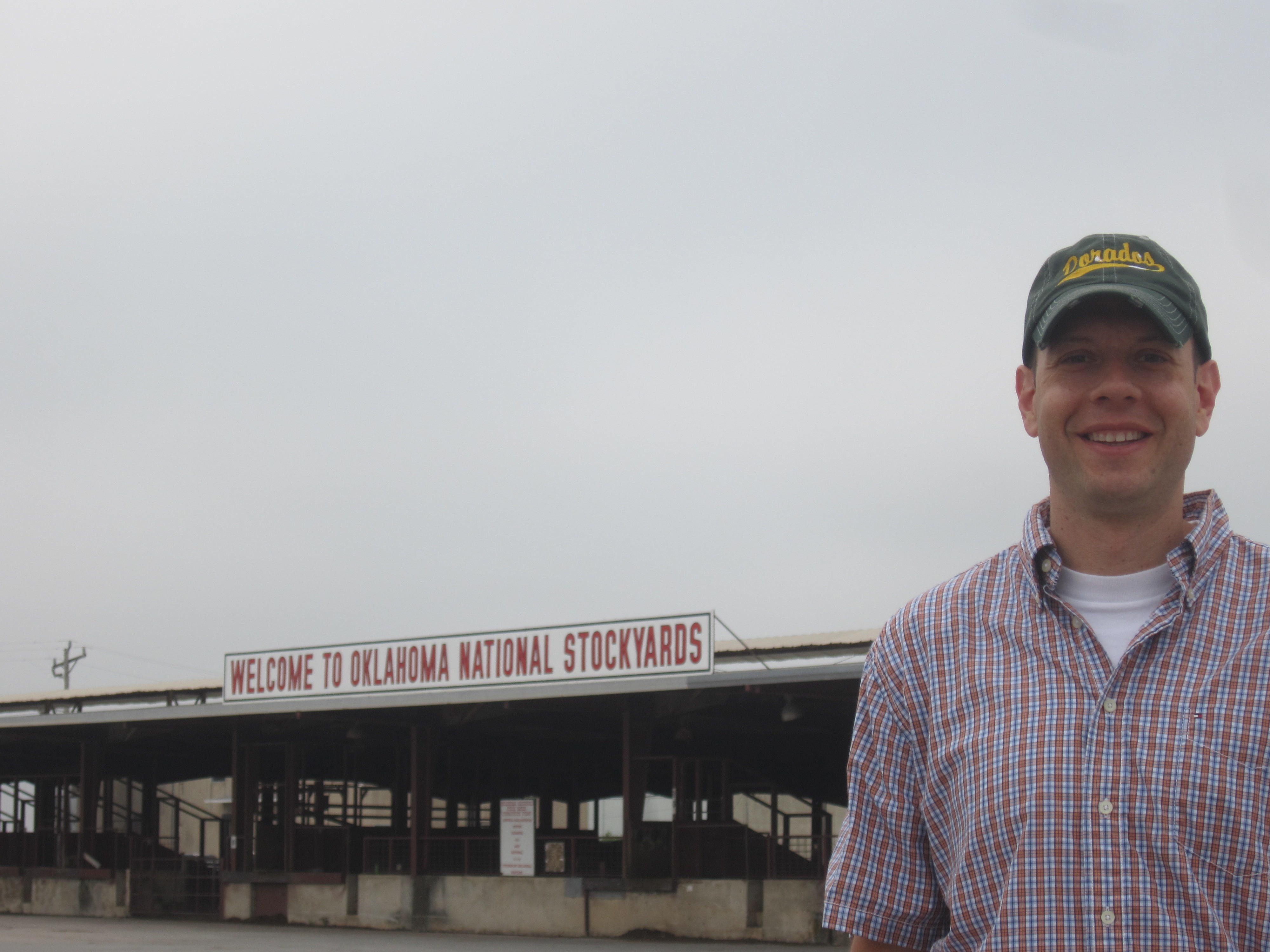
There are three things I look for in a cattle auction. OK, that’s a lie–I have no idea what to look for in a cattle auction. All I knew was that there is such a thing, and it’s held in the Stockyards City section of Oklahoma City every Monday and Tuesday morning, and we could go watch it happen.
When planning the itinerary we always look for activities or sights that are unique to the area and that we can’t do or see at home. A live cattle auction qualifies in spades. It required a late night of driving Sunday and a very early wake-up call Monday morning. But there will be other opportunities to sleep; there will not be other opportunities to bid on a cow (or to watch other people bid on cows, anyway).
Once we got to Stockyards City it took us a little while to find the auction, because we were foolishly looking for a storefront or an auction building. Instead, we had to cross a long catwalk that wound its way over the many dozens of holding pens where the batches of cattle up for sale were being held as they waited their turns.
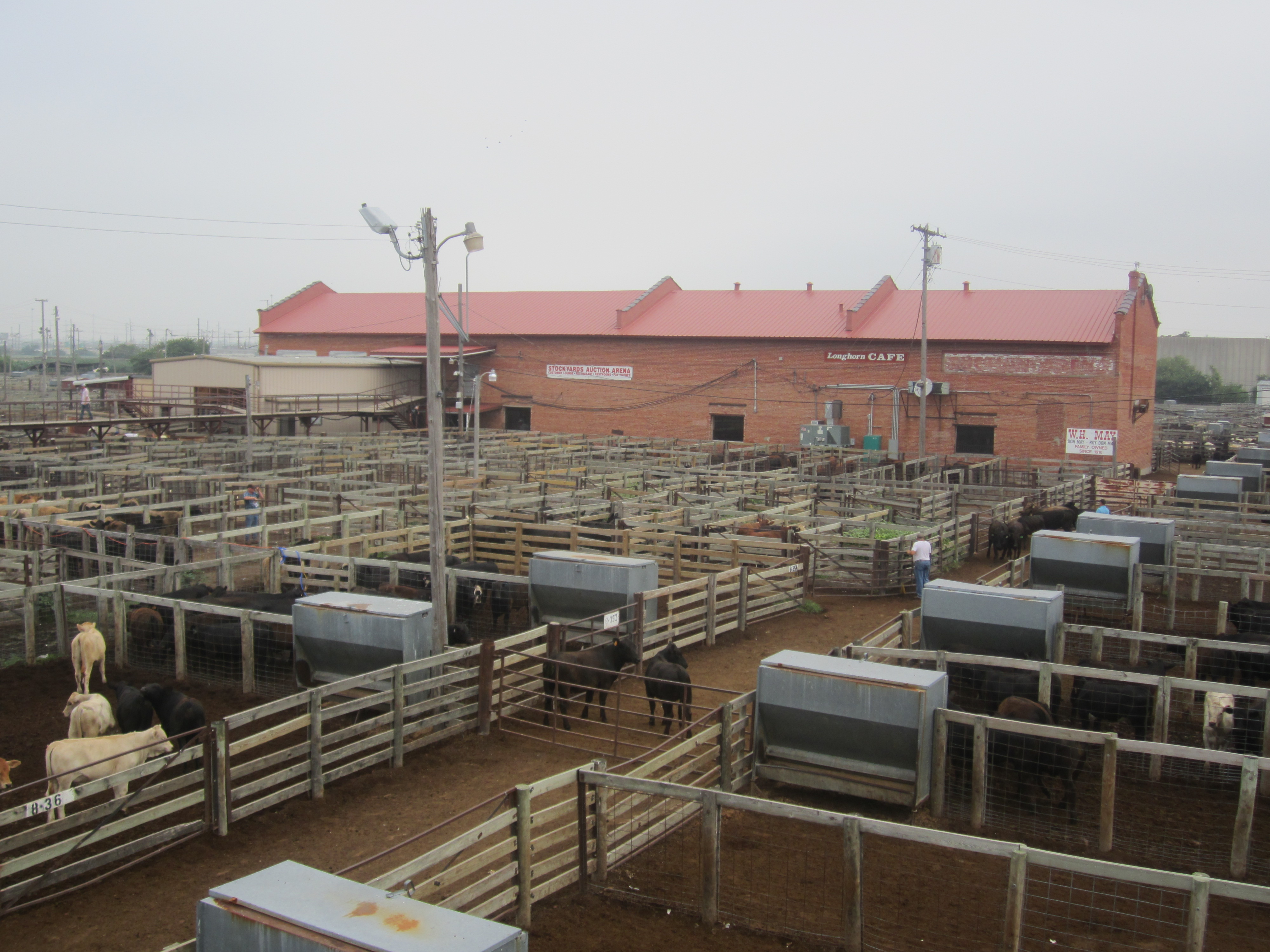
The red brick building is where the auction is held; the horizontal white sign on it reads, “Stockyards Auction Arena.”
I’m going to assume you’ve seen cows before, and I’m going to assume you have heard cows moo as well. Now imagine every moo you have ever heard happening all at once, and then being immediately answered with an equal amount of mooing, and repeat that process indefinitely. The cacophony was constant for the two minutes or so that it took us to walk the interconnected catwalks and find our way into the building. I don’t know if the cows were yelling at us, mocking us for being newbie tourists, or arguing among themselves. Either way I was a little relieved when we finally entered the “arena.”
It actually is set up like an arena of sorts: cushioned stadium seating around the perimeter of a semicircular room, all looking down onto the auctioneer, his helper ladies, and a smaller semicircle where the cows would be brought in from the left side for a minute or two and then ushered out the right side as soon as they were sold.
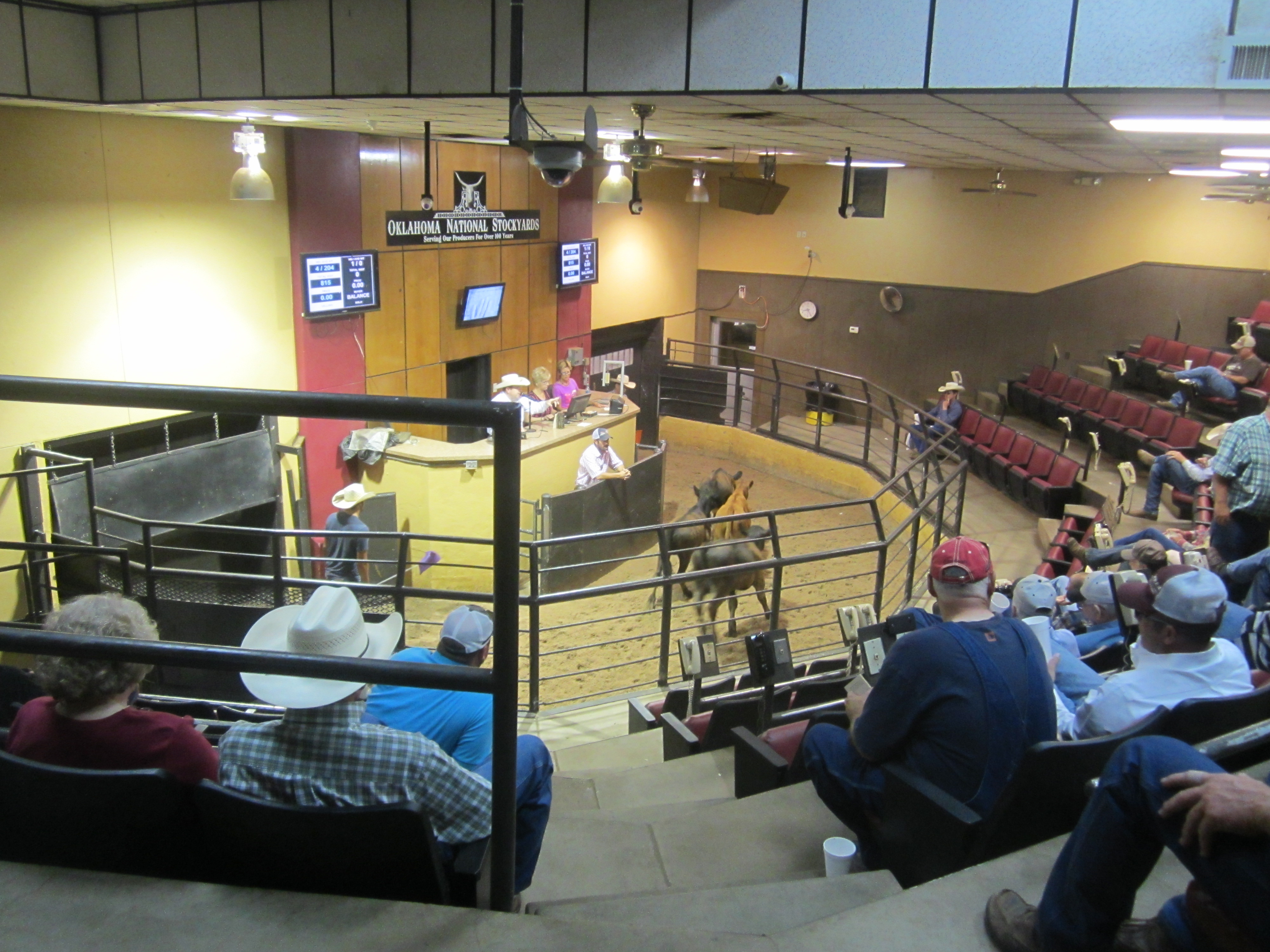
The first thing we noticed was how inappropriately we were dressed. There were lots of cowboy hats but an equal number of baseball caps. We were wearing baseball caps, so we were OK there. But that’s where it ended. Every single person there was wearing jeans, and every single person there was wearing boots of some kind–mostly cowboy boots and a handful of Timberlands. We were in shorts and sneakers. As you can see from the above photo, we took seats in the back and tried to remain as inconspicuous as possible. Watching the auction was my secondary goal, as my main goal was to avoid ruining the auction in some ridiculous way that would happen only to the stars of a bad sitcom.
We succeeded on both counts. But the auctioneer was speaking so impossibly quickly and the whole thing was so foreign to us in every possible way that it took us almost an hour to figure out even the basics of what was going on. Let’s take a slightly closer look so I can explain our findings:
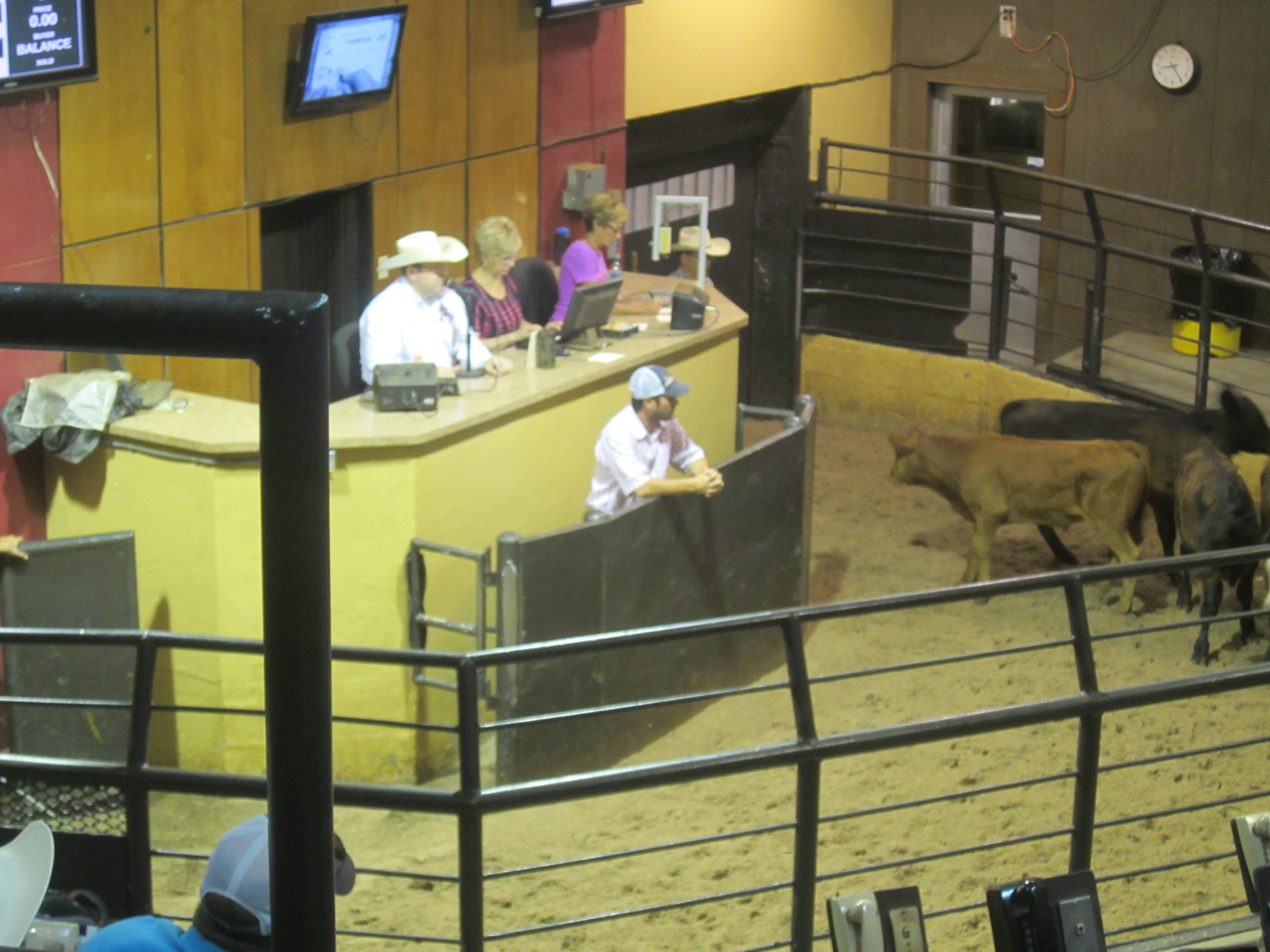
The dude in the cowboy hat at the tall desk is the auctioneer. Next to him are administrative assistants to enter info about the cows into the computer and display the info on the video boards that are on the wall behind them (more on that in a minute). The guy in the baseball cap who’s standing right in front of the tall desk and looks like he’s been put in a timeout is the seller, or at least a representative of the seller. He gives the auctioneer any pertinent info about each lot (antibiotics, diet, etc.), and when his lots are all sold he leaves and a new owner stands in that spot. The cows there are of course the ones for sale at the moment. Notice there are a few of them. In the hour that we watched, we saw lots of no less than three and no more than 18. It gets a little hairy when 15-18 cows are running back and forth in that little area. Meanwhile the cows are so confused about where to go that there’s a guy on each end of the (stage? pit?) whose entire job is to shoo the cows in the opposite direction when the need arises.
Meanwhile, the only real details about the cows that the audience gets besides looking at them is whatever they can decipher from the auctioneer’s lightning-speed announcements, and the TV monitors on the wall, which simply display the number of cows in the lot, their average weight and total weight, their price, and their buyer.

The info on the right is the just-sold lot; the info on the left is for the current lot.
The cows mostly sold in the range of $220-$350 each, which seemed low to me but then again I know absolutely nothing about any of this. We both found the whole experience fascinating, if a little disturbing, and Sam alternated between wanting to free all the cows and wanting me to buy a batch of them to take home. Thankfully neither of those things happened. But we liked the whole cowboy thing so much that we figured we needed to start dressing the part:
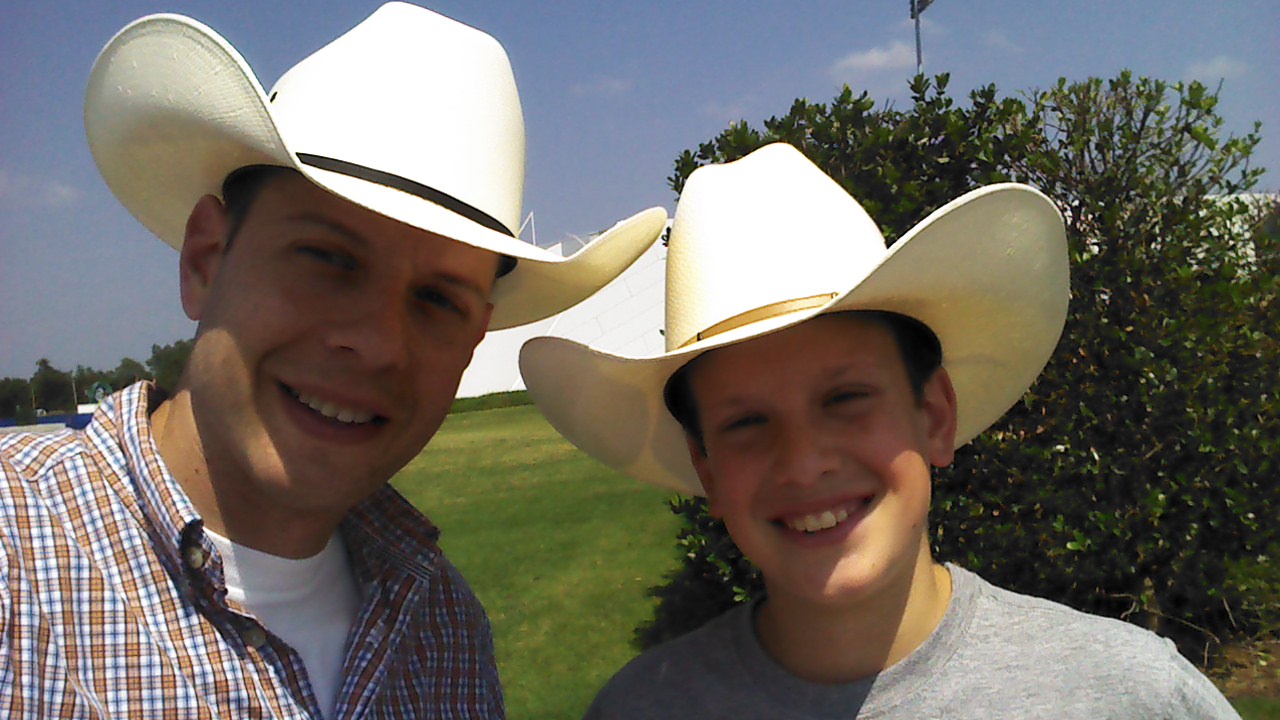
These are not costumes. These are our new hats.
Oklahoma City is a modern city with skyscrapers and cars and an NBA team and everything, but we decided to keep the cowboy theme going for just a little while longer by visiting what used to be the Cowboy Hall of Fame and is now the Cowboy Hall of Fame and Museum of Western Heritage, or some such impossibly long name that means cowboy museum.
We’ve been to several halls of fame on our road trips: baseball, football, rock and roll, tennis, basketball, and even St. Louis Cardinals. On our way to Chicago last week we drove past the RV Hall of Fame in Elkhart, Indiana. I say “drove past” because we had absolutely no desire to go inside. I mean, why would there even be an RV Hall of Fame, and what would be in it? RV models that were especially popular? RV designers and manufacturers? People who drove their RVs to a whole lot of places? We will never know, or care. But Oklahoma City boasts two HOFs: cowboys and softball. I’m sure the softball HOF is lovely, but we decided to pass on it because, as much as we like playing softball, we don’t really know anything about the people who have excelled at it, once you get past Jennie Finch. And I’m saying this as someone who literally wrote the book on softball.
Our pop culture knowledge has a gaping hole when it comes to Western culture and rodeo as well, so we sped through the hall of fame part of the cowboy museum. We also sped through the cowboy art part, and the cowboy history part, and the cowboy clothing part, etc. Where we lingered was the interactive (and very convincing) Old West town, where we got to walk into a schoolhouse, a saddle shop, a local jail, a saloon, etc. as they might have looked and sounded in 1905.
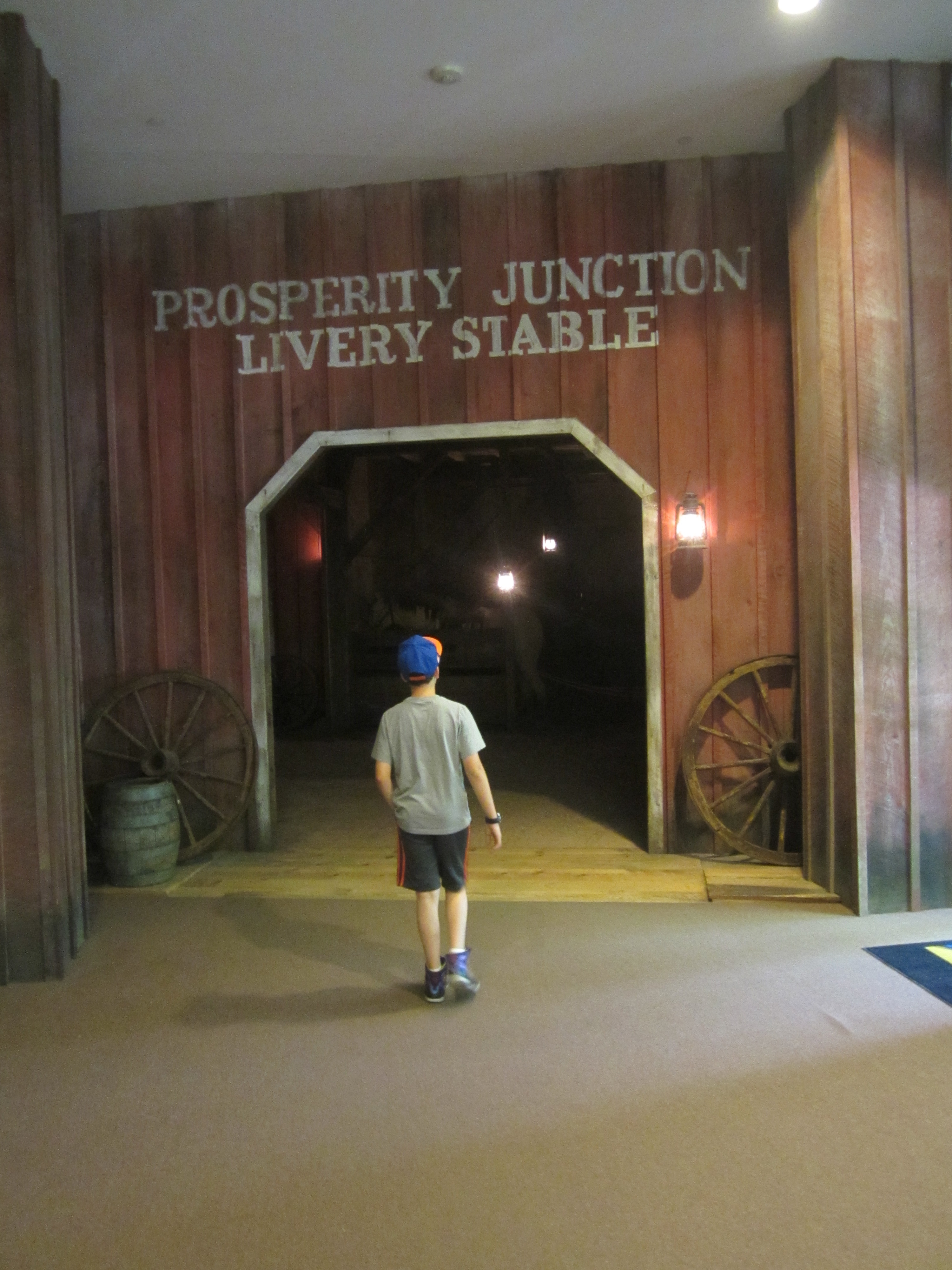


The Hamster in the Hoosegow
Eventually we left the Old West behind for some more modern digs. We paid a quick visit to the state capitol, which looks pretty much like a lot of other state capitols with one major exception: it’s the only one with a working oil well on the grounds.

Then it was time for a little modern history: the memorial for the 1995 Oklahoma City bombing. When planning this trip I went back and forth about whether to visit such a somber and upsetting site on a happy vacation, especially with a child who gets very sensitive about discussing death. Ultimately I decided to go, partly because as New Yorkers I think we have an odd kinship with OKC when it comes to terror attacks, and partly because I just felt like the victims and the survivors deserve our attention, even if we’re on vacation.
Sam, it turns out, had never even heard of the bombing before today. I gave him a very brief overview before we entered, and he was absolutely appalled, as he should be. We were in the museum for only a few minutes when he became so fascinated with the event that he said, in disbelief, “Why did I never learn about this?”
If you want to have fun in Oklahoma City, do not visit the Oklahoma City National Memorial and Museum. If, however, you are looking to be moved to tears (literally, tears) by hearing the grief of parents who lost their children to terrorists, by the sound of the bomb going off, by interviews with survivors, by several seemingly random objects found in the rubble–a set of keys, a coffee mug, a stuffed dog–that convey so much more meaning than you ever thought they could, by reliving the horror of April 19, 1995 … well then you should most definitely go there.
Sam and I went to the museum before the memorial, reasoning that the memorial would be more meaningful after going through the museum. All I can say is that I can’t think of a single way that this museum could have been done any better. It starts with a brief exhibit on terrorism in general and then focuses on what was happening throughout the city on that morning in the hours and then minutes before the bomb went off. Then you experience the blast itself by sitting in a conference room and listening to a brief audio recording of a meeting of the state water board, which was going on a block away from the Murrah Federal Building. The meeting starts at 9 a.m. and goes on for two minutes until it’s interrupted by the blast and then immediate chaos. (The building where the meeting was held was damaged so badly that it ultimately had to be demolished. A moving tribute to the rescue workers who helped out at the scene now resides in its place.) From there there are many exhibits about the immediate aftermath of the bombing–news coverage, the search for survivors, the long and painful recovery of some of the injured survivors, etc.
Sam was overcome with emotion when we heard stories of the search for surviving children from the daycare center that was in the building, and asked to leave. I was on the verge of falling apart myself, so I immediately obliged. Seconds later we were walking out of the building, both shaken, and it’s the only time he’s ever asked not to go to the gift shop.
The museum is in the Journal Record building, which was across the street from the Murrah building and sustained heavy damage but has since been repaired and (obviously) repurposed. What used to be the street that ran between the two buildings is now a block-long reflecting pool. The footprint of the Murrah building is now a lawn populated by 168 chairs, each engraved with the name of a victim, and arranged in an order too complicated for me to properly explain. I took many pictures of all of this but I’m not going to share them with you here. If you want to see what this all looks like, please go visit. You will not enjoy the experience but you will not regret it, either.
At this point in our day we were originally planning to take a tour of a historic old mansion in the center of town, but Sam decided it would be too boring and insisted that we skip it. I agreed, and I was briefly at a loss for what to do next. We had seen a great may things already but none of it took very long so we still had a few hours of day left before dinner. At some point during our travels trough the city we noticed an add for zip lining across the Oklahoma River, though, so I did some quick research and discovered that it was reasonably priced, not very far away, and open until 10 p.m. Oddly, when we arrived at the zip lining place we were the only ones there. It turns out that my quick research was a little too quick, and I missed the part about it being closed on Mondays.
We were a little annoyed but ultimately we didn’t really mind, as we were exhausted from a combination of waking up early for the cattle auction and the weather, which was oppressively hot and humid. So we went back to our room at the Super 8 to rest and recharge a bit before heading out again to have dinner. We ended up finding a shady spot right next to the river, where we grilled Cajun-rubbed chicken wings and green beans. (See, it’s not just burgers and dogs all the time!)

Then we headed to Chickasaw Bricktown Ballpark, home of the Triple-A OKC Redhawks, for our first actual baseball game of the trip. The weather was disgustingly sticky but the ballpark, which is built entirely of red brick, was wonderful. Inside and out, it has to be the nicest minor league park I’ve ever been to. On the outside, bronze statues of Oklahoma’s most accomplished major leaguers (Mickey Mantle, Johnny Bench, and Warren Spahn complement the brick facade and welcome fans into each gate.

Inside, the stadium is roomy and beautiful and about as close to feeling like a Major League park as a Minor League park possibly can, and the mascot, Cooper, is easy to find.
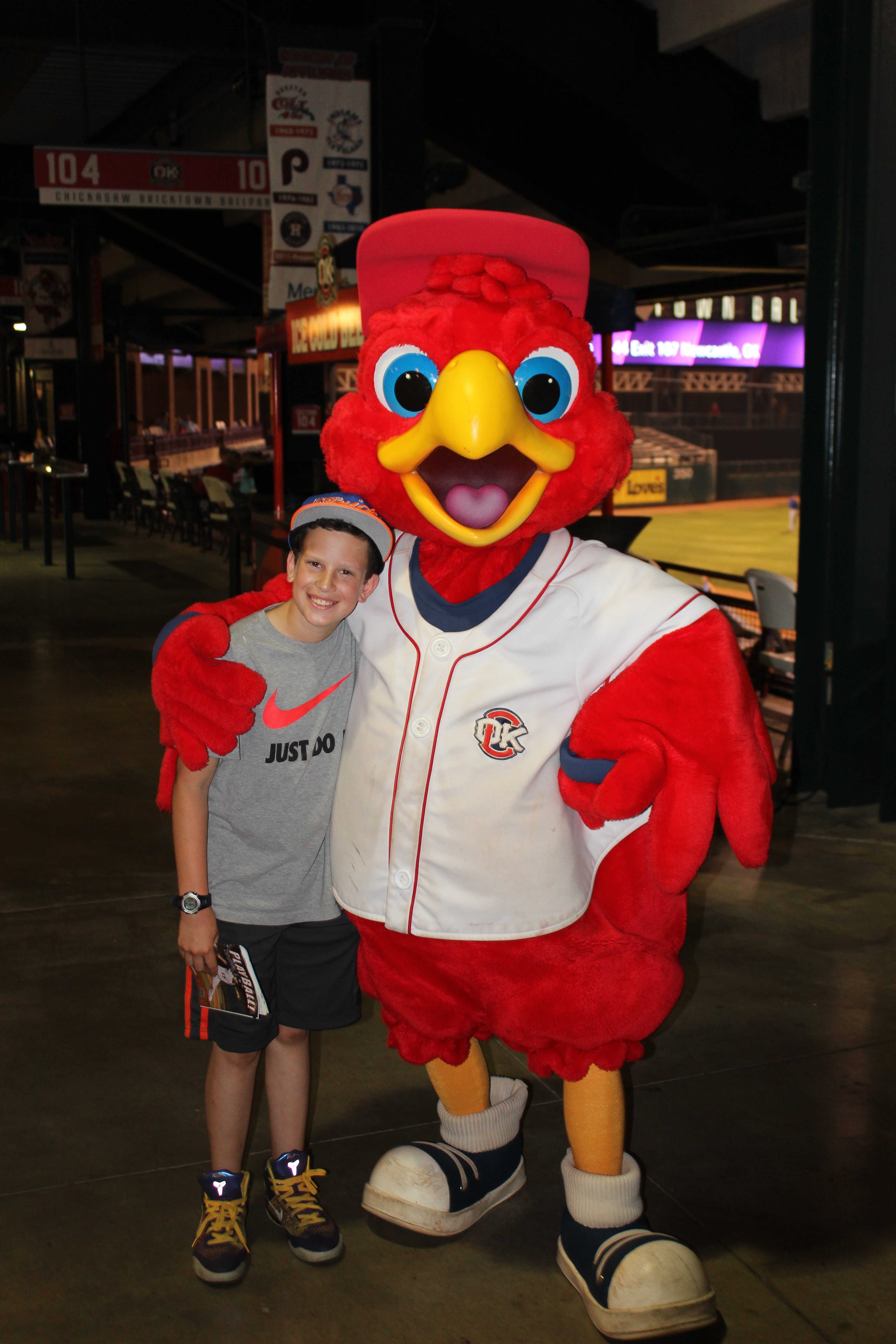
The only downside is that the Redhawks are the minor league affiliate of the Houston Astros, who are absolutely terrible. In fact, the Redhawks were losing 4-0 before even coming to bat. But they battled back repeatedly, and in the bottom on the eighth inning they tied the score at 9. Unfortunately lousy defense in the top of the ninth doomed them to an 11-9 loss. But the temperature eventually cooled off (even if the humidity never broke) and Sam continued his streak of getting tossed a ball in every minor league game I’ve ever taken him to (outside of Brooklyn). So we’re calling it a win.

Our time in OKC was exhausting in every way, but it turned out to be far more than just OK, as the state motto would have you believe. We’re going to miss this town.
Y’all come back now, ya hear?
Roadside Attraction
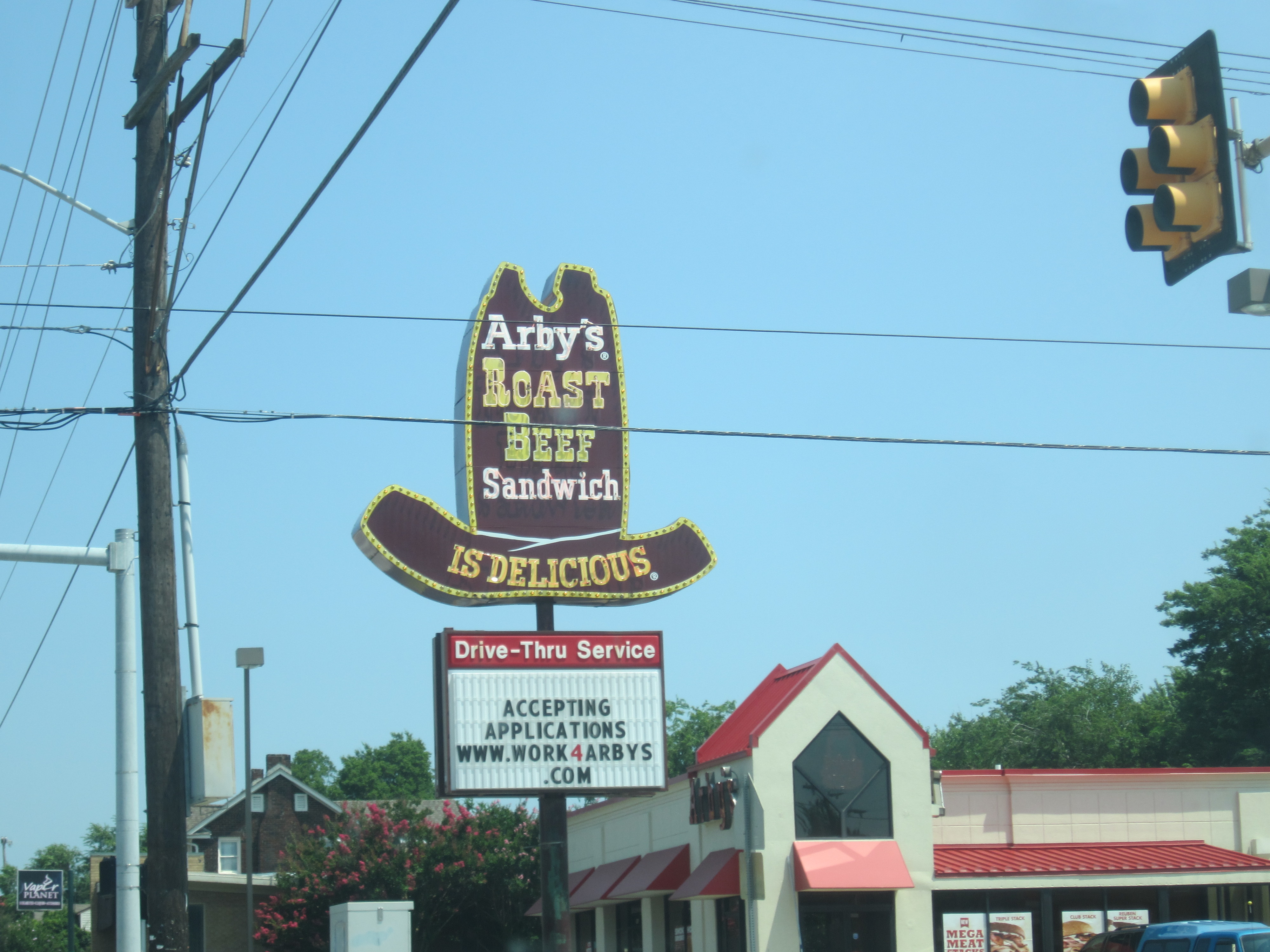
First let me say that Tulsa is lovely. The river’s edge has been turned into beautiful parks and bike paths, which are then bordered by either quaint neighborhoods or quaint shopping districts. The skyline is attractive if not especially interesting, the city is easy to navigate, and there are several major Interstates running through the city in addition to Route 66. Many of the shops and restaurants have cute names (ex: Purple Glaze Pottery), and all of the many Arby’s restaurants scattered around town still feature the old-old-old-school Arby’s hat neon sign.
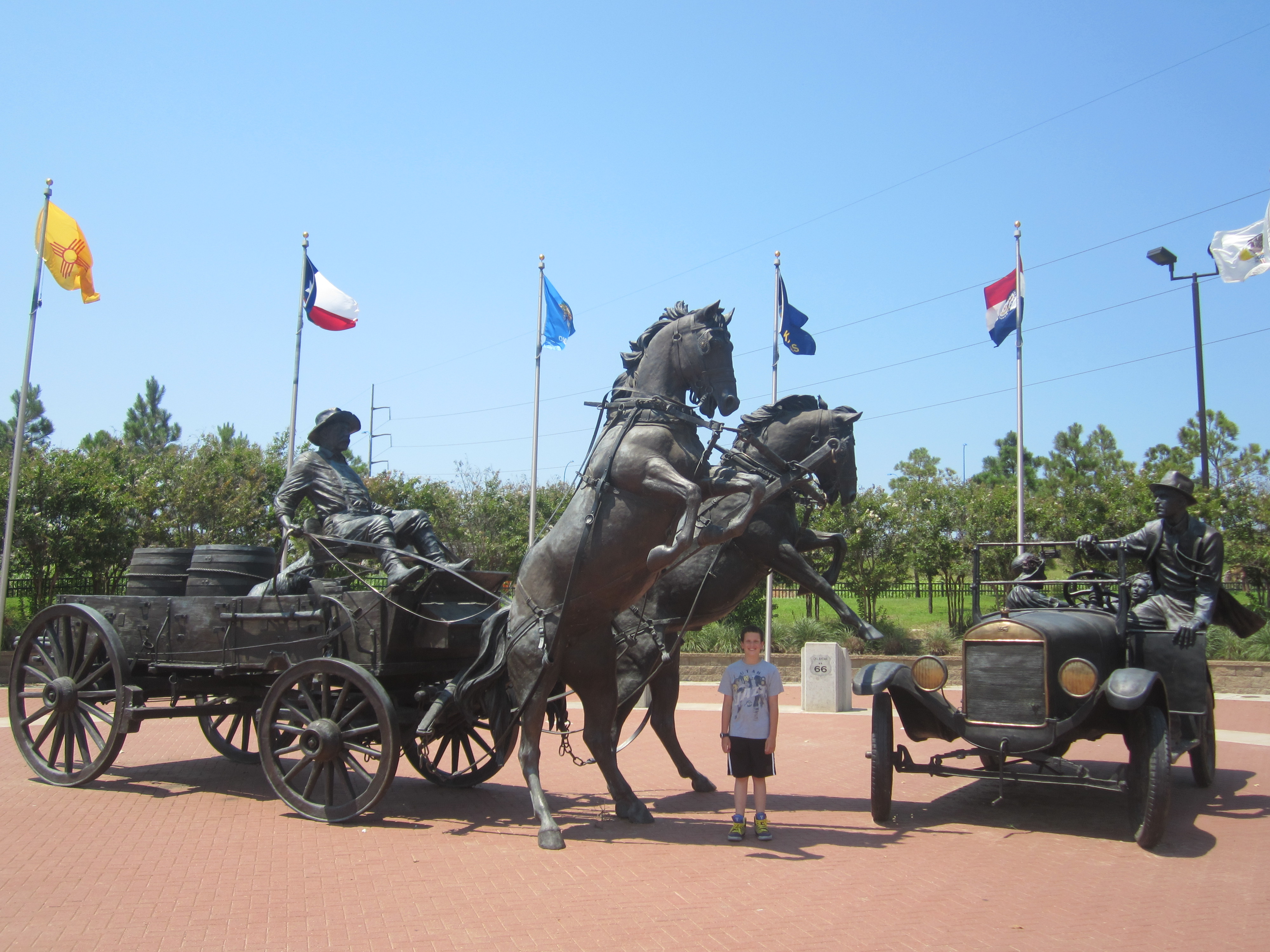
The city calls itself the place where East meets West, meaning that Tulsa is really marks the beginning of cowboy country and is the first time on Route 66 where there’s a palpably different feel to match a palpably different landscape. There’s even a cool statue dedicated to this concept, showing a near-collision between a family in a Model T and a cowboy in a horse-drawn wagon.
 With all that said, there is not a whole lot to do in Tulsa. So today turned out to be more of a seeing day than a doing day.
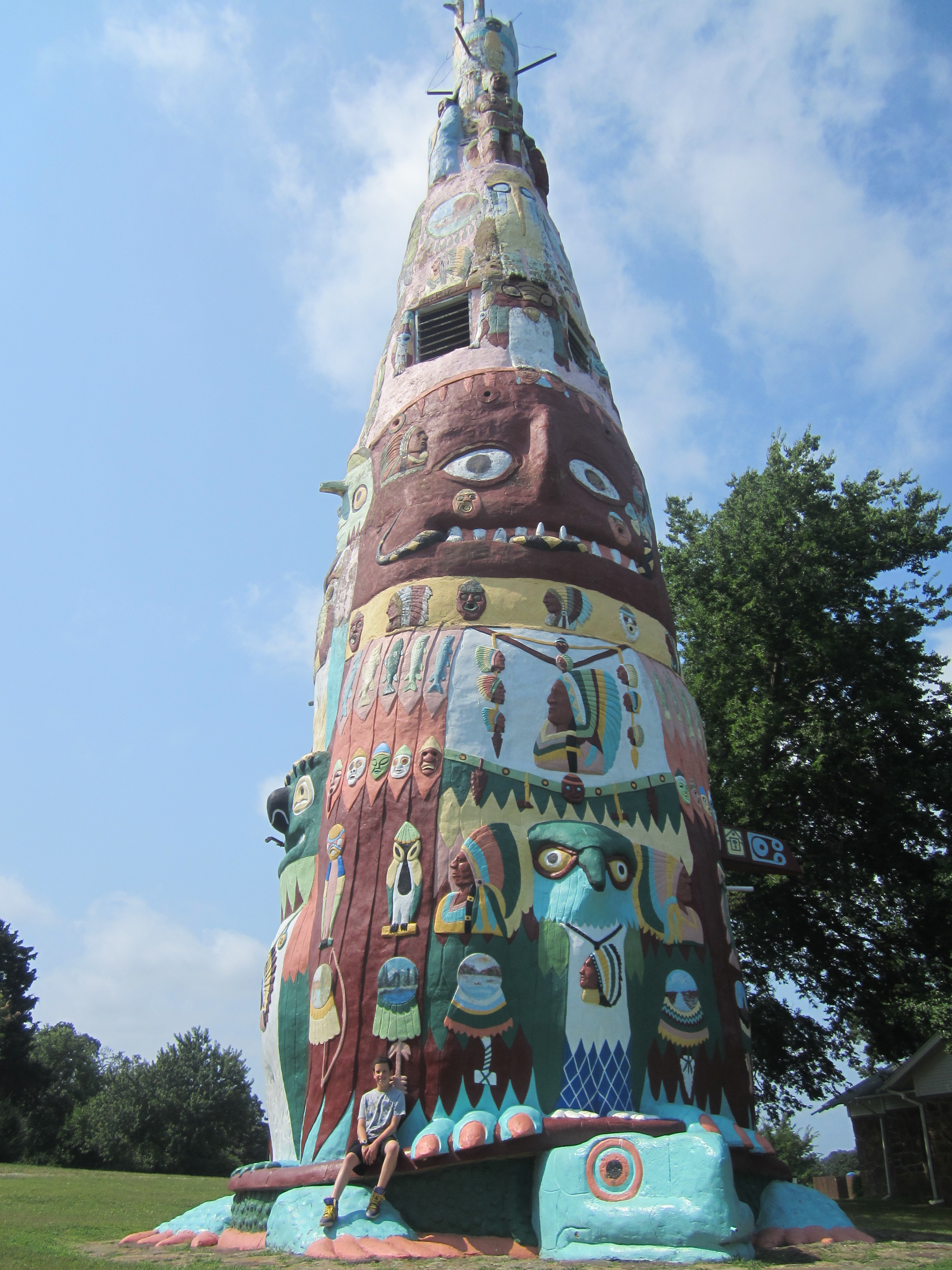
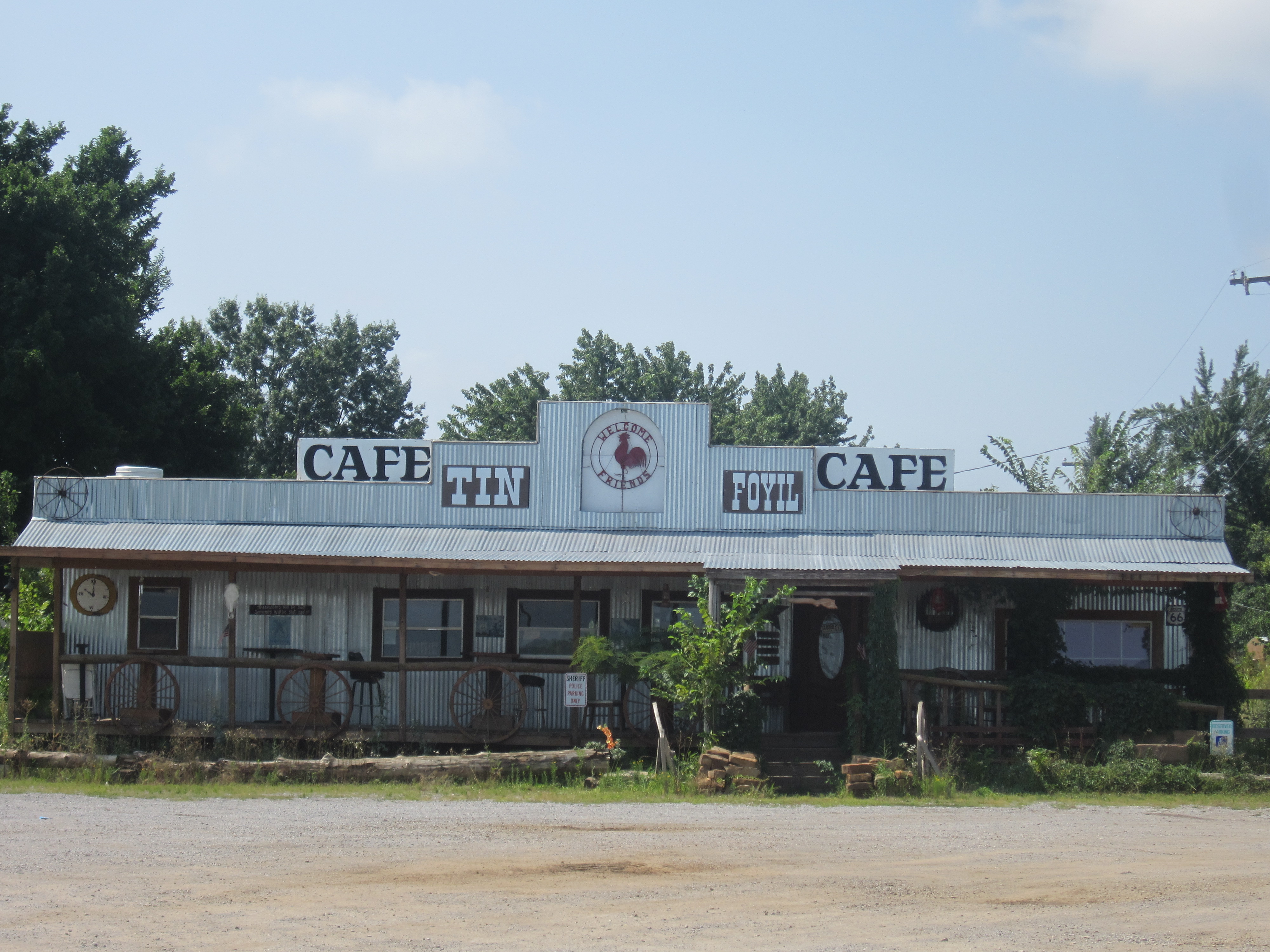
Before we even got to Tulsa, we were bombarded with classic Route 66 roadside nonsense, the first being a totem pole park in Foyil, OK, which features several totems, none of which are of native origin but all of which are colorful and interesting looking. The main draw, though, is the biggest totem pole in America, which stands at 90 feet tall and 18 feet wide.
Just down the road is a cheekily named diner:
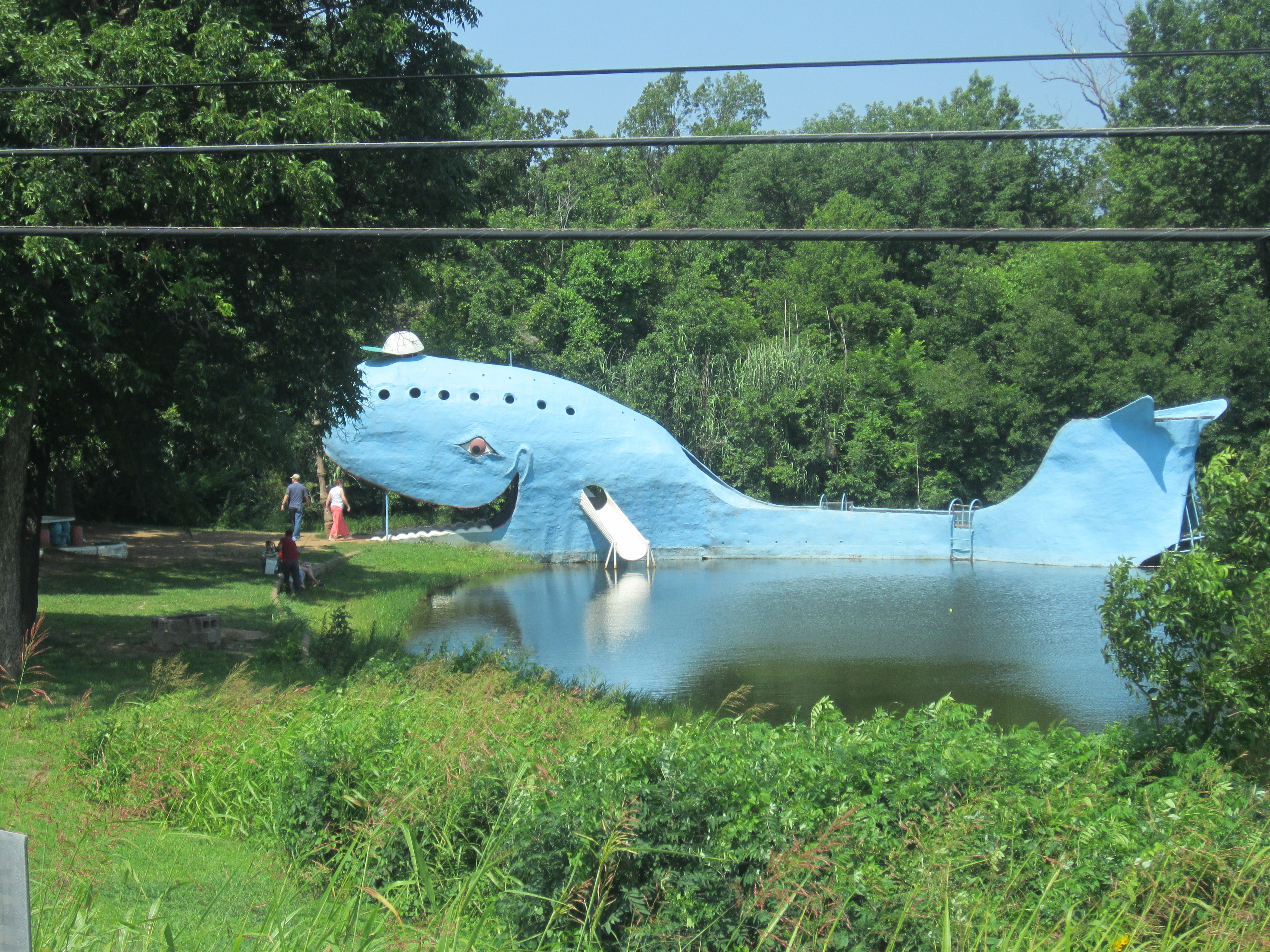
And a few miles later, an enormous blue whale floating on a pond with a water slide coming out of its body:
When we got to Tulsa, our first stop was the convention center, not for the RV and boat show being held there but for the enormous golden statue of a worker leaning on an oil well, known locally as the Golden Driller statue.
However, with not much of substance on our agenda for the day we decided to stay a while and check out the RV show. For $8 admission, we got an hour of gawking at RVs that are more pimped out than my house—multiple bathrooms, sleeping room for six, 60-inch TVs, outdoor kitchens, and more. I tried to emotionally distance myself so that I wouldn’t get too attached, but I have to admit it was nice to fantasize about driving something that not only has room to spare but also an oven, a full-sized fridge, and even a washer and dryer. The six-figure price tags helped snapped me back to reality, though. However, with the excitement and abandon of a 12-year-old and absolutely zero concern about cost, Sam fell deeply in love with a few models and plans to convince both of his parents that a tricked-out RV is a must-have.
Eventually I dragged him out of the RV show and we continued to visit and pass odd and interesting sights around the city, most notably an extremely detailed statue of former Tulsa businessman Hans Helmerich sitting on a park bench and reading a copy of the Tulsa Daily World newspaper.
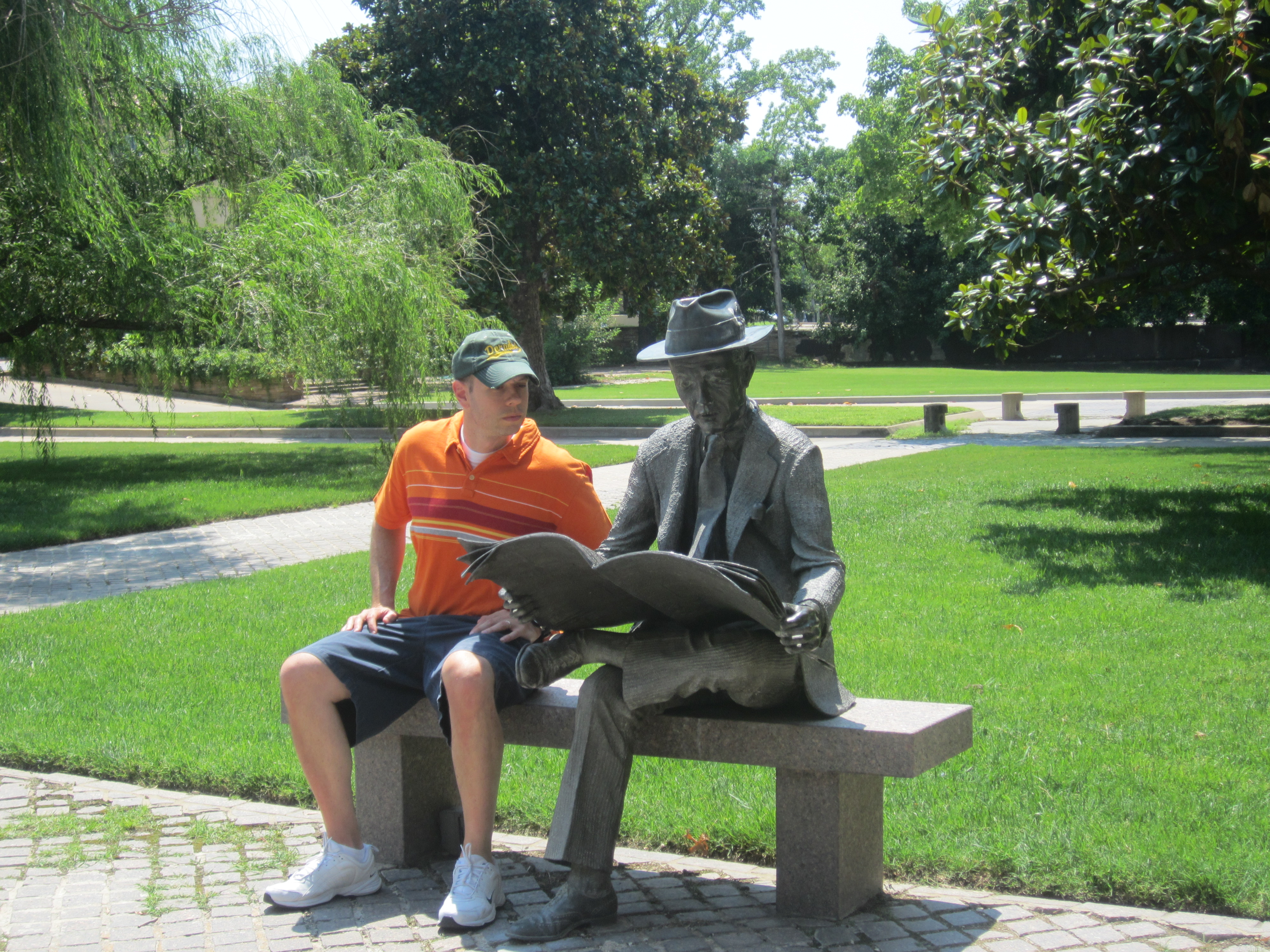
Along the way there were some other gems as well:
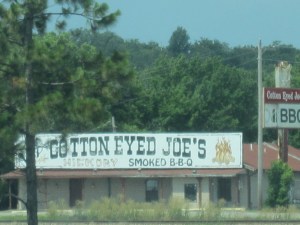
So THAT’S where he came from and/or where he went!
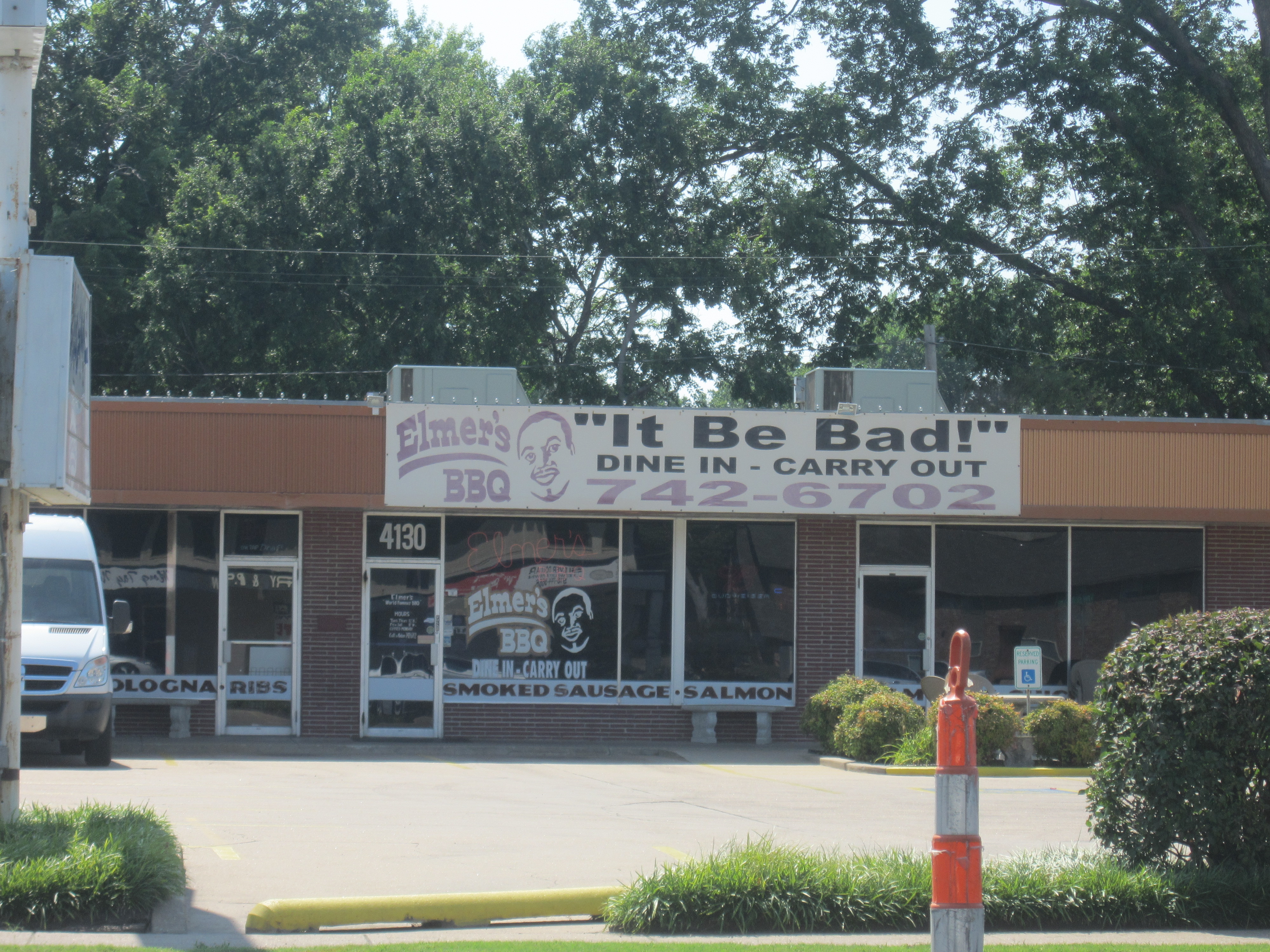
It be bad
Tulsa is one of the few places on our route between St. Louis and Los Angeles with kosher food is available, so we tried to get our hands on some. It didn’t go so well, though. The only synagogue in town has a little store that carries raw meat, and we tried to go there but accidentally ended up at the Chabad house, which does not sell meat but does have a very friendly and kind rabbi and rebbitzen who recommended the aquarium as something fun to do in Tulsa. We then found the synagogue, which was closed by the time we got there.
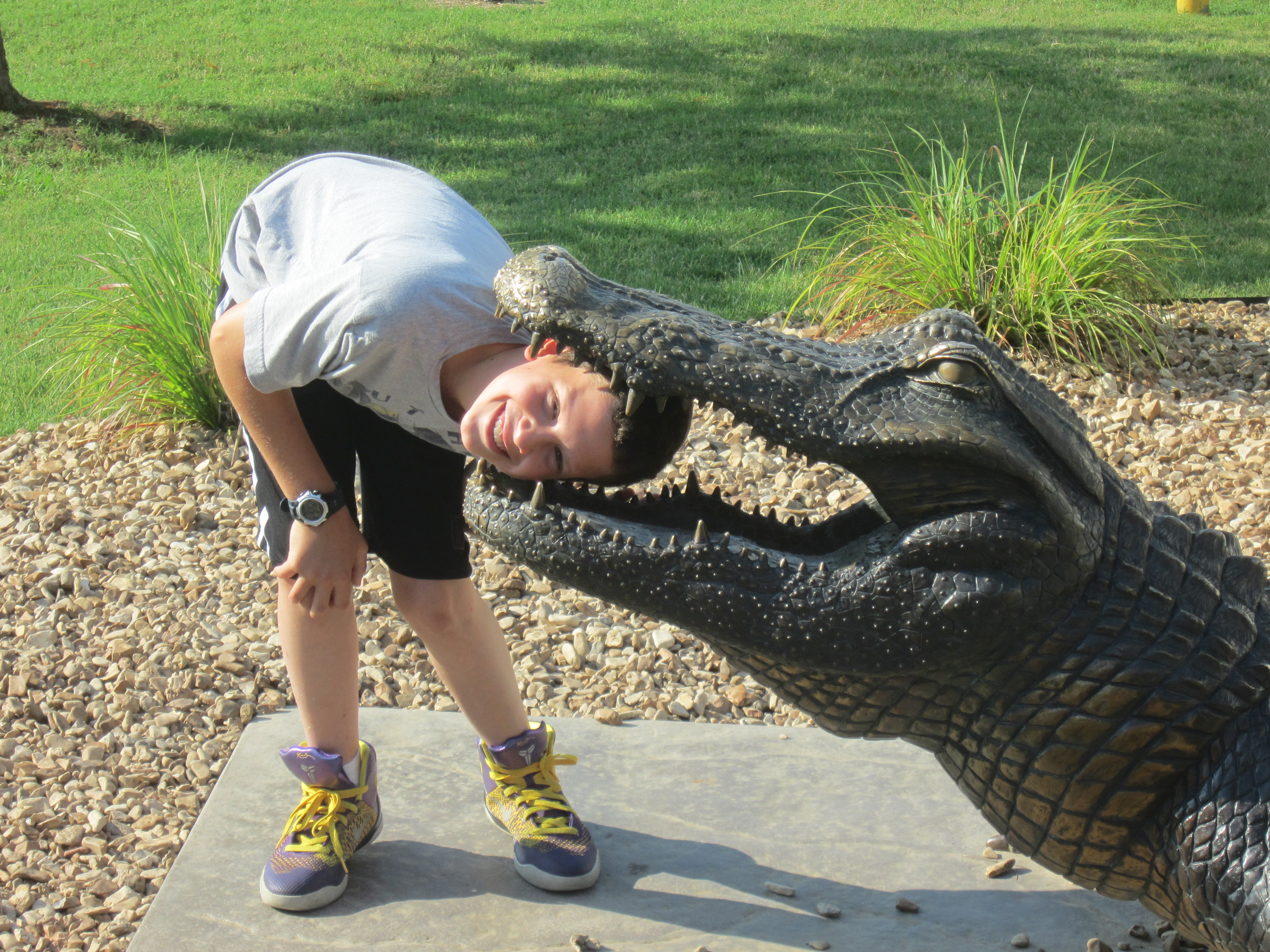
At that point I took advantage of our abundance of free time and got a car wash, where the girl behind the counter recommended the aquarium as something fun to do in Tulsa. So we gave in and went to the aquarium, which was fun but a little on the small side, and we were in and out within an hour.
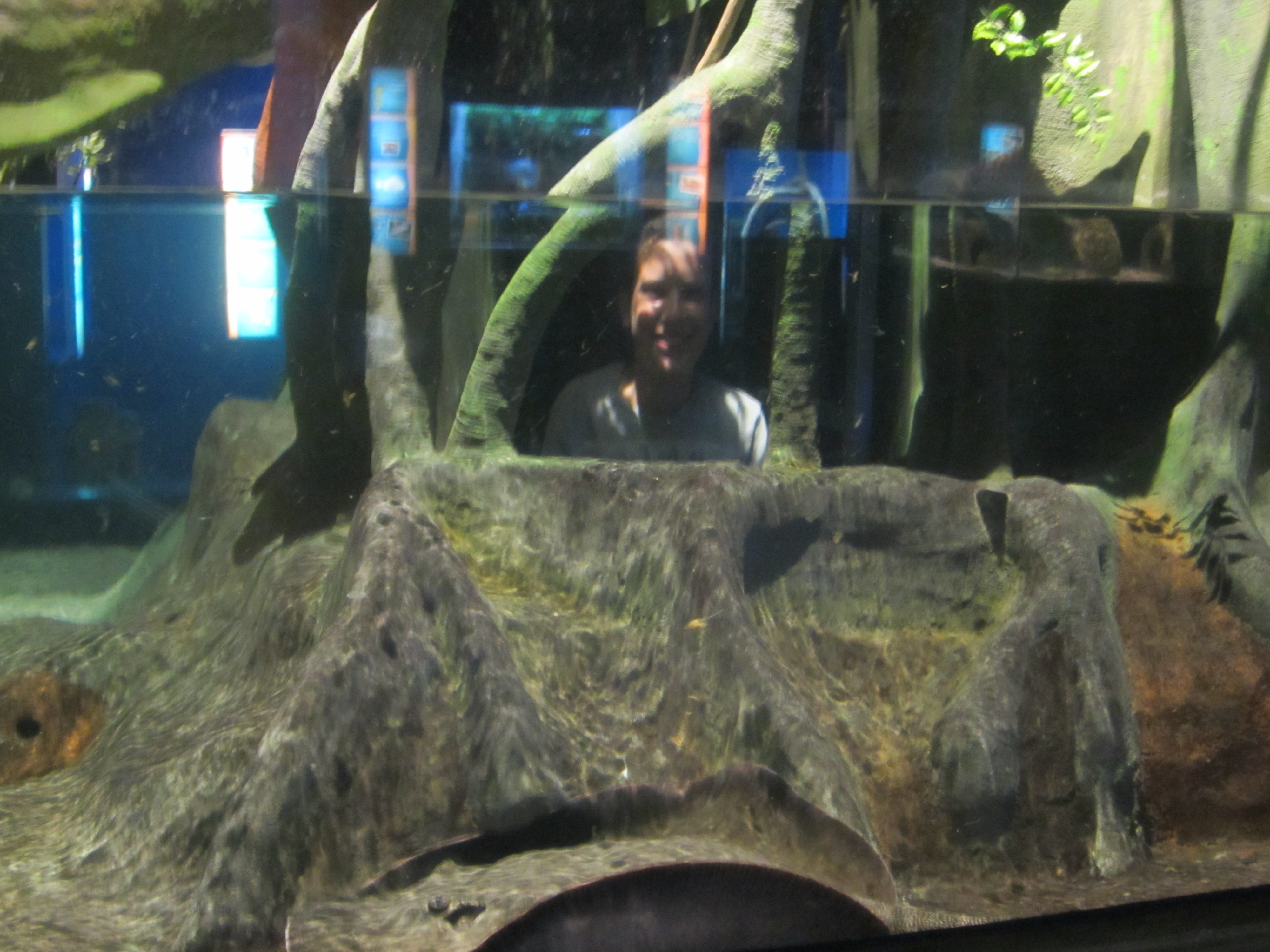
Sam’s in the tank
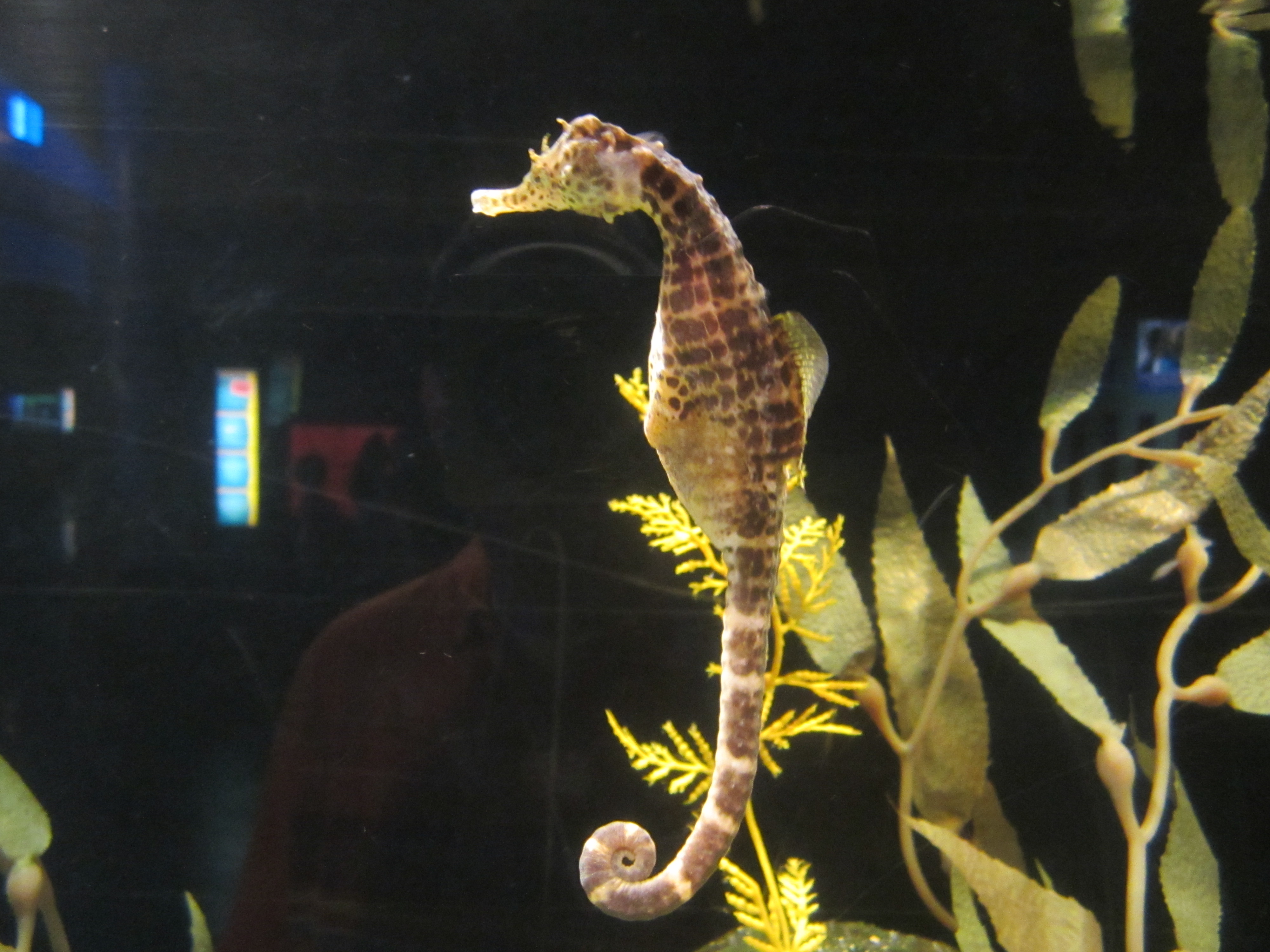
I would like to take this opportunity to mention how much I absolutely love seahorses. There is simply no more awesome animal on earth. They have the heads of horses but the bodies of deformed mermaids. They swim standing up. They are entirely peaceful. The men get pregnant and have the babies. I dare you to name an animal that holds a candle to the seahorse’s coolness. You can’t.
Anyway, there are several cute parks scattered all over the city, not even counting the riverside parks, and after stopping at a market to restock on veggies we found a little park and grilled dinner (hot dogs and asparagus).
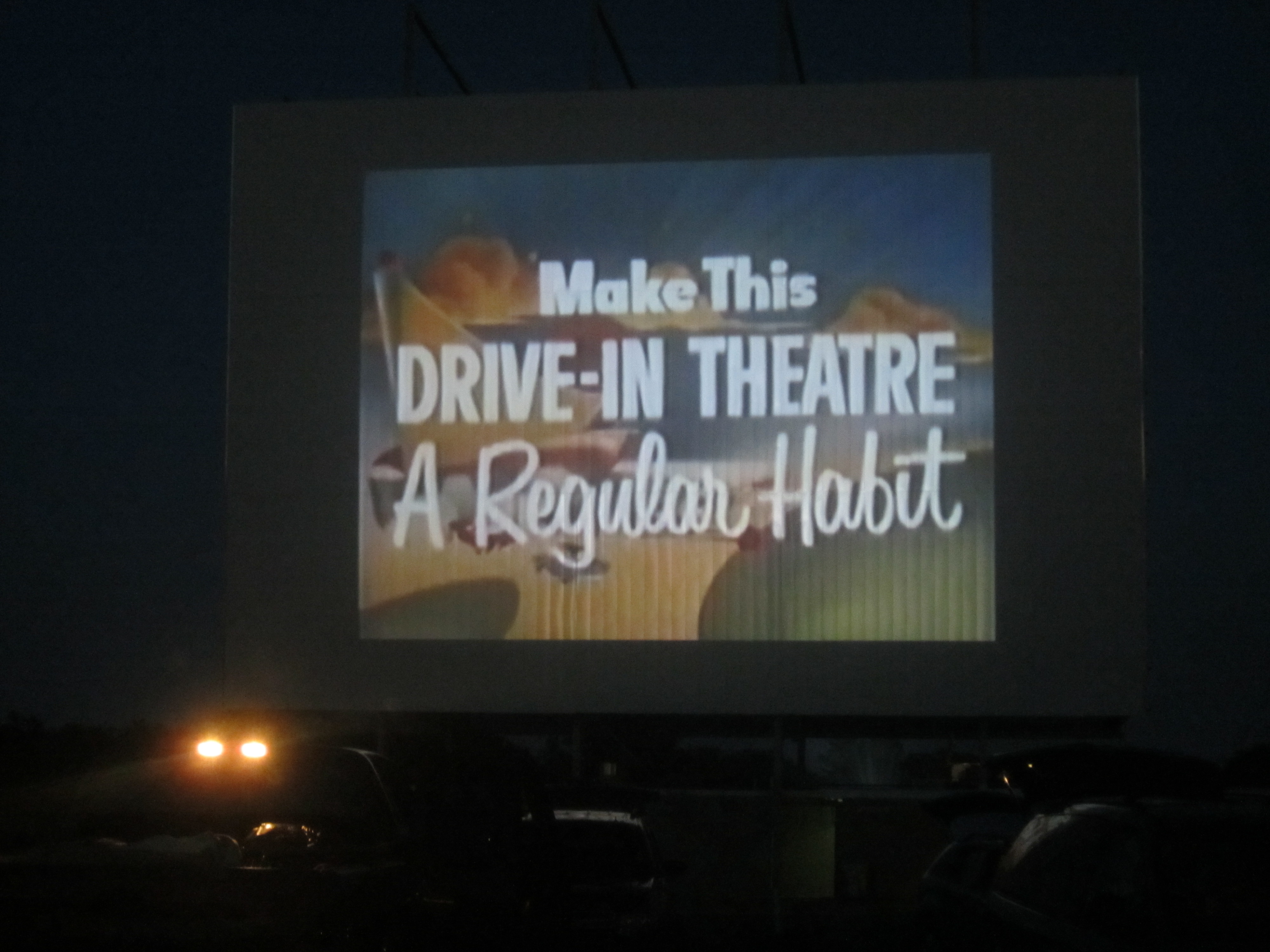
The main attraction of the day was a drive-in movie theater, which was rebuilt a couple of years ago after a big fire and was thus reputed to be rather nice and state-of-the-art. We’d been excited for the drive-in all day but when we finished dinner there was still time to see one more oddity before the movie.
The Center of the Universe is clearly misnamed as it is most definitely not central to the universe, either physically or spiritually. It is, however, a freakish acoustic anomaly that was totally worth a visit. Essentially it’s just a brick circle in the middle of a pedestrian overpass in the arts district. But if you stand right in the center of the circle and speak, your voice reverberates in your own ears as if you’re speaking in a microphone, but everyone else nearby hears your voice normally. Additionally, if anyone outside the circle speaks to you, you hear them normally. There are no buildings or walls very close by that would naturally echo sound, so this phenomenon makes no sense. Adding to the mystery is a strange tower a few feet from the circle that shows dozens of little men and dozens of little hands and has no explanatory plaque.
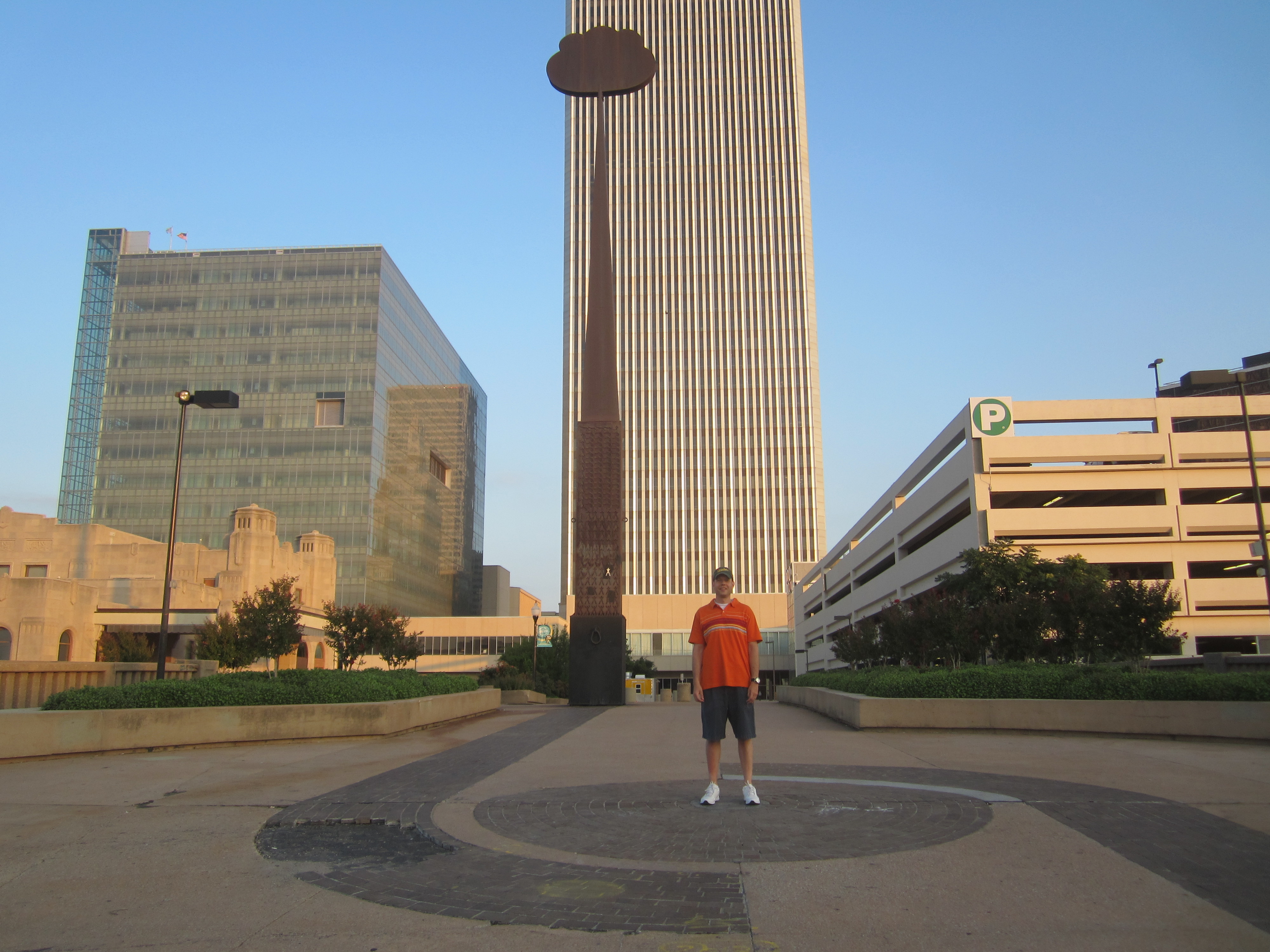
We stayed for only a few minutes but it was lots of fun and super weird and I am at a loss for anything more to say on the matter.
We finally made our way to the drive-in, which caused lots of scheduling problems but was totally worth it. See, the movie can’t start until dark, which is at around 9 p.m. But Monday morning we were planning to go to the live cattle auction in Oklahoma City’s stockyards at 8 a.m. That meant sleeping in Oklahoma City, which is a two-hour drive from Tulsa. Which meant Sunday would be a very late night followed by a very early morning. I toyed with the idea of skipping the movie, but I’d never been to a drive-in before, and I don’t know when I’ll have another opportunity, and Sam completely agreed.
We saw the new Planes sequel. Ordinarily I would have no desire to see this movie, as the first one wasn’t very good and like any rational human being I try to avoid any movie that stars Dane Cook. But I knew Sam would enjoy it, and I also knew it would mean a more family-oriented crowd, which would make the whole experience more comfortable. We ended up having a great time. The movie was mediocre, but it was super cool to park the car, put the top down, and watch from our seats with a gentle breeze keeping us cool. After fantastic weather for the past week (high 70s and sunny most of the time) July finally showed itself today with temperatures around 90 most of the day, so nightfall and the cooler temperatures it brought was especially enjoyable. The movie was mediocre, but Sam and I had a great time.
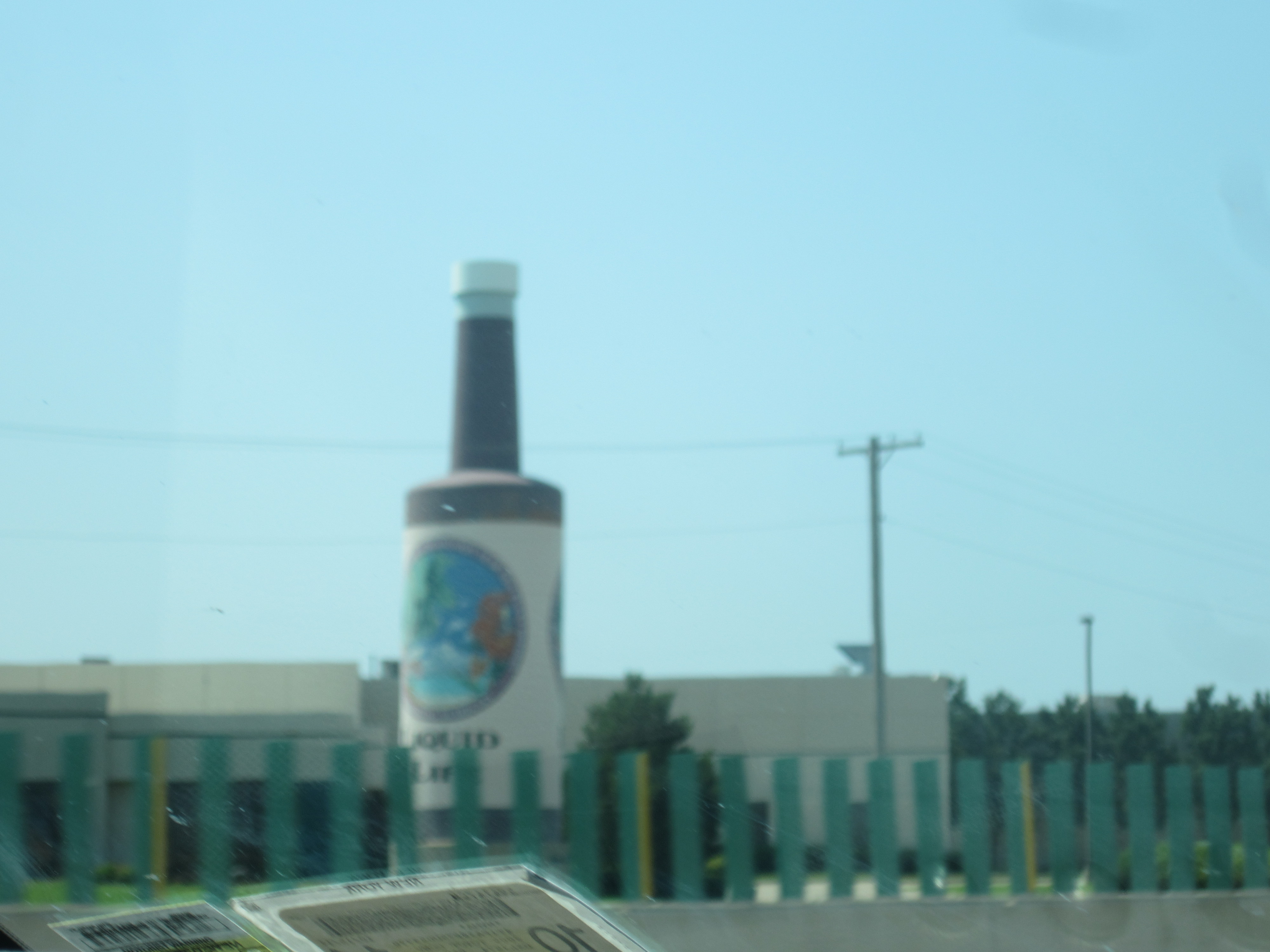
At 10:30 we began the drive to Oklahoma City. Sam fell asleep a little after 11, and by doing so he missed our final roadside sight of the day: a giant neon soda bottle right along Route 66. The bottle is—you guessed it—66 feet tall and lights up in color-changing rings. Nobody else was on the road, so I pulled over to snap a quick photo.
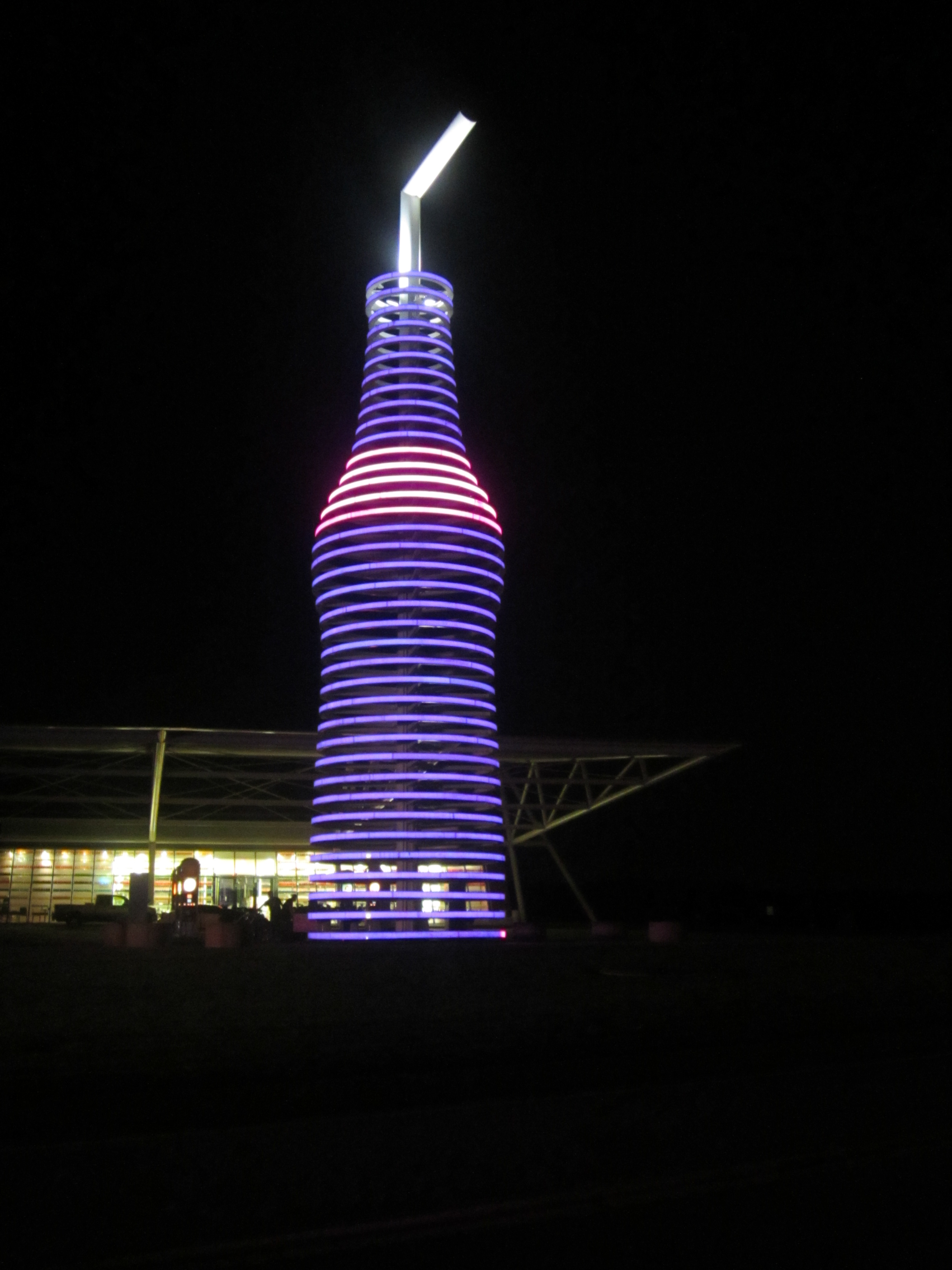
While I was doing so, a police car passed by and, curious, turned around and followed me for a good 20 minutes before losing interest in me.
Eventually we arrived at our motel, the third Super 8 we’ve stayed in thus far. I was pleasantly surprised by the first two. Not this one. But on the bright side, we won’t be here for long, as we’ve got a cattle auction to get to early in the morning.
It’s … OK
We woke up early Friday morning so that we could get a lot in before sundown. We were staying in yet another surprisingly nice Super 8 just outside of Springfield, MO, and we planned to spend the morning doing a couple of interesting-sounding things in Springfield.
The first was a tour of the Pythian Castle, a real stone castle that’s right next to a military base in the middle of town and, we learned, was built in 1911 as an orphanage/retirement home by a national fraternal order called the Knights of Pythias. We went there for the first tour of the day, and we were the only ones on the tour. The castle was cool, though, and the tour guide was not only very nice and very knowledgeable but, in a surprise twist revealed at the end of the tour, is also the owner of the castle. But ultimately it was just not as interesting as we’d hoped it would be.
Next up was Fantastic Caverns, the only drive-through cavern on the continent (there are a few others around the world, we were told). For the hour-long tour everyone piled into a long cart with a low bench running lengthwise down each side, which was pulled by a little Jeep being driven by our tour guide, Elizabeth. Elizabeth meant well but she was rather annoying. She used an announcer voice rather than a normal human voice, which led her to overemphasize roughly half the words in each sentence. She also kept asking, “Is there any more questions?” I can overlook this grammatical atrocity if it’s done once accidentally, but she used the exact same phrasing every time, which was at least half a dozen times. Also, most of the other people on our tour were rather annoying as well. One woman never stopped talking to her adult son for even a second. A little girl whacked into Sam repeatedly for most of the hour. Several other people laughed uproariously at everything the tour guide said, none of which was even slightly humorous Five men on the tour had large, bushy mustaches that looked like push brooms, which might have been cool or at least interesting if these men were travelling together as some sort of cavern-loving barbershop quintet. But alas, these were five individuals who each, on his own, decided that a push broom mustache is a good look for him. All of this would have been much more tolerable if the cave itself was really impressive, but in fact the cave was just average. I mean, an average cave is still pretty awesome, and this was, but it was easily the least impressive cave I’ve visited. Sam enjoyed the cave more than I did; however, like the castle it was enjoyable but not as cool as we’d hoped it would be.
When I originally started researching things to do in Springfield the first thing that caught my eye was The Butterfly Palace, which is literally a building full of butterflies, plus various exhibits and whatnot. I was pretty excited for it, but then I discovered that it’s located not in Springfield but an hour south of Springfield, which is of course the wrong direction when you plan to motor west. So I crossed the Butterfly Palace off our itinerary a few weeks ago, but I spent a good chunk of the morning wondering if we should’ve gone there instead of the other two places. So if you ever find yourself in Branson, MO, please visit the Butterfly Palace and then let me know if I made the right call.
Anyway, after the cave it was right back on 66 for one more stop before we left Missouri: George Washington Carver’s childhood home, which is now a National Monument. It’s about 20 minutes south of Route 66, and on the surface it would seem like an odd entry in our itinerary. But I figured it was veering off for, for two important reasons. First, there are two foods that are deeply and universally beloved by all four Hofstetters: fried chicken, and peanut butter. There are plenty of other foods we enjoy, but these are foods we get excited about, foods we think about when we’re not even hungry, foods we savor every single time we eat them. To avoid an early demise, we severely limit our fried chicken consumption despite our love. But peanut butter is a staple in our house, and on our road trips. In our house, peanut butter is a meal, a snack, a dessert, and an ingredient in marinades, stir fries, cookies, brownies, and whatever else we can think of. So I figured Sam would enjoy learning a bit about the man most closely associated with turning peanuts into other foods and products. The second reason is that Carver is often (appropriately) hailed as an important black man in American history, not just for his agricultural discoveries and advancements but because of his effects on race relations. As we learned in a biographical film at the Visitors Center, Carver’s testimony in Congressional hearings about peanut farm tariffs won over a hostile and racist Congressional panel and did a lot to earn respect for his race as well as for his crop. I grew up in one of the most diverse neighborhoods in Queens, NY, a borough known for its diversity. But Sam is growing up in a disturbingly homogeneous suburb where racism and other prejudices are far too common, and because of that I make an extra effort to expose Sam not just to racial and ethnic and socioeconomic diversity, but to our country’s history of prejudice and intolerance. Visiting Carver’s birthplace was a way to sneak some of that into a fun conversation about all the fun stuff that can be made from peanuts. In fact, the most fun we had while we were there was when we learned that Carver developed both ink and paper made from peanuts, and we were joking about whether you can even see something that’s written with peanut ink on peanut paper. And as we were leaving, we each dug a spoon into a jar of peanut butter and “toasted” Carver.

Warning: Peanuts in Use
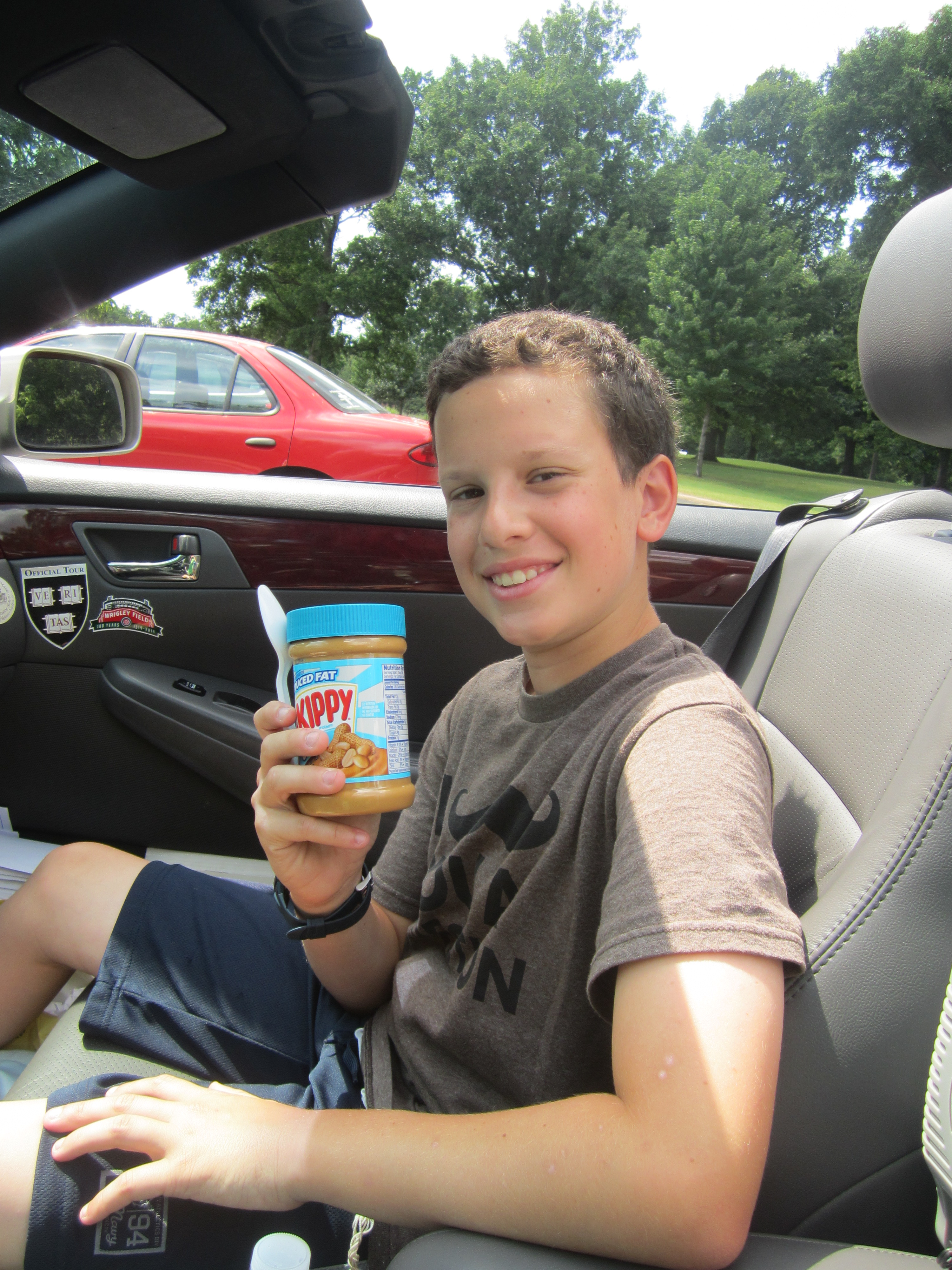
To George!
We did have a little trouble finding the place, though. See, I’ve mostly been ignoring the GPS directions because they keep telling us to get off Route 66 and onto the Interstate. This time I ignored them a little too long and we ended up passing the place by several miles. However, for the rest of the day we didn’t leave Route 66 for more than a few blocks. 66 took us from southwestern Missouri into southeastern Kansas–specifically tiny Baxter Springs, the town where Mickey Mantle played Little League and, at age 15, was discovered by a scout for the Yankees. We stopped off briefly at the Baxter Springs Heritage Center and Museum, which was surprisingly large and nicely done, to see its mini-exhibit on Mantle. However, we found a couple of vehicles on the museum grounds that were a little more interesting:
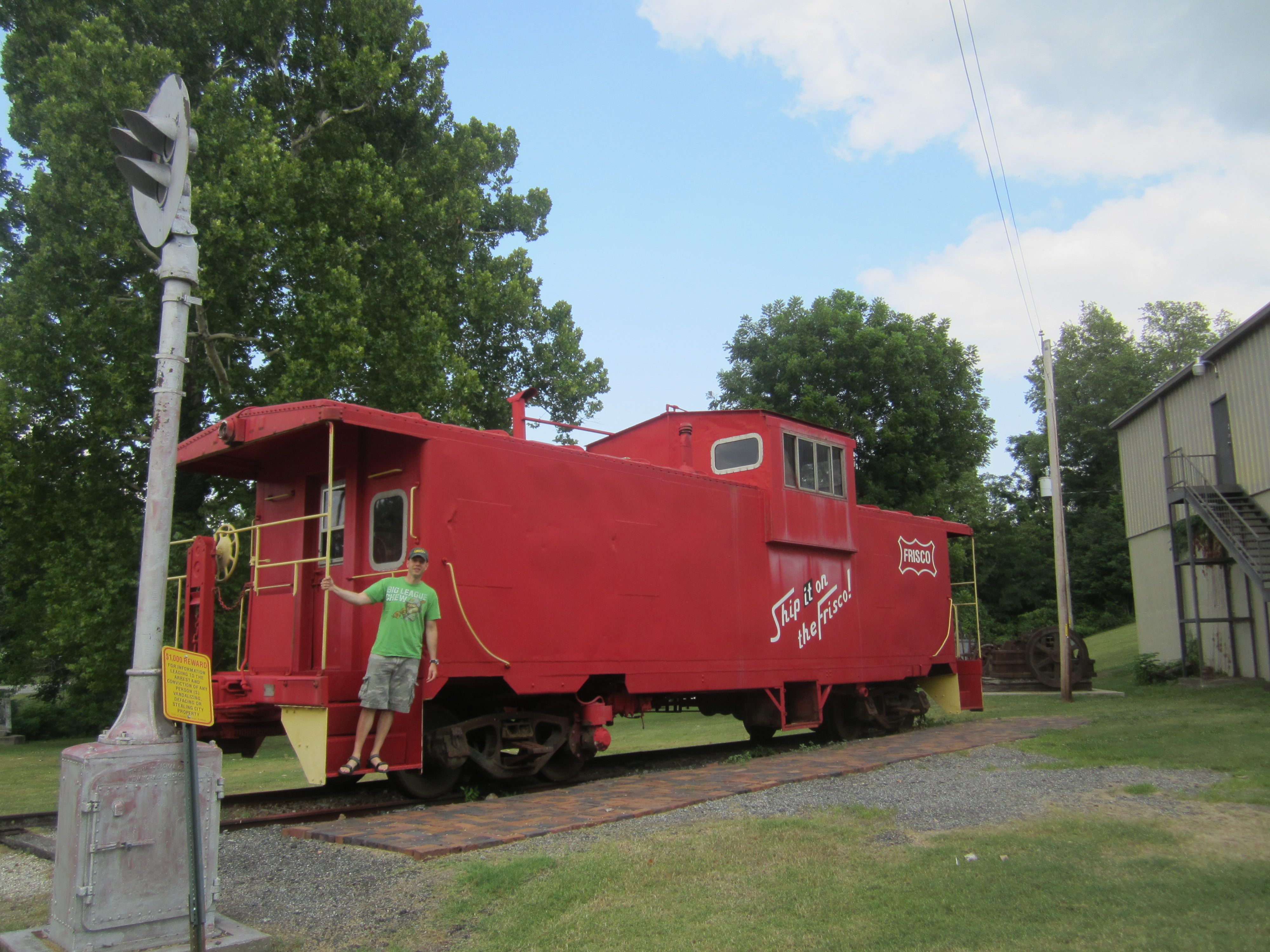
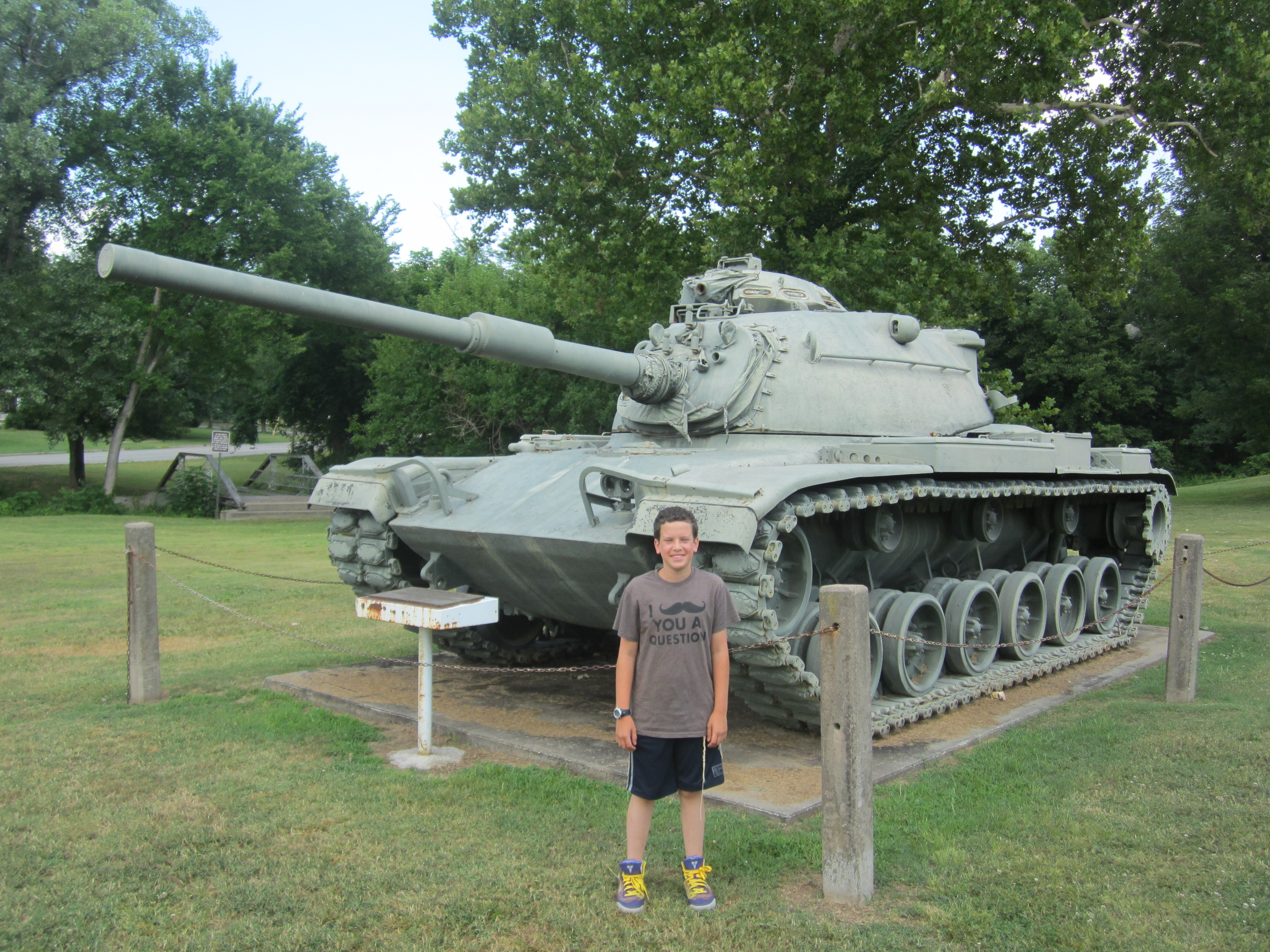
The rest of Radiator Springs–er, Baxter Springs, is extremely, well, I don’t know how to say this except Route-66-ish. The road runs right through the center of this tiny town and acts as the main drag. The stores are both quaint, kitchy, and mostly out of business.
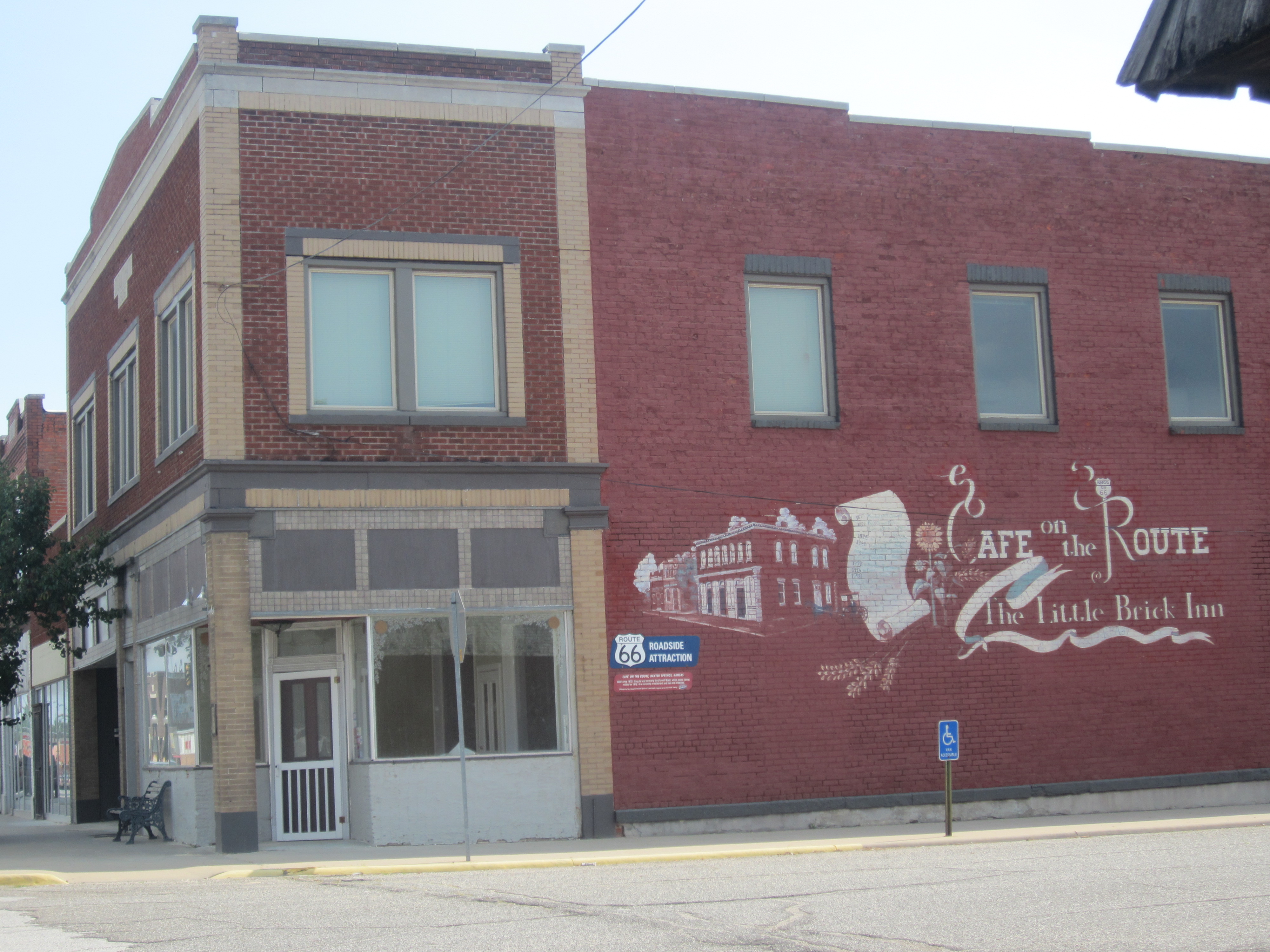
This cute cafe has been designated an official Route 66 attraction, but it’s no longer in business.
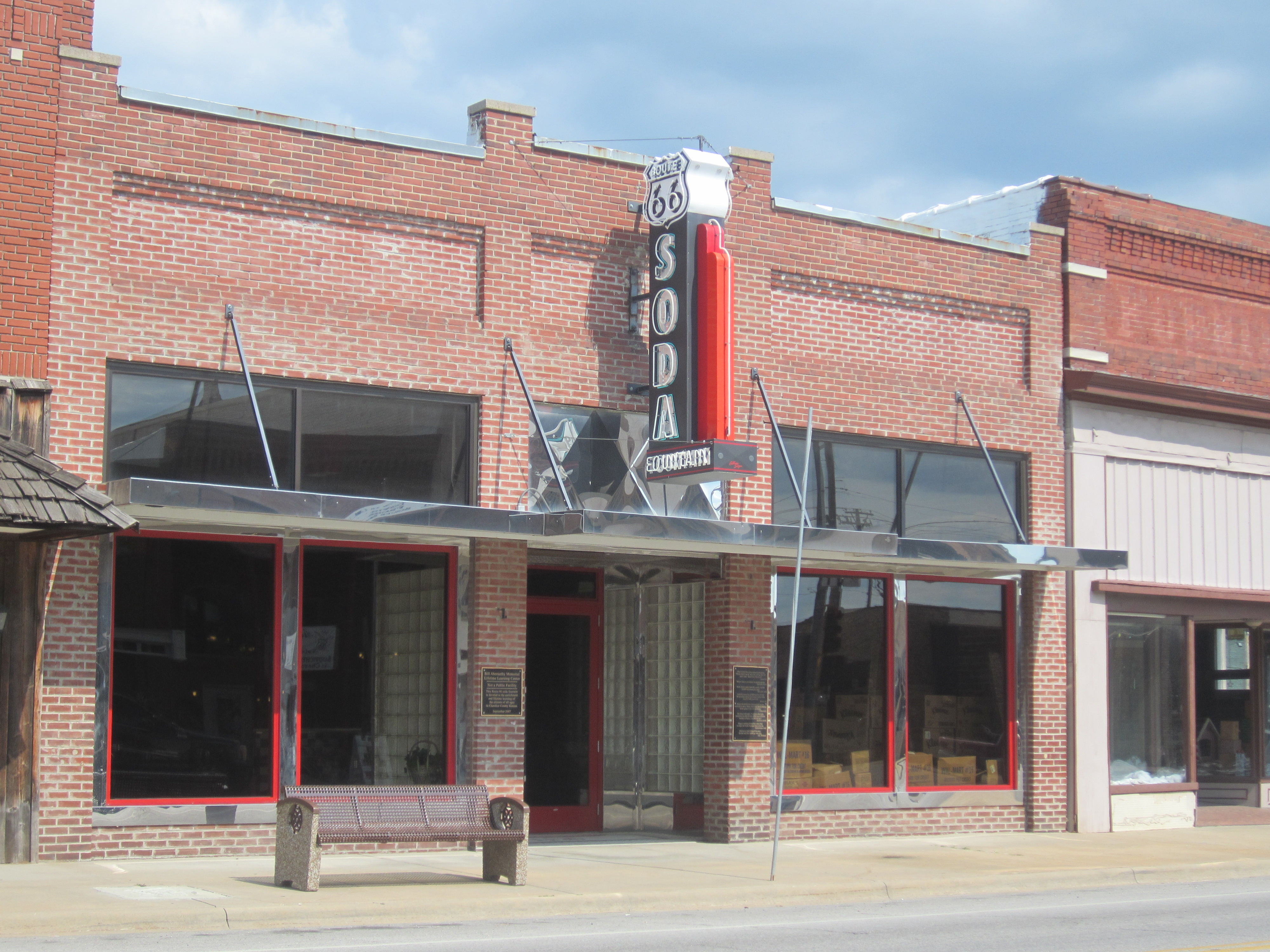
This soda fountain is another defunct Route-66-ish business in Baxter Springs.

This cheesy “flea market” is still in business, but was closed when we passed by, which was at about 4:30 pm on a Friday.
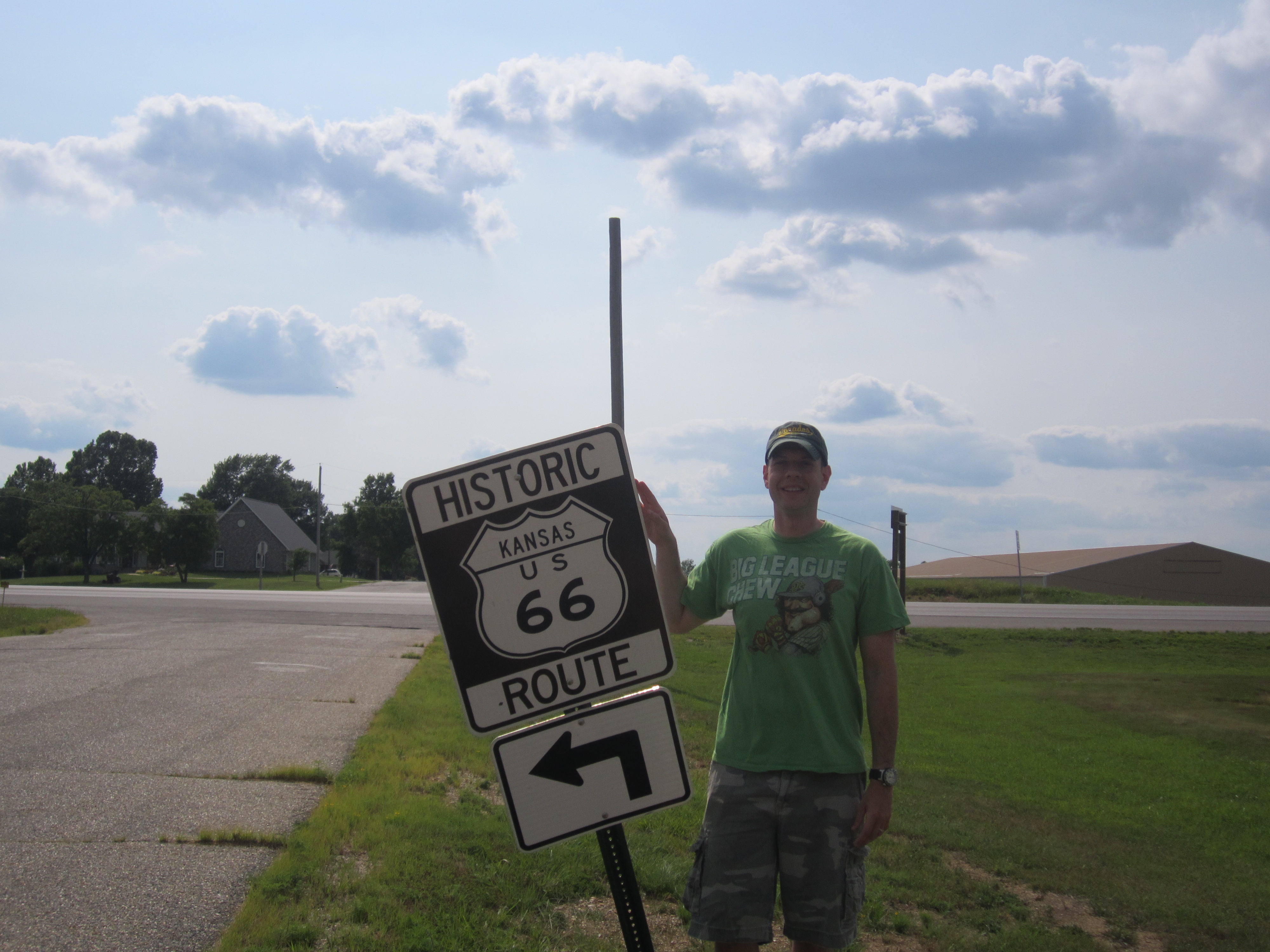
Even the Route 66 road sign was falling over.
It wasn’t more than three minutes before we were not just out of Baxter Springs but out of Kansas entirely, as Route 66 turns south from southeastern Kansas into northeastern Oklahoma. The first town we hit in Oklahoma was the ironically named Commerce. I’m going to be polite and say that there is not a lot of commerce taking place in Commerce. I was actually excited to see the town because it’s where Mickey Mantle grew up; his first nickname was the Commerce Comet. I knew he came from humble beginnings but I’m going to be polite again and say that I underestimated the humility of his beginnings. His boyhood home, which we visited, has three small rooms and is easily the nicest house on the block.
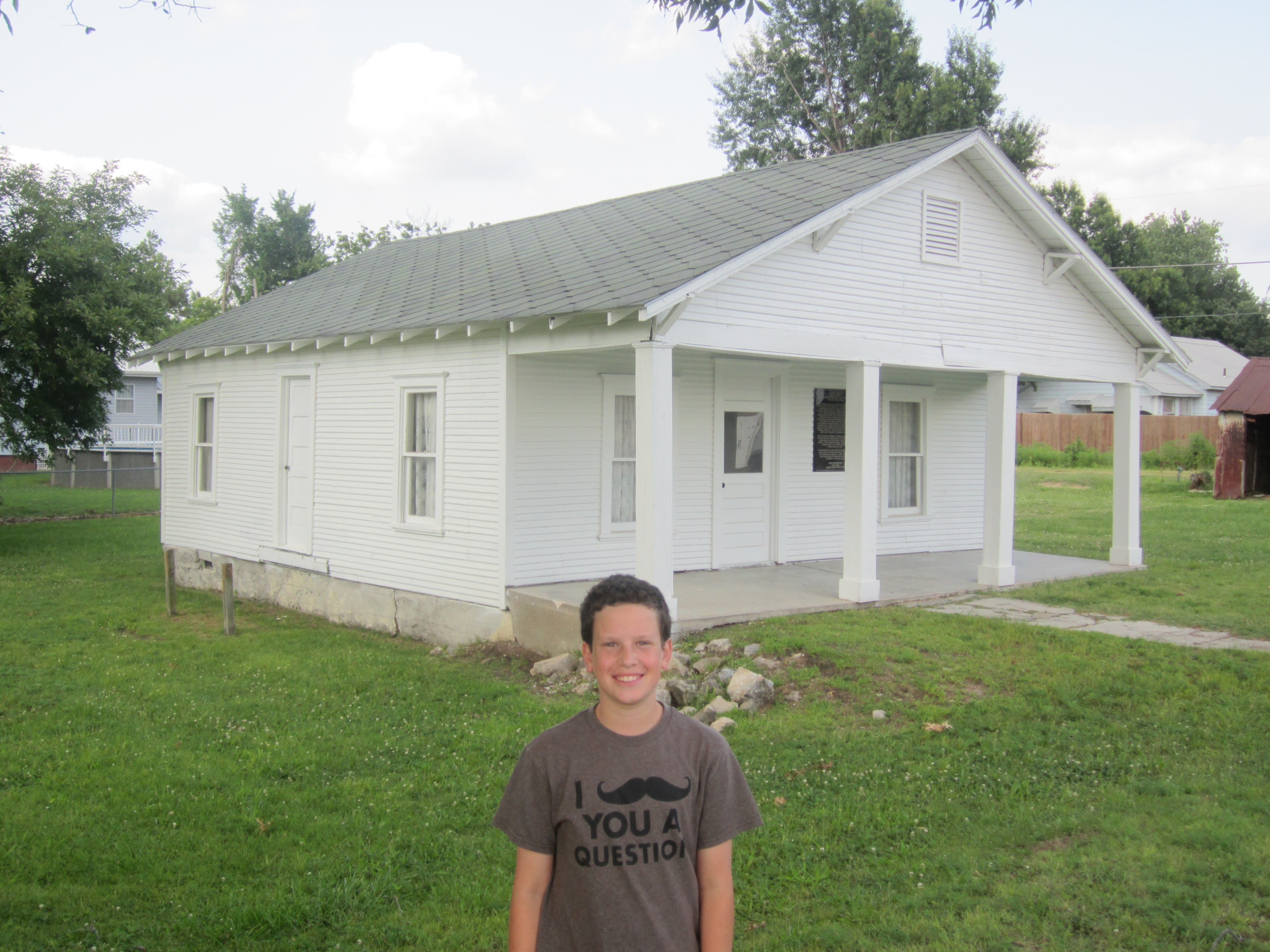
When we parked outside Mantle’s house there were three boys of clearly different ages riding bikes up and down the street. I made a remark to Sam that something about those boys made me think they were trouble. A few minutes later, when we were getting back into the car to leave, a police car rolled slowly up the block, and the oldest boy, who was maybe 11, yelled to the others, “The cops are here! Let’s go!” I’ll never know what that was about but let me just say that Sam and I will not be begging the rest of the family to move to Commerce anytime soon.
The stretch of Route 66 that goes through Commerce is named Mickey Mantle Boulevard. It runs past Commerce High School, which has a big statue of Mickey Mantle outside of its ballfield. I bet you can’t guess what the field is named. Give up? It’s Mickey Mantle Field!
A minute or two later we were out of Commerce and in Miami, Oklahoma, which is just as ugly and run down as Commerce (OK, I guess I’m done being polite now) but it’s bigger, so it has several cheap motels. We ended up staying in a Hampton Inn, and as we drove up I kind of wanted to say to the hotel, “What’s a nice girl like you doing in a place like this?”
So, yes, if any Jews ask, I spent Shabbos in Miami.
Shabbos was perfectly pleasant and very relaxing, but a little boring. In fact, most of the time Shabbos on our road trips can be described that way. We bring games and reading material, packed in a backpack that we affectionately call “The Magical Bag of Shabbos Fun.” We eat a lot, we sleep a lot, we read, we play. But we also miss Mommy, and we get a little sick of our hotel room, which we leave as infrequently as possible because of the difficulty of getting back in with an electronic key.
This is the first time either of us has been to Oklahoma, making it my 46th state and Sam’s 45th (Wisconsin being the difference between us). The state motto is “Oklahoma is OK,” which I think is supposed to be a hilariously clever pun on the state abbreviation but is in fact one of the saddest of all state mottoes, as it declares the state to be mediocre. What were the mottoes that were rejected in order to go with this one? “Oklahoma: meh.” “Oklahoma: whatevs.” “Oklahoma: it’s aiight.” “If you like tornadoes, you’ll LOVE Oklahoma!” “Oklahoma is shaped like a cooking pot.” “Oklahoma: just keep driving for a couple more hours and you’ll be in Texas.”
I’m expecting the next couple of days in Tulsa and Oklahoma City to be a lot of fun, with minor league baseball, cattle auctions, horseback riding, weird roadside statues, and maybe even a drive-in movie. But Friday and Shabbos were, as the motto says, OK.
Friday in … Miami?
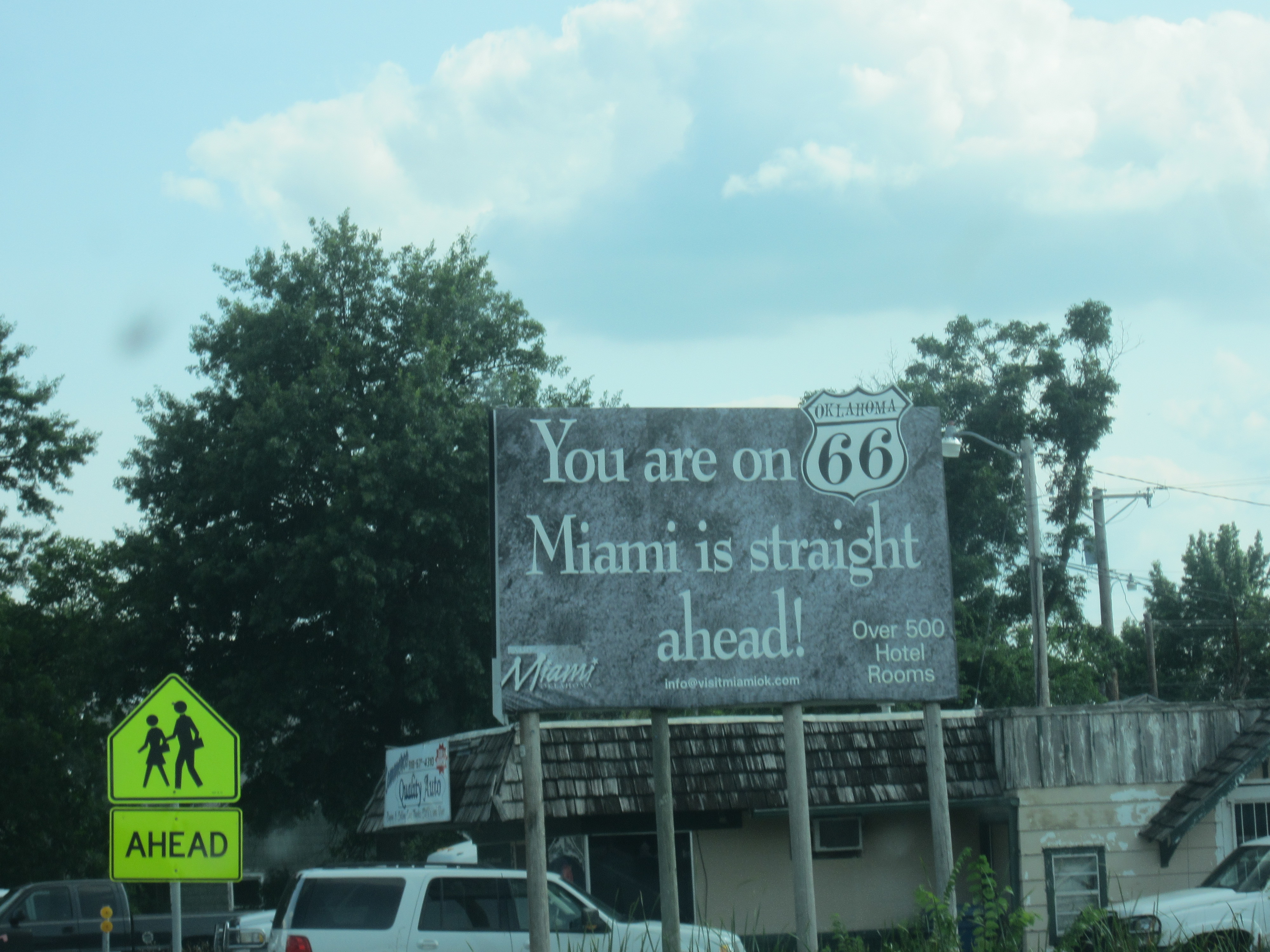
We spent the morning in Springfield, MO, seeing a castle and then a cave, then visited George Washington Carver before heading to a tiny little sliver of Kansas to see Mickey Mantle. Then we headed into Oklahoma for more Mickey Mantle and ultimately ended up in Miami. That’s Miami, Oklahoma, of course, which is where we’re spending Shabbat.
I’ll post details of the day and of Shabbat on Saturday night.
 The Hamster and the Highway