The Last Word
On the final day of our road trip, I’m going to let the Hamster have the last word. (Sorry it’s sideways.)
Road Trip by the Numbers
1: cross-country road trip
33: days on the road
8435.8: miles driven
20: states visited
179:10: spent hours in the car
47.2: average miles per hour
26.2: average miles per gallon
$4.59: highest price paid for gas (Ludlow, CA)
$3.08: lowest price paid for gas (outside Knoxville, TN)
109: highest temperature in degrees Fahrenheit
8: states traversed by Route 66
8: states visited on Route 66
6: state capitals visited (Springfield, Oklahome City, Phoenix, Nashville, Little Rock, Harrisburg)
9: National Parks/Historic Sites/ Memorials visited
4: time zones
2: coasts
1: desert crossed
94: bottles of water purchased
91: bottles of water consumed
134: other types of drinks consumed
4: times doing laundry
3: car washes
2: oil changes
2: boys who had a fantastic time
Welcome Home
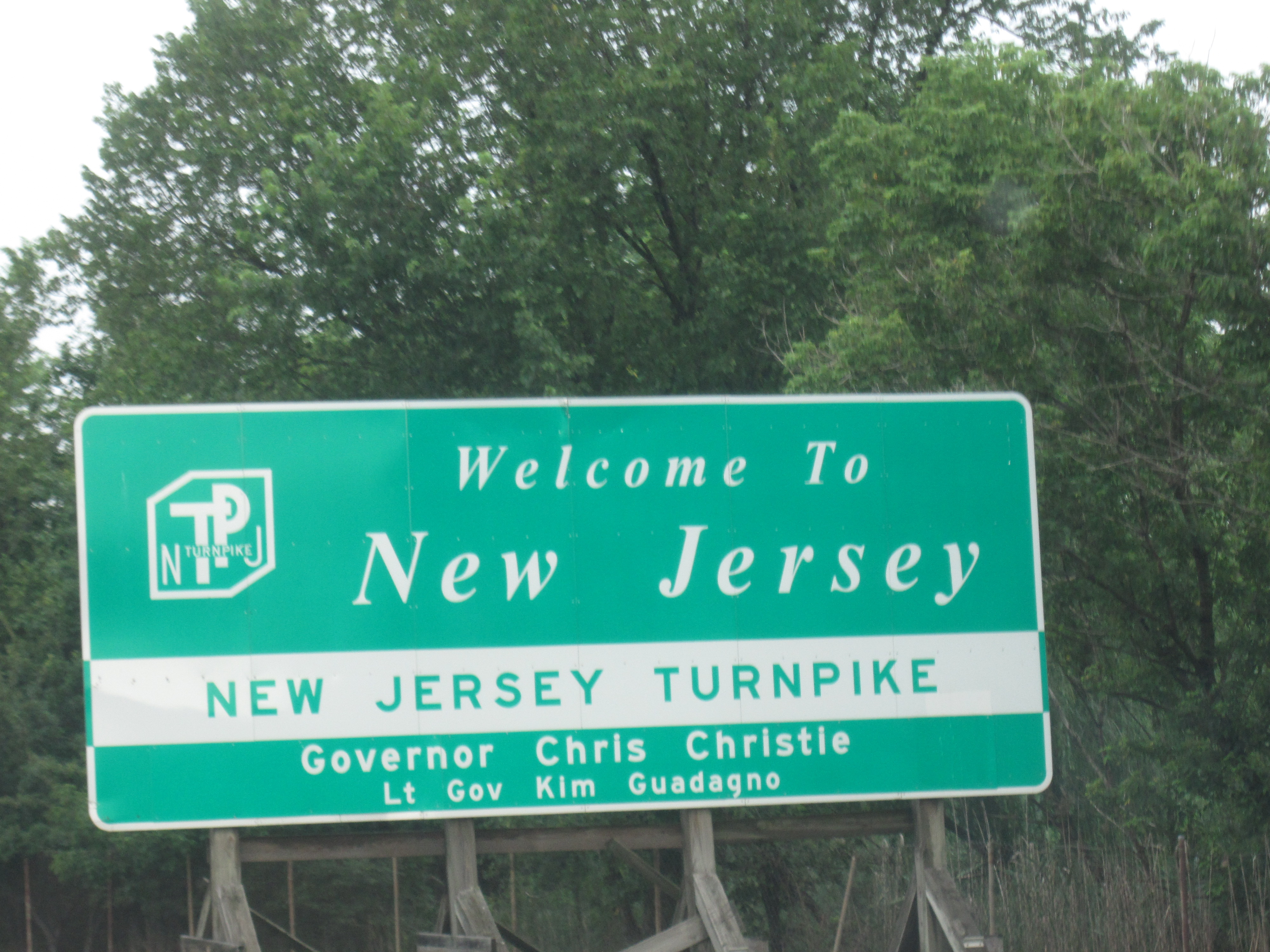


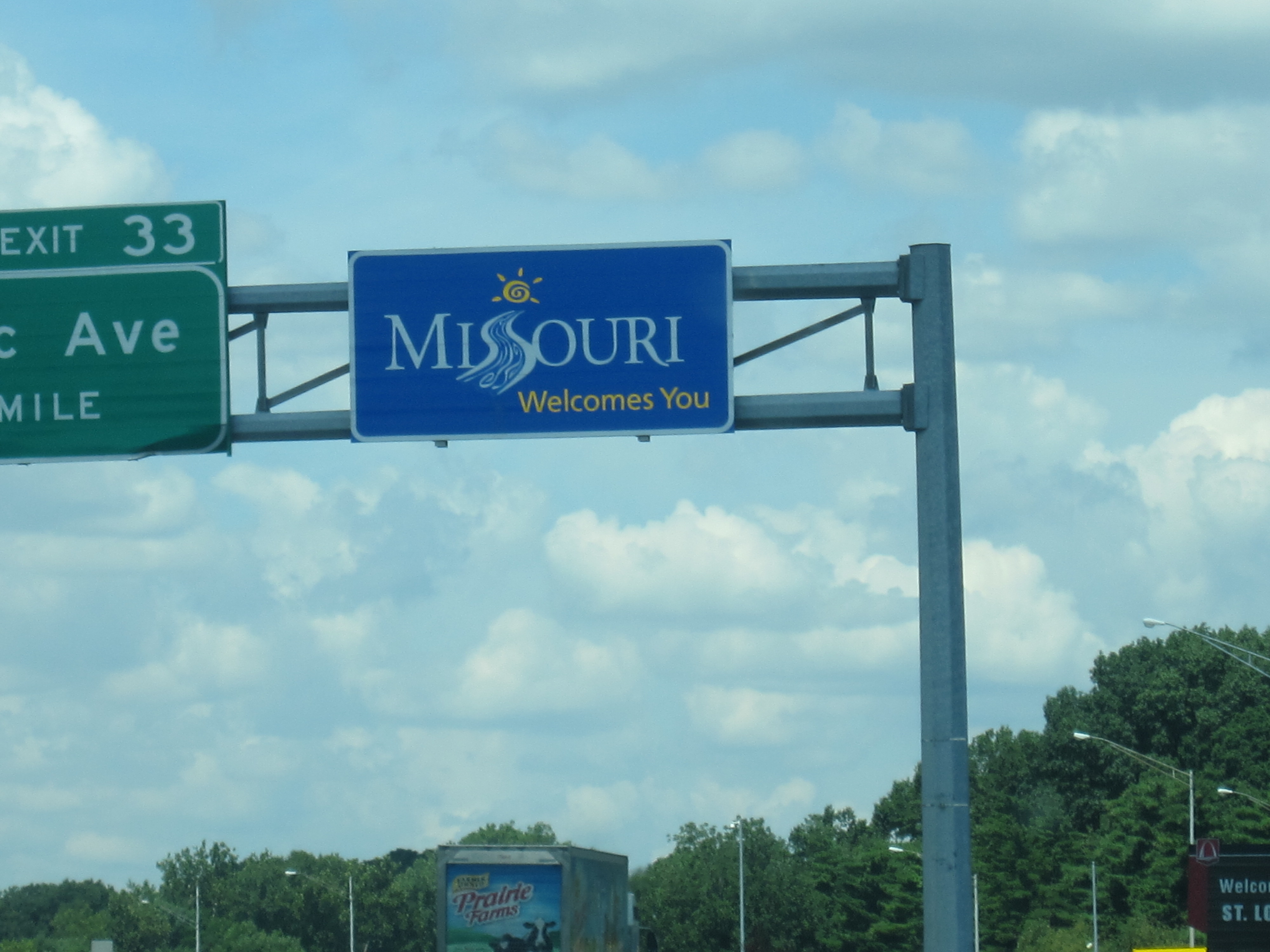

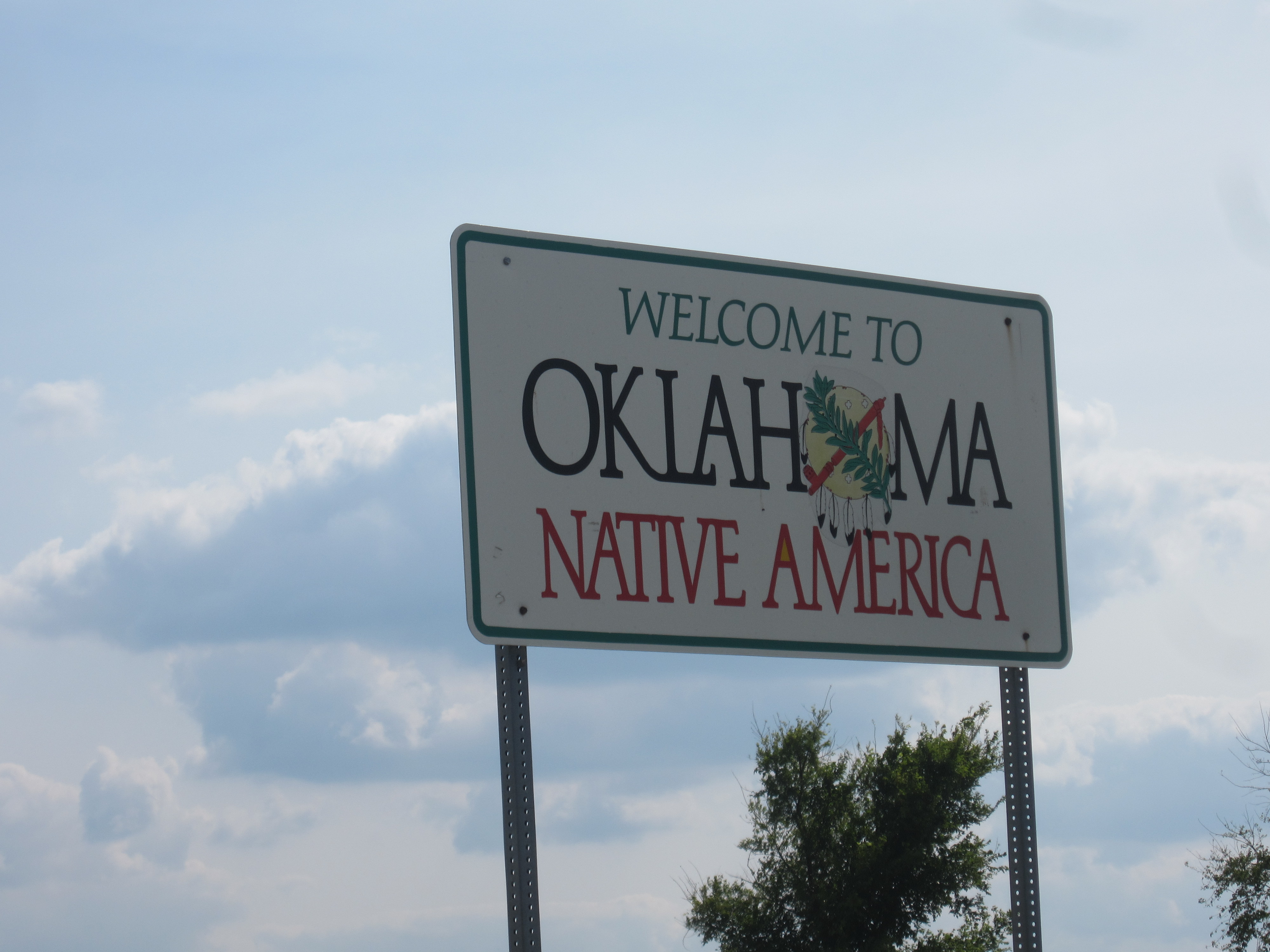
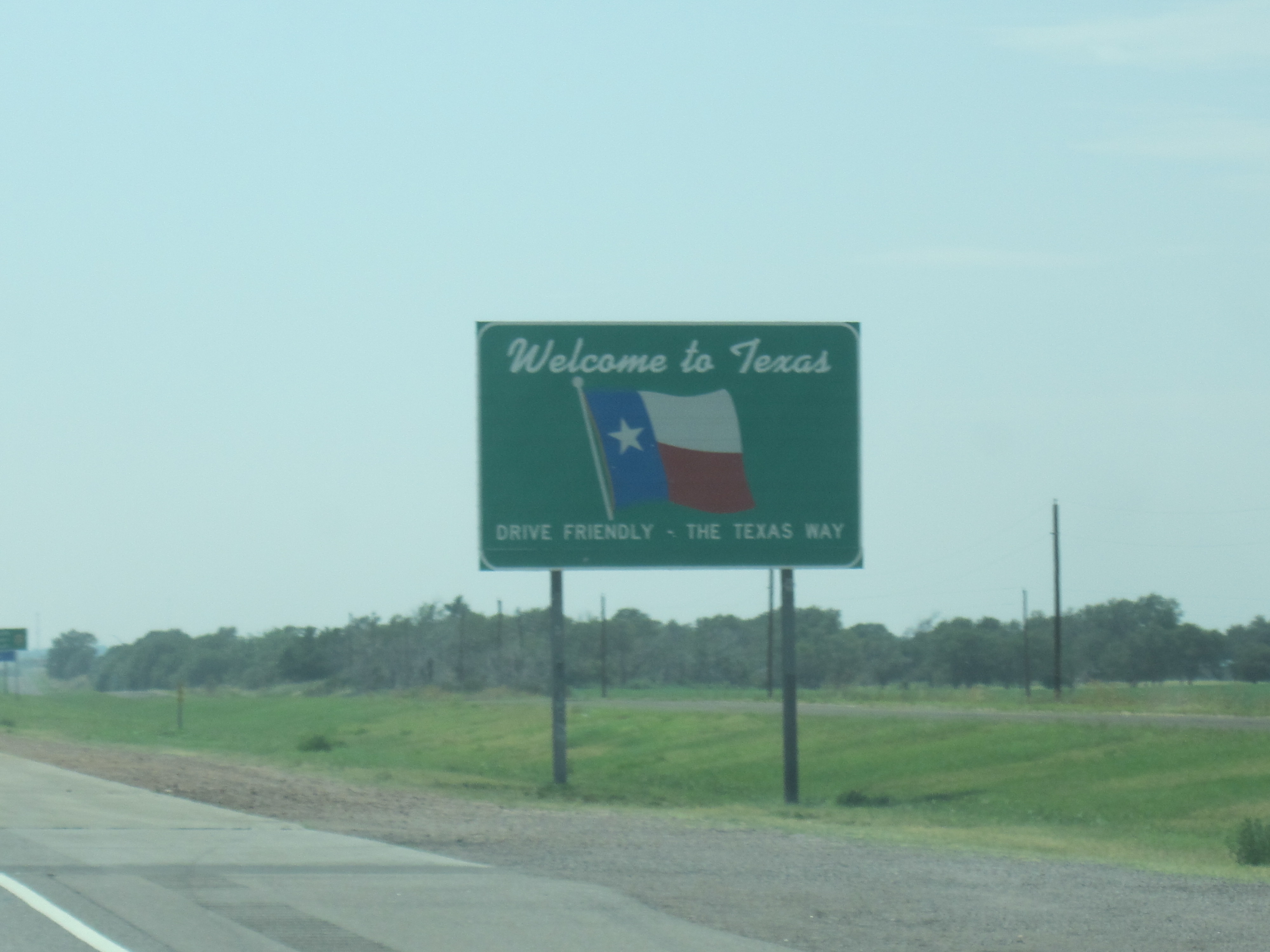
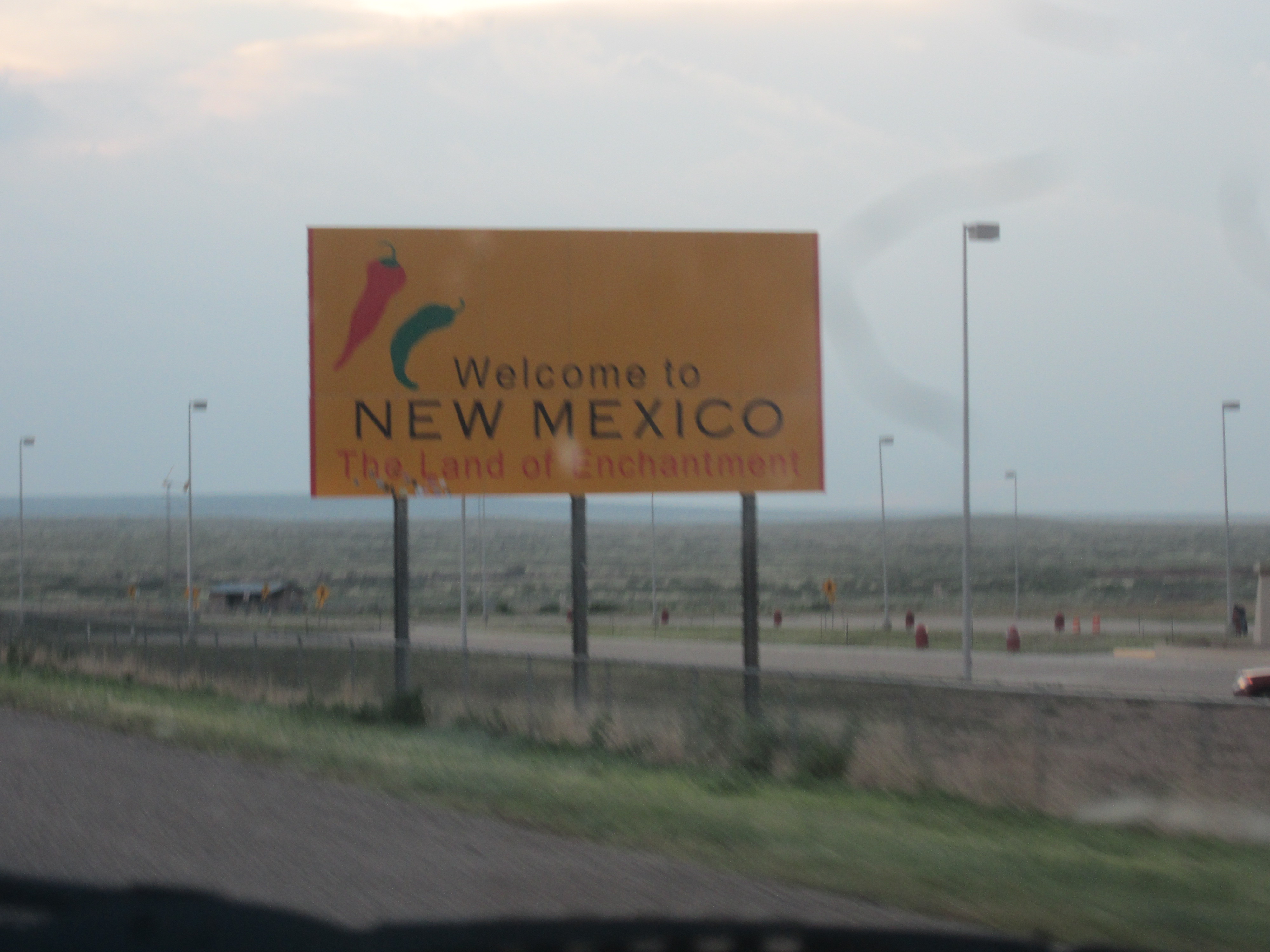
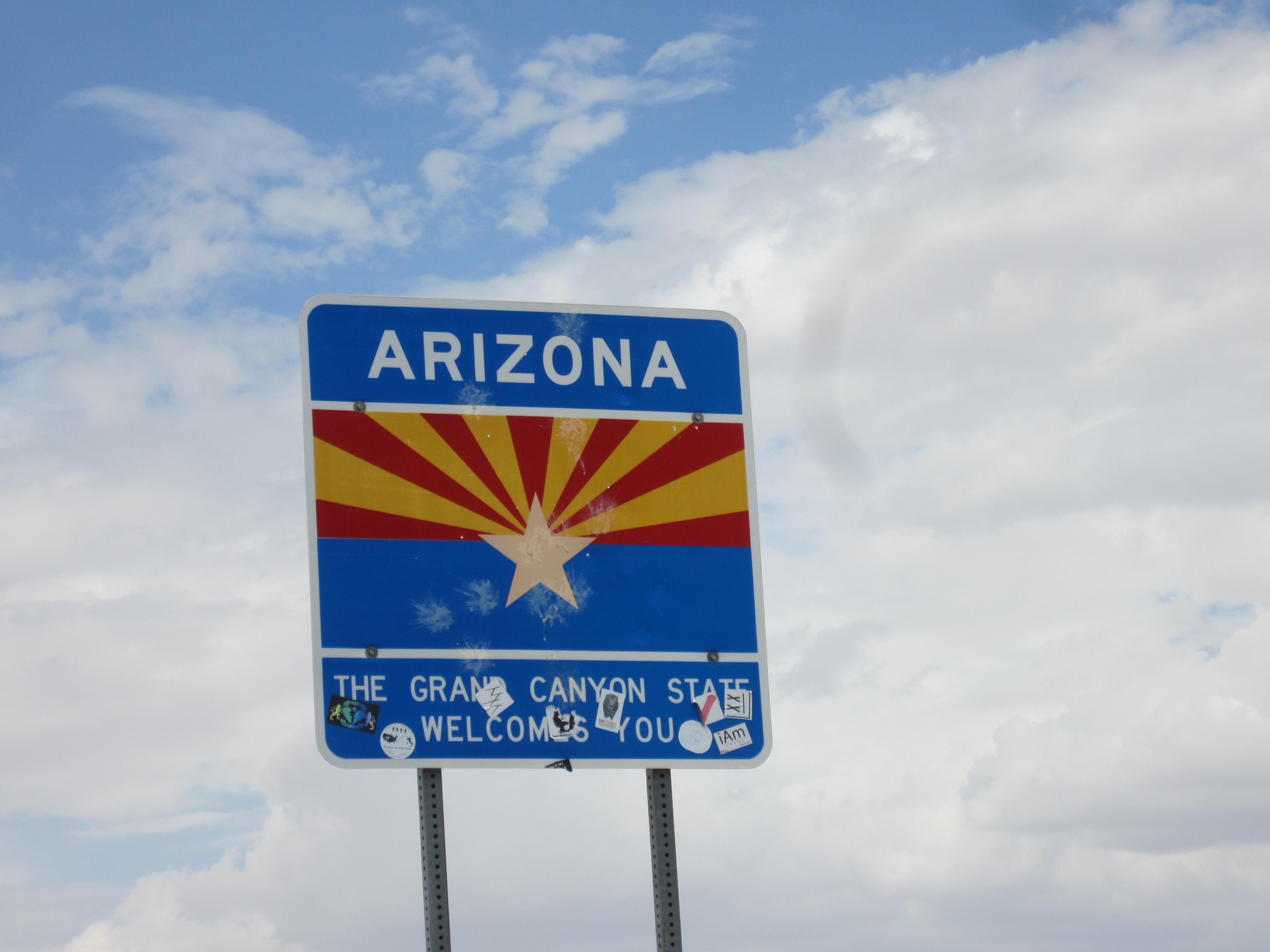

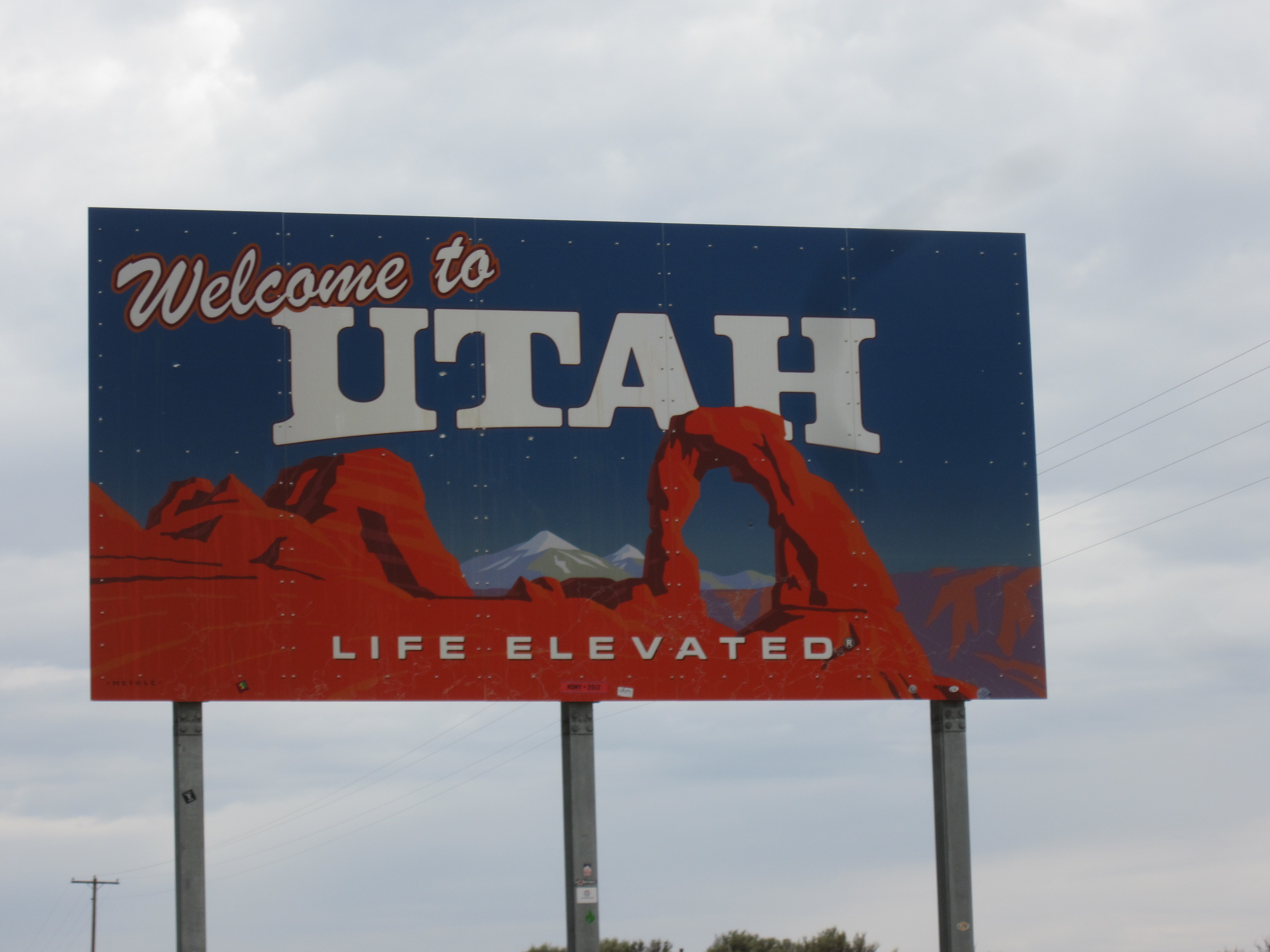


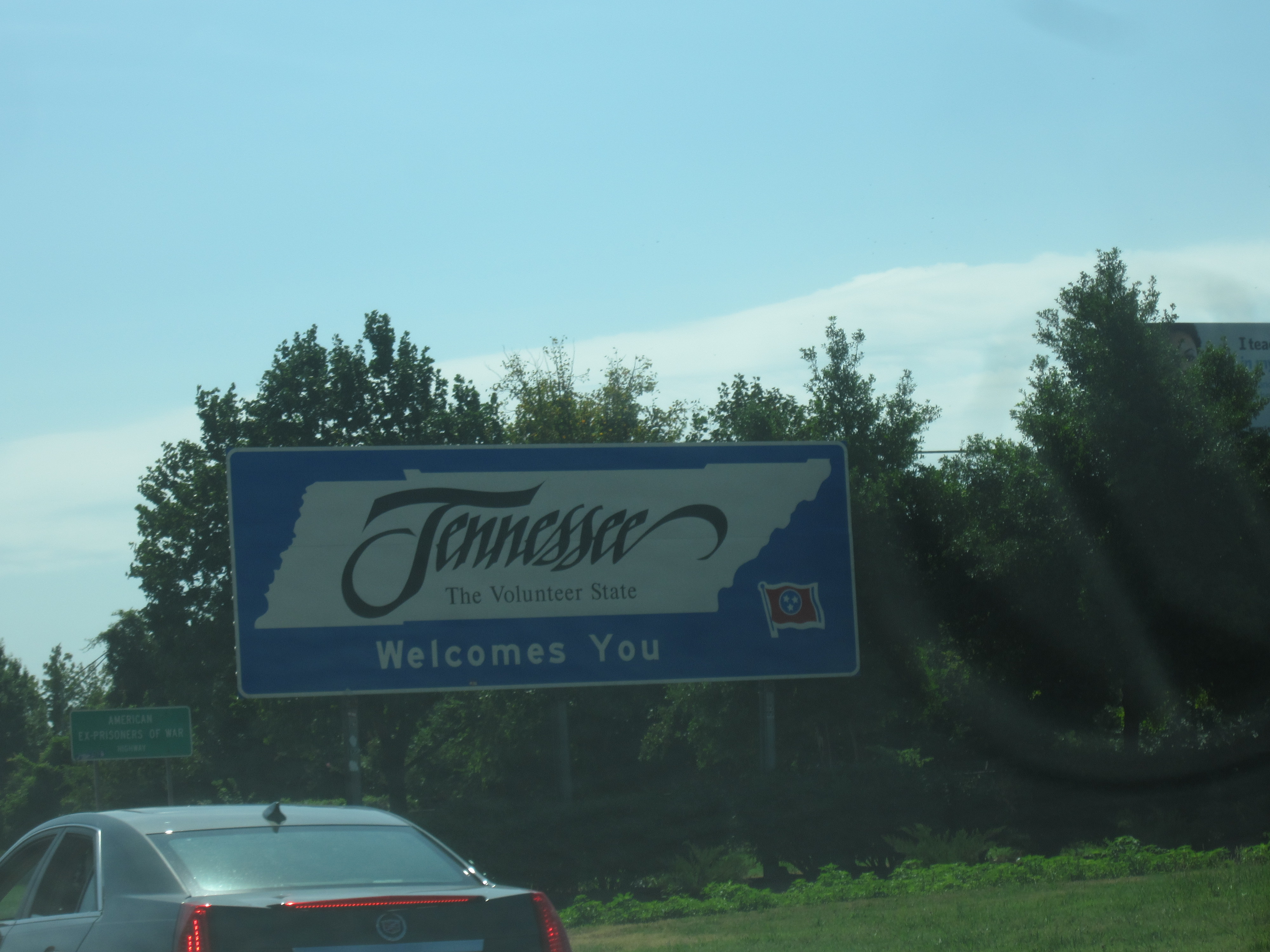

Walking on Water
The grand finale of a fireworks show is always my favorite part. I think it’s most people’s favorite part. How can it not be? Everything’s shooting off together, and you’re barraged with a multitude of shapes, colors, sounds with no lull between them. And just when your eyes and your ears and your heart can’t handle any more excitement, it all stops, and right before the applause there’s that wonderful momentary silence while everyone in the audience realizes that the show is over.
Vacation never works like that. Because after all the fun an excitement comes the anticlimactic drive/flight home. The end of vacation sucks. I was determined to avoid that letdown at the end of this road trip. So even though our last few days are packed with driving, they’re also packed with some of the most interesting stops of the whole trip. On Friday we make one final fun stop and then we go home, which means Thursday was our last full day on the road. And boy did we go out with a bang.
After another terrible night’s sleep for both of us, we woke up much earlier than we wanted so that we could do something truly unique.
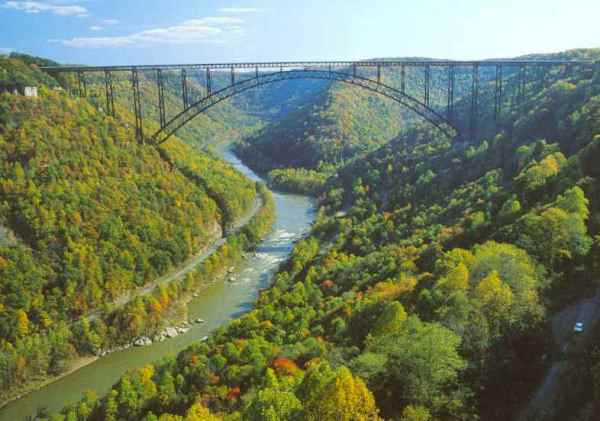
The New River cuts central West Virginia in two. Surrounding the river is a massive gorge so deep that travel across the river was practically nonexistent until 1977, when the state built a colossal steel arch bridge across the gorge. In fact, its the longest arch bridge in the world.
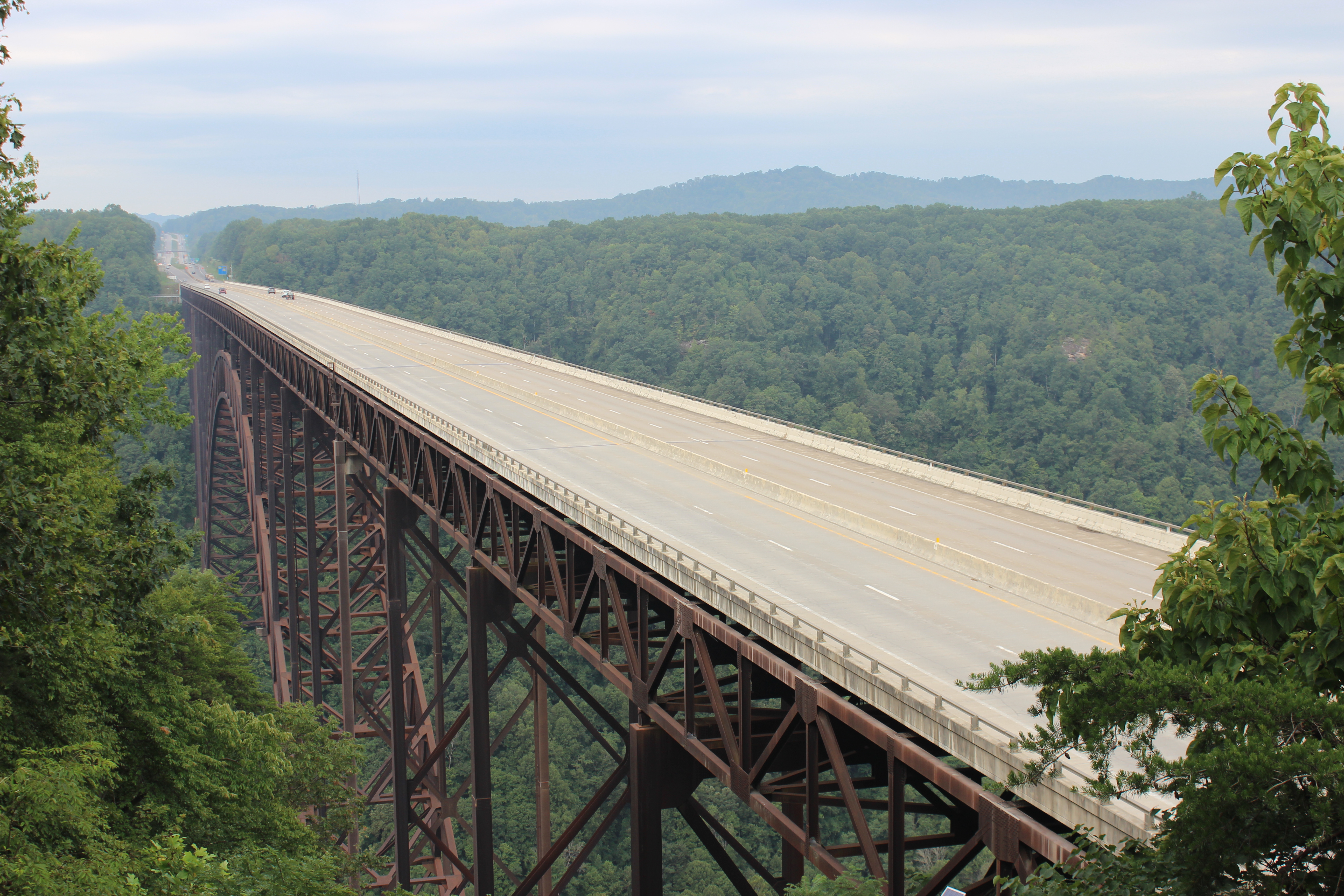
[I took these two photos but not the one at the very top, as the bridge is far too big and I would have had to drive a long, long way to get a vantage point like that.]
The surrounding towns were so thrilled with the bridge that one day every year they celebrate Bridge Day, during which they close the bridge to vehicular traffic and use it instead for rappelling, base jumping, zip lining, and general merriment.
Today was not Bridge Day. However, that’s actually a good thing, as it gave us an opportunity to experience the bridge in a much more intimate way. Base jumping etc. can be done only on Bridge Day, but every other day of the year a local tour company takes people like the Hamster and me for a walk across the bridge under the traffic.
On top is a four-lane highway, which we drove over to get to the tour company headquarters. But directly beneath the median is a thin catwalk that spans the length of the bridge. That’s how we saw the bridge.
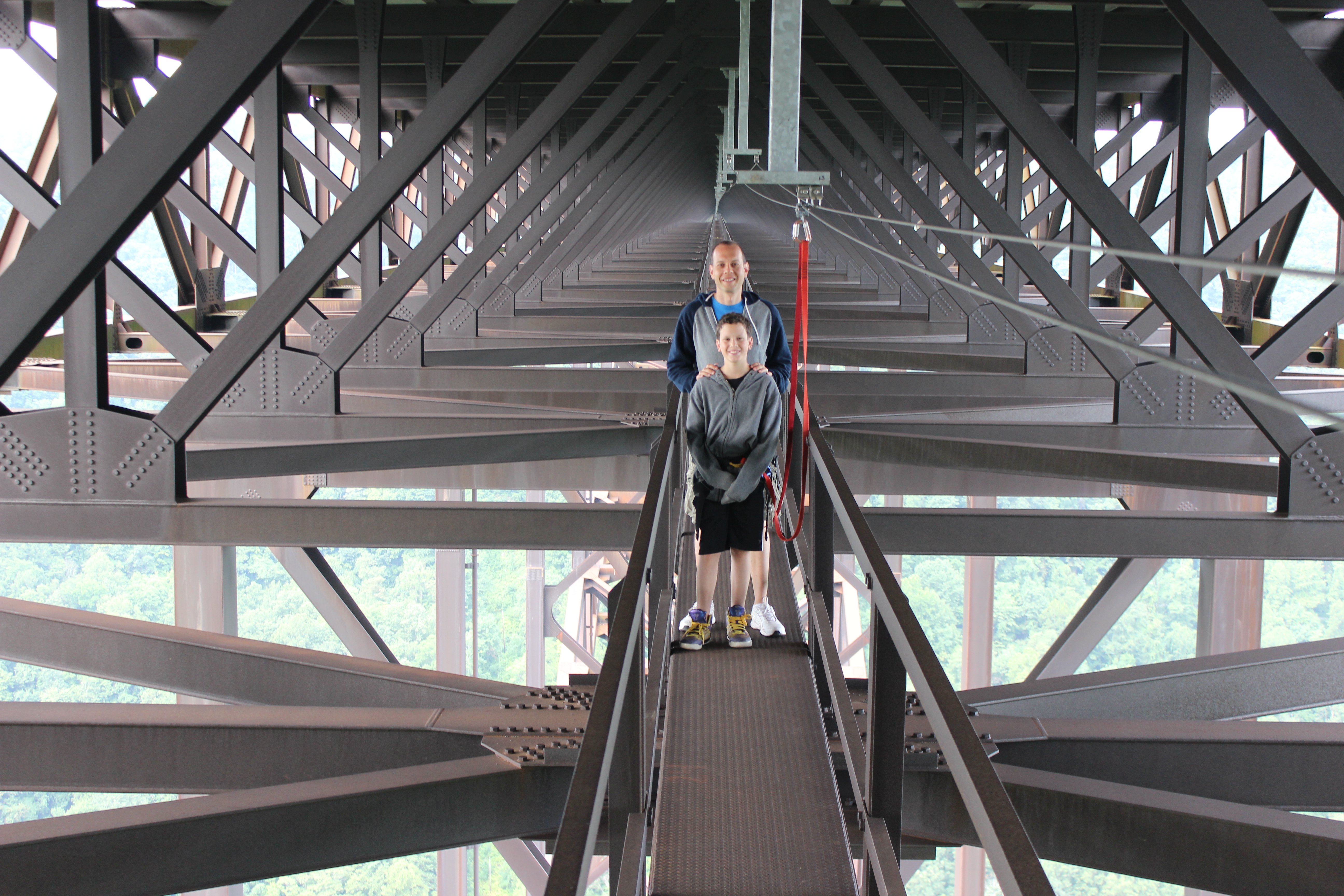
The bridge is so long that you can’t see the other end of the catwalk.
Bridge Walk, as it’s called, was pretty harrowing for the first couple of minutes as we got used to the rapidly dropping ground beneath us, the constant rumble of traffic directly overhead, and the resulting constant shaking of the catwalk and its railings. This is not a mere vibration–this is clearly visible wobbling of sturdy steel beams as if we were experiencing a two-hour-long earthquake. And I’m saying this as someone who was just in an earthquake simulator in Dallas a few days ago.
I knew that Sam would either absolutely love it or freak out. He loved it. I did, too. I loved the secret aspect of it: there were only seven of us including the guide, and it felt almost like we were sneaking across, visible only to each other as the rest of the world passed by unknowingly overhead. We also enjoyed the three falcons we saw perched on various parts of the structure.
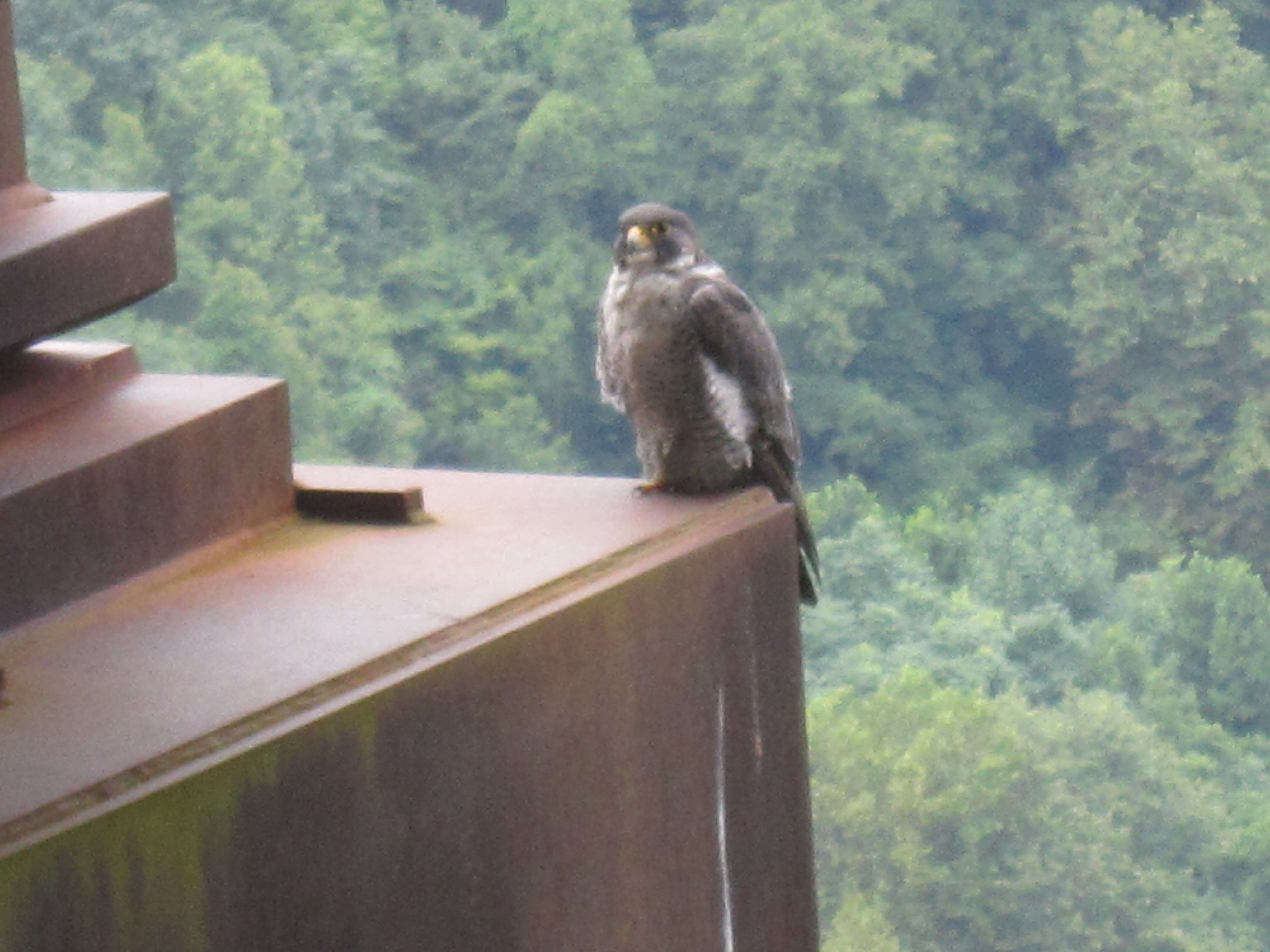
Our guide told us that pigeons and their droppings were a real problem for a few years when the bridge first opened, but then a couple of falcons made the bridge their home and soon there were no pigeons to be seen.
Of course the best part was the view, as we were hovering 850 feet above the river and could see for miles in all directions despite the heavy cloud cover.
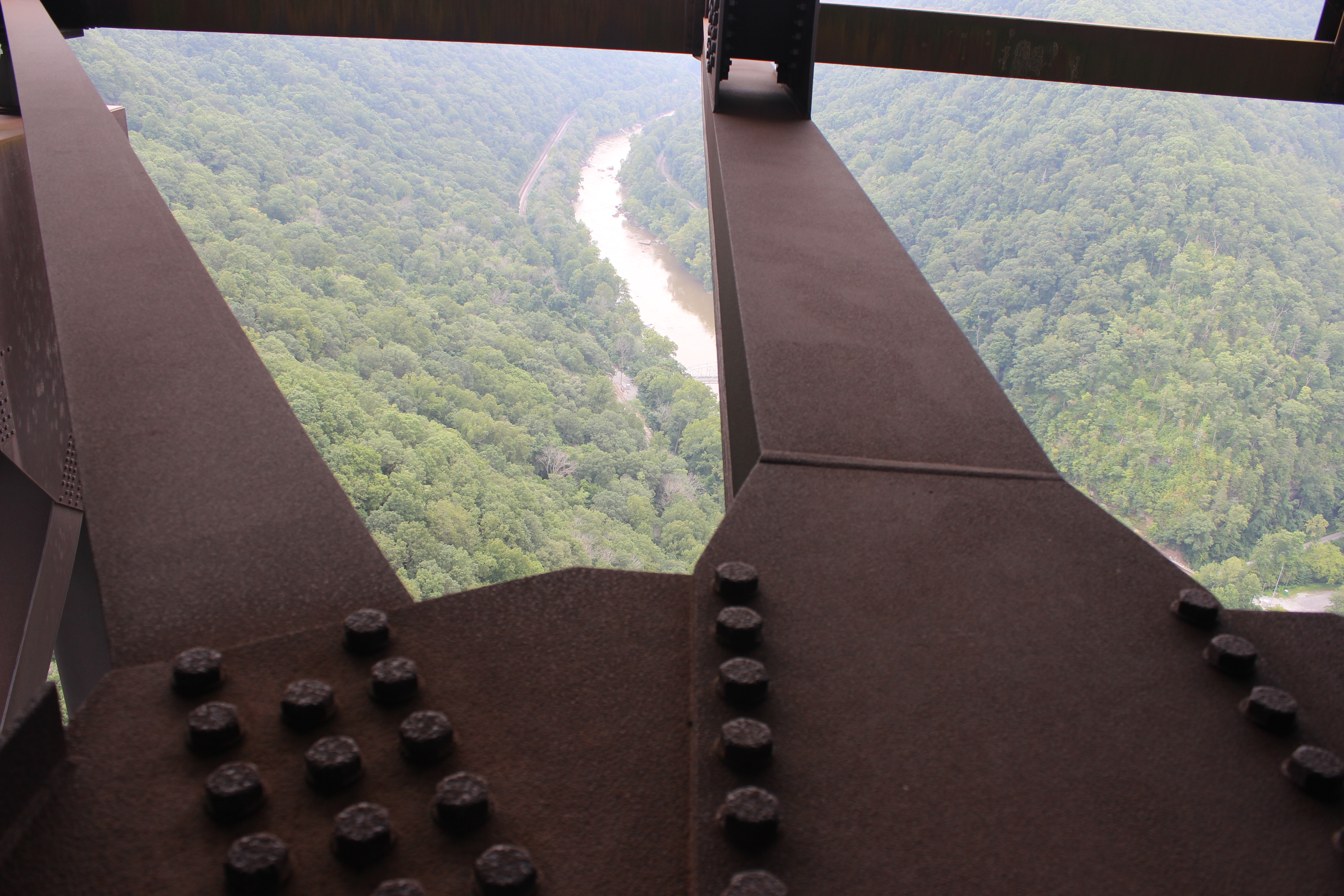
Well that certainly woke us up.
From there we had a pretty long drive up into Pennsylvania, which was largely uneventful except for Sam almost losing a few fingers. He blames me, which is partly fair. We stopped at a rest stop briefly for lunch and when we got out of the car I left the windows open a crack as I often do to minimize the car’s transformation into an oven. When we got back to the car I rolled up the windows that last little bit, not realizing that Sam was resting his fingers over the top of the glass on his side. He immediately started screaming. Once I realized what was happening I opened the window and released his hand, and within a few minutes he was feeling fine. But he gleefully played victim for the rest of the day and will no doubt be reminding me repeatedly in the future about the time I tried to cut off his fingers.
Anyway, the first day of this trip we drove straight through Pennsylvania without stopping for anything besides gas and bathroom breaks. Heading back east we have two stops scheduled in Pennsylvania, one Thursday and one Friday morning. Thursday’s stop was Fallingwater, the iconic Frank Lloyd Wright house.
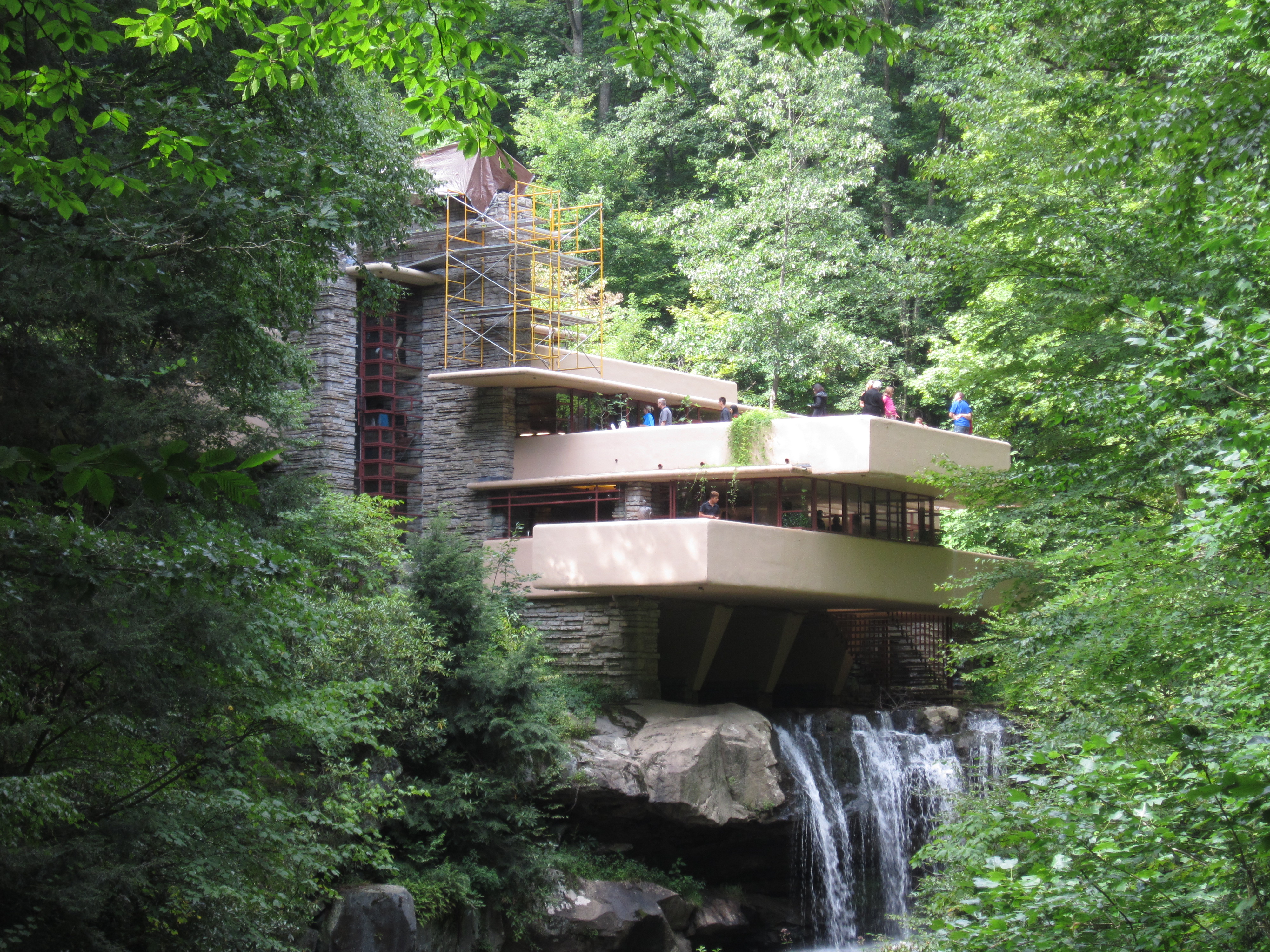
Fallingwater was designed and built in the 1930s as a vacation home for the Kaufman family, who made their money running the Kaufman’s chain of department stores, though you probably know it better by its current name, Macy’s. They bought a gazillion acres of land and then hired Wright to design them a house. He chose this spot and decided to incorporate all the elements of the surrounding environment, including massive boulders and of course the waterfall that runs right underneath some of the cantilevered parts of the house. The Kaufmans’ son donated the house to the Western Pennsylvania Conservancy in the ’60s with the stipulation that they maintain it and open it to the public.
For $8 per person you can tour the grounds and walk around the outside of the house. For $27 per person you can also take a guided tour of the interior. I chose the guided tour. Sam does sometimes get bored during house tours, so I was a little nervous that I had made the wrong choice. But Sam ended up loving Fallingwater even more than I did.
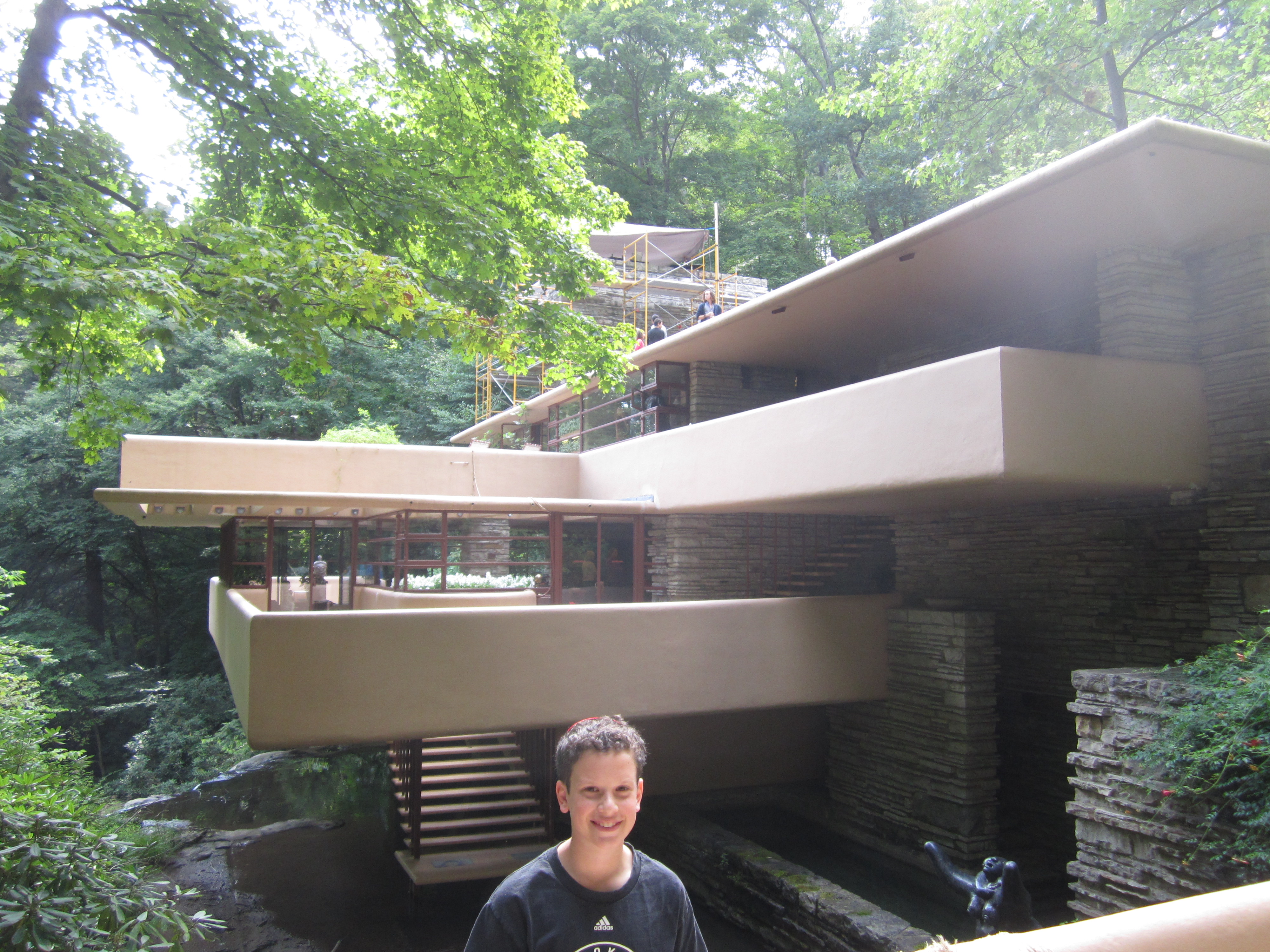
Sam had never heard of Frank Lloyd Wright before today but we were both blown away by all his ingenious design touches and just his brilliance in general. Or as Sam put it, “This guy–Floyd Whateverhisnameis? He’s really inspired me!”
Sam got more enthusiastic with each room we saw. He first decided that we need to buy the house and move in. When he was told it’s not for sale he decided instead upon building a replica of it somewhere else. “I’m going to start saving up my money now,” he said a few times. he even talked about maybe becoming an architect so that he can design incredible buildings like Fallingwater. And for the first time ever, the souvenir he chose was a book. Specifically, it’s a booklet containing photos and explanations of the interior rooms as well as the exterior. (Photography is allowed only outside the house.)
I could go on and on about various features of the house and how brilliant they all are but you really should go and see it for yourself. We had a great time, and certainly a much better time than I would ever expect a 12-year-old to have touring a historic house.
Today definitely felt like a grand finale. At Sam’s request, we grilled hot dogs for our final roadside cookout. Dinner was delicious, but there was something extra enjoyable about it all, and halfway through dinner I figured it out: Sam is awesome. Seriously. There have been so many times on this trip that he’s impressed other people with his behavior, his manners, his curiosity, or his enthusiasm. And there have been several times he’s impressed me, too. There’s nobody else on earth I could take one a trip like this and have this good a time. I just really freaking love that kid.
There’s an overused saying that life’s a journey, not a destination. That’s a load of bull. Life is both. Why bother with a journey that doesn’t go anywhere interesting? These road trips we’ve taken are exactly the same. In a way they’re all about the destinations. We go to places famous and obscure, to vast National Parks and to tiny towns and to soaring skyscrapers, to the biggest and the longest and the tallest and the oldest and the weirdest. We go places we’ve always wanted to go and we do things we’ve always wanted to do. But these trips are also about the journey. Not the journey from one place to another, although we certainly make the best of the many hours we spend in the car together. They’re about the bigger, longer journey we embarked on together the day Sam was born. On these trips we get better at interacting with each other. We develop a routine and we develop a rhythm, not just in terms of packing and unpacking but in terms of how we play off each other’s moods and how we decide things and how we just be, together. And we have shared experiences that are great in their own right but they’re also great because we did them together.
A couple of days ago we were chatting about our trip with Julia, our tour guide at the Lost Sea, during a lull in the tour. She remarked that Sam and I must get along really well to be able to take a trip like this. We smiled and nodded. What I didn’t say at the time was that the inverse is true as well: we get along really well in large part because we takes trips like this.
When I started conceiving the first road trip four years ago, I wanted two things: to see America and to have a good time with my son. I’ve done both more thoroughly than I ever expected.
So as we sat down to our final roadside dinner of the year, we raised our drinks and toasted to another successful trip, another fantastic summer, and to the relationship we have that makes it all possible.
Going Underground
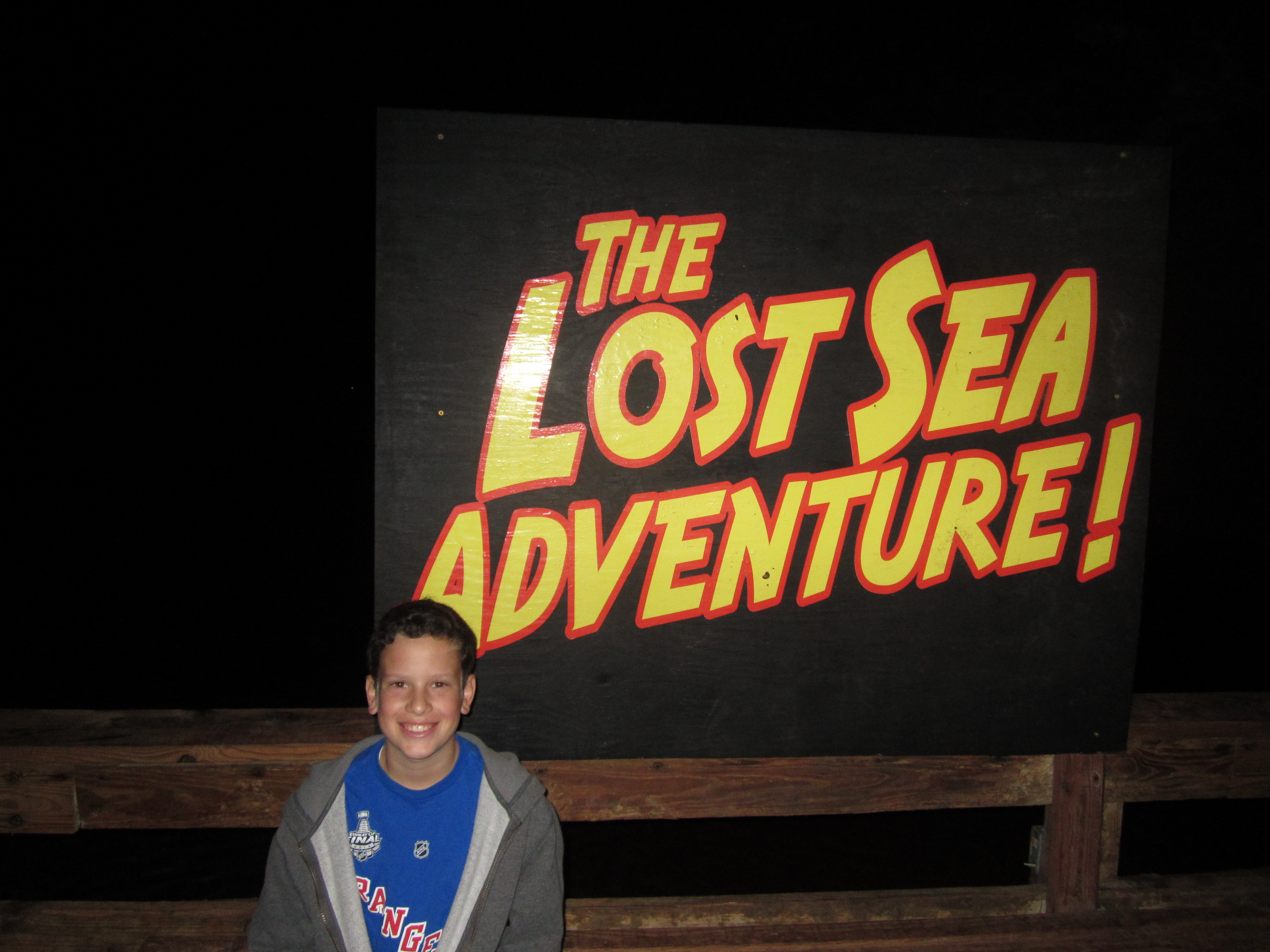
Today we saw very little sunlight for two reasons.
For one, both of our activities were under ground. We started with a visit to the Lost Sea, the largest underground lake in America. The lake is, of course, inside a large cavern. A tour was starting just as we got there, and they held it up for a minute so that we could buy tickets a join them. This was a good sign.
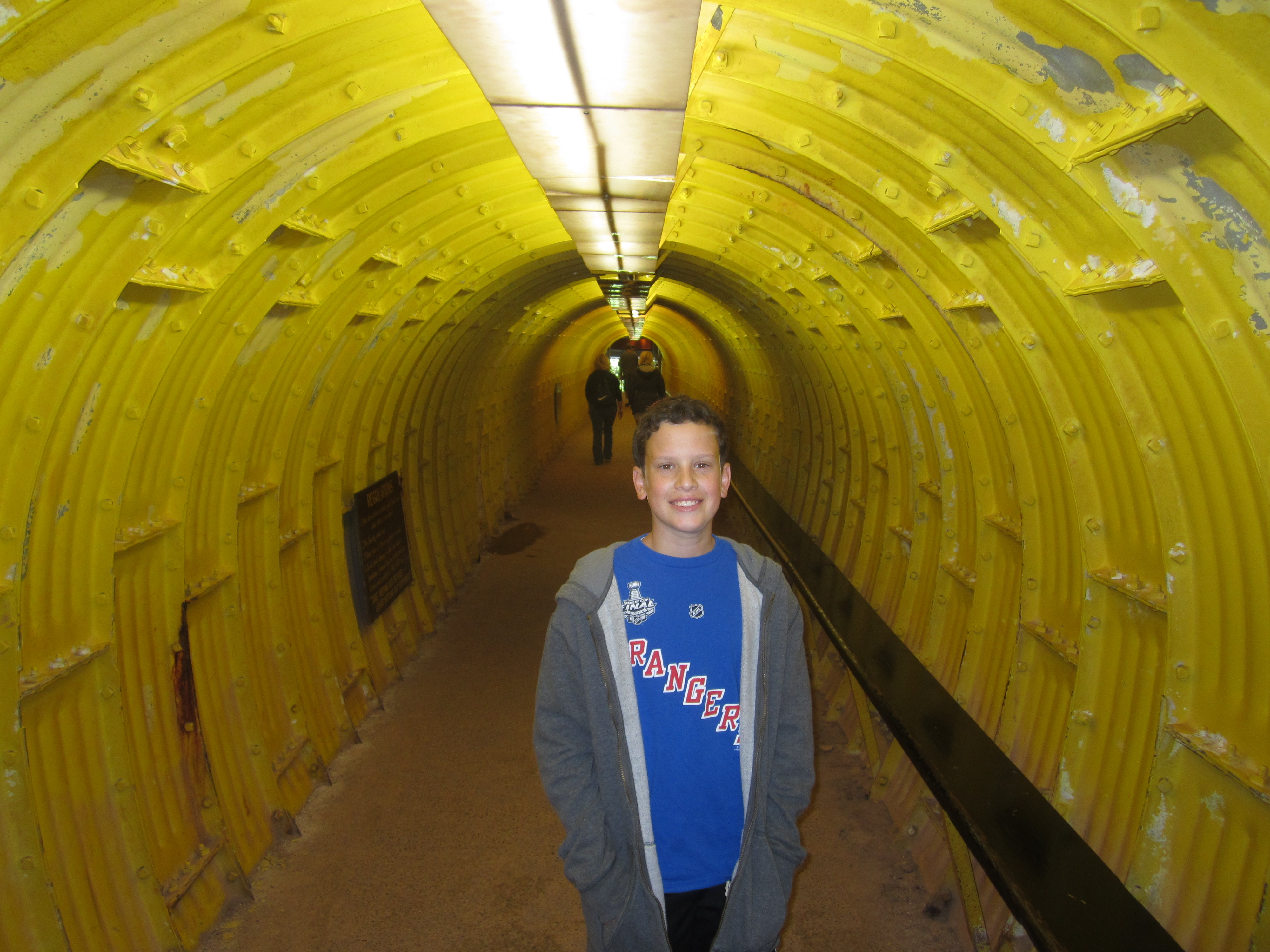
The tour starts with a walk down the yellowest cave entrance ever.
Then there’s a guided stroll through the cavern. The cavern is rather light on interesting cave formations and thus not all that exciting to walk through, but it does have one extremely rare cave formation that we haven’t seen anywhere else: anthodites, which are little clusters of crystals that look a little like frozen Fourth of July sparklers,
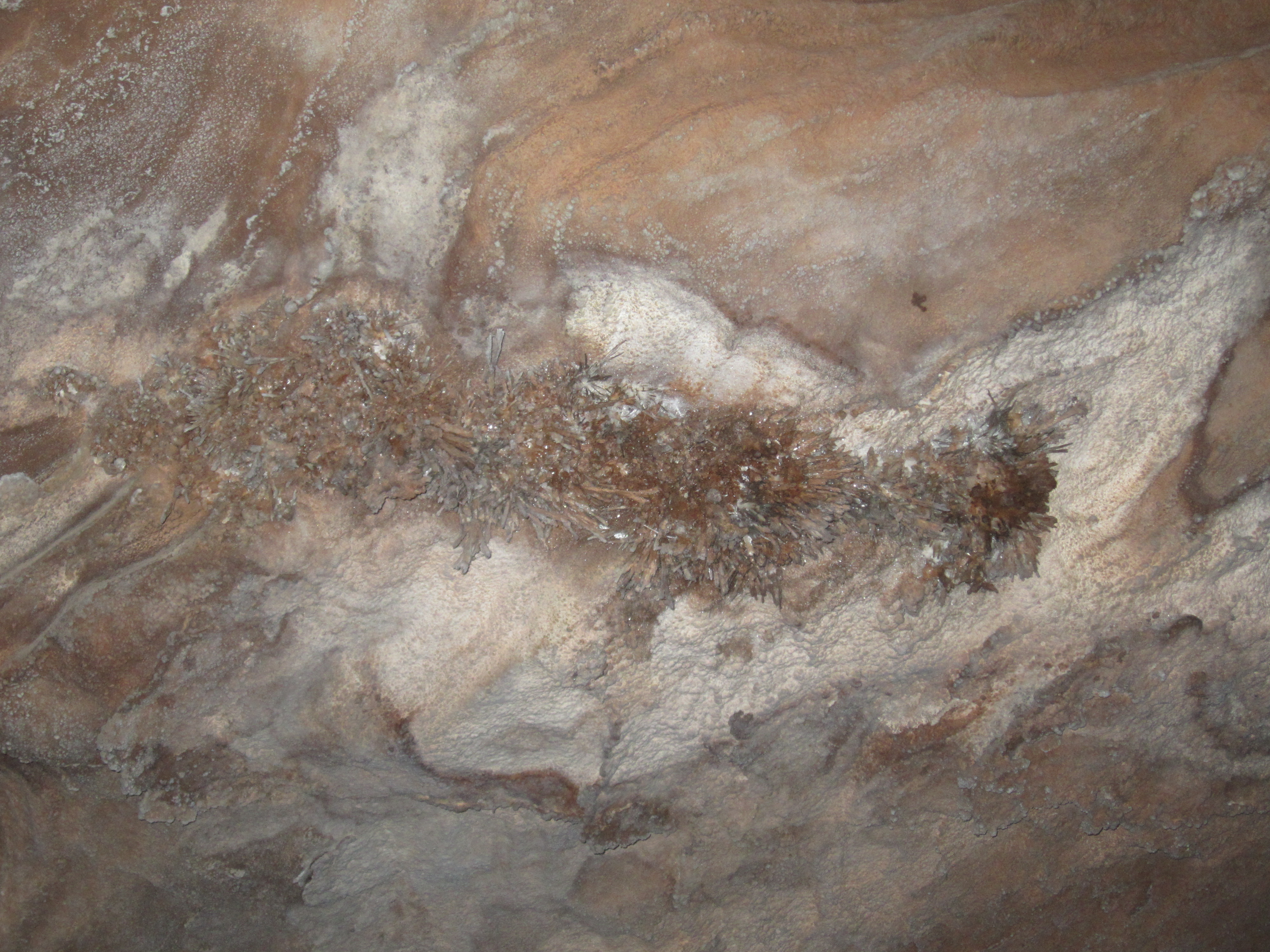 OK, so this is not a great photo, but trust me, anthodites are pretty cool. In fact, you have to trust me, because they appear in only a handful of caves in the world (50% of the entire world’s anthodites are in the Lost Sea cavern).
We also learned a bit about the history of the cavern. Like many caverns throughout the country, it was used during prohibition not only as a secret place to make moonshine but also as a speakeasy. However, in a cave like this one the low altitude and high humidity allow the human body to consume much more alcohol than usual without feeling the effects. This was great for business at first, as people drank like crazy. But then as they walked up the jagged staircase to leave, the altitude rose, the humidity dropped, and the alcohol hit them like a ton of bricks, often knocking them out entirely, at which point they fell back down the stairs and took with them anyone else on their way out. The cavern tavern thus went out of business pretty quickly.
The walk ended at a floating dock and turned into a very slow boat ride across the underground lake. That, too, was not especially exciting, mostly because even with the artificial lighting it’s too dark to see more than 40 feet away or so. Even without seeing it was interesting to be floating on a lake inside a cave. And the water is naturally high in minerals so dipping our hands in the water made them feel all soft and nice, like after you come out of the Dead Sea in Israel. Making it a little more interesting were the rainbow trout. Yes, there are a few hundred rainbow trout living in the underground lake. How did they get there? I’m glad you asked because it’s an odd little story …
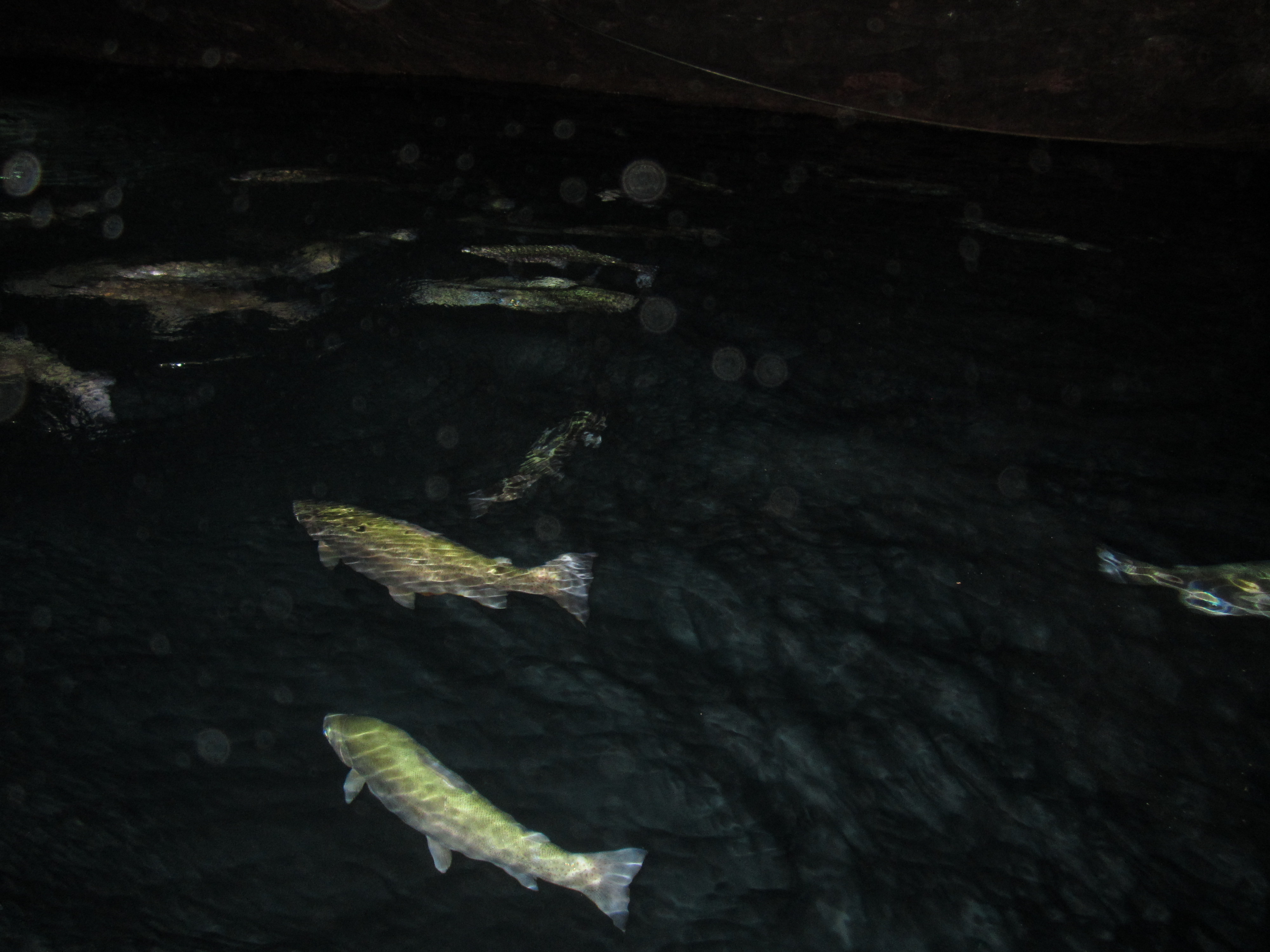
Apparently in the 60s when the cave was opened as a private business, the government populated the lake with rainbow trout to conduct experiments on their adaptability. Rainbow trout need a real current to reproduce, though, so when the original batch of trout died out there were no babies taking their place. As a tradition, the cavern repopulates the lake with trout every year and feed the trout every morning.
Overall the experience was not supremely exciting but it was a fun way to start the day. Two things made it even more enjoyable. First, our tour guide, Julia, was awesome: funny, friendly, and really knowledgeable, not just about the cave but about the country in general. (People asked some weird questions.) Second, there was another father and son on the homestretch of a multiweek cross-country road trip. They were from Texas and had gone west to California, then north to Montana, and then all the way to Boston before heading back toward home, where they’ll be in a few days, just like us. The son looked like he’s maybe three or four years older than Sam, but it was really great to meet a pair of kindred spirits, even briefly.
From there we had a five-hour drive into the heart of West Virginia. I’m not much more of a fan of five-hour drives than you are, especially after the miles we’ve covered over the last few days. But a few things made the drive more enjoyable.
Before we left Tennessee we finally got that car wash we’ve been needing so desperately. I know it may not seem like a big deal to go without a car wash for a while, but when you drive at dusk or later and you’re not in a major city, the amount of bug splatters all over your windshield and grill gets pretty gross. Windshield wipers have no effect in cleaning this mess, even with copious amounts of washer fluid, and there’s only so much you ca do with the dirty little scrubby/squeegie at the gas station. So the car wash didn’t just make the car look better, it provided piece of mind.
We also started the drive with the top down, which always adds an element of fun. Unfortunately, the weather didn’t cooperate for long. It quickly got cloudy and even a little chilly, and stayed that way for the rest of the day. Considering the ridiculous flooding going on at home I am not going to complain about the weather
Also, we’re now a mere Rhode Island license plate away from getting all 50 states for a second time. We saw yet another Alaska plate today. It’s kind of funny how Sam is now so familiar with each state’s license plate design that he often knows the state just by the color. Of course, when you spend too much time staring at cars, they sometimes stare back.
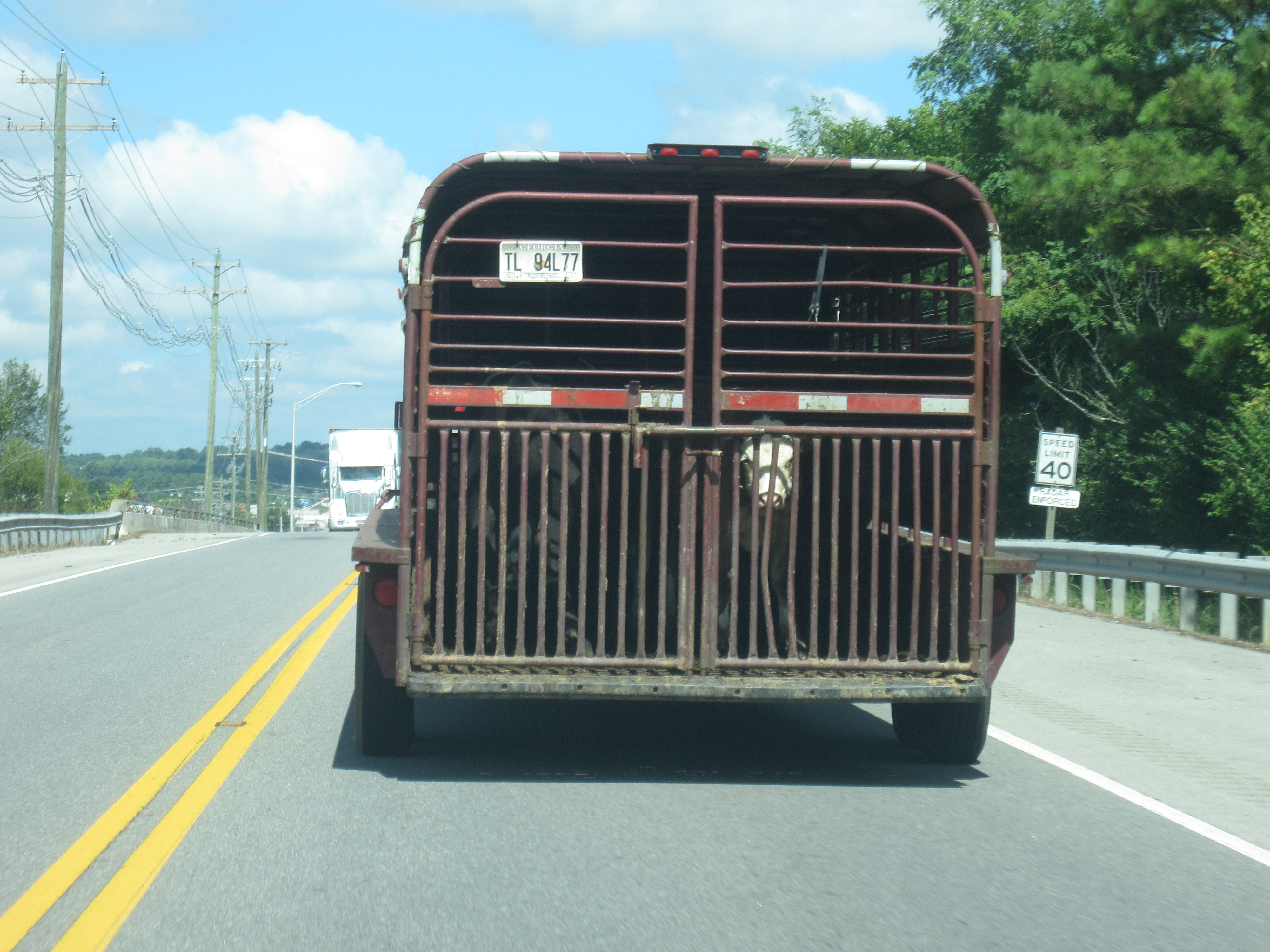
Creepy. Just creepy.
Another thing you notice when you spend a lot of time driving in unfamiliar territory is the sometimes odd names of the towns. Today, for example, we drove through Bland, Virginia. The best part, though, had been building for days. On Monday in Arkansas we stopped for gas in Palestine. Then on Tuesday we stopped for gas in Lebanon, Tennessee. We joked that on Wednesday we’d drive through Syria, Virginia. And sure enough, we did.
Eventually we made it to West Virginia. We’ve been to West Virginia twice before but we didn’t do any sightseeing there; we just drove through on our way to somewhere else. This time around, partly to avoid retracing earlier steps and give us some new places to see and partly to give West Virginia its proper due, I decided we’re going to get home by cutting right across West Virginia from south to north and seeing some of the more interesting places along the way.
West Virginia is known for four things. In no particular order:
1. beautiful mountains and lakes along the Appalachian mountain range
2. widespread poverty
3. racism
4. coal mining
For various reasons I decided not to include numbers 2 and 3 in our itinerary. Number 1 we’ve seen plenty of already, like when we visited Great Smoky Mountains National Park and drove a large stretch of the Blue Ridge Parkway two road trips ago. That left number 4: coal mining. Lucky for us, there’s an actual coal mine in Beckley, West Virginia, that gives tours.

We got there a few minutes before 5 p.m. On the coal mine’s website it says the tours are given every half hour and last for about a half hour, so I assumed we’d get on the 5 p.m. tour. Of course, in real life, the tours last for 45 minutes and run on a rather irregular schedule. The next tour was at 5:30. When a business’s website and its reality don’t match up, that’s often a sign that they don’t quite have it together.
The second sign came as we toured some supposedly original wooden buildings on the grounds of the mine while we waited for our tour time. Looking inside one of the buildings, Sam noticed something out of place in the back corner:
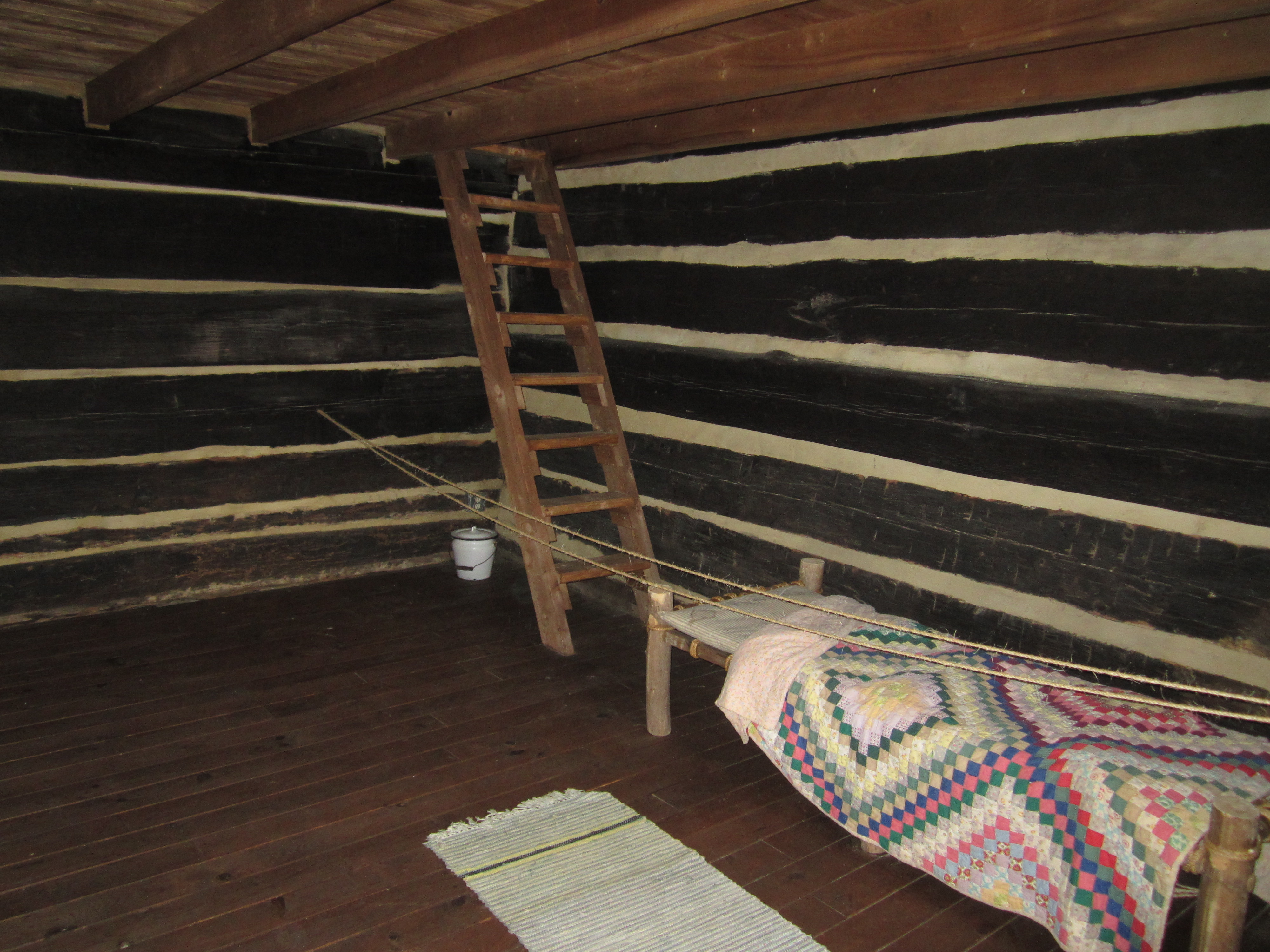
It’s right above that bucket in the back. Don’t see it? Here, let me zoom in for you.

Yes indeed, ladies and gentleman: an “authentic” electrical outlet, preserved ever so carefully from the 1880s.
Sign number three came a few minutes before our tour started, when an older man who was clearly a tour guide walked into the ticket office and said to the ticket clerk, right in front of Sam and me, “Please tell me we don’t have anyone for the 5:30 tour.” Thankfully, that guy was not our tour guide.
And back underground we went.
The guy who was our tour guide was by far the funniest person we’ve encountered on this trip. Unfortunately his humor was all unintentional. I’m going to be as polite as I can by saying he’s a bit past his prime as a tour guide. He was certainly knowledgeable, and he even mentioned casually that he used to be a coal miner himself. BUT … he was the slowest talker I have ever met, and that is saying a lot, as I come from a family of extremely slow talkers. Each … sentence … took … minutes … and … then … he … would … pause … interminably … before … beginning … the … next … one. Every. Time. And he found other ways to make words take extra long, too, like telling us that the mine opened in “the year eighteen … hundred … and … eighty. And it wasn’t just his speech that was slow–everything he did looked like it was being played back on half speed from a recorded version. Every time he pointed out something to us with his flashlight, he continued flashing on it long after he had finished describing it. Every time he stopped the tour tram it took him a few minutes just to get out to walk over to whatever it was that he wanted to show us. I swear the same exact tour could have been done in 15 minutes if the tour guide spoke at a normal pace. It certainly didn’t help that he focused on the most mundane details possible, like the miner’s lunch pail. Yes, toward the end of the tour we got a 10-minute explanation of a cylindrical metal lunch pail that was used by an actual miner. Mr. Slo-Mo explained that the lunch pails had to be metal or else the rats would get into them. This could have turned into an interesting story about dealing with rats as a miner but instead it was like that scene in Forrest Gump when Forrest meets Bubba and Bubba starts listing all the ways to cook shrimp.
If … your … hands … are … dirty … and … you’re … eating … a … Little … Debbie … cake … and … you … throw … the … last … part … of … it … away, … the … rats … will … get … it. … … … If … you’re … eating … a … baloney … sandwich … and … you … throw … the … last … part … of … it … away, … the … rats … will … get … it. … … … If … you … have … your … lunch … in … a … paper … bag, … the … rats … will … get … the … whole … thing. … … … Rats. Will. Steal. Your. Food.
I was trying to focus on sympathizing with the impossibly difficult conditions under which old-time coal miners had to work, but the guide was far too distracting. By the end of the tour Sam and I could barely contain our laughter. The mine “campus” is next to a public park that has a swimming pool, and when our tour ended and we were alone I did a spot-on impression of the coal mine tour guide giving a tour of the pool, including an explanation of why it’s filled with water. Sam was in stitches.
When we left we had a situation we haven’t had to deal with in a long time: no major driving to do. Thursday morning’s activity isn’t far from the Beckley mine, so we checked into a nearby motel, grilled dinner on the motel grounds, and spent the next couple of hours watching Pee-Wee’s Big Adventure, which I’ve been wanting Sam to see since we took the Warner Bros. studio tour two weeks ago. We don’t own the DVD so I immediately ordered it on Amazon. Although the DVD was of course delivered to our house in New York and not our car in who-knows-where, it came with free access to the movie on Amazon Instant Video. So instead of waiting until we got home, we logged onto the motel wifi, snuggled in bed, and watched it here. Sam LOVED it. He laughed at all the parts I knew he’d laugh at, and he repeated all the lines that my little sister and I repeated to each other throughout our childhood.
The Second Time Around
Two years ago when the Hamster and I toured the deep south, Tennessee was one of our favorite parts of the trip. This time around it’s a necessary evil. I say this not because we aren’t enjoying it this time, but because the only reason we’re traversing it now is that it’s on the way home.
However, a do-over of Tennessee, while generally underwhelming, affords us the opportunity to do a few things we missed on our first trip through the state. So we started this morning in Memphis at the Gibson Guitar factory. Two years ago Sam decided at the last minute that he wasn’t interested in touring the factory. I’m not sure why. But this past year Sam took guitar lessons, so now a peek inside a guitar factory was much more interesting to him.

The reception desk at the Gibson factory
Most factory tours, while fun, are ultimately a little disappointing because you just watch everything through big windows rather than walking on the factory floor for up-close views of the process. At Gibson, that’s not an issue. We were given safety goggles, told to put away our cameras and keep our hands of the dangerous machines unless we wanted to lose digits, and led right into the middle of the action.
We learned that the main factory and corporate headquarters is in Nashville, where they make all the solid-body electric guitars. All the acoustic guitars are made in the secondary factory, which is in Bozeman, Montana. The Memphis factory, where they manufacture all hollow and semi-hollow electric guitars, is the smallest but it’s also the only one that offers tours to the public.
We also saw every step of the manufacturing process: cutting and shaping of basic body parts, hand-lathing of the necks, gluing of various parts, painting and varnishing, hand-finishing, and the insertion of electronics.
Most impressive to me was the revelation that very little of this process is automated or even standardized. Each painter decides how many coats a particular guitar needs. Each lathe operator shapes the curved backs of the necks by hand and by eye rather than stencil, yet rarely deviates by more than 1/16th of an inch. The installers of the strings and the electronic innards tune and play each guitar to make sure it sounds just right. All of this requires extremely skilled technicians who have not just knowledge but a feel for when everything is just as it needs to be, and when it’s not.
And we watched it actually happen. This was not some phony Hershey or Coke “factory tour” that was really just a walk-through commercial with some vague explanation about magic and secret formulas. We stood just a few feet away as one worker took disparate guitar parts and built a guitar, just like that, for some customer’s semi-custom order. We watched the lathers lathe and the painters paint and the scrapers scrape and the lacquerers lacquer and the buffers buff and the tuners tune. It was loud, and it was messy, and it was genuine, and it was awesome.
We were glad we got a second crack at Tennessee.
Unfortunately, most of our second crack at Tennessee is about driving. We’re planning to get home on Friday, and home is pretty stinking far away, so we’ve got some ground to cover. We woke up Sunday 1,600 miles from home. We woke up Tuesday 1,200 miles from home. As I write this Tuesday night, we’re down to about 850. Needless to say, most of the rest of the day was in the car.
We made an attempt to get that car washed at some point today, but the city of Jackson, TN, was not having it. We got off the highway looking for a car wash but found only placed that were closed or out of business altogether. The wild goose chase delayed us by about 40 minutes and caused much frustration. Eventually we gave up and made our way back onto the Interstate with the car still filthy.
I was originally thinking that Nashville would make a good stopping point just to break up the long drive across the state. But we had covered Nashville pretty thoroughly the first time around and we couldn’t think of anything we really wanted to do there. This is hardly a knock against Nashville; it’s a fun city and there’s a ton to do if you’re a big country music fan or if you’re there at night without any minors. But we’re not really into country music and we weren’t planning to spend the night and one of us is 12.
Serendipitously, an activity presented itself. Lisa, who I dated briefly in high school and then completely lost touch with for 20 years until the magic of Facebook reconnected us, posted that she was in Nashville on business. So this afternoon we met for the first time since at least 1992 and spent an hour or so catching up.
I love that these road trips allow me to visit friends who are scattered across the country and I never otherwise get to see. Sam, understandably, does not love my reunions, as he is forced to sit through conversations he doesn’t care about and discussions of people he doesn’t know. To his credit, he has been patient and well behaved every single time, and this afternoon was no different. At home when he’s bored he is not shy about making that fact known but on the road he finds ways to entertain himself and he never complains–at least not until we’re alone and back in the car.
Anyway, our final stop in Tennessee is yet another attempt to right an omission from our first time here. Just south of Knoxville, outside the town of Sweetwater, there’s a cavern that is home to the largest underground lake in the country. Our first trip to Tennessee was supposed to include a boat ride on the underground lake, but our plans were thwarted by the Eastern Time Zone, whose border lies somewhere between Nashville and Knoxville. I didn’t know this at the time, so when we lost that hour on the way to the cavern we also lost our opportunity for the boat ride. To make sure that didn’t happen again I scheduled our boat ride for Wednesday morning and made sure to get enough driving done Tuesday night so that we’d wake up in the same time zone as the cavern.
Yes, folks, for the first time in 30 days the Hamster and I are now back in Eastern Daylight Time! Of course, we still have 850 miles to go, and we’ve already been through the entire Book of Questions and found six Alaska license plates (we saw another one today), and the car still badly needs a wash. But tomorrow we have a date with an underground lake.
A Little Rock, a Little Roll

Monday morning did not start out very well. For starters, we woke up in the same disgusting Days Inn we went to sleep in, which is to be expected but part of me was hoping to have been somehow transported to a mediocre motel as we slept. Additionally, after the ridiculous and unexpectedly late night we had, Sam would not get out of bed for anything. By the time I dragged him out of bed and we got through our morning ritual, we were already behind schedule as we got on the Interstate and put the Days Inn behind us both literally and figuratively.
Making matters worse was our pressing need for our second oil change of the trip. I had already pushed it off for a few days, and we were about 1,000 miles overdue. We’ll be driving a few hundred more miles on Tuesday, so it really couldn’t wait. Luckily we found a Wal-Mart with an auto center right along the highway in a city ridiculously named Arkadelphia and there was nobody on line ahead of us. On the plus side, while we waited for the oil change we were able to do a little bit of needed shopping, restocking on produce, getting new windshield wipers, and procuring one more DVD to keep the Hamster entertained on Tuesday’s long drive. (I picked Goonies. He wasn’t happy about it, but after he watches it tomorrow he’ll be thanking me.)
Not to get too far off topic here, but Sam and I have spent a good deal of time mocking the state of Arkansas. Most of our mockery is focused on names. For starters, the name Arkansas is pronounced wrong and is simply a poorly disguised rip-off of Kansas. (If you like Kansas, you’ll love Arkansas!) Then there’s the similarly unoriginal names of the cities. I already mentioned Arkadelphia. And don’t forget the city right by the Texas border that’s also near Louisiana and is thus named Texarkana. They’ve got a few cities named after abstract concepts (Hope and Friendship), and tonight we stopped for gas in Palestine. Oh, and the city where we’re spending the night? It’s a few miles west of Memphis. Wanna guess what it’s called? Yup: West Memphis. This is what happens when a state spends too much time fighting to keep its school segregated and not enough naming its cities. But more on that later.
By the time we left Wal-Mart we were about an hour behind schedule, but at least we had been reasonably productive. I worried about how that hour would affect our day in Little Rock.
In the end everything worked out fine. Some reordering of the day’s stops so we’d get to everything before it closed helped, as did my overestimation of the time we’d spend in several places.
First up was the state capitol, which was very nice if a bit typical.

What was unusual about this one for us is that we actually went inside, less because we were interested in seeing the interior and more because Sam desperately needed to pee. He found a bathroom, and we got a mini-self-guided tour of the building on the way, so everybody wins. The nicest feature of the capital, though, was a statue on the east lawn of the Little Rock Nine walking to school.

Despite not having a degree in history, I taught 11th grade U.S. History and Government a few years ago. Needless to say I know plenty about the Little Rock Nine and the events at Central High School in 1957. (Click on the link if you need a quick refresher of your own. It’s OK, I won’t judge you for not remembering clearly.) Sam, however, had never even heard of the incident, despite a pretty solid knowledge of the Civil Rights Era for someone his age. I figured this out before we arrived in Little Rock, so I gave him a quick briefing before we arrived. This helped immensely when we got to Central High School, which still operates as a public high school but is also a National Historic Site. For legal reasons, the historic site is technically not the school but the gas station across the street from the school, which was used as a base for the dozens of reporters who covered the events as they unfolded. (It had a pay phone, which reporters desperately needed in those days).
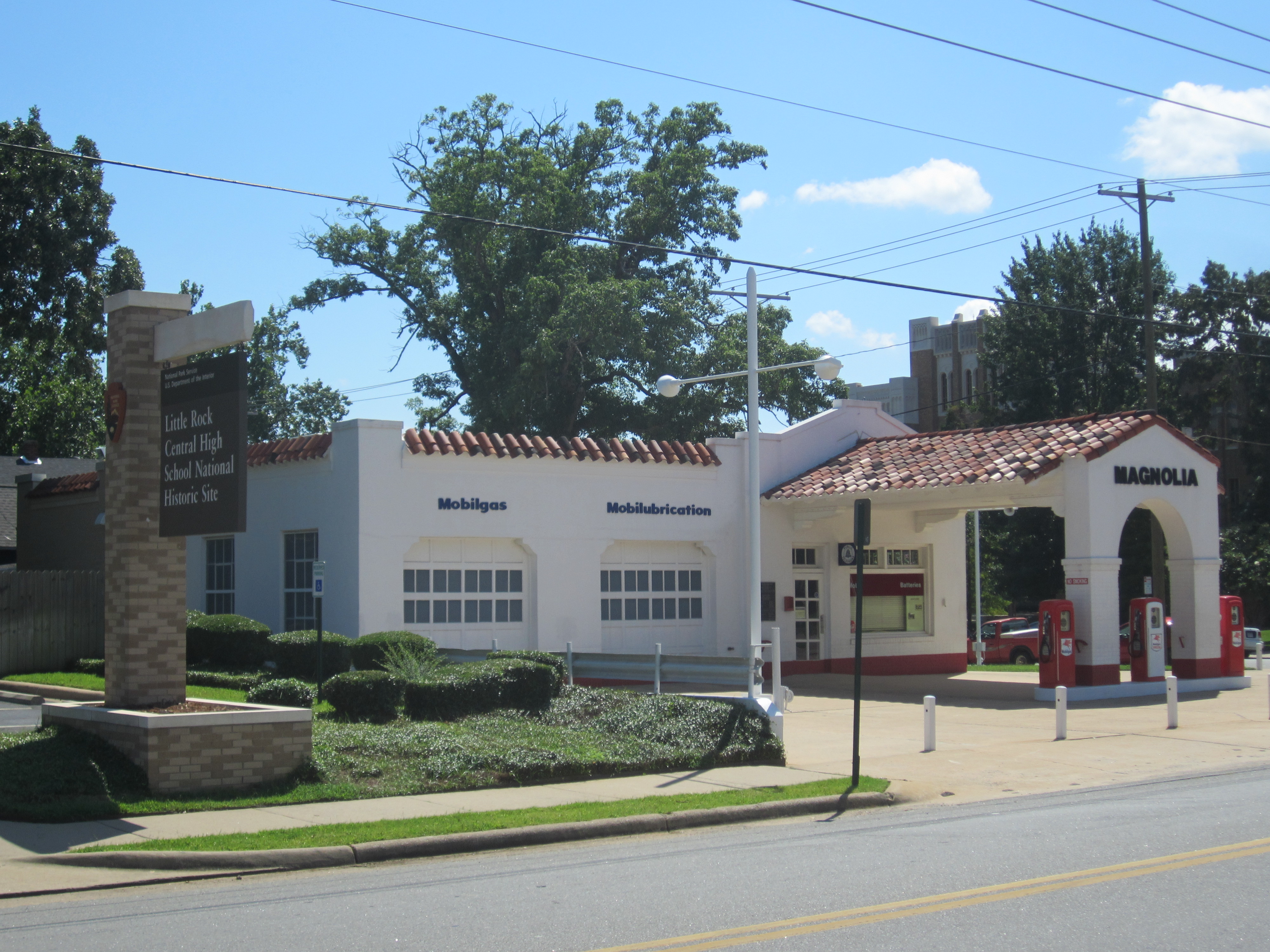
On another corner of the same intersection is a robust Visitors Center. It’s so robust, in fact, that we ended up spending two hours there watching videos, reading placards, filling out the Junior Ranger booklet, and watching an Oscar-winning short film that follows up on the nine kids seven years later. Despite a few previous attempts at various National Parks, this is the first time Sam has actually completed a Junior Ranger booklet, thus earning himself the title (and badge) of Junior Ranger. He had a cute little swearing-in that included a promise to always treat people with respect and to never take school for granted, which I thought was a nice touch.
For me, the most fascinating part was learning more about Arkansas’s desegregation plan, which was originally designed to start gradually in the elementary schools but was changed to start with the high schools after vehement complaints from white elementary school parents. After the fiasco at Central High it took years, and Arkansas schools didn’t finish integrating until 1972. Yeah! In 1971 Arkansas still had some whites-only public schools. I guess I shouldn’t be surprised that Arkansas couldn’t think of any good names for cities, considering how long it took them to acknowledge that people come in more than one color.
When we were finished at the Visitors Center we walked over to the school to get a closer look. The building itself is so gorgeous that I actually fantasized about teaching there.

I also wondered what it might be like to be a history teacher in a high school where history actually happened. But I had to cut my daydreaming short as it was already 3 p.m. and there was much of Little Rock still to be seen.
The day turned out to be quite educational even though I hadn’t intended it to be so,
This was due in large part to our next activity, which was visiting the headquarters of Heifer International. In case you’re not familiar, Heifer International is a humanitarian organization that aims to end poverty and hunger around the world in a variety of ways. The focus is always on teaching a man to fish (sometimes literally), as Heifer workers travel throughout the most poverty-stricken parts of the developing world to teach farming techniques and to gift income-producing livestock (and occasionally plants) to families and communities. My family has been donating to Heifer for several years, and when I found out that its headquarters is in Little Rock and that there’s an interactive “village” where you can learn about all the great work they do, I decided to take the Hamster there. The first thing that impressed us is the building itself, a modern metal structure surrounded by an actual moat, all on a site that used to be an abandoned rail yard.
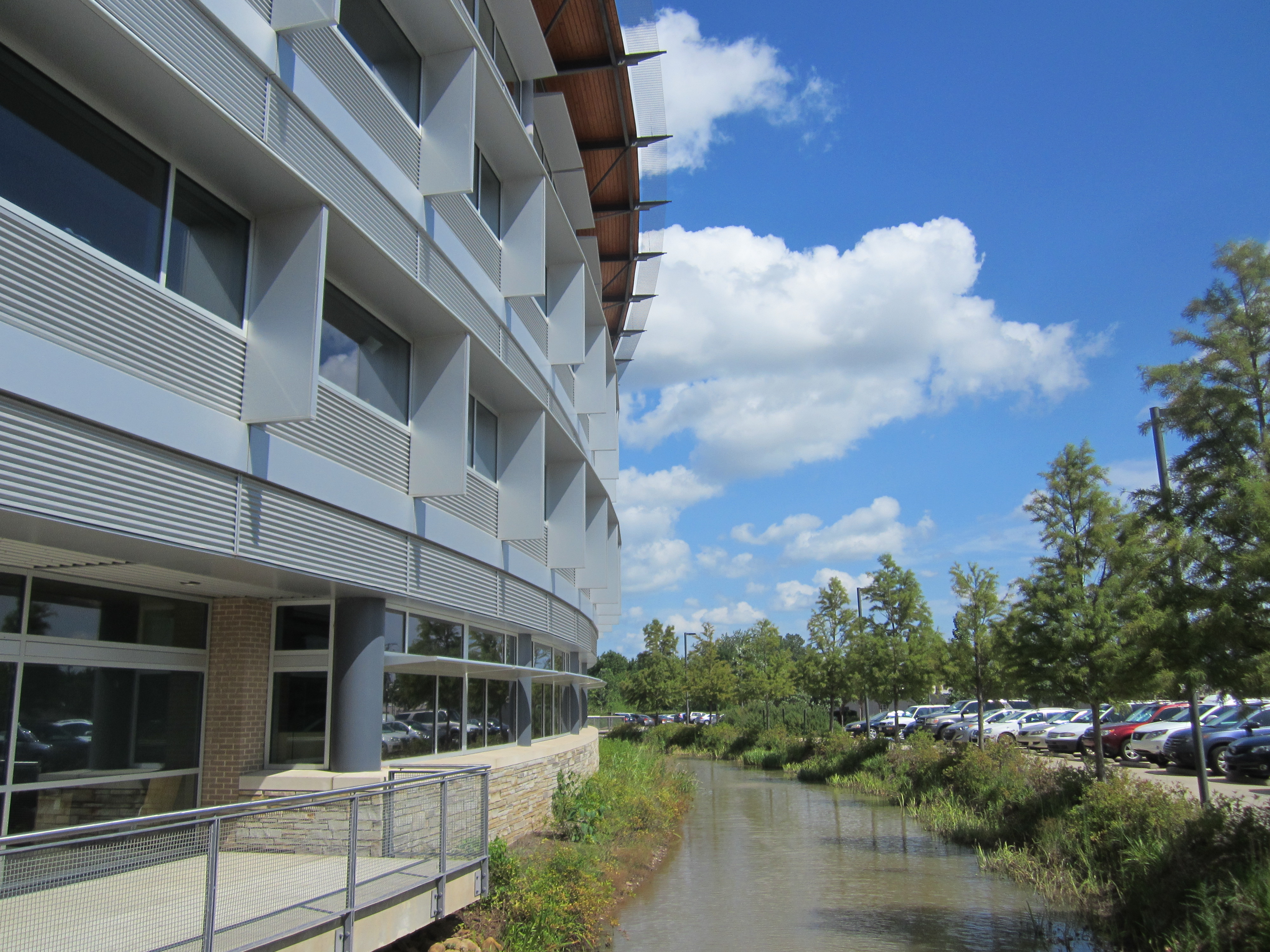
It’s won awards for both sustainability and design, and there’s a separate (free) tour we didn’t take in which you learn all about the design and construction of the building and how it manages to consume a fraction of the energy of similarly sized buildings.
Sam had a great time exploring the kid-focused exhibits, learning about efficient farming techniques, worldwide food consumption, livestock care, fair trade coffee, and more. And the whole visit took maybe half an hour.
Heifer International is also very conveniently located, in that it’s across the street from both the Clinton Presidential Library and the River Rail Trolley. Like we did at the Lincoln Library in Springfield, Illinois, we looked at the Clinton Library but did not go inside, as presidential libraries are not exactly on most 12-year-olds’ summer to-do-lists. We did, however, get on the trolley.

The Rover Rail Trolley costs just $1 and makes several stops along a loop around downtown Little Rock. It’s meant as both a tour of the city and a convenient means of transportation, depending on who’s taking the ride. We hopped on one of the last trolleys of the day, so we were the only riders and we had fun moving around the trolley to get better views of various sites as the driver pointed out landmarks. We even noticed an SUV with Alaska plates, the fourth vehicle with Alaska plates we’ve seen since we left New York.
After about half an hour the trolley dropped us off in the same spot where it had picked us up, and we jumped back in the car for one final Little Rock landmark: the Big Dam Bridge.

The Chain of Rocks Bridge in St. Louis is the world’s longest pedestrian and bicycle bridge. The Big Dam Bridge, however, is the world’s longest pedestrian and bicycle bridge that was built specifically for that purpose, as Chain of Rocks was originally used for vehicular traffic. The bridge sits about 30 feet above a dam as both structures span the Arkansas River. It’s relatively new, having opened in 2006, but it’s quickly become a popular destination for locals and tourists. The bridge sits between two beautiful riverside parks and is part of an impressive network of bike and jogging trails that run through these parks. It also offers fantastic views of the river and the surrounding parks and neighborhoods.

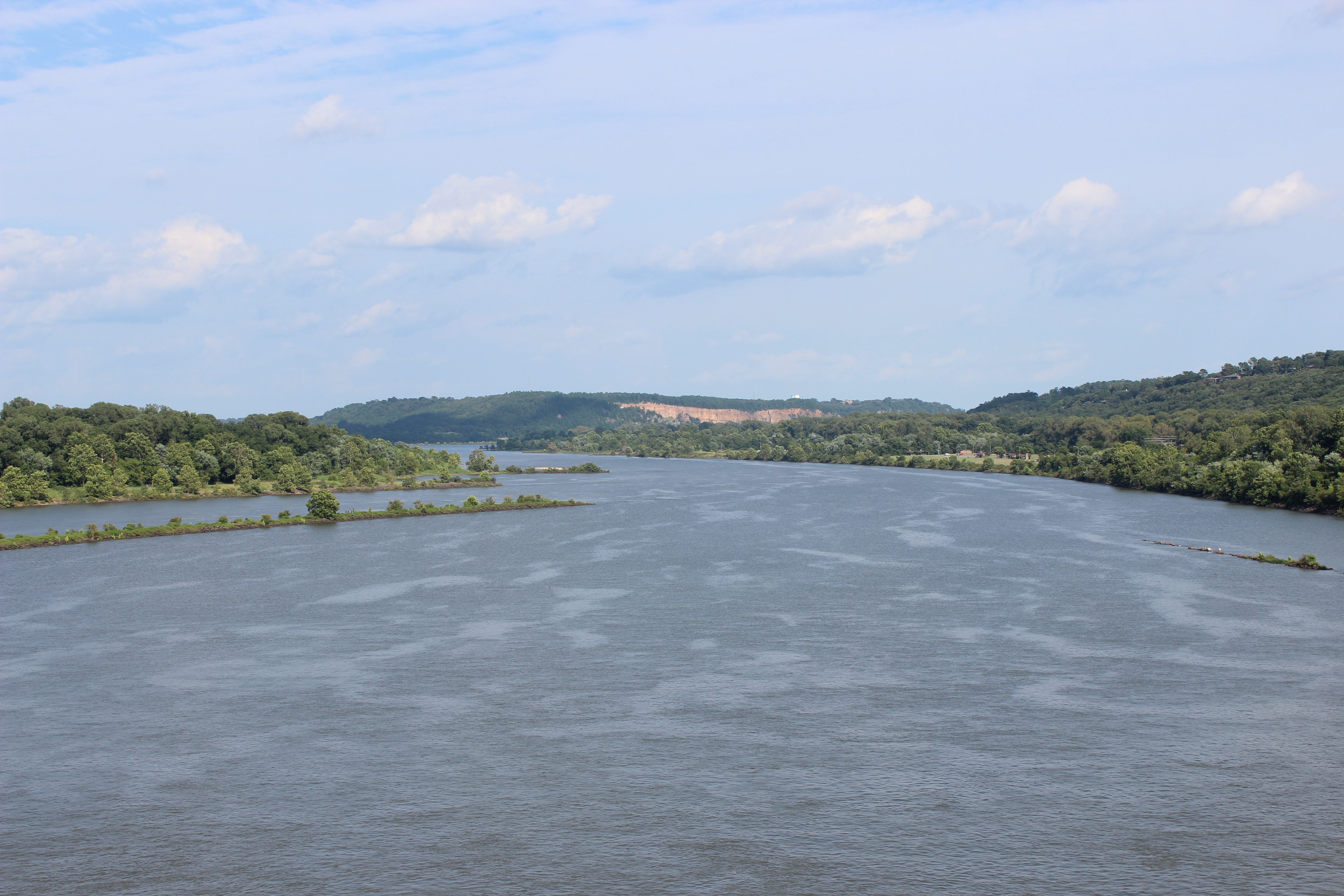
While walking over the bridge we noticed the breeze and talked about how it must be fun to bike over the bridge because the breeze keeps you nice and cool despite the hot sun. And then Sam randomly said this:
Every time I go to a Chinese restaurant I look at the menu and I see “Hunan” and I think it says “Human” and I gasp for just a second.
I have no idea what prompted this sudden declaration and I couldn’t help but laugh. He wasn’t done saying oddly interesting things, either. About an hour later, as we ate dinner at a highway rest stop on our way out of town, he got annoyed by a couple of flies that were hanging around us. He yelled at them to go find a garbage can, and then looked at me and said:
You know, a garbage can must be like paradise to a fly. It would be like if I found a free pizza store.
I was worried early on, but we ended up having a really nice day. Little Rock, though very small, is beautiful, accessible, and fun. Sam learned a lot and enjoyed doing it. We did everything we had hoped and a little more. And we did it all early enough that we had time to grill dinner without rushing, drive most of the way to Memphis, and get settled in a clean motel in time to get a full night’s sleep. The day started out a little rocky (Get it? LITTLE ROCKy?) but we ended up on a roll.
D/FTW
They say that everything’s bigger in Texas, and our plans for Sunday in the Dallas/Fort Worth area started out huge. First a tour of Texas Motor Speedway. Then a tour of Globe Life Park, which is the current ridiculous corporate name for the ballpark where the Texas Rangers play. Then all sorts of fun stuff in Dallas proper.
They also say that man plans and G-d laughs. Because we had to start the day with a three-hour drive just to get to Dallas, we knew we would have to cut out a few items from the itinerary. The first to go was Texas Motor Speedway. We’re not actually racing fans, and we already took a tour of the Talladega racetrack on a previous road trip, so really, how many racetracks do two non-racing fans need to tour?
Next to get crossed off the list was the tour of Globe Life Park. I would have loved to see a Rangers game but they’re not in town until Monday night, so all we’d be doing is touring the stadium. I’ve already seen a game there back when it had a better name, and frankly I’m getting a little bit of ballpark tour fatigue. The stadiums change but the tours are pretty much the same every time, which we know because we’ve been on six of them so far. We have no emotional attachment to this park in particular, so it just didn’t seem that exciting to sit inside yet another press box. At least, not while there were better options.
So we headed straight into downtown Dallas, which is absolutely beautiful. The skyline is no NYC but it’s pretty hefty, not too clustered or spread out, and includes some really interestingly shaped buildings.

Dallas is also clean and reasonably easy to drive through, especially for a major city.
Our first stop was Reunion Tower, which is hardly the tallest building in town but has the highest observation deck.
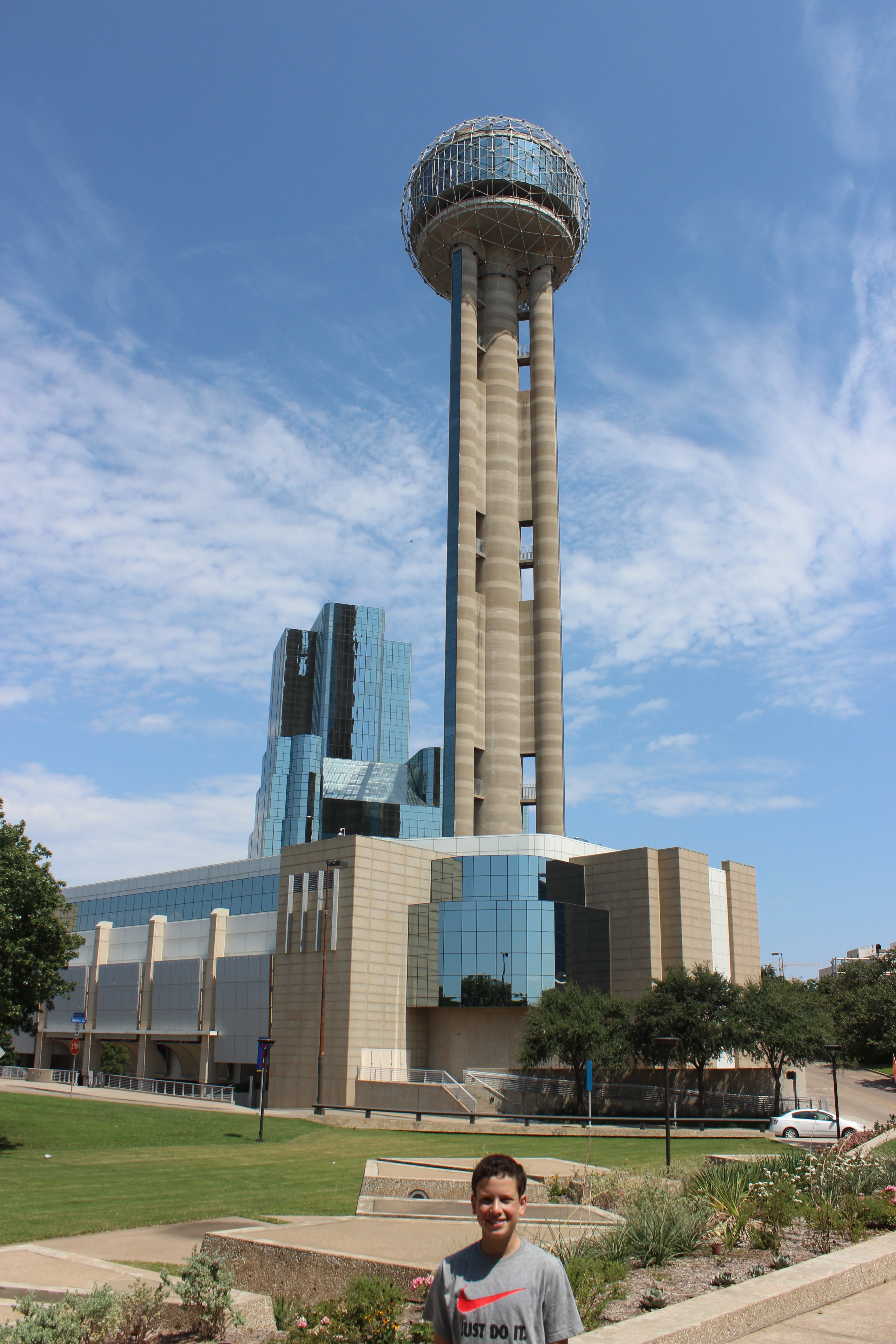
We headed straight to the top for fantastic 360-degree views of the city, which had the added benefit of helping to orient us.

Sam’s favorite part was using those mounted binoculars they have at places like this to zoom in on the people swimming in the pool at the Omni Hotel several block away. He thought he saw a naked guy sitting at the poolside bar but then discovered that the guy was wearing a bathing suit. Phew!
Then it was time to get serious. President Kennedy was assassinated in Dallas, and the former Texas School Book Depository building from where Lee Harvey Oswald fired the fatal shots has been turned into a museum about Kennedy, his presidency, and the assassination. It’s called the Sixth Floor Museum because that’s the floor Oswald shot from, and the entire exhibit is located there.

The window from where the shots were fired.
Apparently the smart thing to do is to order tickets online in advance so that you don’t have to wait on the 35-minute line to buy tickets. We did not do the smart thing. But eventually we got in and made our way through the museum, which is very well done on pretty much every level except for the ticket line. Everyone entering gets an audio guide, which was super informative. The exhibits start with some background about Kennedy’s rise to power and the general mood and issues present in the country at the time. It then goes briefly into some of Kennedy’s challenges and accomplishments as president. Then it explains his trip to Texas, including why he was there, what he planned to do in Dallas, and the various decisions and events leading up to noon on November 22. Then it provides great detail about the motorcade, the shooting, the breaking of the news, the reactions of the Secret Service and of the country, etc. We stood just a few feet away from where Oswald fired the shots, and we looked out the same window to see the street Kennedy’s limo was driving down, the famous grassy knoll, etc. Finally it delves into the crime scene and the initial investigation, followed by a detailed discussion of the various commissions, findings, and conspiracy theories, treating all viewpoints with equal sobriety and respect.
There were many things I learned from the exhibits. For example, I had never even thought about why Kennedy was in Dallas in the first place. I learned that he was there partly to raise money for his upcoming reelection campaign but also to quell a rift in the state Democratic party both to help solidify the governor’s position and so the party could do a better job of helping him carry the state. The most interesting thing I learned, though, was about Oswald. He had gotten a temp job as a stock boy in the warehouse just weeks before Kennedy’s arrival in Dallas, and an examination of his clipboard during the crime scene investigation revealed that he had not filled a single one of his orders.
Photography is not allowed inside the exhibit hall, which is a little disappointing but I think it’s a net positive as it helps add to the appropriately serious tone. Sam and I were both somewhat relieved that the museum, while somber, was not overly sad and ended on an upbeat note about Kennedy’s legacy. We were so shaken after the Oklahoma City memorial that we were a little wary of another death museum, but it turned out OK. We decided not to buy souvenirs because it just didn’t seem appropriate.
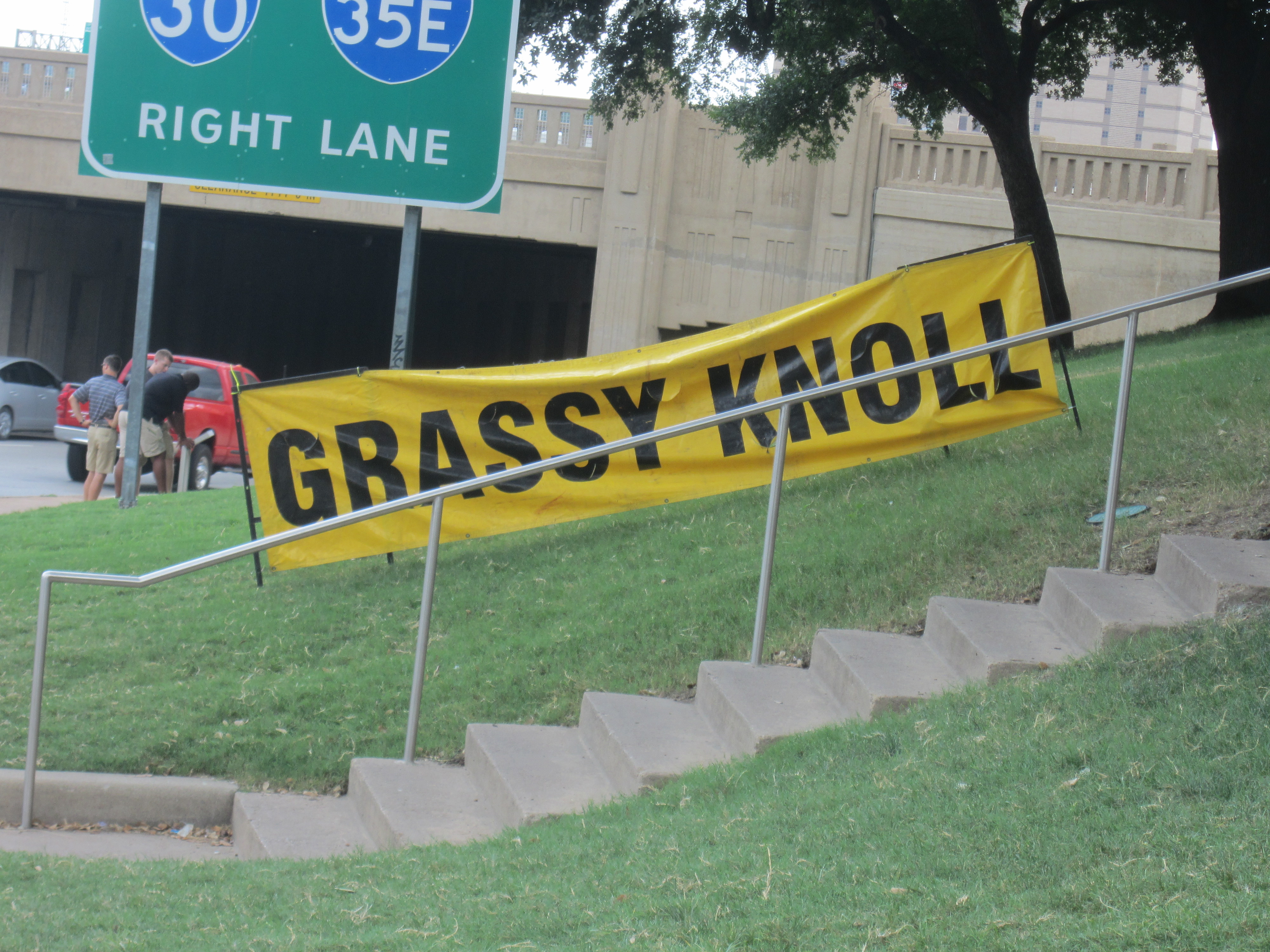
After leaving the museum we walked over to the grassy knoll and unfortunately witnessed a very different mood. The giant, bright yellow sign saying “GRASSY KNOLL” should have been the first clue that the place of Kennedy’s death had been turned into a tourist site, but Sam and I foolishly had higher hopes for humanity.
In the street where Kennedy was shot there’s a permanent white X marking the first time Kennedy was hit and another X a little further down marking the fatal shot. Throngs of tourists were running out into the street and posing for pictures standing on the X’s with big grins on their faces as if they were standing on the Reunion Tower observation deck. Sam and I were both horrified that people could be smiling in the spot where a U.S. President was murdered.
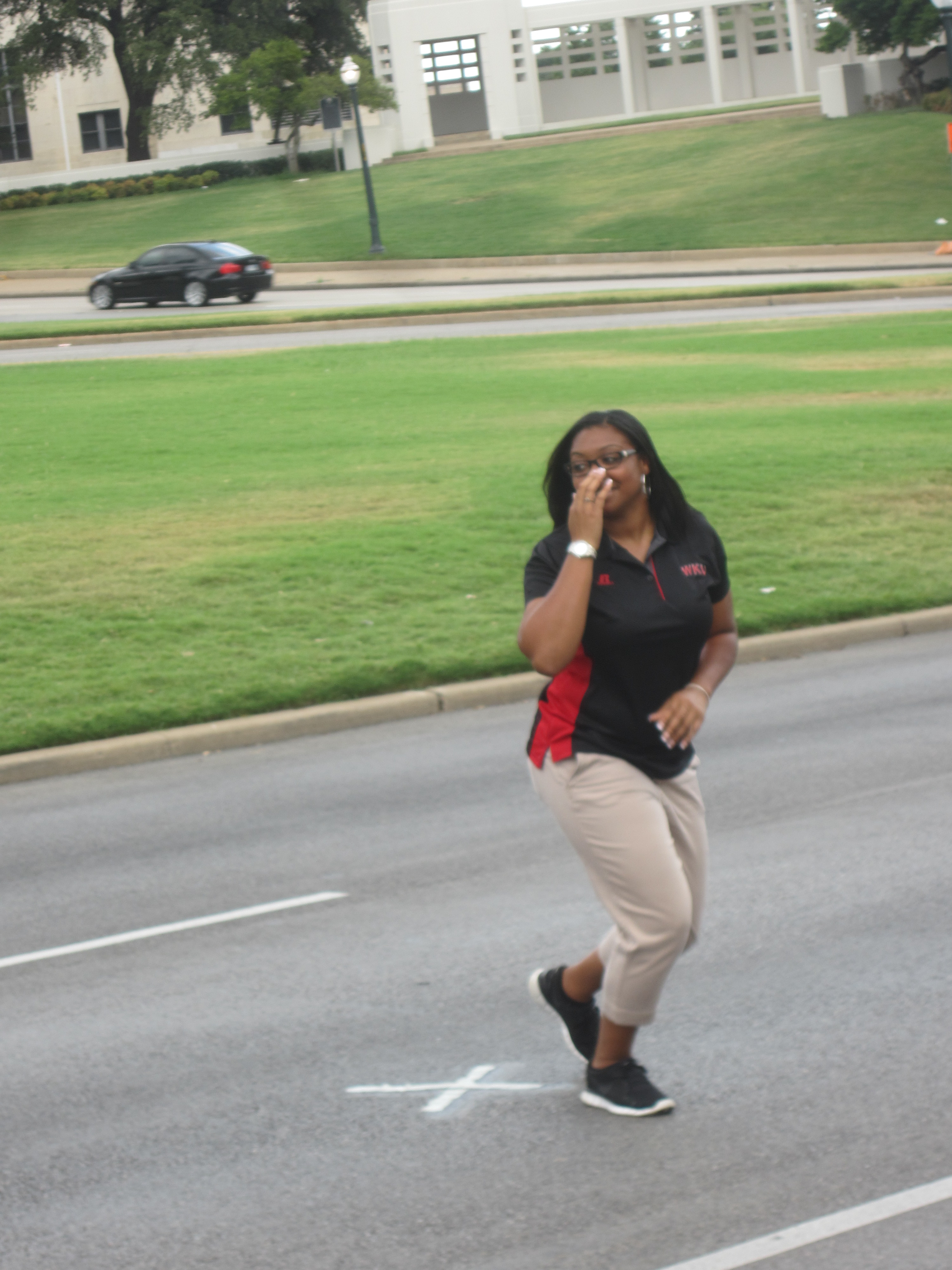
OMG, this is so much fun!
Two blocks from the museum our mood brightened when we saw this mailbox:
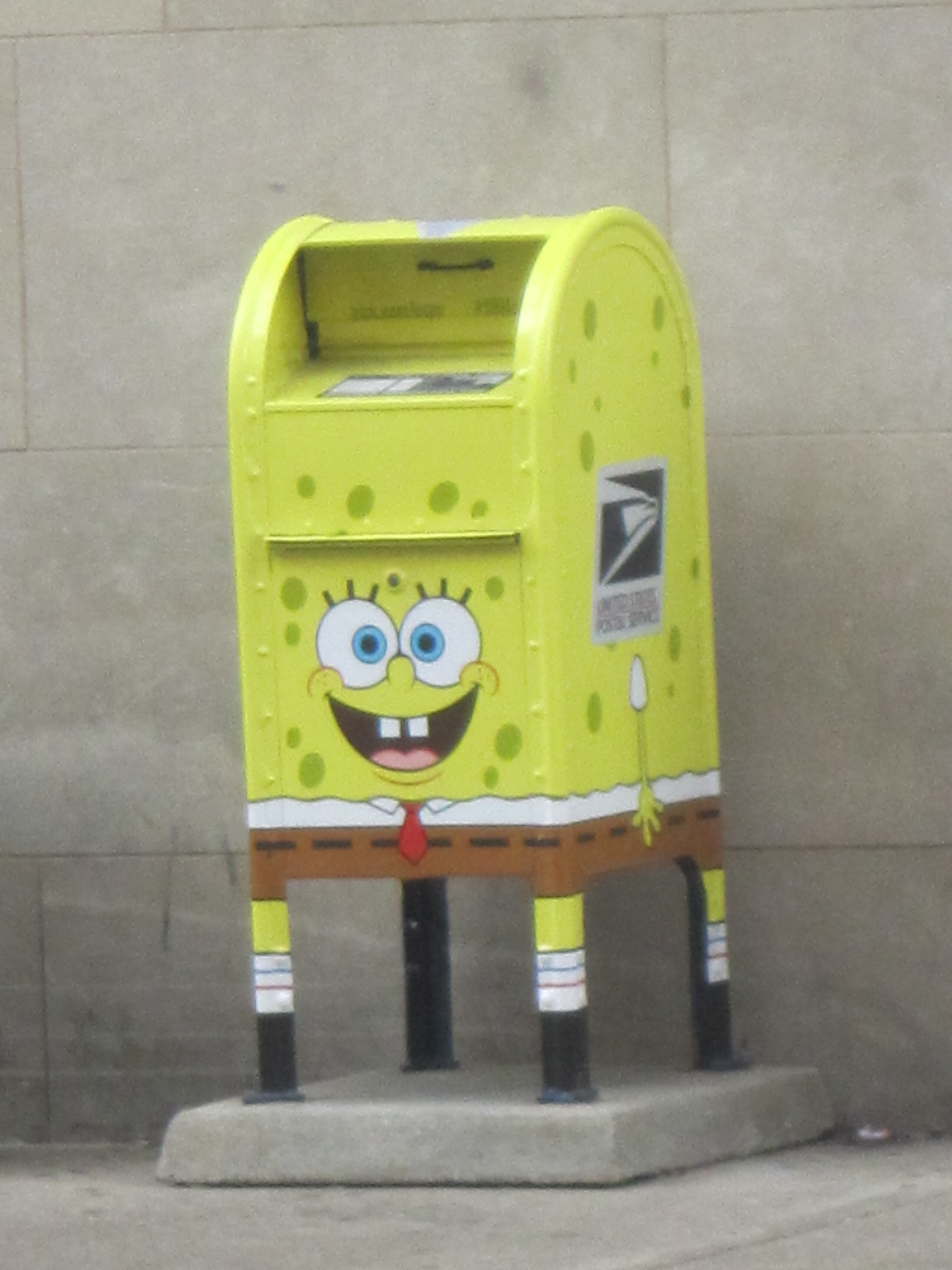
We have no idea why it’s painted like this but it made it hard not to smile.
From there we went in search of more smiles at the relatively new Perot Museum of Nature and Science. It took us a while to get there because Sam accidentally set the GPS to the museum’s secondary location a few miles away. We went there, found out we were in the wrong place, and then had to sit in traffic trying to get back. When we finally got to the right museum we had another fiasco just trying to get into a parking lot.
Eventually we made it inside the museum and we had a fantastic time. It was awesome outside and in.
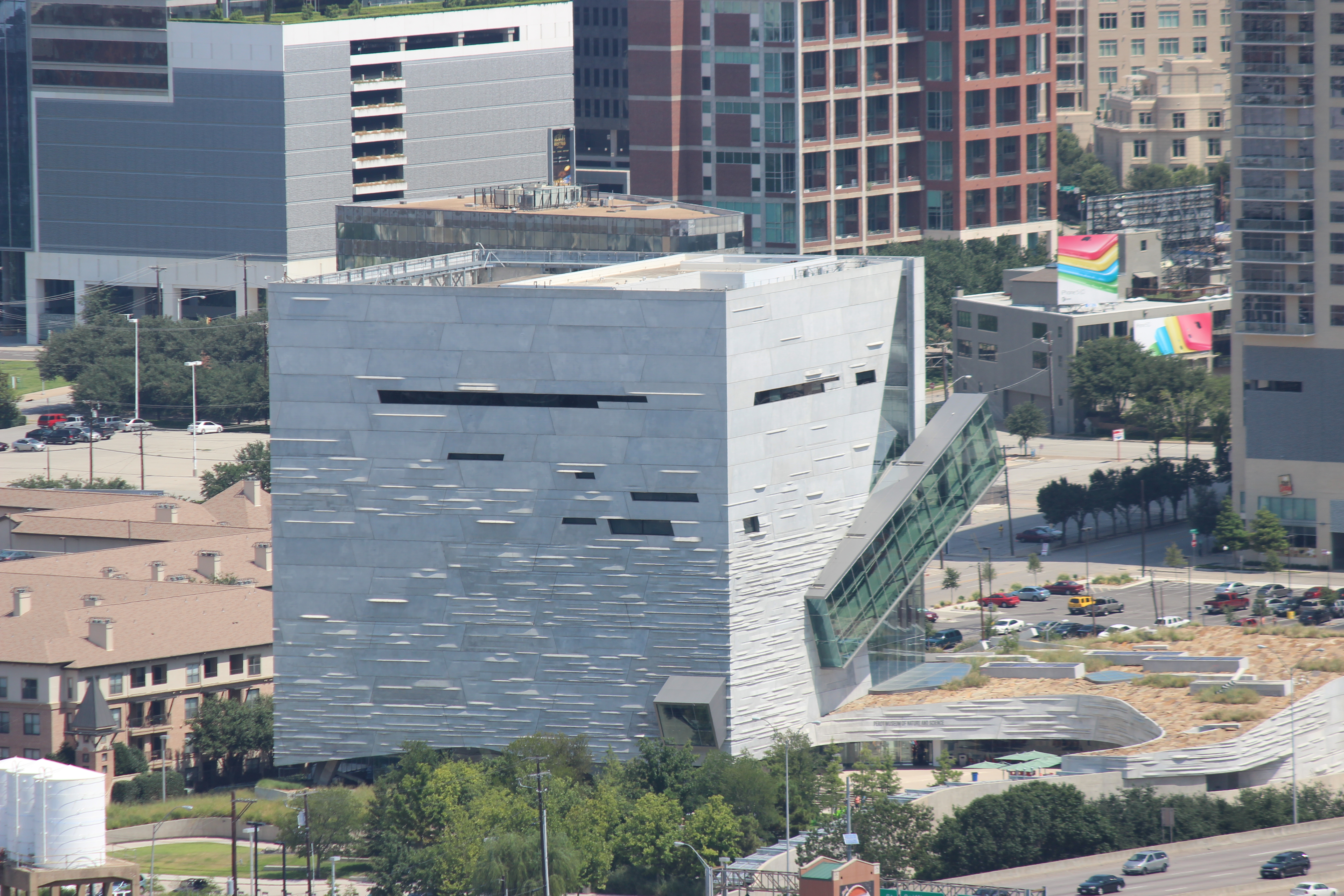
Favorite features included the glass-enclosed four-story escalator that provides fantastic views of the city, the musical staircase (It’s like the movie Big but on stairs!), the earthquake simulator, and the racetrack that lets you race alongside a video of your choice of various professional athletes or a Tyrannosaurus Rex (Sam raced a professional soccer player whose name I didn’t notice, and Sam won thanks to a major false start).
The best part, though, were the 3-D movies. We saw one about dinosaurs that was so good we bought tickets to a second one about reintroducing captive pandas to the wild in hopes of repopulating the species.
Confession: I slept through most of the dinosaur movie. I didn’t mean to, but we both slept horribly Saturday night and woke up early Sunday to get to Dallas at a reasonable hour.
When we finally got kicked out of the museum after it closed, it was time for dinner. There’s a big Jewish community in Dallas and several kosher restaurants, so on Sunday morning I took to Facebook and asked if anyone could recommend one of the many restaurants. It turns out that Abigail, a friend of mine from high school whom I hadn’t seen since, lives in Dallas and invited us to join her family for dinner. We ended up at a place called Meat Point, which was a typical kosher restaurant in that it is mainly Israeli food but also offers a few Italian dishes and some random Asian food. In a place like that, the smart play is always to stick to the Israeli choices. We did, and dinner was pretty good. Catching up with Abigail and meeting her family was even better, and to top it all off she sent us off with a tin of home-baked cookies!
Time flew, and before I knew it it was almost 8. This would not have been a problem except that it’s a 4.5-hour drive from Dallas to Little Rock, and if we’re going to have enough time to do everything we’re hoping to do there, we needed to get some serious driving done tonight. Unfortunately we hit several snags. For starters, we were completely exhausted from long day after getting almost no sleep the night before, so I figured I would drive until around 9:30 and then wed find a place to crash. Then after 15 minute of driving, major construction closed two lanes and left traffic at a near stand-still for a half hour. I reluctantly decided to make up for the delay by driving a little farther, so we pushed ourselves until 10 p.m., at which point we arrived in Mt. Pleasant, Texas in search of a cheap motel.
We were thoroughly spent and were relieved to find a Quality Inn, which is usually reliable and was even cheaper than I had hoped. However, we soon found out why. When we entered our room we found two massive cockroaches in the bathroom, one dead and one on its back still kicking. I guess everything really is bigger in Texas. We were devastated. We knew we could not stay there, but the thought of repacking the car and finding a new motel was more than we could bear. In the end we chose to leave. We repacked the car and I stopped off at the front desk and told the woman that we needed a refund and couldn’t stay there. She didn’t even ask why; I assume she knew.
Down the street was a Days Inn. I have a general policy to never stay in a Days Inn, and this particular Days Inn is a great example of why. The whole building is in decrepit shape and the room we were put in is grimy and falling apart. The tub is full of spackle, the carpet is coming apart, and the A/C only sort-of works. But it was 10:40, we were well past tired, and there were no giant insects to be seen.
We didn’t get to do everything we wanted in Dallas, but we thoroughly enjoyed everything we did do, and I got the bonus of reconnecting with an old friend. Dallas quickly became one of our favorite cities, and we’re already talking about what we’ll do when we come back, whenever that will be. It’s just too bad the rest of the night didn’t go as well as the day did.
Don’t Mess Up Texas
I screwed up. Twice.
For starters, I totally underestimated Carlsbad Caverns, specifically in terms of how much time we should spend there. There are several parts of the cavern and several ways to see it, and I picked what appeared to be one of the best ways: a guided tour of a section of the cavern called King’s Palace. It is, in fact, widely considered the most impressive part of the cave and it is also the deepest part. But when we got there and started to look around and talk to Park Rangers it became clear that, although the King’s Palace tour was going to be great, we should have also done the self-guided tour of the Big Room (the main part of the cave that most visitors see), and we should have also considered either coming in or going out through the Natural Entrance rather than only entering and exiting through the elevator in the Visitors Center. Unfortunately, each of those would have added about an hour and a half to our time at the cavern, which would have been wonderful but would have also required us to stay in the middle of nowhere.
So we had to settle for the King’s Palace tour. But once we were on the tour, it hardly seemed like settling. Sam and I have been inside caves in New York, Missouri, Montana, Alabama, Kentucky, and South Dakota. So at this point in our spelunking careers, it takes a lot to impress us. Carlsbad impressed us. The first thing we noticed was the enormity of the place. It’s not the biggest cave in the world (that’s Mammoth Cave in Kentucky) and it’s not the longest (that’s Jewel Cave in South Dakota), but what makes Carlsbad seem so big is the size of the rooms. The Big Room, which we didn’t see, is the size of six football fields. But the smaller rooms (we saw King’s Palace, Papoose Room, and Queen’s Palace) were immense, and the formations in those rooms were similarly huge.
The next thing we noticed were the stalactites. (I know right now you’re probably wondering whether stalactites are the ones on the floor or the ceiling. Answer: ceiling. Here’s an easy way to remember: stalactites need to hold on “tite” or else they’ll fall down. Also, the word has a “c” in the middle, for ceiling. “Stalagmite” has a “g” in the middle, for ground.) The stalactites in Carlsbad are unusual in that there are a bazillion of them and they’re mostly very thin and long and pointy. In King’s Palace Sam said it looked like someone above ground stuck a million swords down into the ground and we were looking up at their blades. The Park Ranger really liked that description, as did I.

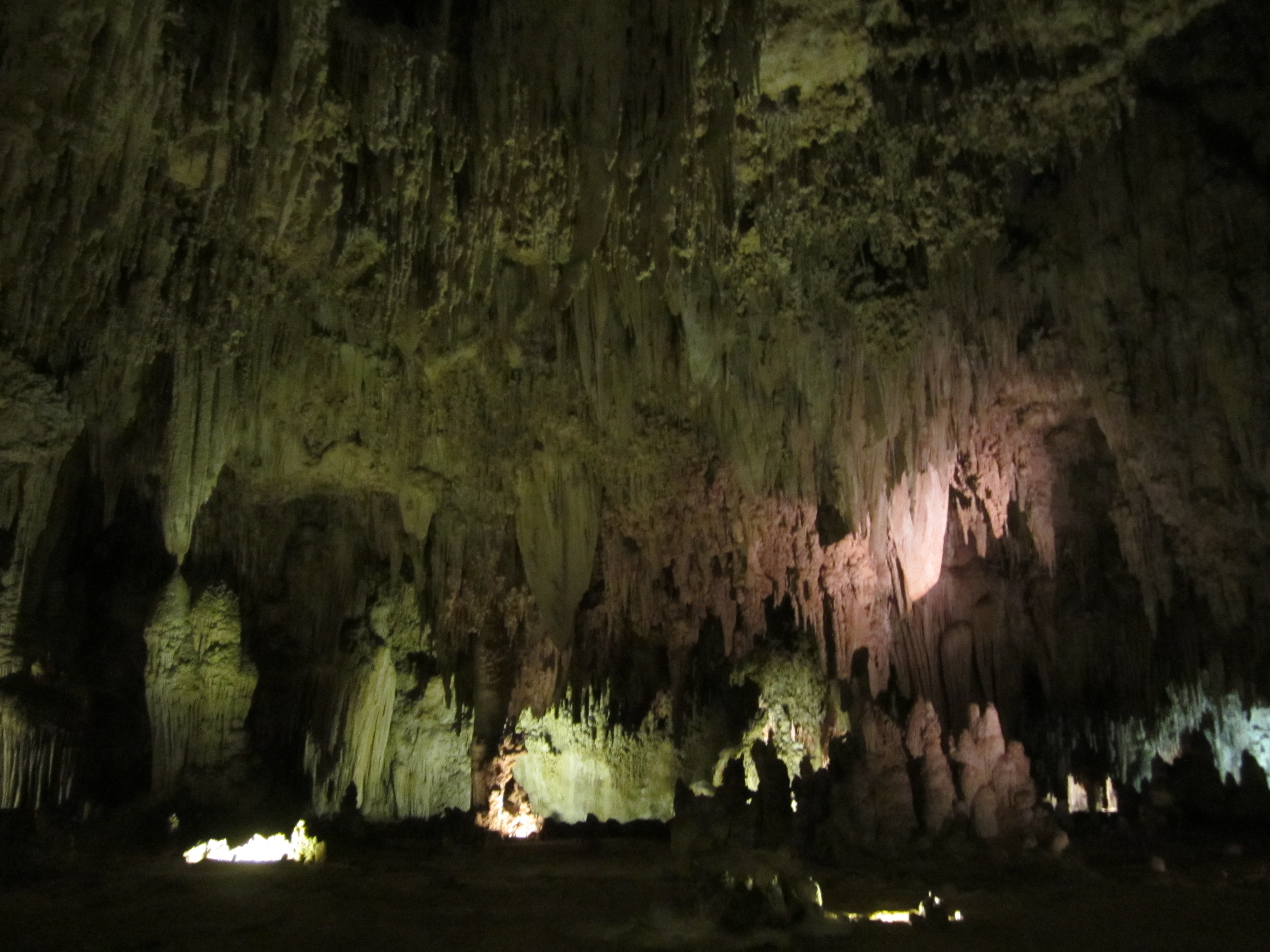

The last major room on the tour, Queen’s Palace, is so named because on each side of the room there are massive stone “draperies” that make the room look rather royal and yes, kind of feminine–for a cave, anyway. The draperies are each about 40 feet tall, which means they took hundreds of thousands of years to form. But from across the room Sam noticed an oddly shaped stalagmite that might have helped give the room its name.
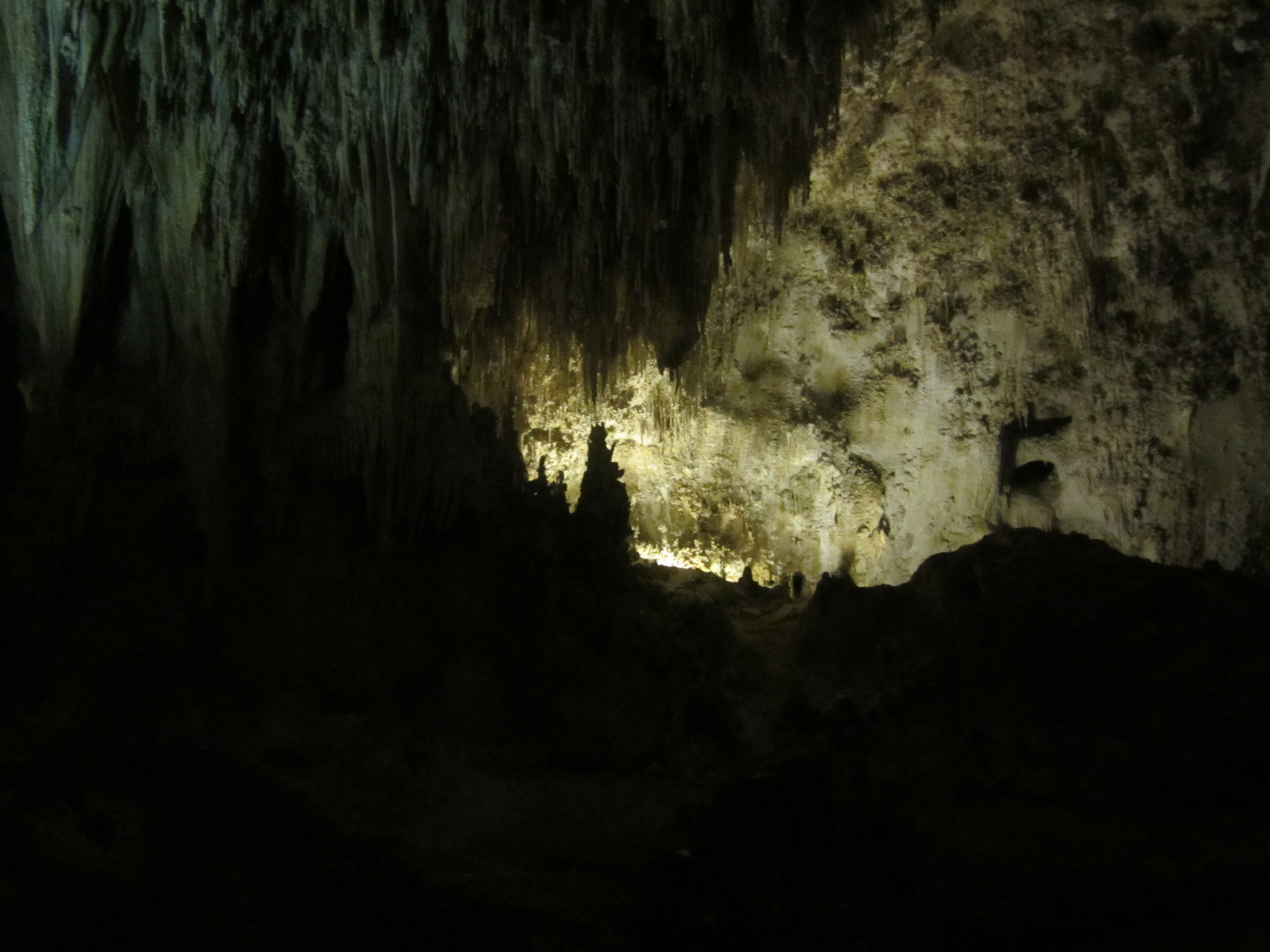
It’s a little hard to see in this shot, which makes it all the more impressive that Sam noticed it. So here’s a closer look:

See how it looks kind of like a queen?
Sam wasn’t done impressing people just yet. As the tour was ending he asked the Ranger what the difference is between a cave and a cavern. The Ranger, who had recounted the entire history of the cavern and had quoted multiple nature writers from memory, was stumped by Sam’s question.
On the way out we got to see one cool little rock formation that the people who just go to the Big Room never get to see. It’s called the Bashful Elephant because it looks like an elephant who has turned away in embarrassment.
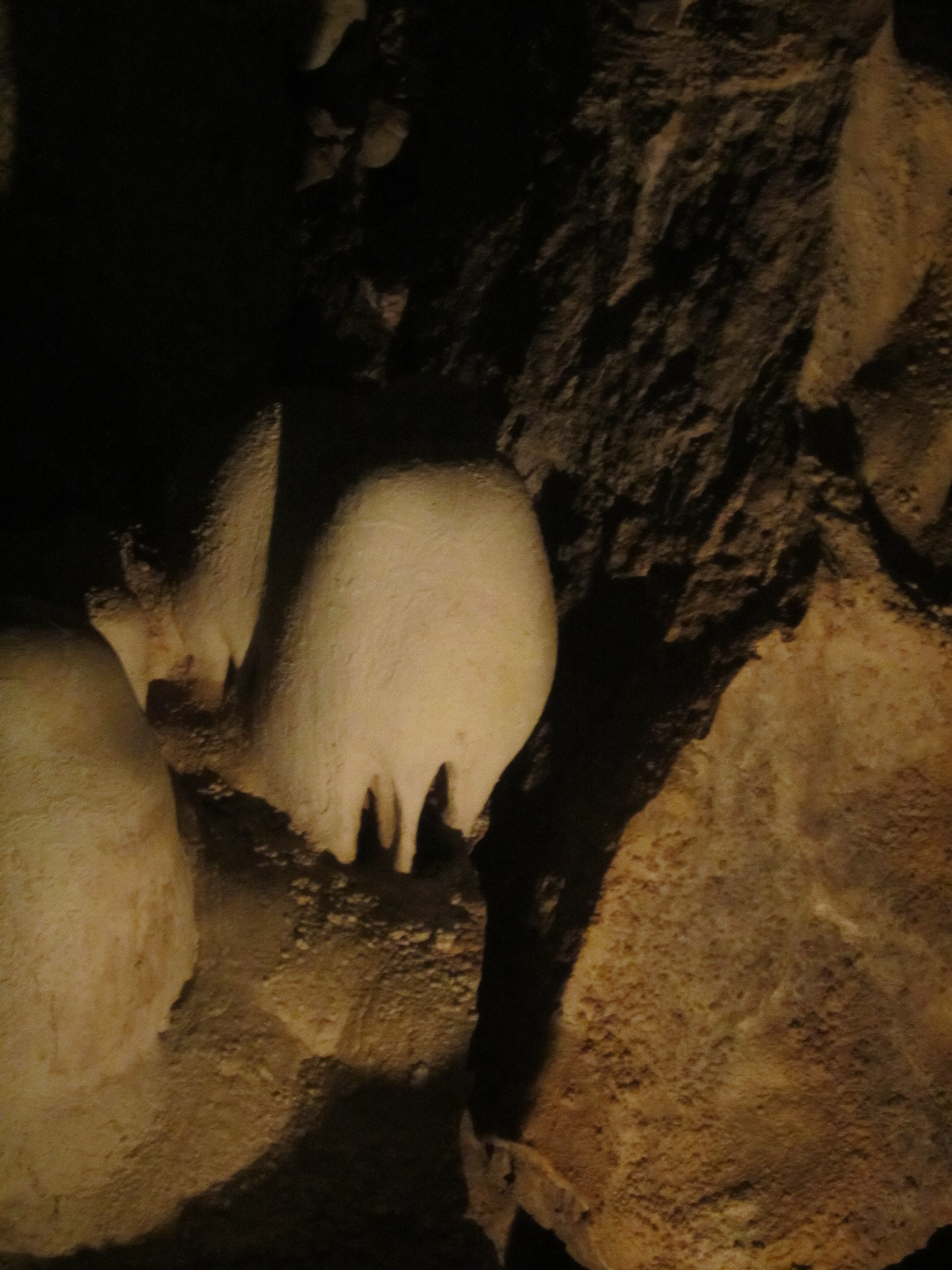
And we finished our visit to Carlsbad by doing something you can’t do anywhere else in the world: go to the bathroom 800 feet below ground.

So in the end my blunder may have prevented us from seeing more of this extraordinary cave, but between the tour and the bats the previous night, we did just fine. That said, if you ever visit Carlsbad Caverns please do yourself a favor and budget at least three hours and preferably five so that you can see all the really cool parts.
After a quick lunch we spent the rest of the day driving east. Literally. We left Carlsbad at around 12:30 and we didn’t stop driving until almost 6:30. And Western Texas is not exactly known for its scenery. It’s known for its oil. So the drive was pretty much five hours of this…
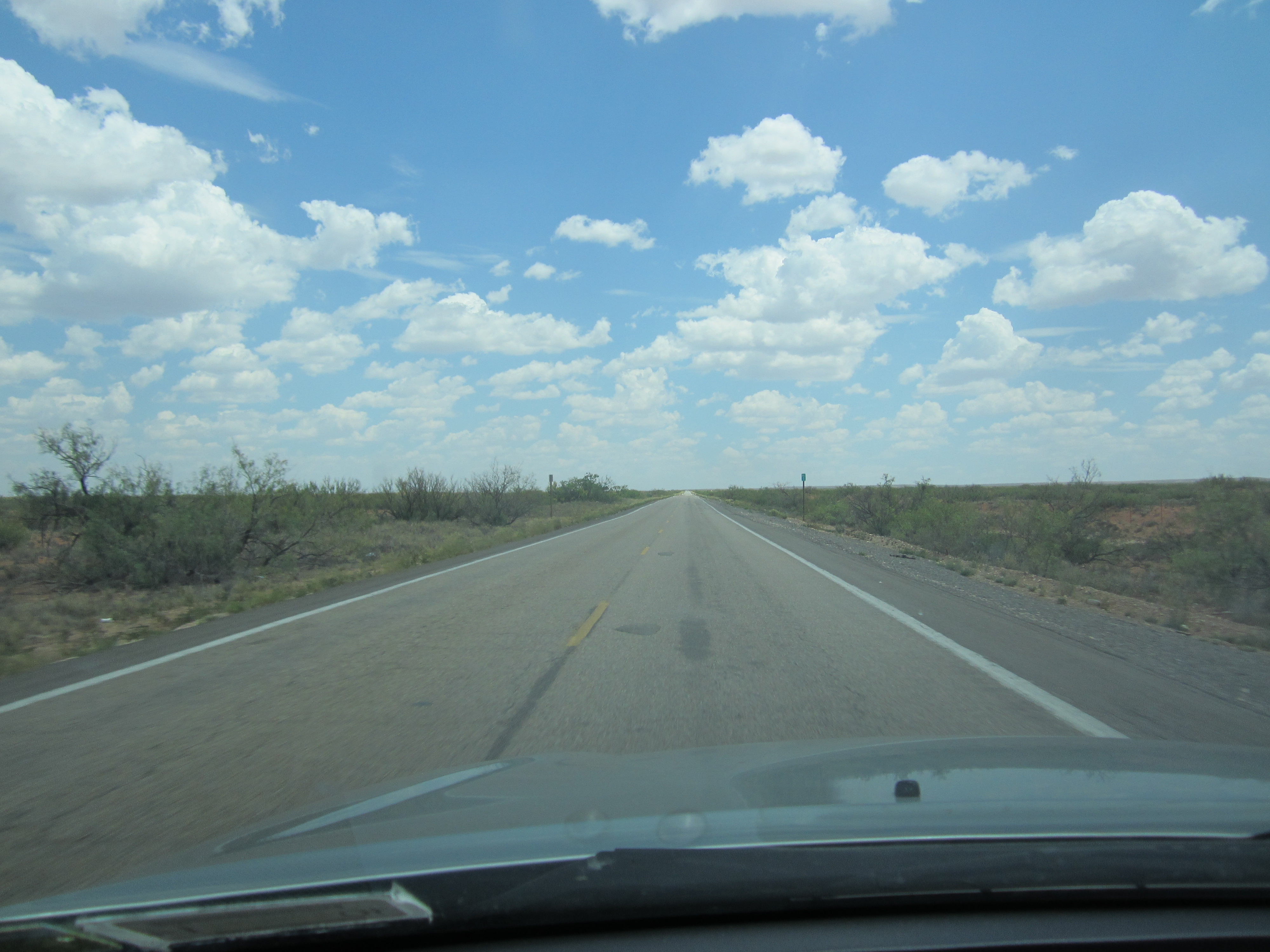
…interrupted occasionally by this:

And that’s where my second mistake came into play. See, those five hours of driving were actually six hours on the clock. When we crossed from New Mexico into Texas we changed time zones, losing an hour and bringing us much closer to sunset than we wanted to be on a Friday. Originally I thought we might spend Shabbos in Dallas, but losing that hour along the way made that impossible. So instead we ended up in Abilene for Shabbos. Abilene is a fine little city but it’s no Dallas. (In fact I did a little research and the city is actually named after a Kansas cowtown with the same name. So it’s not even the original Abilene.) And waking up Sunday morning in Abilene means we’ll get a later start in Dallas than I wanted, which means we may not get to do all the fun stuff I had planned.
With that said I’d better wrap this up, as we’ve got to get up early so we can get to Dallas. While I’m sleeping, you can enjoy Sheryl Crow’s tribute to Abilene. This is the song I think of whenever I hear anything about Abilene, even though the song is not really about the town. But, like the city, this song is not the original Abilene, either. The song at the top of this post was written in the 60s and is actually about the town of Abilene … Kansas.
We Come In Peace
Thursday has to be the most productive day I’ve ever had that involved seven hours of driving.
The ultimate goal was to get to Carlsbad Caverns National Park. The cavern itself is supposedly very impressive but for the Hamster and I the biggest draw was the bats. Some 400,000 bats live in the cavern, and at sunset they wake up and swarm outside through the cave’s biggest entrance. You can’t enter the cavern after 5 p.m. but you can still come to see the bats.
Unfortunately, Carlsbad, New Mexico is a seven-hour drive from Tombstone, which was our last stop on Wednesday. To break up the long drive, we had a choice: either we follow I-10 through El Paso and stop off there, or we hook north a bit and hit Roswell. Some cursory research showed there to be very little of interest in either city. We chose Roswell.
Of course, getting to Roswell required several hours of driving, most of which took us through huge stretches of land so barren that the U.S. government uses a chunk of it to test missiles.
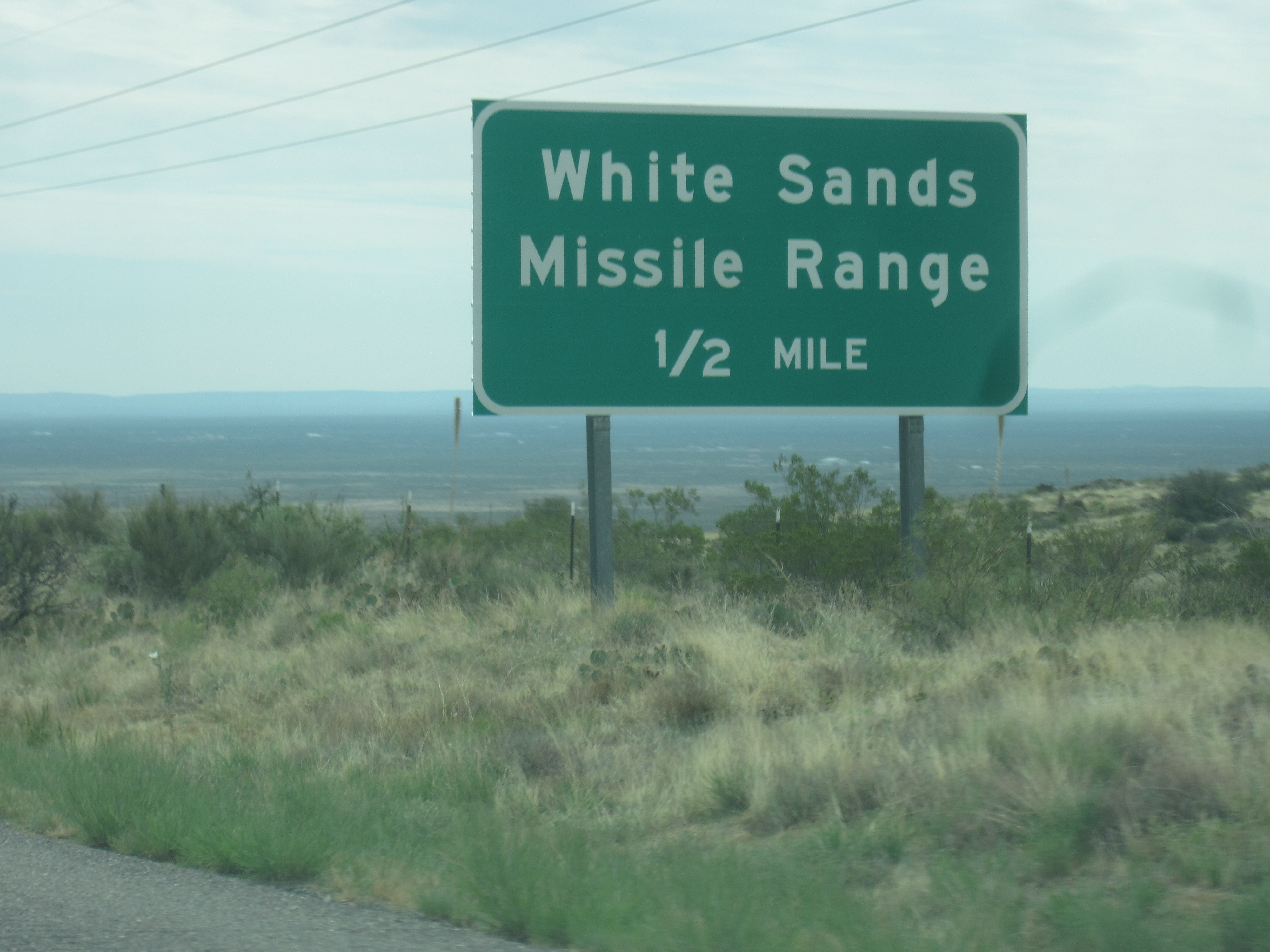
We also had to stop at another U.S. Border Patrol checkpoint. The guy asked me if we’re U.S. citizens. I said yes. He waved us through.
Sam spent most of the drive watching The Incredibles. I spent most of the drive watching the road, which was considerably less entertaining with the single exception of a roadside stand called Pistachioland.
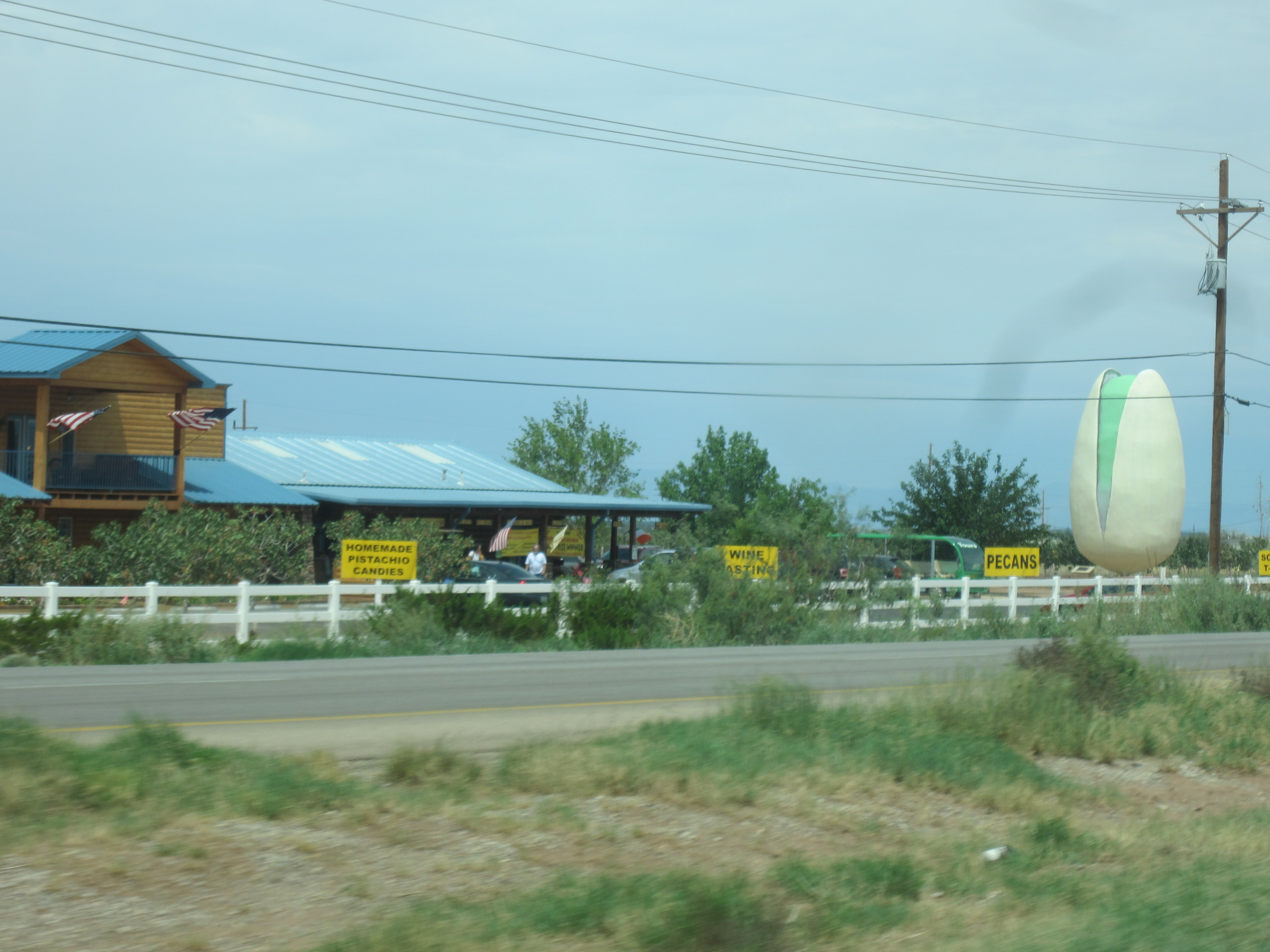
Yes, that thing on the right is an enormous statue of a pistachio.
As we got close to Roswell the skies appropriately darkened and, after threatening for a half hour or so, opened up with a fury. Within minutes the road was so flooded that partially submerged police SUVs were diverting traffic. Sam took this photo out his window:
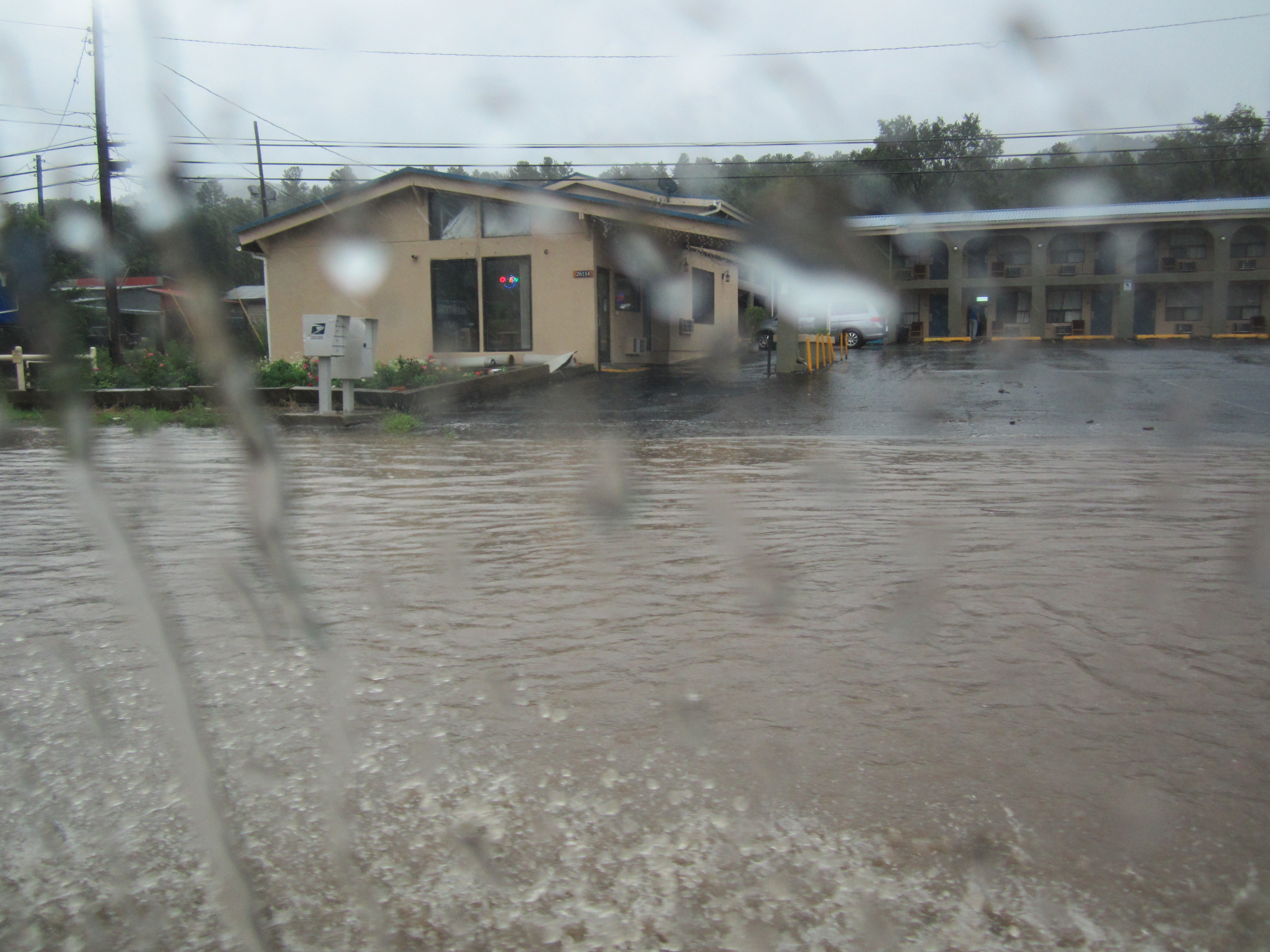
Somewhere underneath all that water is the road. It was rather worrisome but we made it through and the rain soon stopped.
We arrived in Roswell at around 1:30. What I really wanted to do there was to take a guided tour of the city and particularly the alien-landing-related sites. There’s one reasonably reputable guy who does this, and he tends to fill up pretty far in advance. So a month ago I checked his availability, and sure enough he was already booked for this afternoon. Plan B was to head straight to the International UFO Museum and Research Center. Sounds official, doesn’t it? The exhibits even look kind of official, until you finish reading about the supposed UFO crash of 1947 and you get up to the incredibly cheesy “alien” displays:
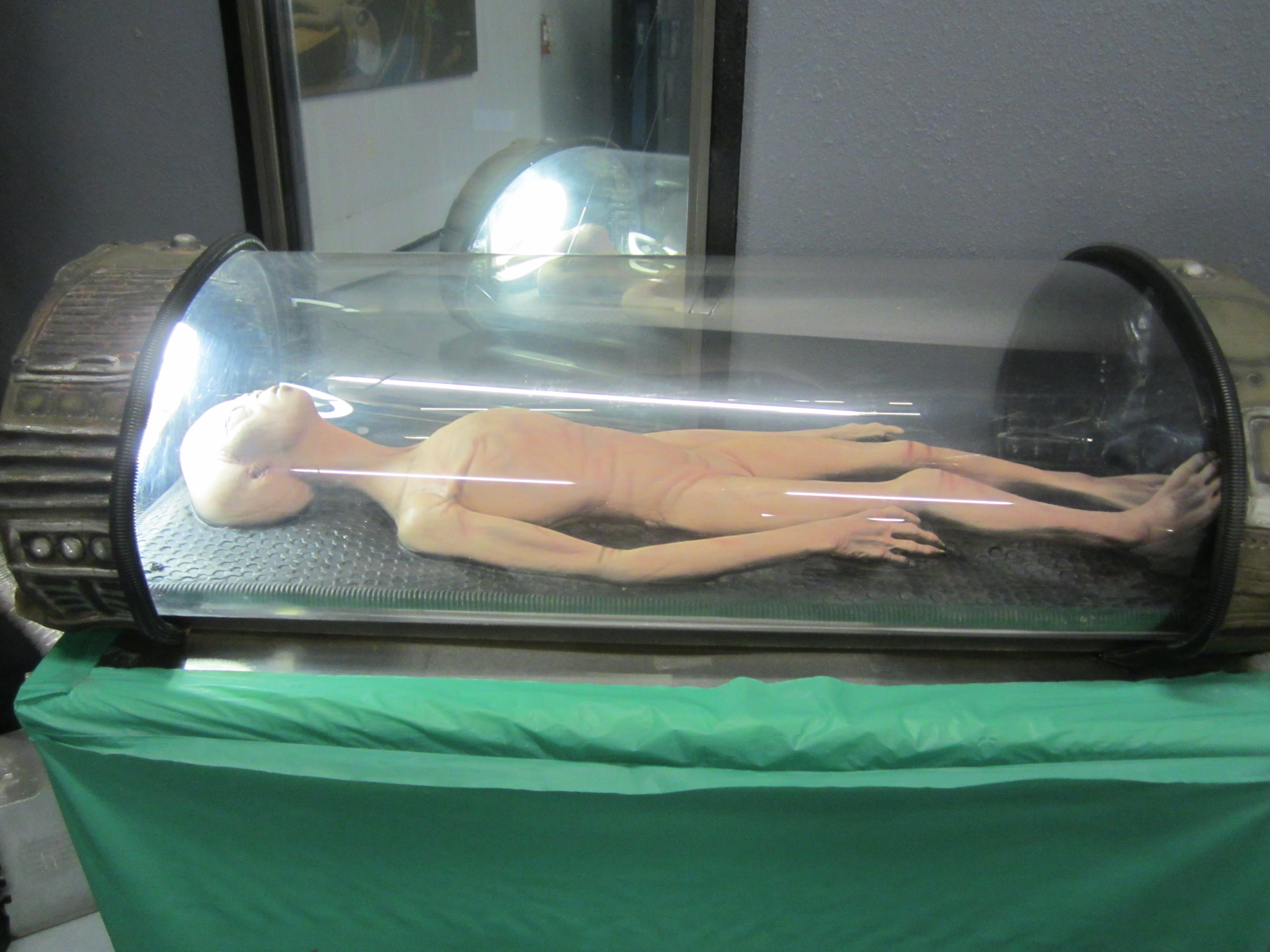
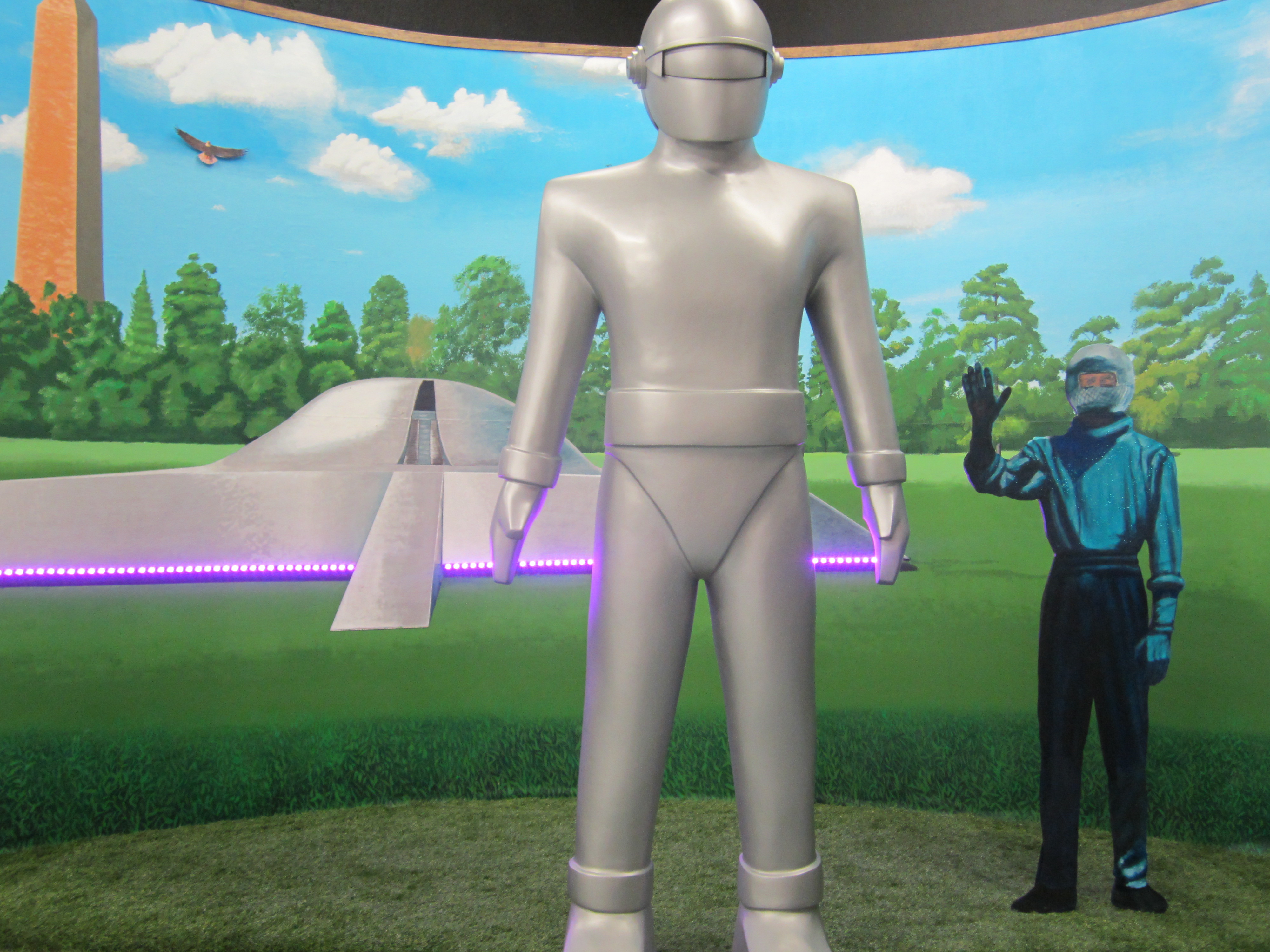
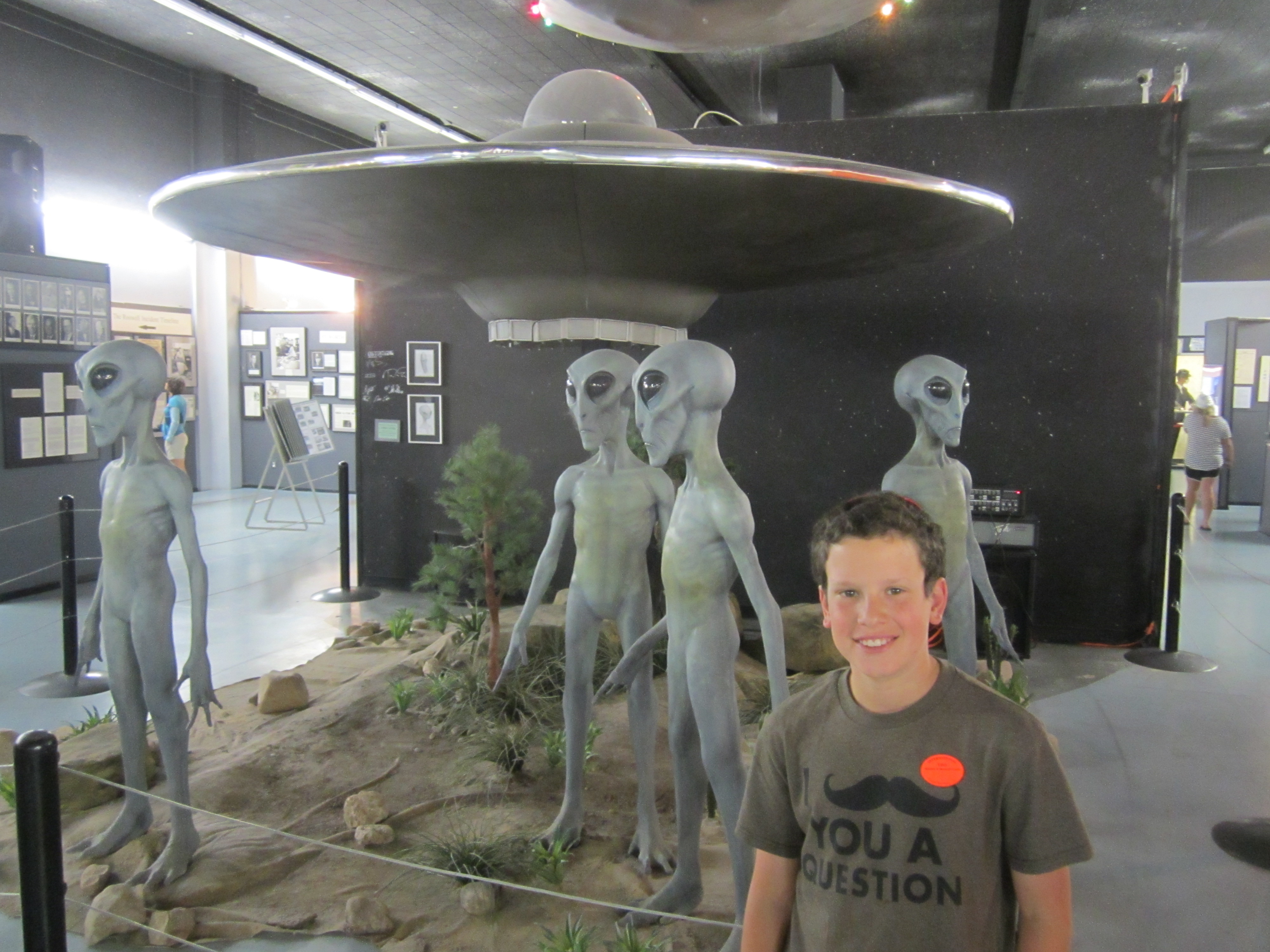
Very scientific.
Sam, being 12, has a much less discerning eye for fakery and came away from the 1947 exhibit pretty convinced that it was really aliens that crashed in the desert outside of Roswell. To convince him otherwise, I could have pointed out the faulty grammar in the museum exhibit explanations. I could have pointed to the unclear timeline of supposed events. I could have focused on the fact that much of the “evidence” refuting the government account of the crash was related third- and fourth-hand. I could have mentioned that the Washington Post reported that the UFO was just a weather balloon–the same Washington Post that uncovered the Watergate scandal and was thus no puppet for government conspiracies. I could have argued logically that if aliens sophisticated enough to get to Earth had crashed, someone from their home planet would have gone looking for them and thus this would not be the only alien contact in world history. Or that the White House couldn’t keep the secret of the Watergate break-in for even a few months, there’s no way that several branches of federal government plus half the Air Force could keep alien corpses a secret, even in pre-Internet 1947. I did none of those things. Instead I showed him this museum display from the TV movie about the Roswell incident:
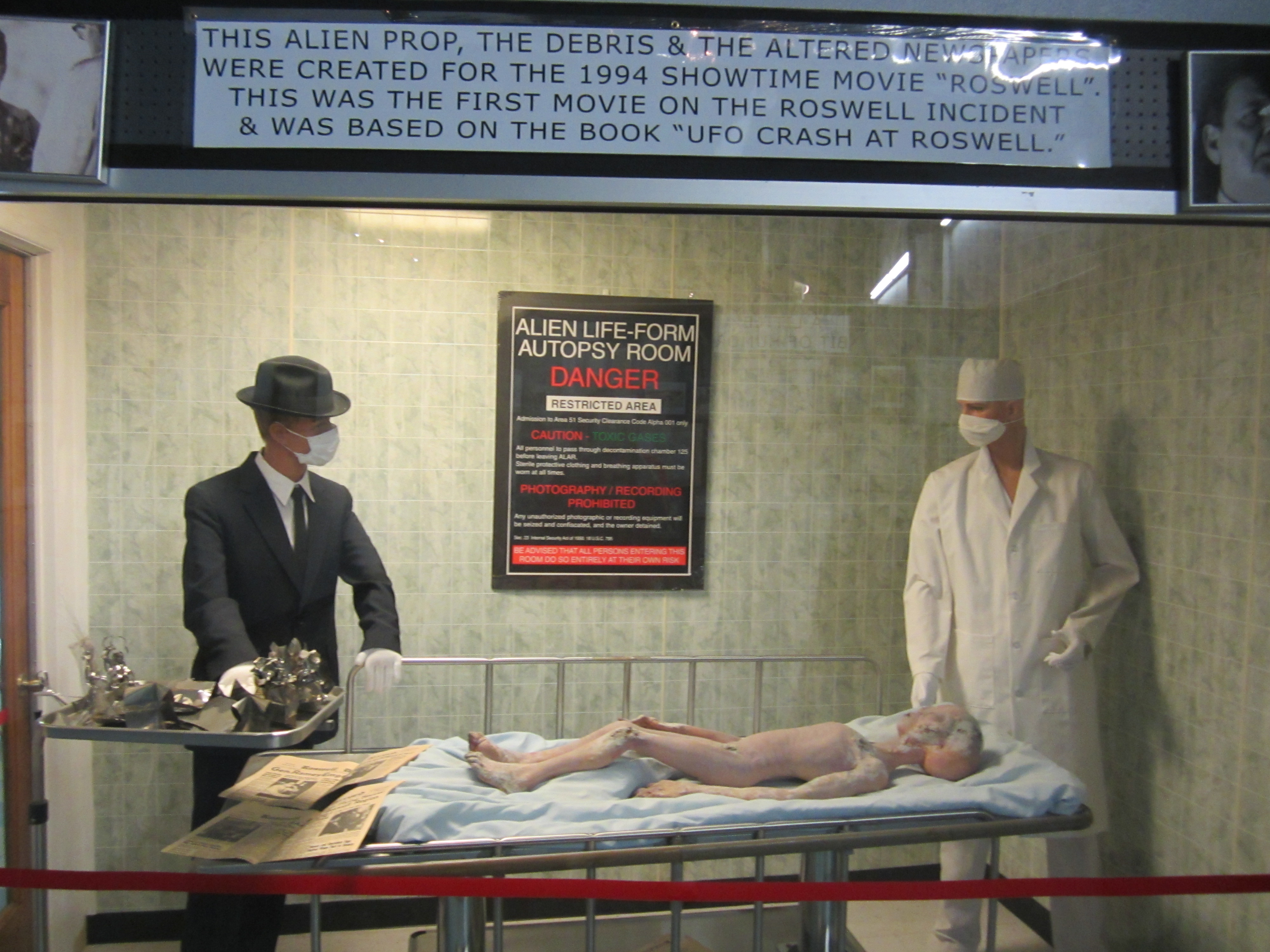 See at the top, where it says, “altered newspapers”? It’s referring to the newspapers at the foot of the alien’s bed. See them? It means those newspapers were fakes made just for the movie. I had Sam take a close look. Then I took him back to the main exhibit and had him look again at the local newspaper that first reported the crash.
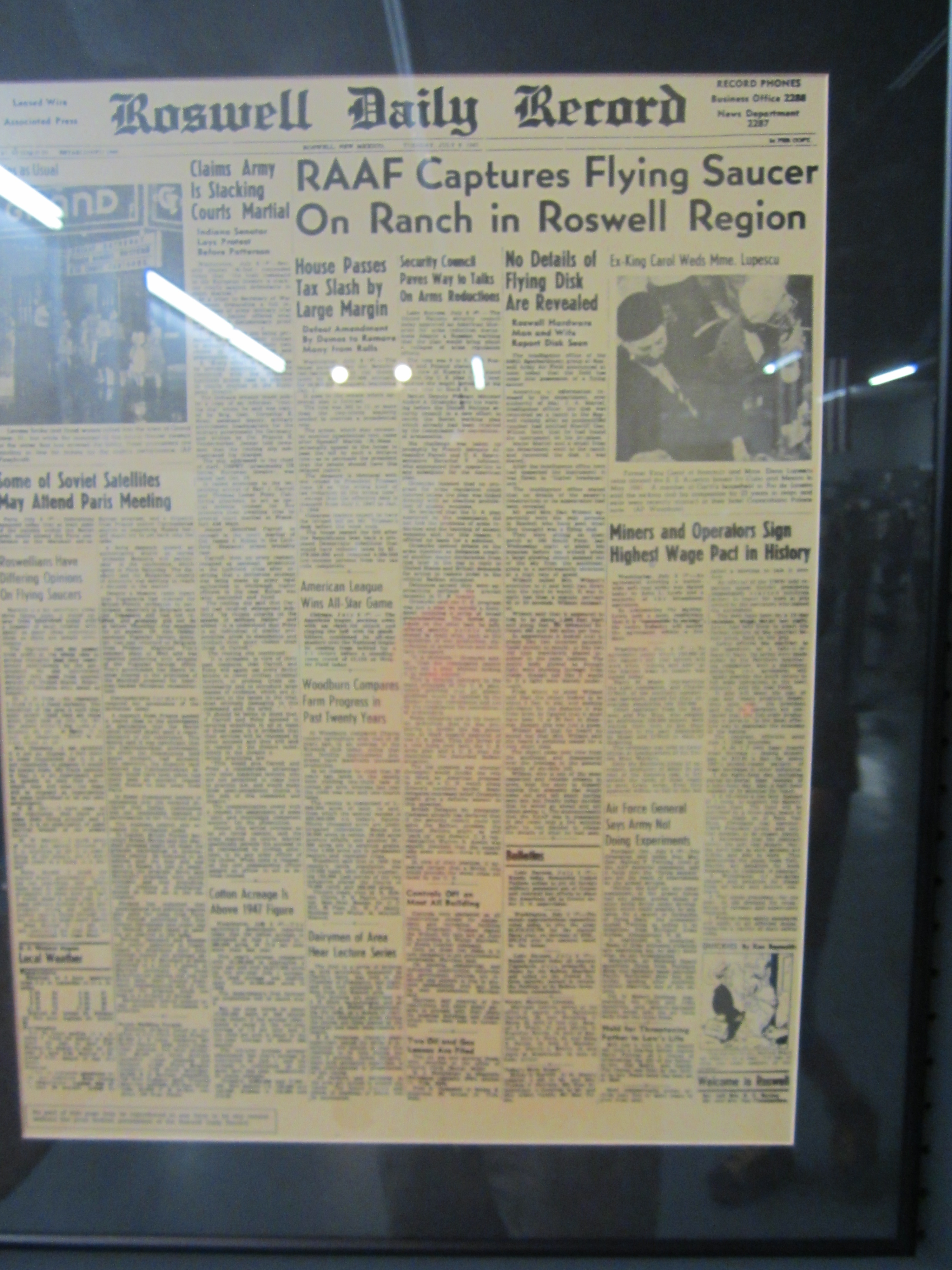 It’s exactly the same newspaper that’s in the movie set. The UFO “museum” is using a movie prop as evidence of a visit from aliens. Conclusion: there may very well be intelligent life out there, but if there is it sure didn’t crash in Roswell in 1947. Sam laughed, both at the museum and at himself for briefly falling for this nonsense.
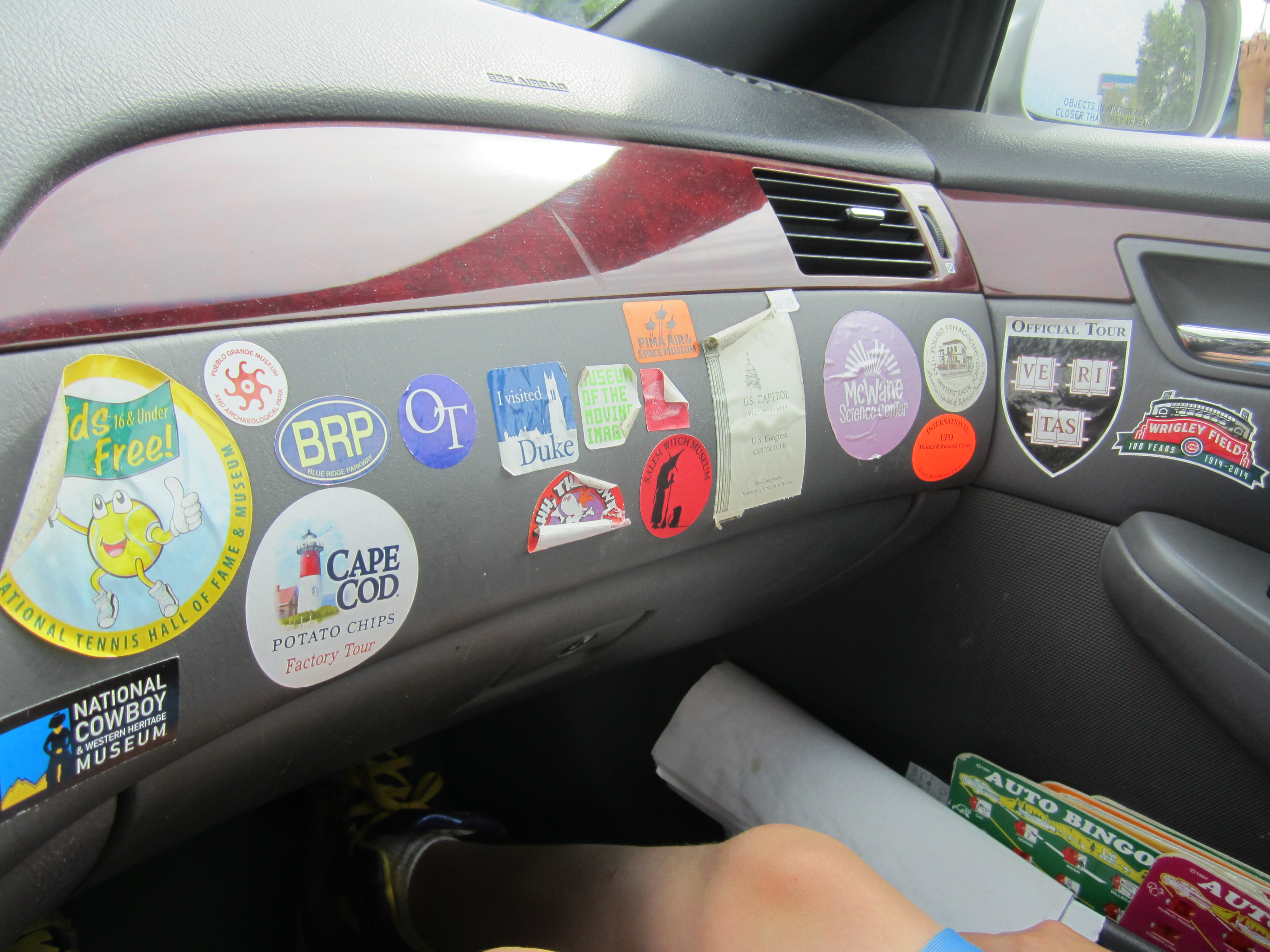
Despite our skepticism we still had fun with all the alien nonsense. We posed with alien cutouts, we made corny jokes about the museum being out of this world, and we shopped for alien souvenirs. And hey, the museum even gave us stickers, so the dashboard in front of Sam’s seat now looks like this:
But that was not the best part of Roswell. The best part was that it let us finish everything else on our to-do list. For starters we stopped at a Dollar Tree store and bought supplies to better store our poorly packed Shabbos food from Tuscon. We got disposable tins to replace the smashed Styrofoam clamshells, and a sturdy plastic jug to hold the soup, which had leaked badly despite the deli guy’s insistence that it was properly sealed. With that out of the way we then found a barbershop. It was a really old-school barbershop, with a striped pole outside and gray-haired barbers inside. Sam’s was named Claude; mine was named Dewain. They took forever, but they did a decent job and Sam looks like a human again instead of a woolly sheep.
All this, and we were still ahead of schedule.
The bat flight program was scheduled to start at 7:30. It takes place at a stone amphitheater built specifically for viewing the bat exodus, and it consists of a Park Ranger talking about the bats until they start coming out, and then shutting up while everyone watches the bats. But it gets cancelled for safety reasons if there’s lightening too close to the park. The sky was still very overcast as we drove to Carlsbad, and I started to worry that one of the events I’ve been most looking forward to on this trip might be cancelled.
We got to the park at a little after 6 p.m., and the bat program was still scheduled for 7:30. So we grilled hot dogs in a nice little picnic area overlooking a vast sea of desert land, and then we headed to the amphitheater. We grabbed seats in the back row, and then when she started talking the Ranger mentioned very casually that the folks in the back row ma or may not get visited by wildlife, including raccoons, rattlesnakes, or tarantulas. Sam and immediately moved down one row.
As she spoke we noticed lightning in the distance behind her. She explained that they have sensors that determine its distance, and if it gets too close the whole park closes and everyone has to leave. Then she got interrupted by another Ranger, who came and whispered something to her. Several people in the crowd worried that it was about the lightning. My heart sank. But then the Ranger continued her speech. Game on.
I was told by a Ranger earlier that the bats can be a little unpredictable, exiting the cave as early as 7:45 or as late as 8:15. Tonight they started coming out at 7:40. Sam and I both expected a massive swarm of bats to come shooting out all at once, but it started slowly. A few dozen came out, flew around in circles in front of the cave for speed and self-defense, and then flew off. More came out in dribbles, and then another wave of several dozen. It was cool but a little underwhelming. Sam joked to me that there must be someone inside the cave holding a clipboard and yelling, “Group A! Go! Go! Go! Group B, get ready, you’re up next!”
And then it happened. Hundreds of bats, followed by hundreds more, and hundreds more, and on and on nonstop for 40 minutes. They flew in all directions. One flew right past me and Sam, inches from our faces. We marveled at how the bats didn’t fly into each other considering how many of them were in such a small space and going in so many directions. And then two bats smacked right into each other, making an audible clap and momentarily free-falling before they both righted themselves and flew off. These guys are so baller, not even a head-on collision phases them.
When there were a decent number of bats flying out we could hear their wings flapping if everyone was quiet and we listened carefully. But now the flapping sounded like a rainstorm. Which was good because the people sitting next to us Would. Not. Shut. Up. It was so cool. Occasionally we heard the bats squeak, too. We just sat there, the Hamster and I, awestruck by the sight, the sound, and the abilities of this very cool creature. I said something about there being a ton of bats, and Sam wondered if their collective weight actually added up to a ton.
I had been excited about seeing the bats since I started planning this trip. I don’t especially love bats in general but they are pretty interesting animals, and they eat mosquitoes, which is a big bonus in my book. Plus there’s just something extraordinary about watching tens of thousands of bats swarm out of their cave and into the night sky. You can see bats at any zoo, but you can’t see this anywhere in the world but here. I had been worried that reality might not live up to my expectations, or worse–that lightning would ruin the whole thing. In the end it was just as cool as I had hoped. Even cooler, really, because the occasional flash of lightning lit up the sky and the bats and made it all the more dramatic.
Also, there’s no picture-taking allowed. In fact, no electronic devices of any kind can even be on, because they disrupt the bats. At first I was disappointed that I wouldn’t have pictures but it actually freed me to just focus on watching the scene and soaking it up.
Eventually the crowds of bats started to thin out and the sky was getting too dark for us to really see them. We got up to leave, still in awe at what we had seen, and right at that moment a Ranger announced that the lightning was getting too close and we were all going to have to leave. I could hardly complain about the timing.
On the way out we asked a Ranger about the size of the bats. The bats who live in Carlsbad are tiny. Their bodies are about the size of my thumb, and they weight only half an ounce–about the weight of three nickels. Sam and I did some quick math. Half an ounce each means you’d need 32 bats to make a pound. That means 64,000 bats would weigh a ton. We probably didn’t see all 400,000 bats who live in the cave, but we definitely saw a ton of bats.
 The Hamster and the Highway